

Planning a boat trip should feel exciting, not stressful. But for most first-time renters and families, the process quickly becomes a maze of confusing websites, vague pricing, and questions like "Do I need a license?" or "What if I pick the wrong boat?" The fear of hidden fees alone stops many people from booking at all. This guide cuts through that confusion with a clear, practical roadmap. By the time you finish reading, you'll know exactly what to prepare, how to book with confidence, and what to watch out for so your trip stays fun from start to finish.
Table of Contents
- What you need to book a boat
- Step-by-step boat booking process
- Common mistakes and how to avoid them
- What to expect after booking
- A practical perspective on stress-free boat booking
- Set sail with confidence: Start your boat booking today
- Frequently asked questions
Key Takeaways
| Point | Details |
|---|---|
| Prepare your documents | Gather ID, licenses, and required info before starting your booking. |
| Follow each booking step | Use a clear, step-by-step process to compare and secure the right boat. |
| Avoid common mistakes | Read policies and review details to prevent unexpected surprises. |
| Know what to expect | After booking, bring documents and understand the check-in process on the day. |
What you need to book a boat
With the problem of boat booking confusion clear, let's get organized by knowing exactly what you'll need before you start searching.
Documents and personal information
Before you open any booking platform, gather your essentials. Most rental companies ask for a valid government-issued photo ID (passport or driver's license), a credit card for the security deposit, and sometimes a boating license depending on the destination. In the United States, boating license rules vary by state, so check local requirements early. In Europe, requirements differ by country and vessel size.
Here's a quick prep checklist so you walk into the booking process fully ready:
- Valid photo ID for all adults in the group
- Boating certification or license (if required in your destination)
- Credit or debit card for deposit and payment
- Emergency contact details
- Rough itinerary or planned route
- Group size and any special needs (wheelchair access, child life jackets)
Budgeting before you book
Most people budget for the rental fee and forget everything else. That's where surprises happen. A realistic boat trip budget includes the rental itself, the security deposit (often $200 to $1,000 refundable), fuel costs, marina fees, crew or skipper hire if needed, and any on-board equipment rentals like snorkeling gear or fishing rods.
| Cost type | Typical range | Notes |
|---|---|---|
| Boat rental (half day) | $150 to $600 | Varies by vessel size and location |
| Security deposit | $200 to $1,500 | Usually refundable |
| Fuel surcharge | $30 to $200 | Depends on distance traveled |
| Skipper hire | $100 to $400/day | Required in some destinations |
| Cleaning fee | $50 to $150 | Common if not returned clean |
| Insurance add-on | $20 to $80/day | Highly recommended |
Pro Tip: Always ask the rental company to confirm in writing which fees are included in the quoted price. An emailed summary before payment protects you if anything is disputed later.
Choosing the right boat for your group
Boat types vary wildly in size, speed, and purpose. A family of four on a calm lake needs a very different vessel than a group of eight on a coastal sailing trip. Think about how many people are coming, whether you need a covered deck for sun protection, whether small children require extra safety features, and whether you want power or sail. Matching the boat to your actual needs prevents discomfort and overspending on a vessel that's far bigger than necessary.
Step-by-step boat booking process
Once you've gathered what you need, it's time to walk through the actual booking steps so you don't miss a thing.
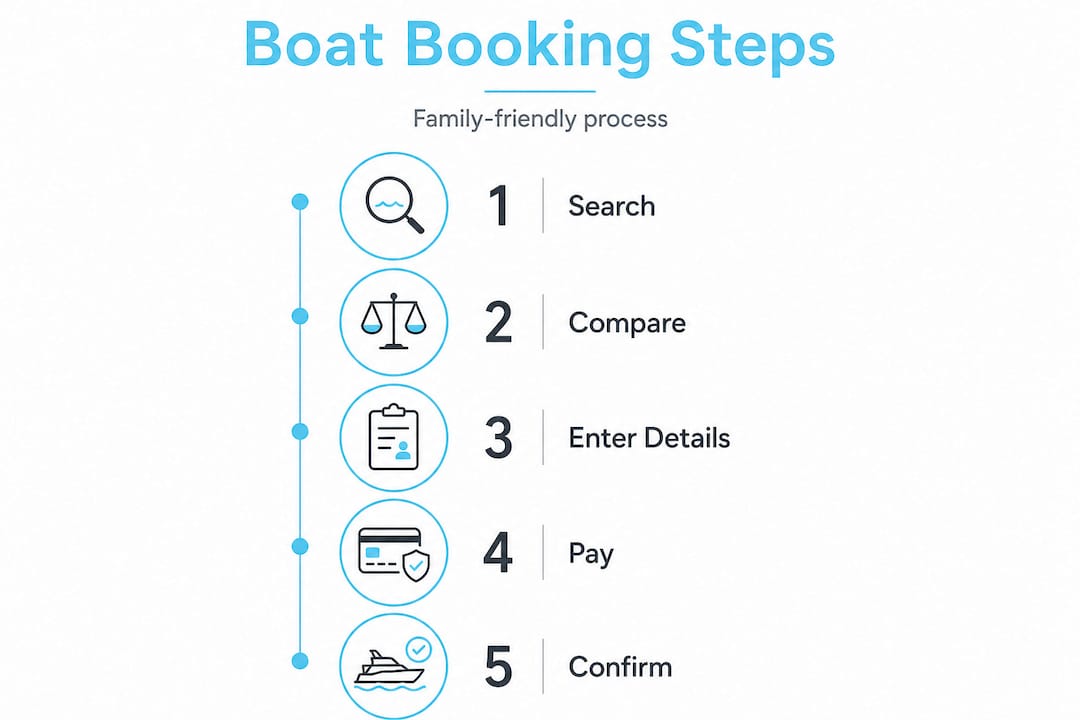
Step 1: Search for reputable platforms and companies
Start with platforms that show real-time availability and verified reviews. A trustworthy booking service will display the boat's full specs, photos, owner ratings, and clear pricing before you commit. Avoid any website that asks for payment before showing you a contract or full rental terms.
Step 2: Compare boats by features, price, and reviews
Don't book the first boat you find. Use filters to narrow by group size, boat type, location, and date. Then compare at least three options using this framework:
| Comparison factor | What to look for |
|---|---|
| Price transparency | No vague "starting from" rates |
| Cancellation policy | Flexible vs. strict refund windows |
| User reviews | Look for patterns, not just star ratings |
| Included equipment | Life jackets, anchor, radio, first aid |
| Fuel policy | Full-to-full or fixed fee |
| Skipper availability | Optional or required |
Reading reviews carefully pays off. Look for mentions of hidden fees, how the company handled problems, and whether the boat matched its photos. Three or four honest reviews tell you more than a perfect 5-star average.
Step 3: Enter your details and confirm availability
Once you've chosen your boat, select your date and time window. Fill in your group size accurately since most contracts cap passenger numbers for safety and insurance reasons. Double-check the pickup location because marina addresses can be tricky to navigate, especially in unfamiliar ports.
Step 4: Review the rental agreement before paying
This is the step most people skip, and it's the most important one. Read the full rental agreement. Look specifically for:
- Damage liability limits and what insurance covers
- Fuel return policy (are you expected to return it full?)
- Late return fees (often charged by the hour)
- Prohibited zones or distance restrictions
- Guest limits and age restrictions for operators
- Cancellation and refund conditions
Step 5: Make your payment and save your confirmation
Pay through the platform's official payment system, never by bank transfer to an individual. Once payment goes through, save your confirmation email and download any booking documents. Screenshot the key rental terms in case you need to reference them at the marina.
Pro Tip: Set a calendar reminder two days before your trip to re-read the pickup instructions and marina access details. Dock numbers and gate codes sometimes change, and arriving unprepared at a marina wastes precious time on your rental day.
Step 6: Spot hidden fees before they surprise you
Hidden fees usually hide in the fine print around fuel, cleaning, and "optional" insurance that turns out to be mandatory. One tactic that works: before confirming, ask the company to send you a total cost breakdown by line item. If they won't, that's a red flag worth noting.
Common mistakes and how to avoid them
After learning the main steps, it's just as important to know the pitfalls that catch even experienced renters off guard.
The top five mistakes boat renters make
- Booking too late. Peak season boats sell out weeks in advance. Last-minute availability usually means leftover options at premium prices.
- Ignoring the cancellation policy. Life happens. A strict no-refund policy on a trip scheduled during hurricane season is a real financial risk.
- Skipping the insurance question. Many renters assume their travel insurance covers watercraft. It often doesn't. Check your policy and the rental company's coverage terms before departure.
- Underestimating group needs. A boat rated for ten people can feel extremely cramped for a full-day trip with kids, coolers, and gear. Go one size up if you're close to the limit.
- Not verifying safety equipment. Every rental should include Coast Guard-approved life jackets for each passenger, a working radio, flares, and a fire extinguisher. Confirm this before you leave the dock.
"The single most common complaint from first-time boat renters is that they didn't read the fuel policy. Returning a boat on empty when the contract requires a full tank can add $150 to $400 to your final bill without warning." — Experienced charter industry insight
How to double-check rental policies
Call or message the company directly at least 48 hours before your trip. Ask explicitly about the fuel policy, where to park, the check-in process, and what to do if you encounter a mechanical issue on the water. A good rental company answers these questions quickly and clearly.
Pro Tip: Take timestamped photos of the entire boat, including any existing scratches or damage, before you leave the dock. Share these photos with the rental company via email right away. This simple step has saved renters hundreds of dollars in disputed damage claims.
What to expect after booking
Now that you know what not to do, let's clarify what happens after your booking is confirmed, so there are no surprises on the day.
The confirmation process
Within minutes of booking, you should receive a confirmation email with your booking reference, the rental dates and times, the pickup location details, and a summary of your payment. If you don't see it within 30 minutes, check your spam folder and then contact the company. Keep this email accessible on your phone.
Check-in at the marina
Arriving at a marina for the first time can feel disorienting. Most marinas have a check-in office near the main entrance or harbormaster's building. Bring your ID, your booking confirmation, and your boating license if required. The check-in process typically takes 15 to 30 minutes.
Here's what to expect during check-in:
- Signature on the rental agreement
- Payment of the security deposit (usually on a credit card hold)
- Handover of keys, access codes, or dock lines
- A walkthrough of the vessel's controls and safety gear
- Confirmation of emergency contact procedures
The safety briefing and boat inspection
A proper boat safety briefing takes about 20 to 30 minutes and covers engine startup, radio use, anchor procedures, and emergency protocols. Don't rush it. Ask questions if anything is unclear. Then conduct your own visual inspection of the vessel before leaving the dock.
On-boarding inspection checklist:
- Life jackets for every passenger (correct sizes for children)
- Fire extinguisher (charged and accessible)
- Navigation lights working
- Horn or sound signal present
- First aid kit stocked
- No visible fuel leaks or unusual odors
- Radio operational and set to Channel 16
Studies show that boating accidents in the U.S. are most commonly caused by operator inattention and failure to follow safety instructions during onboarding. Taking the briefing seriously is not just a formality.
If something seems off
If the boat has damage not documented, equipment is missing, or the vessel smells strongly of fuel, do not leave the dock. Flag the issue immediately with the rental company or marina staff. You have every right to request a replacement or a refund if the vessel doesn't match what was booked.
A practical perspective on stress-free boat booking
Here's something most booking guides won't tell you: the biggest barrier to a great boat trip isn't the ocean, it's the planning anxiety. People spend weeks dreading the booking process when the actual steps take less than an hour once you know what you're doing.
Rushing the process almost always costs money. Renters who book in a panic, pressured by a sale or a friend's schedule, skip the contract review, choose the wrong boat size, and end up paying extra fees on the water. Slowing down for just one afternoon of research consistently delivers better pricing, better boats, and fewer surprises.
Early comparison shopping is genuinely underrated. Most renters look at one or two options before booking. Renters who compare five or more options consistently find pricing that's 15 to 25 percent lower for comparable vessels, simply because they took an extra twenty minutes to scroll through more listings.
There's also real value in asking boat-specific questions that feel "too basic" to ask. Questions like "What happens if the engine stops?" or "Is there a minimum experience level required?" feel obvious after the fact but go unasked surprisingly often. A rental company that answers those questions patiently is also signaling that they handle problems well when they arise on the water.
For families booking their first trip, the most important thing is this: the process is learnable. You don't need sailing experience or industry contacts. You need a checklist, a bit of lead time, and a platform that shows you real prices without games. That combination removes almost all of the stress.
Set sail with confidence: Start your boat booking today
With knowledge and expert tips in hand, it's time to find the right boat for your own trip.

Finding a boat that fits your family's needs, budget, and dates shouldn't require hours of research or uncomfortable surprises at checkout. Sailorix affordable boat rentals gives you exactly what this guide describes: transparent pricing, real-time availability, and a membership model that slashes service fees to around 1%, compared to the 10 to 20 percent that most booking platforms quietly add. For €100 per year, you gain access to a global catalog of boats and yachts at the lowest market prices, making boating genuinely accessible for families and first-time renters. Browse, filter, compare, and book your next trip knowing the price you see is the price you pay.
Frequently asked questions
What documents do I need to rent a boat?
You typically need a valid government-issued ID and, depending on your destination, a boating license or completed safety certification. Some locations also require proof of experience for larger vessels.
How far in advance should I book a boat for my trip?
Booking at least 2 to 4 weeks ahead is strongly recommended, especially during summer and peak travel seasons when popular boats and desirable routes fill up quickly.
Are there extra fees in addition to the boat rental price?
Yes, most rentals include additional costs like a refundable security deposit, fuel charges, cleaning fees, and optional insurance add-ons. Always request a full cost breakdown before confirming your booking.
Can I cancel or change my boat booking?
Cancellation and change policies vary widely by company. Most platforms allow modifications or partial refunds if you cancel within a defined window before your trip date, so review the policy carefully before paying.