
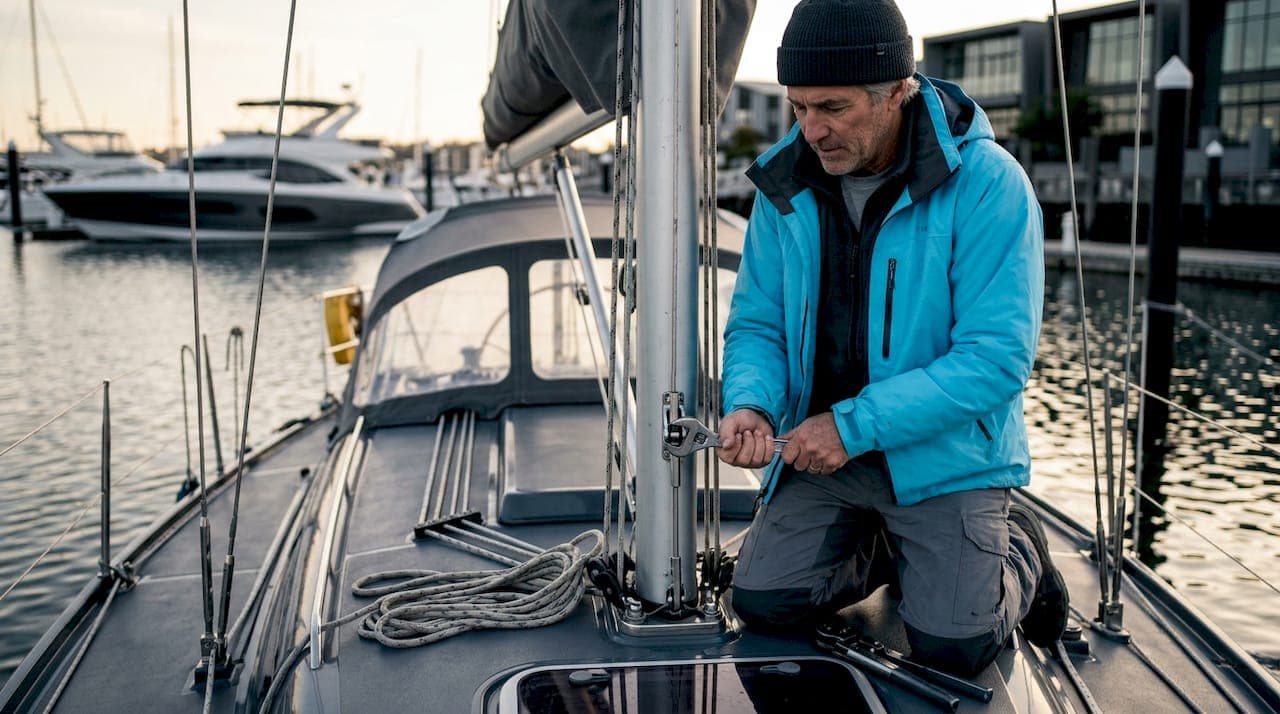
Most sailors spend years learning the wind and the water but rarely stop to question what's holding their sail up. Your mast is the single most structurally critical component on your boat, and treating it as an afterthought is one of the most common mistakes in sailing. The wrong material, a neglected fitting, or a missed annual inspection can turn a beautiful passage into a rigging failure at sea. This guide walks you through everything you need to know about mast construction, materials, stepping types, and maintenance so you can sail with real confidence.
Table of Contents
- What is a boat mast and why does it matter?
- Comparing mast materials: Aluminum, carbon fiber, or wood?
- Deck-stepped vs. keel-stepped masts: What's the difference?
- Mast maintenance essentials and rigging safety
- Common mast failures and how to prevent them
- Our perspective: Why routine mast care beats high-tech upgrades
- Maintain your mast with expert support
- Frequently asked questions
Key Takeaways
| Point | Details |
|---|---|
| Know your mast type | Understanding your mast's material and stepping is crucial for proper care and sailing safety. |
| Prioritize routine inspections | Annual checks and timely rigging replacements prevent most failures and extend mast life. |
| Match materials to your sailing style | Select aluminum, carbon fiber, or wood based on your cruising, racing, or aesthetic preferences. |
| Learn to spot risk signs | Noticing early warning signs and subtle wear can help avoid expensive and dangerous failures. |
| Expert support is invaluable | Professional rig checks and expert advice are more valuable than costly upgrades or DIY shortcuts. |
What is a boat mast and why does it matter?
A sailboat's mast is far more than a vertical pole. It is the structural backbone that everything else depends on. A sailboat mast) is the vertical spar supporting sails and rigging, typically made from aluminum, carbon fiber, or wood, with aluminum being the most common choice for its strength-to-weight ratio and corrosion resistance. Without the mast, you have no way to harness the wind. It dictates the height of your sail plan, the shape of your rig, and how forces transfer from the sails into the hull.
Understanding the key parts of a mast is the first step toward being a knowledgeable sailor. Key mast components include masthead sheaves, fittings, spreaders, halyard exits, pulleys, and the heel or base, while standing rigging like shrouds, forestay, and backstay supports the mast laterally and longitudinally. Each of these parts plays a specific role:
- Masthead: The very top of the mast, often carrying navigation lights, wind instruments, and blocks for halyards.
- Spreaders: Horizontal arms that push the shrouds outward, reducing the compression load on the mast by shortening its effective unsupported length.
- Halyards: Lines that run through the mast to hoist sails up and bring them back down.
- Sheaves: Pulleys built into the mast that allow halyards to change direction smoothly.
- Heel fitting: The base of the mast where it contacts the deck or keel step; this is a critical wear and leak point.
- Standing rigging: Shrouds, forestay, and backstay. These wires or rods hold the mast in position and keep it from falling forward, backward, or sideways.
"Think of your mast as a loaded spring under constant compression. Every element of the standing rigging is tuned to keep that spring from buckling. When one element fails, the whole system can collapse."
The mast's design also directly shapes your boat's sailing performance. A taller mast gives you more sail area, which means more power in light winds. But it also means more leverage on the hull, more heel in gusts, and a higher center of effort. Getting the balance right between sail area and hull stability is one of the fundamental challenges of yacht design.
Now that you've seen why masts are more than just a "pole," let's dig into the materials they can be made from.
Comparing mast materials: Aluminum, carbon fiber, or wood?
Choosing a mast material is not purely a matter of budget. It shapes your maintenance routine, your repair options offshore, and your boat's overall performance. Each material has a real place in the sailing world, but they suit different sailors and different missions.
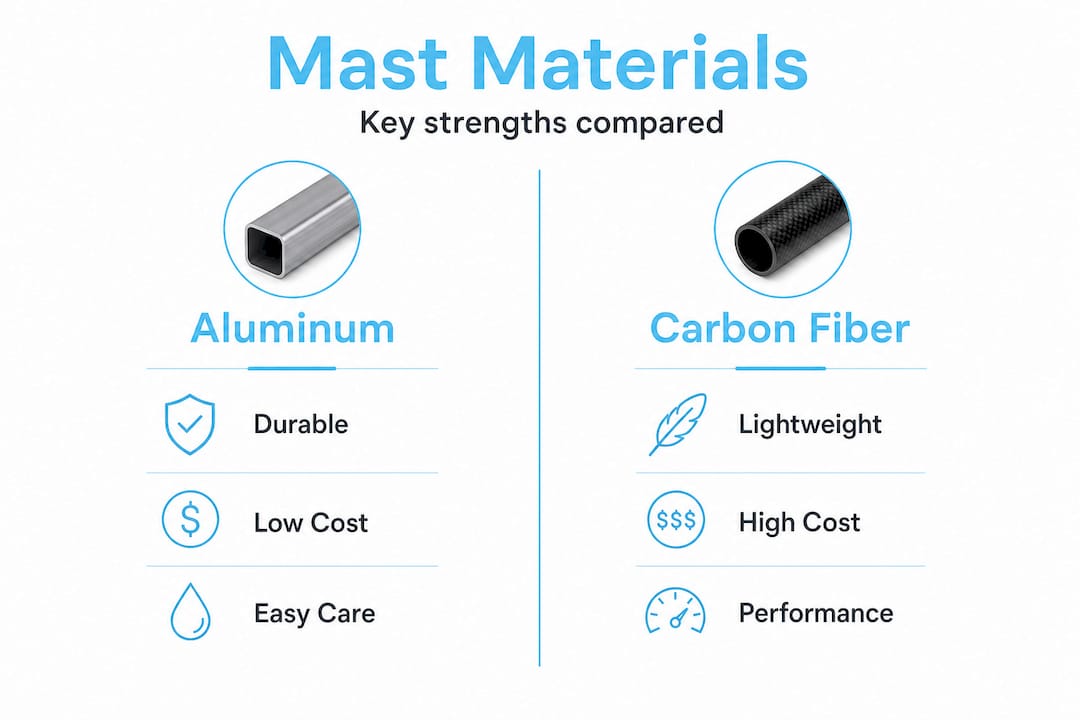
Aluminum suits most cruisers because it is affordable and low maintenance, while carbon fiber is the lightest option with the best performance but comes with expensive repairs, and wood offers a classic aesthetic at the cost of high maintenance and a real risk of rot. Meanwhile, traditionalists favor wood) for aesthetics despite the maintenance burden, racers prefer carbon for the weight savings aloft, and cruisers stick with aluminum for the practical balance it provides.
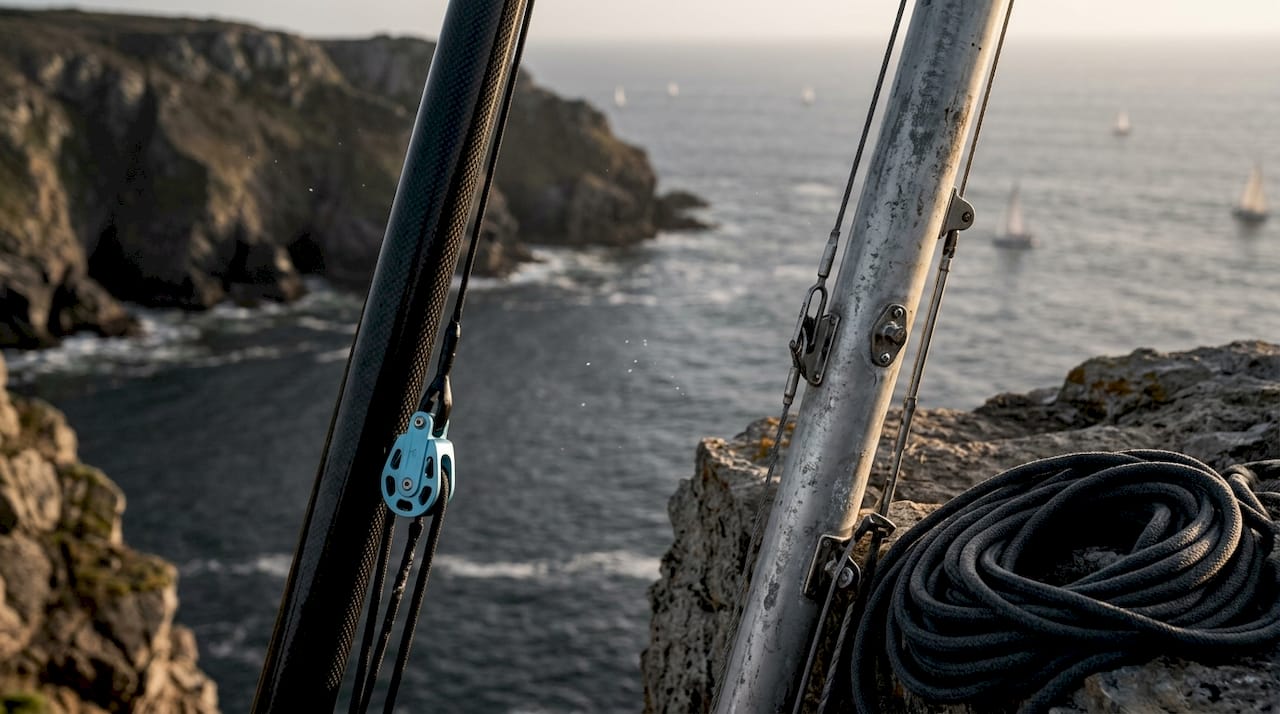
Here's a clear breakdown to help you compare:
| Material | Weight | Cost | Maintenance | Best for |
|---|---|---|---|---|
| Aluminum | Medium | Low to moderate | Low (inspect annually) | Cruisers, coastal sailors |
| Carbon fiber | Very light | High | High (crack-sensitive) | Racers, performance sailors |
| Wood | Heavy | Variable | Very high (rot risk) | Classic/traditional vessels |
Aluminum is the workhorse of the sailing world for good reason. It does not corrode easily in saltwater, handles physical impacts reasonably well, and can be repaired by most boatyards worldwide. If you crack or dent an aluminum mast, the fix is usually straightforward and affordable.
Carbon fiber is a different story. It is dramatically lighter than aluminum, and reducing weight aloft has a huge effect on stability and responsiveness. Every kilogram you remove from the top of the mast improves the boat's righting moment. But carbon is brittle compared to aluminum. A serious impact or an undetected delamination can cause a sudden, catastrophic failure. Repairs require specialist facilities and are often expensive.
Wood demands the most respect. A well-maintained wooden mast on a classic yacht looks stunning and performs adequately for coastal sailing. But wood absorbs moisture, can harbor hidden rot within its core, and needs regular varnishing, sealing, and antifungal treatment to stay safe. We'll see later exactly how dangerous a neglected wooden mast can be.
Pro Tip: If you're outfitting a cruising boat for offshore passages, aluminum is almost always the smartest choice. The global availability of repair facilities, combined with the material's forgiving nature, outweighs any performance advantage you'd gain from carbon fiber.
Knowing what your mast is made of guides how you care for it and what to watch for. Next, let's look at how masts are installed on your boat.
Deck-stepped vs. keel-stepped masts: What's the difference?
Where your mast sits changes everything about how forces are transferred into your boat's structure. The two main configurations are deck-stepped and keel-stepped, and choosing between them is not just an aesthetic preference.
Deck-stepped masts are pinned via a compression post and result in a drier cabin with easier maintenance, while keel-stepped masts act as a propped cantilever that provides better rigidity and stability but can be prone to leaks where they pass through the deck. Keel-stepped configurations are generally preferred for offshore passages because of their superior structural integrity.
| Feature | Deck-stepped | Keel-stepped |
|---|---|---|
| Structural support | Relies on compression post | Direct contact with keel structure |
| Cabin dryness | Drier (no deck penetration) | Leak risk at deck collar |
| Mast removal | Easier to remove and reposition | Requires more work to unstep |
| Offshore suitability | Less preferred | Strongly preferred |
| Rigidity | Good | Excellent |
Here are the key practical considerations for each type:
- Deck-stepped masts are common on production coastal cruisers and day sailors. They're easier to step and unstep, which is useful if you use a marina with a mast crane or need to fit under bridges regularly.
- Keel-stepped masts penetrate through the deck and rest on the keel structure itself. If a keel-stepped mast loses its rigging, it's less likely to fall overboard completely, which can be a real safety factor offshore.
- Leaks are the biggest headache with keel-stepped masts. The collar where the mast passes through the deck needs regular inspection and bedding to prevent water intrusion into the cabin.
- Compression loads in deck-stepped masts are carried by a post below deck. That post must be properly sized and in good condition. A rotten or undersized compression post is a hidden failure point that many sailors overlook entirely.
For blue-water passagemakers, keel-stepped is the overwhelming preference among experienced offshore sailors. For weekend cruisers and racers who never go far from a marina, deck-stepped masts offer real practical advantages without meaningful safety compromise.
Once you've identified your mast's construction and stepping, the next priority is keeping it strong and safe, so let's discuss essential mast maintenance.
Mast maintenance essentials and rigging safety
Maintaining your mast and rigging is not optional. It is the single most important thing you can do to prevent a catastrophic failure at sea. The good news is that a methodical approach covers the vast majority of real-world risks.
Here is a practical step-by-step maintenance routine every sailor should follow:
- Annual visual inspection aloft. Go up the mast in a bosun's chair at least once a year. Look for cracks, corrosion pitting, bent spreaders, or worn sheaves. What you can't see from the deck will surprise you.
- Inspect standing rigging closely. Regular inspections should cover broken strands, corrosion, and play in fittings, and include checking the mast itself for dimples, heel corrosion, and sheave wear. Run a cloth along wire shrouds slowly; broken strands will snag it immediately.
- Check all mast fittings and fasteners. Every fitting bedded into the mast should be inspected for movement, corrosion, or cracking at the edges. Fittings that move indicate a failed sealant bed, which allows water ingress and the start of electrolytic corrosion.
- Bed all fittings with appropriate sealant. This prevents the electrolysis that silently eats aluminum from the inside. A professional rig check is recommended annually or before any offshore passage.
- Replace standing rigging on schedule. Wire rope rigging should be replaced every 10 to 15 years due to hidden internal corrosion, and insurance policies often require replacement at the 10-year mark. Synthetic rigging and rod rigging last longer but cost more upfront.
- Pay attention to the mast heel. This is where moisture collects and where aluminum corrosion most commonly begins. Clean it, inspect it, and treat it regularly.
The Grace Bailey dismasting case is a sobering real-world reminder that wood masts require antifungal treatment to prevent rot, and that even inspected masts can carry hidden failures. The USCG investigation found that internal rot had compromised the mast's structural integrity despite prior inspections.
"Standing rigging doesn't look dangerous right up until it fails. The corrosion that breaks it starts on the inside, invisible to the naked eye. Your 10-year rule isn't conservative — it's the minimum."
Pro Tip: Before any offshore passage, hire a qualified rigger to perform a full top-to-bottom rig check. The cost is a fraction of what a lost mast, emergency tow, or crew injury would cost you. Think of it as insurance you can actually control.
Understanding maintenance is vital, but to fully protect your mast and crew, you should also be aware of how and why mast failures still occur.
Common mast failures and how to prevent them
Even well-maintained masts can fail. Understanding the real mechanisms behind mast failure helps you recognize what to watch for before it becomes an emergency.
The most common causes of mast failure include:
- Rigging failure: The most frequent cause. A broken shroud or forestay immediately removes lateral support and allows the mast to bend and buckle under sail load.
- Over-compression: Excessive rig tension combined with heavy loading in strong winds can cause the mast to buckle, particularly in the middle section between spreaders.
- Hidden rot or corrosion: Particularly dangerous in wood and aluminum masts respectively. The Grace Bailey case is a stark example of how internal rot escaped visual inspection and led to a full dismasting.
- Improper tension: Both too little and too much tension create problems. Mast rigging mechanics show that the mast operates under compression from rigging tension, and spreaders reduce buckling by shortening the effective length; pre-tension halves deflection under load.
- Fatigue at fittings: Repeated cycling of loads at chainplates, toggles, and swage fittings causes fatigue cracks that are invisible until failure.
An offshore rigging checklist is an essential tool for preventing mast failure on long-distance passages, especially given that rigging failure is the most common cause and internal issues like rot can escape standard inspections.
Pro Tip: If you hear an unusual sound in your shrouds, such as a high-pitched vibration that wasn't there before, take it seriously. Shrouds under incorrect tension vibrate differently than properly tuned ones. A sudden change in tone can indicate a broken strand or failed fitting that needs immediate inspection.
Recognizing these risks brings everything together. Now, let's share hard-won lessons and challenge some common thinking about mast care and choice.
Our perspective: Why routine mast care beats high-tech upgrades
Here's an opinion you won't hear often in the sailing press: the obsession with carbon fiber masts has led many sailors to spend money in the wrong place. Marketing around performance materials is compelling, but the data on mast failures tells a different story. The overwhelming majority of dismastings and rigging failures involve deferred maintenance, not inferior materials.
A well-maintained aluminum mast with fresh standing rigging and properly bedded fittings will outlast a neglected carbon mast every single time. We've seen boats with expensive carbon rigs fail offshore because the owner trusted the material rather than the process. Meanwhile, modest cruising boats with aluminum masts and consistent annual inspections complete ocean passages without incident year after year.
The sailing community also underestimates how much professional rig checks matter for non-racing sailors. Many amateur and day cruisers assume that because they sail conservatively, their rigging faces less risk. In reality, age affects wire rope regardless of how hard you push the boat. A shroud that has sat for 12 years on a light-use cruiser has the same hidden internal corrosion risk as one on an actively raced vessel.
Thoughtful maintenance and clear risk recognition matter more than any hardware upgrade. Know your mast material, know your stepping type, follow your replacement schedule, and get a rigger up the mast once a year. That simple routine will protect you far more effectively than switching to a carbon spar ever could.
Maintain your mast with expert support
Smart sailors know that great gear is only half the equation. The other half is access to the right resources, tools, and expertise to keep everything in top shape.

At SAILORIX, we believe that every sailor deserves affordable access to the knowledge and connections that make boating safer and more enjoyable. Whether you're looking for mast care resources, rig inspection checklists, or guidance on finding certified marine technicians before your next offshore adventure, SAILORIX is built to help you get there. Our membership model, just €100 per year with service fees around 1%, means you spend less on booking overhead and more on the things that actually keep you sailing. Take the next step toward safer, smarter time on the water.
Frequently asked questions
How long does an aluminum mast last on a sailboat?
Aluminum masts can last several decades with proper care, and they are preferred by most sailors for their corrosion resistance) and durability in marine environments.
How often should standing rigging be replaced?
Standing rigging should be replaced every 10 to 15 years for wire rope, and most insurance policies specifically require replacement at the 10-year mark due to hidden internal corrosion risks.
What are the warning signs of mast failure?
Look for broken strands, corrosion, dimples in the spar, and play in fittings, as regular rig inspections can catch sheave wear and heel corrosion before they become dangerous failures.
Is a keel-stepped or deck-stepped mast better for offshore sailing?
Keel-stepped masts are strongly preferred for offshore sailing because they offer better rigidity and structural integrity, reducing the risk of complete dismasting if rigging is lost at sea.
Why do masts fail even after inspections?
Hidden internal corrosion or rot can escape visual checks entirely, which is why the Grace Bailey dismasting case remains such a powerful reminder that periodic professional surveys are not optional for offshore sailing.