

You finally found the perfect yacht for your Mediterranean getaway, the base price looks reasonable, and you're ready to confirm. Then the checkout page loads. Suddenly, a tangle of platform fees, booking charges, and processing surcharges adds 15 to 20 percent on top of what you expected to pay. Sound familiar? Service fees are the single biggest source of confusion for boat rental enthusiasts worldwide, and understanding them is the fastest way to protect your travel budget and book smarter.
Table of Contents
- What is a service fee?
- How service fees appear in boat rentals
- Comparing service fees: What makes a fee 'low'?
- How to find boat rentals with the lowest service fees
- The real value of low service fees in your travel experience
- Explore affordable boat rentals with Sailorix
- Frequently asked questions
Key Takeaways
| Point | Details |
|---|---|
| Service fee basics | Service fees are added charges for operational support, separate from base rental costs. |
| Impact on pricing | Low service fees can lower total trip cost and make boat rentals more affordable. |
| Hidden fee awareness | Always check for hidden charges before booking to maximize value. |
| Smart booking strategies | Comparing platforms and understanding fee structures leads to the best deals. |
| Balance value and experience | Lowest fees don’t always mean a better experience; service quality matters too. |
What is a service fee?
Before anything else, let's nail down the definition so there's no confusion later. A service fee is, according to Merriam-Webster, "a fee charged for a particular service, often in addition to a standard/basic fee." In plain terms, it's the extra charge a platform or provider layers on top of the core price you see advertised.
Many boaters assume the price listed on a rental page is what they'll pay. That assumption costs real money. The listed price almost always reflects the bare minimum: the cost of the boat itself for the number of days you want it. Every other operational cost the platform carries, from maintaining the website to running customer support, gets passed to you through service fees.
Here's where common misconceptions pile up:
- Service fees are not tips. They go to the platform, not the boat owner or crew.
- Service fees are not security deposits. Deposits are separate and usually refundable.
- Service fees are not fixed. They scale with the base price, so a more expensive yacht generates a bigger fee in absolute dollar terms.
- Service fees are not optional. On most platforms, you cannot skip them.
"A service fee is charged in addition to the standard base price, meaning you always pay more than the advertised rate unless the platform is fully transparent upfront."
Understanding that distinction changes how you evaluate a rental listing. When you see a 40-foot sailing yacht listed at $800 per day, the real question is: what percentage gets added at checkout? That percentage is your service fee rate, and it varies wildly between platforms.
How service fees appear in boat rentals
Now that you know what a service fee is, let's see how these fees actually affect your boat rental bookings. The mechanics can be surprisingly complicated, and knowing the process protects you from checkout sticker shock.
According to Consumer.org.nz, booking fees and service fees are additional charges added on top of the base price when you buy online. In the boat rental world, those additions appear at a specific stage of the booking flow, usually after you've already invested time selecting a vessel, choosing dates, and reviewing features. By that point, many people just accept the fee rather than start over.
Here's a step-by-step look at how the fee process typically unfolds on a standard boat rental platform:
- Browse and select. You filter by location, boat type, and price range. The prices shown here are base rates only.
- Choose dates and extras. Add-ons like a skipper, fuel packages, or snorkeling gear get listed separately.
- Reach the summary page. This is where the service fee first appears, often as a line item labeled "platform fee," "booking fee," or simply "service charge."
- See the total. The final number can be 10 to 20 percent higher than the price you started with.
- Confirm and pay. Most platforms require full payment upfront, locking in whatever fees were shown.
The lack of upfront transparency is the core problem. Platforms technically disclose the fee, but they bury it late in the process to keep browsing prices competitive.
Pro Tip: Before spending time researching any boat on a new platform, scroll to the site's FAQ or pricing page first. Look for a line that states the exact service fee percentage. If you can't find it in under two minutes, that platform is probably not being fully transparent about its charges.
Service fees cover real operational costs: secure payment processing, 24/7 customer support, insurance coordination, dispute resolution, and platform development. Those are legitimate expenses. The issue isn't that fees exist; it's that many platforms charge far more than necessary to cover them.
Comparing service fees: What makes a fee 'low'?
With a solid understanding of service fees, it's time to compare what "low" actually looks like in boat rental settings. The range across major platforms is dramatic, and knowing the benchmarks helps you evaluate whether any given platform is actually offering value.
As noted by Merriam-Webster, service fees vary by platform and are separate from the standard price. What counts as low or high in this context?
| Service fee level | Typical range | Impact on a $1,000 base rental | What it usually signals |
|---|---|---|---|
| Very low | 0 to 2% | $0 to $20 added | Membership model or direct listing |
| Low | 2 to 7% | $20 to $70 added | Competitive platform with lean overhead |
| Standard | 7 to 12% | $70 to $120 added | Typical major marketplace |
| High | 12 to 20% | $120 to $200 added | Premium or legacy platform |
| Very high | Over 20% | $200+ added | Red flag; rarely justified |
To put this in real-world terms: if you're booking a week-long sailing trip at a base rate of $3,500, the difference between a 1 percent fee and a 15 percent fee is $490 in cash. That's enough to cover a night in a marina, two days of fuel, or a quality snorkeling excursion for a group of four.
Several factors influence where a platform lands on this scale:
- Business model. Platforms that charge annual memberships can afford to charge lower per-booking fees because their revenue comes from subscriptions.
- Market position. Dominant platforms often charge more simply because they can.
- Technology investment. Modern platforms with automated systems pass savings to users; older platforms with large support teams pass those costs on as fees.
- Volume of listings. More boats means more competition, which typically drives fees down.
How to find boat rentals with the lowest service fees
Once you know what separates low from high fees, here's how to find rentals that offer the best value for your money. This is where strategy matters. You don't need to accept whatever fee a platform decides to charge.

Per Consumer.org.nz, fees are add-ons to the base price. That means the base price is your negotiating anchor, and the fee is the variable you can influence through platform choice.
Here are the most effective strategies for finding low service fees on boat rentals:
- Compare platforms, not just boats. Run the same boat or similar vessel type through two or three platforms and compare the final checkout price, not just the listed rate.
- Look for membership models. Platforms that offer annual memberships often charge dramatically lower per-booking fees in exchange for the upfront subscription cost.
- Read the fee disclosure carefully. Reputable platforms disclose fees before you reach the final checkout screen. If you only see the fee at the last step, treat that as a warning sign.
- Ask the boat owner directly. Some platforms allow direct messaging with owners before booking. Ask whether the platform fee can be reduced through a direct agreement.
- Book early. Some platforms apply surge pricing during peak demand periods, which can push fees higher. Booking weeks or months in advance often locks in base rates before fees scale up.
Pro Tip: Create a simple spreadsheet when comparing multiple rentals. Track the base price, the service fee percentage, the fee in dollar terms, and the total cost for each option. This quick exercise often reveals surprising gaps between platforms that appear similarly priced at first glance.
Here's a data table comparing hypothetical booking scenarios across different fee structures:
| Scenario | Base price | Service fee % | Fee amount | Total paid |
|---|---|---|---|---|
| Weekend sailboat, low-fee platform | $600 | 1% | $6 | $606 |
| Weekend sailboat, standard platform | $600 | 12% | $72 | $672 |
| Week-long catamaran, low-fee platform | $4,200 | 1% | $42 | $4,242 |
| Week-long catamaran, standard platform | $4,200 | 15% | $630 | $4,830 |
| Luxury yacht, low-fee platform | $12,000 | 1% | $120 | $12,120 |
| Luxury yacht, high-fee platform | $12,000 | 18% | $2,160 | $14,160 |
The luxury yacht example is the most striking. A $2,040 difference in total cost comes entirely from the platform's service fee choice. That gap is not a small rounding error; it's a meaningful portion of the entire booking.
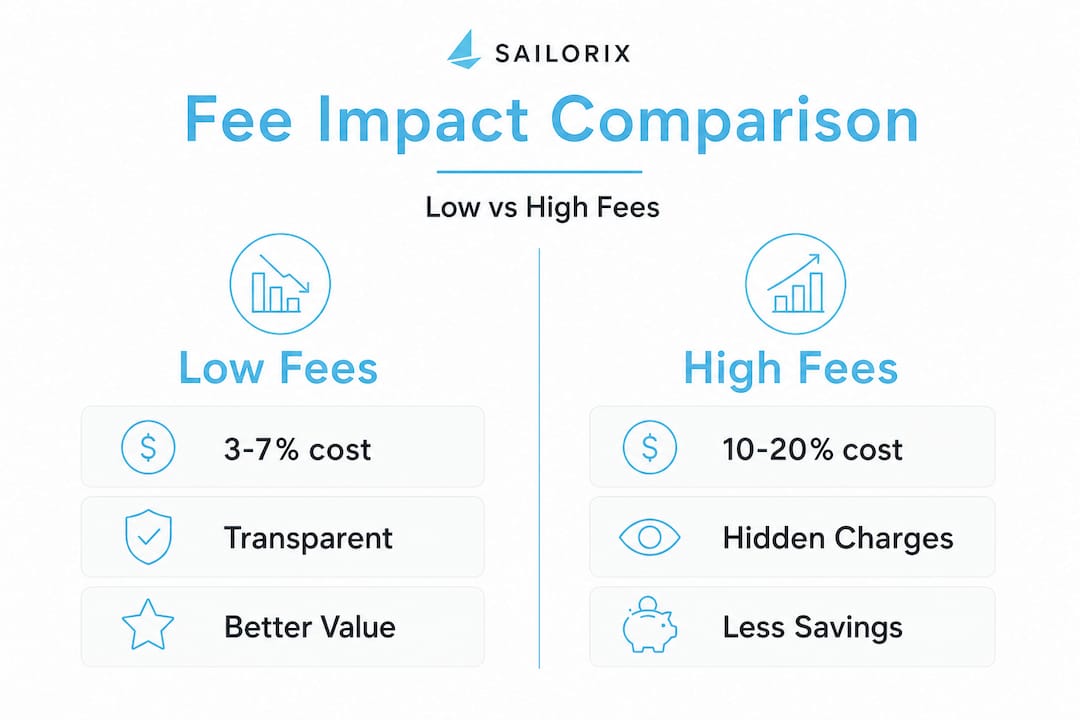
Red flags that suggest hidden or inflated charges include vague fee descriptions at checkout, platforms that show fees only in the final payment step, fees that change between sessions or browsers, and "convenience fees" layered on top of already-stated service fees. If you spot any of these, move on.
The real value of low service fees in your travel experience
Here's something most articles about boat rental fees won't tell you: obsessing purely over the lowest number can occasionally work against you. That's a counterintuitive position, so let me explain it carefully.
Very low service fees are usually a genuine advantage, especially when they come from a well-engineered membership model with transparent pricing. The savings are real, they compound across multiple bookings, and they directly extend how much travel you can afford. We believe in that model deeply.
But there is a specific scenario where fee chasing goes wrong: when a traveler picks an unvetted platform purely because its fee is lower, without checking what that fee actually does or doesn't cover. Some platforms strip out customer support, insurance coordination, and dispute resolution to keep fees low. On those platforms, if something goes wrong during your booking or while you're on the water, you're on your own. The "savings" evaporate fast.
The question to ask is not just "how low is the fee?" but "what does this fee cover, and what happens if I need help?" A platform charging 1 percent with full support, verified listings, and a clear cancellation policy is a genuinely great deal. A platform charging 1 percent while outsourcing everything and offering no support structure is a gamble.
What experienced boat enthusiasts know, and newer renters often discover the hard way, is that the total cost of a rental includes both the price you pay upfront and the risk you absorb. A great platform with low fees and solid infrastructure reduces both. A cheap platform with low fees and poor infrastructure reduces only one.
The smartest approach is to look for platforms that combine genuinely low fees with transparent operations, verified boat listings, and accessible customer support. Those platforms exist. They're built on efficient technology rather than large overhead, and they pass those savings directly to you without cutting corners on the experience.
Explore affordable boat rentals with Sailorix
If you've been frustrated by checkout fees that eat into your boat rental budget, you're not alone, and you don't have to keep accepting it.
Affordable boat rentals are exactly what Sailorix was built to deliver. The platform runs on a simple membership model: for €100 per year, you unlock access to global yacht and boat bookings with service fees of approximately 1 percent. Compare that to the industry standard of 10 to 20 percent, and the math becomes very clear, very fast. A single week-long booking on a mid-range catamaran can recover your annual membership cost many times over. Sailorix combines real-time availability, verified listings, and full pricing transparency so the number you see early in your search is the number you pay at checkout. No surprises.
Frequently asked questions
What is a service fee in boat rentals?
A service fee is a charge added to the base rental price for platform services like support and maintenance; as Merriam-Webster defines it, it is "a fee charged for a particular service, often in addition to a standard/basic fee."
Are low service fees always the best option?
Low fees often mean cheaper bookings, but they're most valuable when the platform also provides reliable support, verified listings, and transparent cancellation policies throughout your trip.
How can I identify hidden service fees before booking?
Check for transparent pricing on platforms before you reach checkout, and as Consumer.org.nz notes, fees are always additions to the base price, so any charge that appears only at the final payment step is worth questioning.
Why do boat rental platforms charge service fees?
Platforms charge service fees to cover operational costs like payment processing, customer support, and platform maintenance; per Merriam-Webster, a service fee is charged specifically for a particular service rendered.