
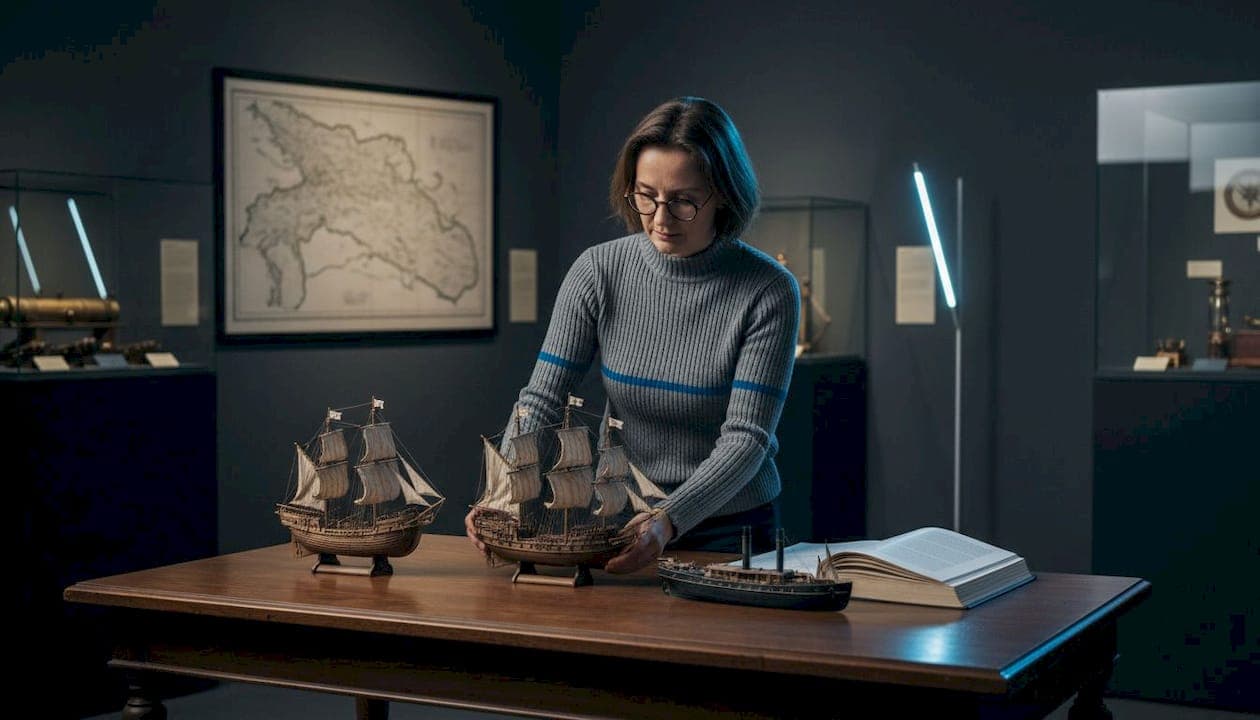
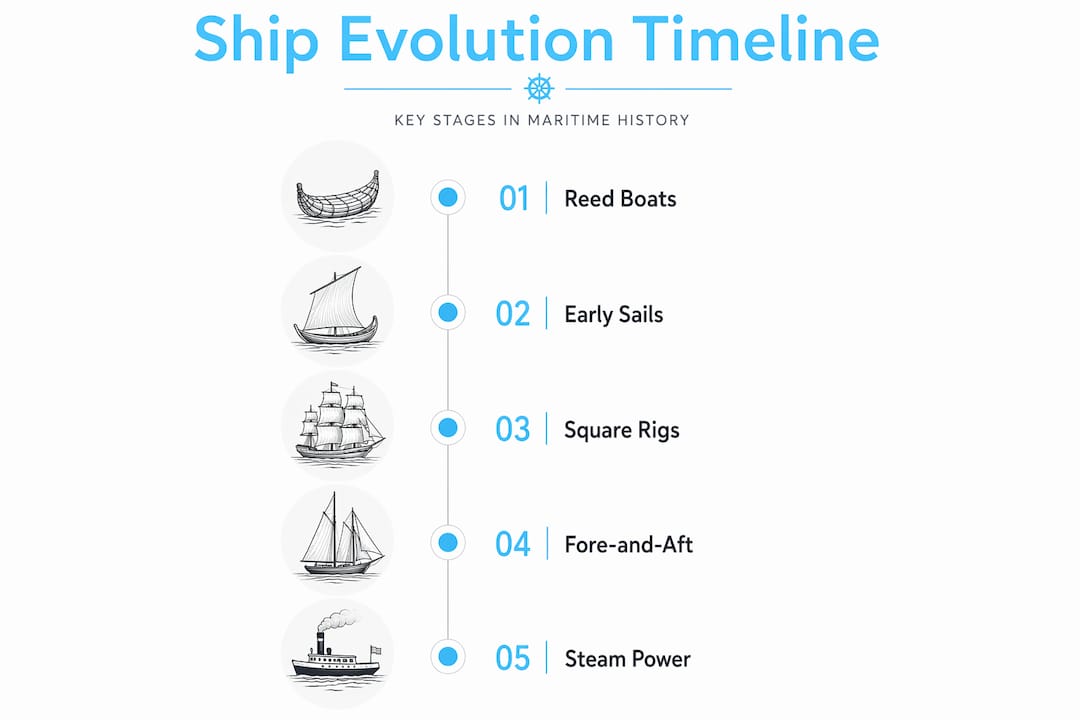
Sailing history isn't a clean timeline of bigger ships and faster crossings. It's a layered, often contradictory story of communities gambling their lives on wind and water, reinventing tools when old ones failed, and building cultures around the specific dangers and possibilities of their local seas. The popular image of sailing history as a smooth march from primitive rafts to steam engines obscures some of the most fascinating chapters in human ingenuity. Rig design, repair culture, navigation risk, and material science all evolved in conversation with each other, and the people steering those developments were solving very specific, very urgent problems.
Table of Contents
- From reed boats to rigged ships: Early sailing developments
- How sail plans and rigs evolved: Square vs. fore-and-aft
- Safety, navigation, and risk: The Age of Sail to early industrial revolution
- Materials, repair, and maritime "life cycles" through the lens of archaeology
- Modern research: How technology re-examines maritime history
- Why sailing history is more than technological progress
- Explore more sailing history with Sailorix
- Frequently asked questions
Key Takeaways
| Point | Details |
|---|---|
| Sailing’s ancient origins | Early sailing combined wind and human power, with innovations dating back to ancient Egypt. |
| Rig evolution shaped voyages | The choice between square, lateen, and fore-and-aft rigs depended on local conditions and navigation needs. |
| Safety advanced over time | Improvements during the Age of Sail significantly reduced risks of wrecks and loss at sea. |
| Archaeology informs maritime history | Shipwreck analysis reveals past techniques in construction, repair, and resource use. |
| Modern tools deepen understanding | Researchers use digital simulations to reconstruct vessel performance and interpret challenges from centuries past. |
From reed boats to rigged ships: Early sailing developments
To better appreciate sailing's complexity, let's step back to its ancient beginnings and see how early societies set the course for maritime advancement.
The story begins on the Nile. Early sails appeared in ancient Egypt during the 4th millennium BCE, where wind power supplemented oarsmen on river craft. These weren't sails in the modern sense. They were simple square panels of woven material hoisted on a mast, designed to catch a favorable tailwind while rowers handled steering and maneuvering. The Nile's predictable north-to-south wind made this combination practical and effective. Sailors would hoist the sail heading upstream and row downstream with the current.
The transition from river sailing to open-sea navigation was a much bigger leap than it might appear. It required rethinking hull shapes, loading strategies, and the very concept of what a "safe voyage" meant. Cargo ships venturing from Egypt into the Mediterranean had to contend with unpredictable swells, cross-winds, and the absence of landmarks. Each adaptation, from deeper keels to multiple masts, addressed a real failure mode that an earlier crew had experienced the hard way.
Modern researchers don't have to guess at how these ancient vessels actually performed. Explicit modeling methods combine vessel performance data with voyage simulations and safety filters to reconstruct the realistic limits of prehistoric sailing routes. This approach gives historians a way to test hypotheses about which routes were actually viable, not just theoretically possible.
Key characteristics of early sailing development include:
- Square sails dominated early river and coastal sailing due to ease of construction and use
- Hull shapes evolved from flat-bottomed river craft to deeper ocean-going designs
- Early voyagers used coastline-hugging routes to maintain reference points and reduce open-water risk
- Cargo capacity was often the primary design driver, with safety as a secondary constraint
- Social organization around boats, including crew hierarchy and maintenance duties, emerged alongside the technology itself
"The earliest sailing vessels were not primitive failures waiting to be improved. They were precisely calibrated solutions to the specific problems of their waterways and trade routes."
How sail plans and rigs evolved: Square vs. fore-and-aft
Building from the earliest sail concepts, the next great leap in maritime history was the dramatic diversification of rig designs and their alignment with local sailing conditions.
The fundamental tension in sail design is this: square sails generate tremendous power running downwind, but they struggle badly when the wind comes from the side or ahead. For cultures sailing predictable oceanic routes with consistent trade winds, this was a minor inconvenience. For traders working the narrow, wind-shifting passages of the Mediterranean, it was a daily crisis.
The lateen sail, a triangular sail mounted on a long yard at an angle to the mast, solved a major part of this problem. It allowed ships to sail much closer to the wind, making Mediterranean and Middle Eastern sea routes far more practical. Arab traders used lateen-rigged dhows for centuries to work the Red Sea and Indian Ocean routes, where wind shifts are seasonal and reliable. The rig became so associated with the region that it's still in use today in traditional craft.
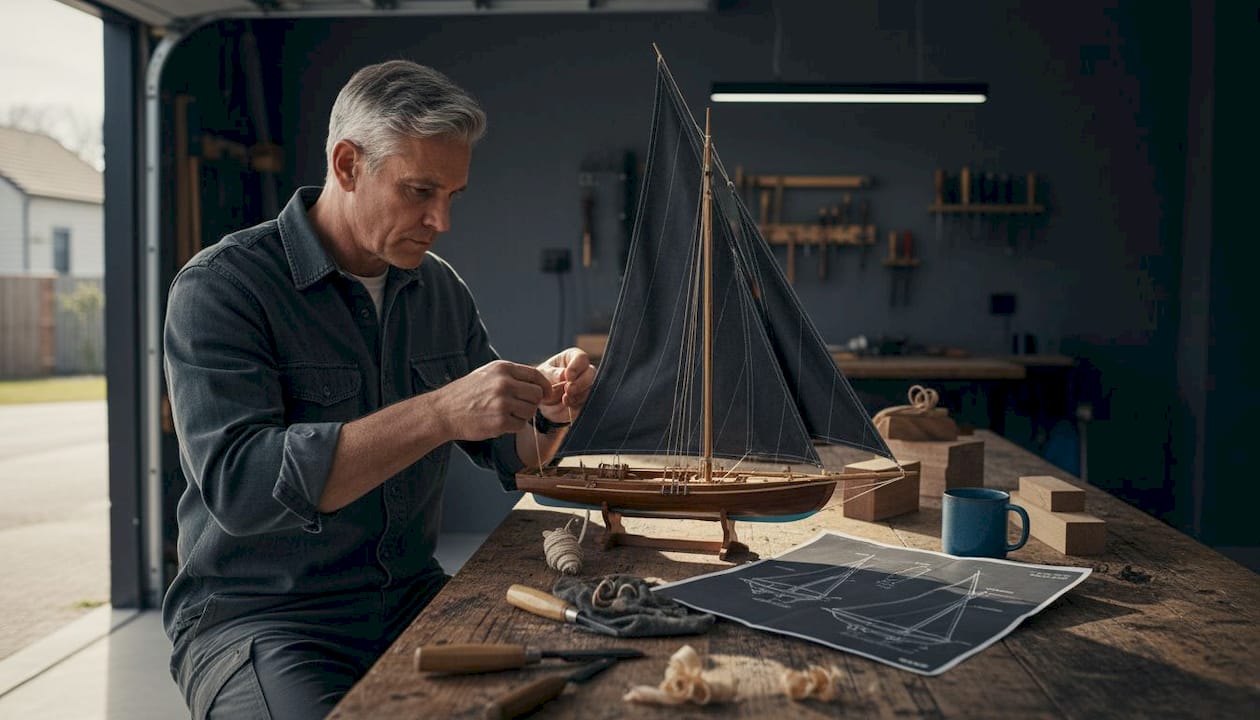
In northern Europe, a different path emerged. Fore-and-aft rigging developed in Europe around the early 15th century, with Dutch shipbuilders leading the way. Their innovations produced vessels that could work effectively in the shallow, tide-influenced waters of the North Sea and Baltic, where quick tacking and precise handling mattered more than raw downwind speed.
Comparison of major sail rig types:
| Rig type | Best wind angle | Typical region | Key advantage |
|---|---|---|---|
| Square rig | Downwind (following wind) | Atlantic, Pacific trade routes | Maximum power and speed |
| Lateen | Close-hauled (into wind) | Mediterranean, Indian Ocean | Upwind maneuverability |
| Fore-and-aft | Versatile, especially upwind | Northern Europe, coastal trade | Tacking efficiency |
| Mixed (ketch, schooner) | Adaptable | Global, post-1500s | Balance of power and control |
Pro Tip: When studying a historical sailing culture, always ask where they were sailing before asking how. The waterway almost always explains the rig choice better than any technological theory.
This is why it's misleading to call square-rig vessels "primitive" compared to fore-and-aft designs. They were purpose-built solutions. A Portuguese nau crossing the Atlantic with the trade winds needed a square rig. A Dutch herring buss tacking through the Zuider Zee needed something completely different. Evolution in sail design was about matching the tool to the context, not simply upgrading to a better version.
Safety, navigation, and risk: The Age of Sail to early industrial revolution
While sail and hull innovation shaped what ships could do, revolutionary progress in how crews navigated and managed risk proved just as transformative.
One of the most persistent myths in maritime history is that the period between the Age of Exploration and the arrival of steam power was essentially stagnant. Ships sailed, ships sank, and not much changed. The actual data tells a very different story. Research on historical shipping shows that the risk of being wrecked fell by approximately one third, and the risk of foundering (sinking without a collision) fell by roughly two thirds, between 1760 and 1825. These are dramatic improvements that happened entirely within the Age of Sail.
Risk reduction in Atlantic shipping (1760 to 1825):
| Risk type | Approximate reduction | Key drivers |
|---|---|---|
| Wrecking | Down by ~1/3 | Better charts, trained pilots |
| Foundering | Down by ~2/3 | Hull design improvements, pumping technology |
| Overall voyage loss | Significant decline | Insurance incentives, crew practices |
What drove these improvements? Several developments stacked on top of each other over roughly 65 years:
- Improved nautical charts that replaced educated guesses with systematically surveyed coastlines
- Chronometer adoption that solved the longitude problem and allowed accurate position-fixing at sea
- Copper sheathing on hulls that prevented shipworm damage and reduced the risk of sudden structural failure
- Lifeboat and rescue practices that formalized the response to maritime emergencies
- Marine insurance markets that created financial incentives for ship owners to invest in safety
- Signal codes that allowed ships to communicate distress and position to nearby vessels
- Professional pilot systems that kept large vessels in charge of local experts for dangerous coastal passages
Each of these developments emerged from a failure. Charts improved because ships ran aground. Chronometers got funded because entire fleets were lost due to navigation errors. The history of maritime safety is a history of learning from disaster, which makes it both sobering and remarkable.
Materials, repair, and maritime "life cycles" through the lens of archaeology
Beyond design and navigation, the success of voyaging repeatedly depended on what ships were made of and how cultures learned to keep them afloat for the long haul.
A ship is never finished. From the moment it's launched, it begins degrading. The hull absorbs water, planks swell and shift, caulking loosens, and marine organisms attack any exposed wood. The cultures that thrived at sea were the ones that understood this and built maintenance into their operating model. A ship that sailed for twenty years wasn't built better than one that lasted five. It was repaired more intelligently and more often.
Analysis of Roman shipwreck coatings in the Adriatic provides a striking example of how sophisticated this maintenance culture could be. Scientific analysis of hull materials revealed not just a single coating applied at construction, but multiple distinct layers representing different repair episodes using locally sourced materials. The ship's hull was essentially a map of its maintenance history, recording every yard where it had been refitted.
Key materials used across sailing cultures for vessel maintenance included:
- Pine tar as a wood preservative and waterproofing agent, applied hot to penetrate grain
- Beeswax and resins for sealing joints and protecting metal fittings from saltwater corrosion
- Hemp and flax cordage that required regular inspection and replacement due to UV and saltwater degradation
- Lead sheeting used on Roman and later vessels as a hull lining in areas prone to abrasion
- Caulking materials including oakum (tarred hemp fiber) driven into hull seams to prevent leaking
Pro Tip: The variety of coating layers found on archaeological wrecks often tells researchers more about a ship's trading routes than its cargo does. Regional materials used in repairs point directly to the ports and coastlines it visited.
The practical lesson here is that durability wasn't built into ships at launch. It was actively maintained through a continuous relationship between crews, craftsmen, and the materials available at each port of call. This repair culture was every bit as much a part of sailing civilization as the rigs and hulls themselves.
Modern research: How technology re-examines maritime history
Finally, with modern research methods, historians and engineers collaborate to uncover insights that mere artifacts and texts can't fully reveal.
The tools available to maritime historians today would have astonished researchers from even thirty years ago. Digital modeling allows teams to reconstruct the performance characteristics of a vessel from fragmentary archaeological data, testing how a reconstructed hull would have handled in specific sea conditions. Simulation tools can run thousands of virtual voyages and identify which routes were realistically viable given period-typical weather patterns.
"Technology doesn't replace historical interpretation. It tests it. Simulations can falsify assumptions that generations of historians accepted simply because no one had the tools to challenge them."
Modern maritime research employs benchmark datasets and standardized protocols to study vessel performance across a range of conditions, including how sailboats and other craft handle domain-specific failure modes that aren't obvious from simple physical inspection. This kind of rigorous, quantitative approach has already overturned several long-held assumptions about ancient voyaging capabilities.
Current frontiers in maritime historical research include:
- Wave occlusion modeling that reconstructs how ancient vessels would have behaved in specific swell patterns
- Machine vision analysis applied to historical paintings and engravings to extract performance data from visual sources
- Pollen and isotope analysis from shipwreck sediments to identify cargo origins and voyage routes
- 3D scanning of wrecks that creates permanent digital records before archaeological sites degrade
- Network analysis of historical trading records to map how maritime cultures connected and influenced each other
What technology cannot do is recover the human experience. The fear, the physical exhaustion, the social bonds formed on long voyages, and the cultural meaning that sailors attached to their ships and routes all remain out of reach of any algorithm. This is why maritime history needs both the archaeologist and the data scientist working together.
Why sailing history is more than technological progress
The evidence across these eras points to something that gets overlooked in most popular accounts of sailing history. Innovation at sea was almost never driven by a desire to go bigger or faster for its own sake. It was driven by problems. Specific, painful, expensive problems that destroyed ships, killed crews, and disrupted the trade networks that entire economies depended on.
This reframes what we should look for when we study any maritime era. The square rig wasn't replaced by the fore-and-aft because sailors suddenly realized it was superior. It was adopted in specific contexts where the alternative caused specific, documented problems. The chronometer wasn't embraced overnight. It took decades of institutional resistance before the navigation community accepted that a mechanical clock could be more reliable than celestial observation alone.
The idea of "stagnation" between major technological eras is almost always wrong when you look closely. Between 1760 and 1825, no one invented a revolutionary new type of sail. But ships got dramatically safer. Materials improved. Insurance markets matured. Navigation became more systematic. These were not glamorous changes, but they were meaningful ones, and they reflect a pattern you see throughout sailing history: progress often comes through the accumulation of small, targeted improvements rather than dramatic reinvention.
The repair culture of ancient Rome, the rig adaptations of Dutch traders, and the safety reforms of the Georgian maritime industry all share the same underlying logic. People identified what was failing, applied the best tools and materials they had, and passed that knowledge forward. That iterative problem-solving approach is the real through-line of maritime history, and it's far more interesting than a timeline of ships getting bigger.
When you explore any maritime epoch, the most revealing question you can ask isn't "what could their ships do?" It's "what problems were they actually trying to solve?" The answer usually tells you everything about the culture, the trade routes, the political pressures, and the daily realities that shaped the ships we still find buried on the ocean floor.
Explore more sailing history with Sailorix
If this journey through sailing history has sparked your curiosity, discovering practical resources and joining conversations can take your interest even further.

Maritime history and the living culture of sailing are deeply connected. At SAILORIX, we believe that understanding how sailing evolved makes actually getting out on the water more meaningful. Whether you're a history enthusiast who wants to experience traditional sailing routes firsthand or someone building a deeper connection with maritime culture, explore sailing resources at SAILORIX and discover how affordable and accessible modern sailing has become. With a simple annual membership, you can get out on the water that shaped so much of human history, at prices that make it a genuine option rather than an occasional luxury.
Frequently asked questions
When and where were sails first used for navigation?
Sails were first used on boats in ancient Egypt around the 4th millennium BCE, primarily on Nile river craft before maritime use expanded to open sea routes.
What's the difference between a square sail and a lateen/fore-and-aft rig?
Square sails are optimized for downwind power, while lateen and fore-and-aft rigs offer greater upwind maneuverability, making them better suited for narrow waterways and variable wind conditions.
How did sailing ships become safer before the use of steam engines?
Improvements in charts, hull materials, navigation tools, and institutional practices meant that shipwreck and foundering risk fell sharply between 1760 and 1825, long before steam power arrived.
How do scientists learn about shipbuilding and repairs from ancient times?
Researchers analyze shipwreck coatings and hull materials to identify repair layers, with Roman wreck analysis in the Adriatic revealing multiple distinct maintenance episodes using locally sourced materials.
Can modern technology recreate how ancient ships sailed?
Yes, digital voyage simulations combine vessel performance data with weather modeling to reconstruct realistic sailing capabilities and test assumptions about ancient maritime routes.