
You've finally booked that week in Croatia or the Greek islands, and you're ready to charter a bareboat yacht with friends. Then the charter company sends you a checklist: ICC, VHF radio license, proof of experience. Suddenly, the excitement stalls. Sailing license requirements vary dramatically from one country to the next, and the confusion catches thousands of would-be sailors off guard every year. This guide cuts through the noise, explains exactly which certifications matter where, and shows you how to get qualified without spending more than you need to.
Table of Contents
- Understanding sailing license requirements worldwide
- The main sailing licenses and certificates: ICC, IPC, ASA and RYA
- Step-by-step: How to get your sailing boat license
- Cost comparisons and how to save on your sailing license
- Common mistakes and how to avoid them
- Why sailing license confusion actually benefits prepared sailors
- Ready to set sail? Get support for your next adventure
- Frequently asked questions
Key Takeaways
| Point | Details |
|---|---|
| Global requirements vary | Each country has its own sailing license and certificate rules that you must check before booking. |
| ICC and IPC explained | The ICC is widely recognized in Europe, while the IPC is often accepted by charter firms but isn’t government-issued. |
| Course vs. direct assessment | You can get licensed by taking a full course or through assessment if you have enough sailing experience. |
| Budget for fees early | Training can be costly, but official certificate fees are generally modest in comparison. |
| Preparation pays off | Getting the right license ahead of time saves you stress and expands your sailing and rental options. |
Understanding sailing license requirements worldwide
The first thing to accept is that there is no single global sailing license. Each country sets its own rules, and charter companies often layer their own requirements on top of national law. That patchwork system trips up even experienced sailors who move between regions.
In Europe and the Mediterranean, the standard is the International Certificate of Competence, commonly called the ICC. Countries like Croatia, Greece, Italy, Spain, and Turkey all require the ICC or an equivalent national certificate for bareboat charters, and most also demand a VHF radio operator's license. France is slightly different: there is no government-mandated sailing license for recreational sailing, but charter agencies there almost always ask for documented proof of competence before handing over the keys.
Cross the Atlantic and the picture shifts. The United States has no federal sailing license for recreational sailors. State-issued boater education cards satisfy local requirements, but they carry little weight when you try to charter in Europe or even in some Caribbean destinations. The Caribbean is generally the most flexible region: many charter companies there will accept a detailed sailing resume and a brief skills demonstration instead of a formal certificate.
Here is a quick country-by-country snapshot:
| Region | Requirement for bareboat charter | Notes |
|---|---|---|
| Croatia, Greece, Italy, Spain, Turkey | ICC or equivalent + VHF license | Government-mandated |
| France | No government license for sailing | Charter agencies want proof of competence |
| Caribbean | Sailing resume often accepted | Varies by company and boat size |
| USA (domestic) | State boater education card | No federal sailing license |
| USA (chartering in Europe) | ICC or IPC recommended | State card not sufficient |
Key takeaways at a glance:
- The ICC is the gold standard for European and Mediterranean sailing.
- A US state boater card does not substitute for an ICC when chartering abroad.
- Caribbean flexibility does not mean zero requirements: larger or more expensive boats often demand formal credentials.
- Always verify with the specific charter company, not just the country's general rules.
The main sailing licenses and certificates: ICC, IPC, ASA and RYA
With the regional landscape clear, let's look at the specific certifications that actually open doors for international sailing and rentals.

ICC (International Certificate of Competence): The ICC is the most widely recognized sailing credential in Europe and the Mediterranean. It is issued under the United Nations Economic Commission for Europe framework and is accepted by most European governments as proof that you can handle a vessel safely. The ICC is obtained through organizations like the RYA (Royal Yachting Association) in the UK or IYT (International Yacht Training) by holding qualifying certificates such as Day Skipper or Bareboat Skipper. The application fee is modest, typically $60 to $120, and the certificate is valid for five years. You must be at least 16 years old and provide photo ID along with evidence of competence.
IPC (International Proficiency Certificate): US sailors who complete ASA 104 Bareboat Cruising can apply for the IPC through the American Sailing Association. Many charter companies worldwide accept the IPC, but it is important to understand that the US is not a signatory to UNECE Resolution 40, which means the IPC is not an official government-equivalent to the ICC in European waters. Some charter operators in Europe will accept it; others will not. Know before you go.
ASA (American Sailing Association): ASA offers a tiered system of courses from basic keelboat sailing (ASA 101) through offshore passage making (ASA offshore). ASA 104 is the key level for bareboat chartering and IPC eligibility.
RYA (Royal Yachting Association): RYA courses are globally respected and form the foundation for ICC issuance. The Day Skipper course is the entry point for most sailors seeking the ICC.
| Certification | Issuing body | Accepted in Europe | Accepted in Caribbean | Validity |
|---|---|---|---|---|
| ICC | RYA / IYT | Yes, government level | Generally yes | 5 years |
| IPC | ASA | By charter company only | Widely yes | No expiry listed |
| RYA Day Skipper | RYA | Qualifies for ICC | Widely yes | Ongoing |
| ASA 104 | ASA | Qualifies for IPC | Widely yes | Ongoing |
- ICC: best choice if you plan to sail in Europe or the Mediterranean.
- IPC: practical for US-based sailors chartering in the Americas or with flexible charter companies.
- RYA and ASA courses: both are solid foundations; your destination should drive your choice.
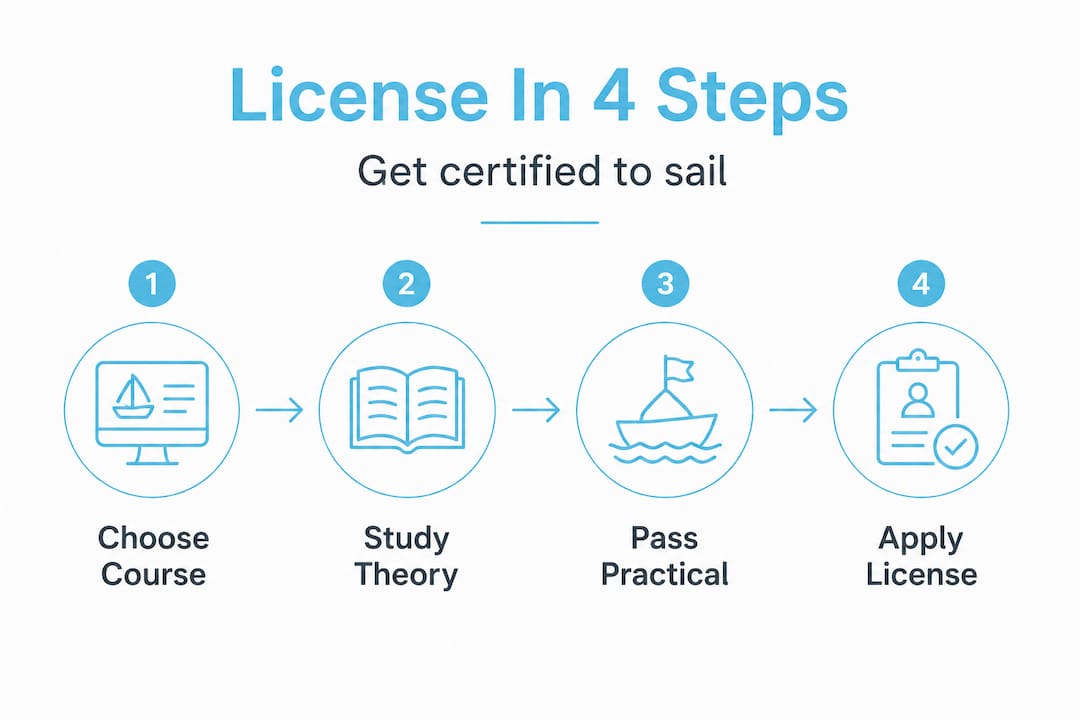
Step-by-step: How to get your sailing boat license
After understanding your options, you're ready to take concrete steps toward certification. The process is more straightforward than it looks once you break it down.
-
Decide where you want to sail. If Europe and the Mediterranean are your target, aim for the ICC. If you're based in the US and plan to sail in the Caribbean or with flexible charter companies, the IPC via ASA 104 is a practical route.
-
Check your prerequisites. For the ICC, you need to be at least 16, hold a qualifying certificate (like RYA Day Skipper or IYT Bareboat Skipper), and provide a passport-style photo and valid ID. For ASA 104, you typically need ASA 101 and 103 first.
-
Choose a course or an assessment. If you are new to sailing, enroll in a structured course. The RYA Day Skipper is a five-day practical course that covers coastal navigation, passage planning, and boat handling. If you already have significant sea time, an assessment-only route is faster and cheaper.
-
Complete the course and log your sea miles. Most qualifying courses require you to accumulate a minimum number of hours on the water. Keep a logbook from day one because charter companies and licensing bodies may ask to see it.
-
Submit your application and pay the fee. Once you hold the qualifying certificate, apply to the RYA or IYT for the ICC. The application cost is typically between $60 and $120, well below the cost of the training itself.
-
Add a VHF radio license. If you plan to charter in Croatia, Greece, or similar destinations, you will also need a Short Range Certificate (SRC) or equivalent VHF radio operator's license. Many training centers offer this as a one-day add-on.
-
Renew every five years. The ICC expires after five years. Mark your calendar well in advance so you are never caught with an expired certificate mid-booking.
Pro Tip: Book your practical course during the off-season (October through March in the Northern Hemisphere). Prices are often lower, class sizes are smaller, and instructors have more time to focus on individual students. You'll get more sea time per day and finish the course with greater confidence.
Cost comparisons and how to save on your sailing license
With your path mapped, knowing what you'll spend and where you can save helps make it practical. Sailing certification costs vary widely depending on your route, location, and experience level.
| Certification path | Typical cost | Notes |
|---|---|---|
| RYA Day Skipper (course) | £800 to £1,500 | Varies by training center and location |
| ASA 104 Bareboat Cruising | $2,000 to $4,000 | Includes boat and instructor time |
| ICC application fee | $60 to $120 | After qualifying certificate obtained |
| Assessment-only route | $200 to $600 | For experienced sailors with logged sea miles |
| VHF SRC license | $100 to $300 | One-day course, often bundled |
The single biggest cost driver is the training course. If you already have meaningful sailing experience, the assessment-only route can cut your expenses by 60 to 80 percent compared to a full course. The key is documenting your existing experience properly in a logbook before you approach an assessor.
Group courses are another smart way to reduce costs. Many training centers offer discounts when you book as a group of four or more. If you have sailing friends who also need certification, coordinate your schedules and share the expense. Some centers will even arrange private charters that double as training voyages, giving you real passage experience while working toward your certificate.
Pro Tip: Self-study the theory components before your course begins. Both RYA and ASA publish official textbooks and online modules. Arriving at your practical course with the theory already mastered means you spend more water time on boat handling, which is where the real learning happens and where assessors focus their attention.
Common mistakes and how to avoid them
Even after earning certification, avoiding these simple traps can make the difference between a dream trip and disappointment.
-
Assuming your US credentials work everywhere. A state boater education card is not recognized for international charters. The IPC is accepted by many charter companies in the Americas and Caribbean, but it is not a government-equivalent to the ICC in European waters. If you plan to sail in the Mediterranean, get the ICC.
-
Arriving without your VHF certificate. In Croatia, Greece, and several other Mediterranean countries, a VHF radio operator's license is a separate legal requirement for bareboat charters. Showing up with only your sailing certificate and no VHF license can result in the charter company refusing to hand over the boat.
-
Not verifying requirements with the specific charter company. Country rules set the floor, but individual charter companies often add their own requirements. Some ask for a minimum number of logged sea miles, a specific certificate level, or even a co-skipper for certain boat sizes. Always email the company directly and ask for their exact paperwork checklist before you travel.
-
Leaving paperwork to the last minute. Certificate applications processed by mail can take two to four weeks. If you are applying for the ICC through the RYA from outside the UK, factor in international postal times. Rushing an application is stressful and sometimes impossible.
"ASA is strong in the Americas and Caribbean, but if you plan to charter in Europe, get the IPC at a minimum and verify acceptance in advance. The ICC remains the safest choice for Mediterranean destinations."
Why sailing license confusion actually benefits prepared sailors
Here is a perspective most sailing guides skip entirely: the global patchwork of licensing rules is not just a headache. For sailors who take the time to get properly certified, it is a genuine competitive advantage.
Think about what happens on the other side of that confusion. Casual renters who do not bother with proper credentials get turned away at the dock or are limited to smaller, less capable boats in less interesting destinations. The sailors who invest in an ICC, log their sea miles, and add a VHF certificate suddenly have access to the full fleet: 50-foot performance cruisers in Croatia, catamarans in Greece, blue-water passage makers in Turkey. That access gap is real, and it is created entirely by paperwork.
There is also a pricing dynamic that rarely gets discussed. Charter companies know that certified sailors are lower risk. Fewer incidents mean lower insurance claims. Some companies quietly offer better rates, newer boats, or more flexible departure windows to clients who show up with strong credentials and a clean logbook. It is worth asking directly whether your certification level affects your booking options or pricing.
The ambiguity in the system also gives prepared sailors leverage in negotiation. If a charter company in the Caribbean tells you they need a formal certificate but you have a strong resume and an IPC, you are in a conversation. If you show up with nothing, you have no leverage at all. Certification is not just about legal compliance. It is about positioning yourself as the kind of sailor charter companies want on their boats.
Ready to set sail? Get support for your next adventure
Your certificate is the key, but it only works if you have the right boat waiting on the other side.

Once you hold your ICC, IPC, or ASA credentials, the next step is finding a charter that matches your skills, your budget, and your destination. That is where the cost of chartering can surprise you just as much as the licensing process did. Most booking platforms charge service fees of 10 to 20 percent on top of the base price, which adds up fast on a week-long charter. At SAILORIX, you can find global boat rentals at the lowest market prices through a straightforward annual membership. For €100 per year, you get access to real-time availability worldwide with service fees of around 1 percent. Your license opens the door. SAILORIX makes sure walking through it does not cost more than it should.
Frequently asked questions
Do I need a sailing license to rent a boat in the Mediterranean?
Yes, most Mediterranean countries require ICC or equivalent plus a VHF radio license for bareboat charters in Croatia, Greece, Italy, Spain, and Turkey.
What is the difference between the ICC and the IPC?
The ICC is accepted by European governments as an official credential, while the IPC is not an official ICC equivalent since the US is not a signatory to UNECE Resolution 40, though many charter companies accept it.
How long does it take to get the ICC?
If you already hold a qualifying certificate, the ICC assessment can be completed in a single day; otherwise, plan for a five-day RYA Day Skipper course first.
How much does it cost to get a sailing license?
Full courses range from £800 to $4,000 depending on the program, but if you already qualify, the ICC application fee itself is only $60 to $120.
Is a US boater safety card enough to charter in Europe?
No, a US state boater card is not sufficient for European charters. You need an ICC or IPC at minimum, plus a VHF radio certificate for most Mediterranean destinations.