

Yacht bookings look deceptively simple until you see the final invoice. The base rate you find listed is rarely what you actually pay, and for first-timers especially, the gap between that number and the real total can be jarring. Knowing how to save on yacht booking is not about hunting for the cheapest option available. It is about understanding what drives costs up, when to act, and how to negotiate and book in a way that protects your budget without gutting the experience. This guide walks you through exactly that, from decoding hidden fees to timing your booking and verifying the details that most people skip.
Table of Contents
- Understanding the true cost of yacht bookings
- Preparing to book: research and timing strategies for savings
- Step-by-step execution: booking your yacht smartly to maximize value
- Verifying your booking and tips to avoid costly mistakes
- Why saving on yacht booking is about strategy, not just luck
- Discover affordable yacht bookings with Sailorix
- Frequently asked questions
Key Takeaways
| Point | Details |
|---|---|
| Total cost awareness | Yacht booking costs extend beyond base price to include provisioning, taxes, and gratuities. |
| Timing matters | Booking during off-season or last-minute can unlock significant charter savings. |
| Short-term charters save | Chartering for shorter periods with groups reduces cost per person effectively. |
| Verify details | Reviewing contracts and inclusions prevents unexpected extra expenses. |
| Strategic flexibility | Flexible planning and informed choices maximize value without compromising experience. |
Understanding the true cost of yacht bookings
To save money, first understand what makes up the total yacht charter cost beyond just the base price. The number listed on any charter platform is almost never the number you pay. And the gap is not small.
Most yachts list a base rate for the vessel and crew. But add 50% to 55% for the APA, which stands for Advanced Provisioning Allowance, a prepaid fund that covers fuel, food, beverages, taxes, port fees, and crew gratuities. If you see a yacht listed at $10,000 per week, expect to budget $15,000 to $15,500 minimum before any personal extras.
Here is a breakdown of the typical cost components beyond the base rate:
- APA (Advanced Provisioning Allowance): Covers fuel, food, drinks, port fees, and gratuities. Usually 50 to 55% on top of the base rate.
- VAT and local taxes: Varies by region. Greece charges VAT on charters departing from Greek ports. Croatia has its own cruising tax. These are easy to overlook.
- Crew gratuity: Industry standard is 10 to 20% of the base charter fee, and while not always mandatory, it is expected.
- Marina and port fees: Charged per night in popular ports and can run several hundred dollars per stop.
- Transit logs and local permits: Some regions require paid documentation for sailing in their waters.
| Cost component | Typical range |
|---|---|
| Base charter rate | 100% (reference point) |
| APA | +50% to 55% |
| VAT and local taxes | +5% to 25% (location-dependent) |
| Crew gratuity | +10% to 20% |
| Port and marina fees | +5% to 10% |
| Estimated total | 170% to 200%+ of base rate |
Pro Tip: Before comparing two charter listings, always ask for an itemized all-in estimate from both. A cheaper base rate on one yacht can easily become the more expensive option once APA and taxes are applied.
Understanding this structure is the single biggest advantage you can have when trying to save money on yacht trips. Most people optimize the wrong variable. They focus entirely on the base rate while the real cost drivers sit in the extras.
Preparing to book: research and timing strategies for savings
With the cost components clear, let's explore how timing and location choices help reduce booking prices. This is where smart preparation pays off disproportionately compared to the effort it takes.

Timing is one of the most powerful variables you control. Last-minute yacht charters in high-traffic hubs like the French Riviera, the Greek Isles, or the Croatian coast often come with significant price reductions. Owners and brokers would rather fill a vacant week at a discount than leave the yacht sitting empty. If you have scheduling flexibility, this is one of the most effective boat rental savings tips available.
Shoulder season bookings, typically May, early June, and late September in the Mediterranean, offer a middle ground. The weather is still good, marinas are less crowded, and prices can be 20 to 40% lower than peak summer rates. Off-season repositioning trips, when yachts move between cruising grounds, can offer even steeper discounts, though destination flexibility is required.
Here are the most practical ways to reduce costs through research and timing:
- Book shoulder season for Mediterranean destinations (May, early June, late September). Rates drop substantially and conditions are still excellent.
- Watch for last-minute deals in popular charter hubs. A week's notice in peak season can still land you a quality boat at a reduced price.
- Consider bareboat charters if you or someone in your group holds a sailing license. Removing the crew from the equation eliminates a major cost layer.
- Opt for a sailing yacht over a motor yacht. Fuel consumption differences alone can lower your APA by several thousand dollars on a week-long trip.
- Target repositioning windows where the yacht is being moved between regions. Prices often drop dramatically and the route itself becomes the experience.
- Stay flexible on departure port. Flying into a less popular marina rather than a major hub can reduce both travel costs and local charter pricing.
Pro Tip: If you are targeting a specific region, set up alerts or check availability weekly starting about 8 to 10 weeks out. Last-minute deals emerge unpredictably, and being ready to commit quickly is what separates people who get them from those who miss them.
Step-by-step execution: booking your yacht smartly to maximize value
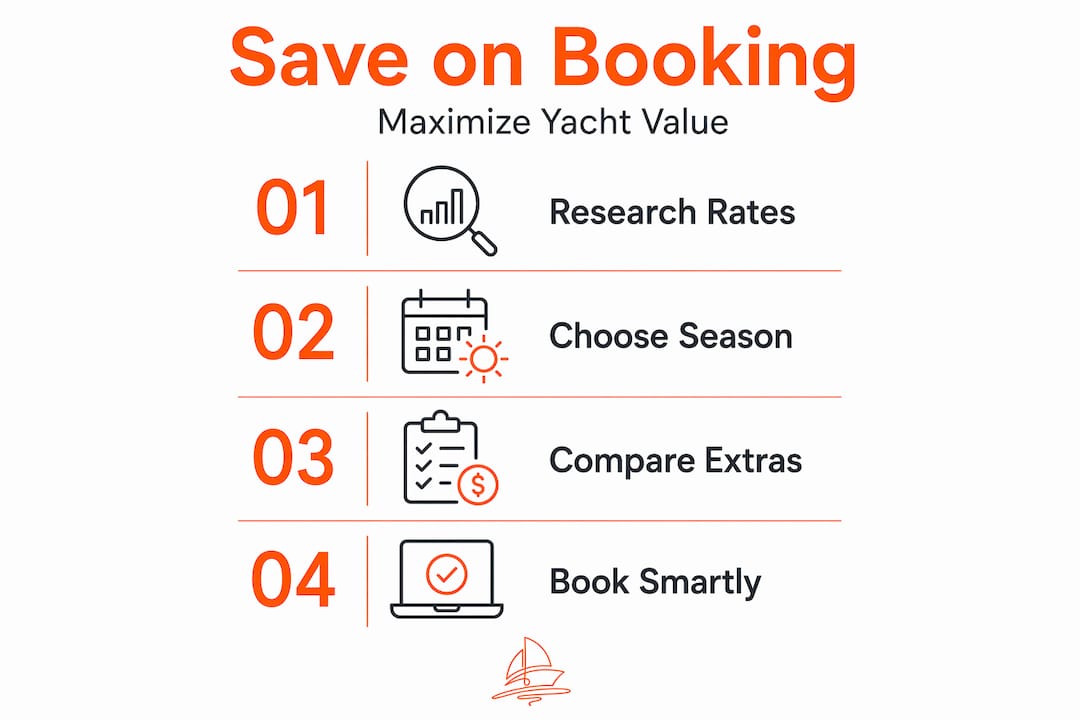
Now that you have prepared and researched, here is exactly how to book your yacht to save money while ensuring quality. The research phase means nothing without sharp execution.
- Compare multiple listings side by side. Use aggregator platforms to pull charter options in your target region and date range. Do not stop at the first yacht that fits your budget. Reviewing five to ten options often reveals meaningful price differences for similar vessels.
- Request a full cost breakdown before committing. Ask for APA estimate, port fees, VAT, and any additional charges in writing. This is not optional. It is the only way to make accurate comparisons.
- Split costs with a group. Short-term yacht charters under ten days have grown in popularity precisely because dividing costs across six to eight guests turns an expensive private experience into one that costs less than many hotel vacations. A $7,000 all-in week split among eight people is $875 per person.
- Negotiate inclusions, not just price. Charter companies are often more willing to add value than lower price. Ask for extra provisioning, a complimentary night in a premium marina, or included water toys before asking for a rate reduction.
- Book early for peak season, last-minute for shoulder or off-season. These two approaches are not contradictory. They apply to different timing windows. Prime summer weeks in Mykonos or Ibiza go fast. Everything else rewards patience.
- Read the cancellation policy before signing. Some contracts offer no refund within 60 days of charter start. Others offer flexible rescheduling. This directly affects your financial risk.
| Booking approach | Best for | Potential savings |
|---|---|---|
| Early booking (6+ months out) | Peak season, popular destinations | Secures availability, avoids price increases |
| Last-minute booking (1 to 3 weeks out) | Shoulder/off-season, flexible travelers | 15% to 40% off base rate |
| Shoulder season booking | Mediterranean, Caribbean | 20% to 40% lower base rates |
| Bareboat charter | Licensed sailors with group | Eliminates crew costs entirely |
| Group cost splitting | Short-term charters | Reduces per-person cost dramatically |
Pro Tip: When negotiating inclusions, ask specifically about the APA cap. Some charters allow you to set a fixed provisioning budget rather than an open-ended fund, which gives you much greater control over the final bill.
Verifying your booking and tips to avoid costly mistakes
After booking, carefully verifying details helps you avoid unexpected expenses and ensures the anticipated value. Most cost overruns on charters happen not because people booked the wrong yacht, but because they did not read what they agreed to.
Some hidden fees or misunderstandings about provisioning can significantly increase final costs if not confirmed upfront. Here is what to check before you finalize anything:
- Reread every line of the APA clause. Confirm what is included and, critically, what is not. Some charters include fuel in APA only up to a certain mileage. Anything beyond that becomes an additional charge.
- Confirm the VAT structure in writing. Tax treatment varies widely. For EU charters, VAT is often charged based on the proportion of time spent in EU waters. Get the calculation method documented.
- Verify gratuity expectations upfront. If crew gratuity is described as "customary," ask for the expected range. Surprises at the end of the trip are avoidable.
- Check the yacht's recent condition and reviews. A well-priced listing on a poorly maintained yacht is not a deal. Look for dated photos, recent guest reviews, and charter history.
- Clarify the cancellation and force majeure terms. Bad weather, mechanical issues, and personal emergencies happen. Knowing your options before they arise is basic financial protection.
- Confirm who handles provisioning. On some charters, the crew shops based on an agreed list. On others, you order direct. The process affects cost control significantly.
"The contract is the deal. If it is not written there, it does not exist. Review every clause before you wire a deposit." This is the mindset every charter guest should bring to the verification process.
Pro Tip: After signing, send a follow-up email to the charter company summarizing the key agreed terms, APA inclusions, cancellation window, and departure conditions. Having that confirmed in writing outside the contract adds a useful layer of clarity.
Why saving on yacht booking is about strategy, not just luck
Here is what most budget yacht charter guides will not tell you: the people who consistently pay less for better experiences are not finding secret deals. They are making deliberate trade-offs and exercising patience at the right moments.
The yacht charter industry prices around assumptions. The assumption that guests want peak season in the most popular ports. The assumption that motor yachts are the default. The assumption that provisioning will be generous and largely unmonitored. Every one of those assumptions costs you money if you go along with them unthinkingly.
Flexibility is not just a nice feature to have. It is your primary negotiating asset. A traveler who can move their dates by two weeks, consider a sailing yacht instead of a motor yacht, or target a slightly less famous anchorage will consistently find better value than someone locked into fixed parameters. This is how boat rentals lower travel costs in a real, material way, not by accident, but by design.
There is also a comfort trade-off conversation that most articles avoid. Chartering a slightly smaller yacht and allocating some of those savings toward extraordinary provisioning, a better anchorage itinerary, or simply more days on the water often produces a more satisfying trip than stretching the budget to get the largest vessel available. Experience is the product. The yacht is the vehicle.
The final insight is this: understanding the pricing dynamics of yacht charters means you stop reacting to listed prices and start shaping them. You know which components are negotiable, when owners are motivated to deal, and what questions to ask before signing. That knowledge is worth more than any single discount.
Discover affordable yacht bookings with Sailorix
You now have a clear picture of where yacht charter costs come from and exactly how to reduce them. Putting that knowledge into practice is the natural next step.

Affordable yacht bookings are at the core of what Sailorix was built for. The platform gives you access to yacht and boat rentals at the lowest market prices globally, with only around 1% in service fees once you hold a Sailorix membership. Compare that to the 10 to 20% service fees common on other booking platforms and the savings become concrete fast. For €100 per year, you unlock access to competitive pricing, real-time availability, and full cost transparency before you commit to anything. For anyone serious about applying the strategies in this guide, Sailorix is where those strategies become actual bookings.
Frequently asked questions
What is the Advanced Provisioning Allowance (APA) in yacht bookings?
APA is an upfront payment that covers fuel, food, beverages, taxes, port fees, and crew gratuities. It typically adds 50 to 55% on top of the base charter rate, making it the largest hidden cost for first-time charterers.
When is the best time to book a yacht charter to get the lowest price?
Booking during the shoulder season or off-season generally yields the best rates, while last-minute charters in high-traffic hubs like the Greek Isles or French Riviera often come with reduced prices due to last-minute availability.
Are short-term yacht charters more affordable than long-term ones?
Short-term charters under ten days are growing in popularity and become significantly more affordable when the total cost is split among a group, often bringing per-person costs down to a level comparable to standard vacation accommodations.
How can I avoid hidden fees when booking a yacht?
Requesting an itemized all-in cost estimate before signing, confirming APA inclusions in writing, and reviewing the VAT and cancellation terms thoroughly help you avoid the hidden fees in provisioning and taxes that catch many charterers off guard.