

Most renters assume a security deposit is just another upfront cost they'll never see again. That assumption costs people real money. Whether you're signing a lease on an apartment or booking a bareboat yacht charter in the Mediterranean, the deposit you pay follows specific rules, and knowing those rules is the difference between a full refund and a frustrating dispute. For sailors and travelers booking charters, the stakes are even higher because the contracts look nothing like a standard lease, and the amounts can be significantly larger.
Table of Contents
- What exactly is a security deposit?
- How security deposits work: Apartments vs. yacht and boat charters
- Rules, limits, and your rights as a renter or charterer
- Common pitfalls and how to protect your deposit
- Why protecting your security deposit requires a proactive mindset
- Ready to chart your course? Deposit confidence, every trip.
- Frequently asked questions
Key Takeaways
| Point | Details |
|---|---|
| Deposits protect owners | A security deposit is a refundable payment that protects landlords and charter companies from damage and unpaid fees. |
| Apartments vs. boats differ | Deposit rules, payment forms, and release procedures are stricter and faster for yacht and boat charters than for apartments. |
| Know your legal rights | Laws set deposit limits, timelines for return, and rights to itemized deductions—understand these before signing. |
| Documentation is key | Photos, videos, and receipts help ensure you aren't unfairly charged for damages. |
| Proactive approach matters | Being proactive and reading contracts closely can help you reclaim your deposit in full. |
What exactly is a security deposit?
A security deposit is money you pay upfront, before you take possession of a property or vessel, as a form of protection for the owner. It isn't a fee. It isn't rent. It's a refundable payment held in trust until the rental ends.
As Zillow explains, a security deposit is a refundable payment held by the landlord or charter company to cover potential damages, unpaid rent or fees, or breaches of the rental agreement, and is returned when no issues arise.
Here's what a deposit typically covers:
- Physical damage beyond normal wear and tear (broken fixtures, torn upholstery, damaged sails)
- Unpaid rent or charter fees left at the end of the agreement
- Cleaning costs if the property or vessel is returned in unacceptable condition
- Breaches of agreement, such as unauthorized guests, smoking where prohibited, or bringing pets into a no-pet rental
The single biggest misconception is treating a deposit as the last month's rent. These are two completely separate things. Deposits are held in reserve for damages. Rent pays for your time using the property. Using one to cover the other without written permission from the owner is a breach of contract and can result in legal action. For charter sailors especially, this distinction matters because end-of-charter invoices often include fuel top-offs, provisioning shortfalls, and port fees, none of which your deposit is designed to automatically cover unless explicitly stated in your contract.
Security deposits exist because property owners take real financial risk every time they hand over keys or lines to someone new. A yacht can suffer tens of thousands of dollars in damage in a single charter week. Even an apartment can cost thousands to repair after a problematic tenancy. The deposit isn't personal. It's just practical risk management.
How security deposits work: Apartments vs. yacht and boat charters
The core concept is identical, but the mechanics, timelines, and protections differ considerably depending on what you're renting.
Apartment deposits are almost always paid by check or bank transfer before you move in. They're held in a dedicated account, sometimes interest-bearing depending on the state, and returned after you vacate. Most states regulate every step of this process, including how long landlords have to return the deposit and what penalties they face if they don't.
Yacht and boat charter deposits work differently. Charter companies typically place a credit card pre-authorization hold rather than collecting cash upfront. That hold freezes a set amount on your card for the duration of the charter. Once you return the vessel in good condition, the hold is released, usually within a few business days. No actual charge hits your statement unless damage is documented.

Here's a side-by-side comparison:
| Feature | Apartment rental | Yacht/boat charter |
|---|---|---|
| Payment method | Cash, check, bank transfer | Credit card pre-authorization |
| Typical amount | 1 to 2 months' rent | €1,000 to €5,000+ depending on vessel |
| Legal regulation | State/country specific laws | Contractual, minimal government oversight |
| Return timeframe | 14 to 60 days by law | 3 to 10 business days after charter |
| Dispute process | Small claims court | Arbitration or charter company policy |
| Normal wear protection | Required by law in most states | Defined by contract waiver language |
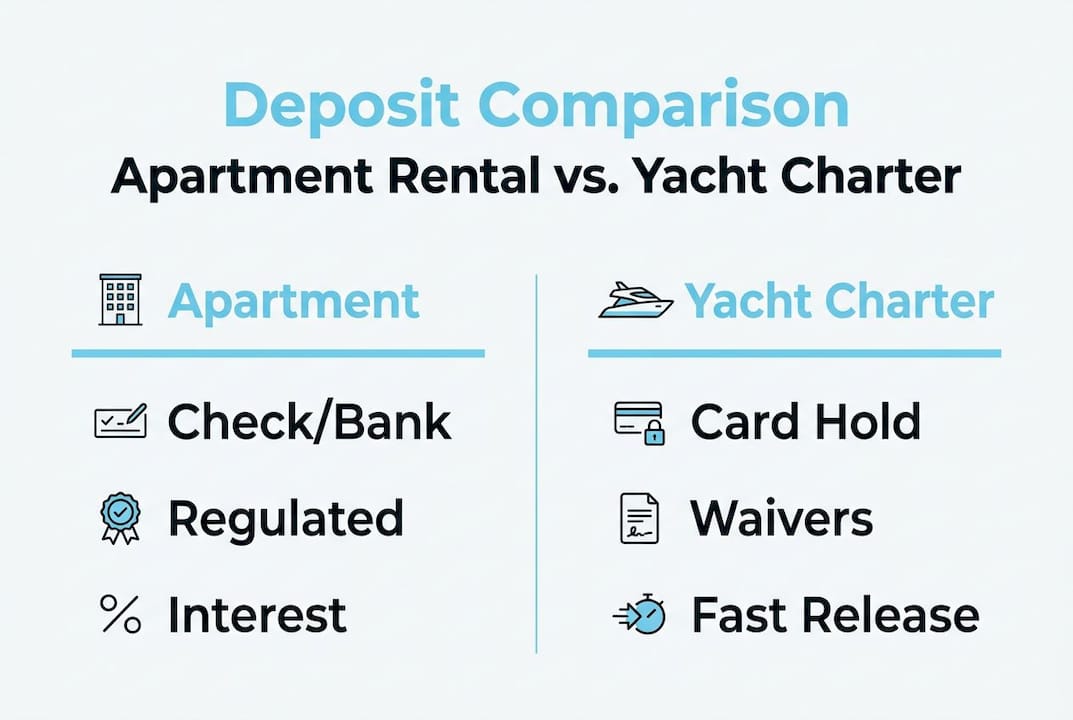
As Nolo's state-by-state breakdown shows, apartment deposits are tightly regulated, with states like Massachusetts imposing triple damages on landlords who wrongfully withhold deposits. Yacht charters operate under private contracts, so the protections are only as strong as the clauses you negotiated or accepted when you signed.
One critical consideration for charter sailors: many companies offer a damage waiver as an add-on, typically costing 3% to 5% of the charter fee. This waiver limits your liability in the event of accidental damage. It does not cover negligence. If you run aground while ignoring a chart warning or cause damage while under the influence, the waiver won't protect you, and the full deposit amount or more could be at stake.
Pro Tip: Before any charter, ask the company directly how the pre-authorization works on your specific card type. Some cards process holds differently, and international credit cards sometimes convert the hold amount using an exchange rate that can temporarily freeze more funds than expected.
Rules, limits, and your rights as a renter or charterer
Your rights as a renter depend heavily on where you are. For apartment renters in the United States, state deposit caps and return rules vary significantly. California now caps deposits at one month's rent. New York caps at one month. Texas, Florida, and 22 other states currently have no statutory cap, meaning landlords can legally request two, three, or even more months upfront.
Here's a quick reference for some key states:
| State | Deposit cap | Return deadline | Penalty for non-compliance |
|---|---|---|---|
| California | 1 month | 21 days | 2x deposit damages |
| New York | 1 month | 14 days | Actual damages |
| Massachusetts | 1 month | 30 days | 3x deposit damages |
| Texas | None specified | 30 days | 3x deposit plus attorney fees |
| Florida | None specified | 15 to 60 days | Forfeiture of deposit |
For renters outside the US, regulations vary even more. In many European countries, deposit amounts are capped at two months' rent, and landlords face strict penalties for late returns.
If your deposit is withheld unfairly, here's what to do:
- Request an itemized statement in writing. Landlords and charter companies are legally or contractually required to explain every deduction with receipts.
- Compare their claims to your move-in or boarding documentation. Photos, videos, and written checklists are your evidence.
- Send a formal demand letter citing the applicable law or contract clause and giving a deadline for the return.
- File a small claims court claim if you're an apartment renter. The process is low-cost and designed for cases exactly like this.
- Escalate through the charter company's complaint process for boat rentals, or contact your credit card company to dispute a charge if funds were actually withdrawn.
One underused right: in at least 10 states, landlords must pay interest on deposits held for extended periods. If you're renting long-term, check whether your state is one of them. That's money you're legally owed at the end of your tenancy, and most tenants never ask about it.
Common pitfalls and how to protect your deposit
The most avoidable deposit disputes come down to one thing: lack of documentation. Renters and charterers lose deposits they should have kept simply because they can't prove what condition the property or vessel was in when they arrived.
Here are the most common pitfalls and how to sidestep them:
- Skipping the move-in walkthrough. Whether it's an apartment or a yacht, always complete a formal condition check with the owner or company representative present. Anything damaged before you arrive should be written down and signed.
- Assuming photos aren't necessary. Written checklists aren't enough on their own. A photo timestamp is difficult to dispute. A written description alone is much easier to argue over.
- Not reading the charter contract's exclusion clauses. Many boat rental agreements define "damage" differently than you'd expect. Faded varnish might be wear and tear on an apartment but a chargeable item on a yacht. Know what you're agreeing to before you sign.
- Returning the vessel or property without a final inspection. Get a sign-off at checkout. If you leave without written confirmation that everything's fine, you leave yourself exposed.
- Ignoring small pre-existing damage. A tiny scratch on a boat hull or a stain on an apartment wall that isn't documented can become your problem if you don't flag it immediately.
As the NYC Bar Association notes, normal wear and tear is not deductible from a security deposit. That includes faded paint, minor scuffs on baseboards, small nail holes from hanging pictures, and carpet wear along high-traffic paths. Landlords who attempt to deduct for these items, and who fail to provide itemized receipts, can actually forfeit their right to withhold any amount at all.
For charter sailors, the equivalent protection comes from waivers and documented pre-departure condition reports. The skipper should always walk through the vessel before departure with a company representative and note every existing mark, scratch, or mechanical issue. Get it in writing.
Pro Tip: Take a continuous video walkthrough of the entire property or vessel at both check-in and check-out. Narrate what you see as you go. This creates a timestamped, defensible record that photos alone don't fully capture, and it only takes five minutes to do.
Why protecting your security deposit requires a proactive mindset
Here's an uncomfortable truth most guides skip over: the majority of deposit disputes aren't caused by bad landlords or shady charter companies. They're caused by renters who hand over significant sums of money without spending five minutes to document what they received.
We've seen first-hand how often sailors arrive at a marina, excited to get on the water, and skip the pre-departure inspection entirely. They return the boat five days later, pointing to a scratch that was there when they boarded, with nothing to prove it. That's not a contract failure. That's a documentation failure.
The proactive mindset means treating every rental as if you'll need to prove the condition of the property in court. Because sometimes you do. As Zillow points out, a security deposit is never last month's rent, it exists specifically to protect against damage and unpaid obligations, and understanding that framing changes how you approach the entire rental experience.
For yacht charterers, the additional complexity is that charter contracts are not standardized the way apartment leases often are. A contract in Greece looks different from one in Croatia, which looks different from one in the Caribbean. Waivers that cover accidental damage in one jurisdiction may be void in another. Reading the fine print is not optional. It's the difference between a relaxing sailing trip and an unexpected bill for hull repair.
One more thing worth saying: if you genuinely can't afford to have your deposit amount frozen for the duration of a charter, choose a charter company that offers damage waivers and be upfront about your concerns. Good operators want you to have a stress-free trip. They'll walk you through the terms. The ones who get defensive when you ask questions are the ones to avoid.
Ready to chart your course? Deposit confidence, every trip.
Understanding deposits is a big part of sailing with confidence. But so is choosing a platform that values transparency.

At Sailorix, we built our platform around one idea: boat and yacht rentals should be straightforward, affordable, and fair. That includes how deposits and fees are communicated. With our annual membership for €100, you access the global fleet at roughly 1% service fees instead of the 10% to 20% industry norm. No hidden charges, no surprise deductions. Just clear terms so you can focus on the trip, not the fine print. If you're planning your next sailing adventure, Sailorix is the place to start.
Frequently asked questions
Is a security deposit always refundable?
Security deposits are fully refundable provided no damages occur, no fees go unpaid, and no contract terms are violated. Any deductions must be itemized in writing with supporting documentation.
What happens if there is normal wear and tear?
Normal wear and tear, such as faded paint or small nail holes, cannot legally be deducted from a security deposit. Landlords who fail to provide itemized receipts may forfeit their right to withhold any amount.
How quickly must a security deposit be returned?
For apartments, the return timeline varies from 14 to 60 days depending on state law. Boat charter holds are typically released within 3 to 10 business days of return, subject to the contract terms.
Can a landlord or charter company keep my entire deposit?
They may keep all or part of the deposit for documented damage, violations, or unpaid fees beyond normal wear and tear. Undocumented or unitemized withholdings are generally not enforceable.
Does a security deposit cover the last month's rent?
No. A security deposit is separate from rent and cannot substitute for the last month's payment unless the contract explicitly allows it. Misusing a deposit this way is a breach of most rental agreements.