
Marina fees look simple on the surface. You park your boat, you pay a fee. But what are marina fees in practice? They're a layered system of slip charges, utility costs, surcharges, and seasonal variables that catch most boaters off guard. A 35-foot boat docked at a California coastal marina can cost two to three times more than the same boat at an inland lake, even before electricity and liveaboard fees enter the picture. This guide breaks down every component of the marina fees breakdown so you know exactly what you're paying for and where you can save.
Table of Contents
- Key takeaways
- What marina fees actually cover
- How location shapes your marina costs
- Hidden costs beyond the slip rental
- How to compare and budget marina fees accurately
- My take on what boaters consistently get wrong
- Find transparent marina pricing with Sailorix
- FAQ
Key takeaways
| Point | Details |
|---|---|
| Fees go beyond slip rental | Most marina bills include electricity, pump-outs, and surcharges not listed in the advertised rate. |
| Location drives price dramatically | Coastal and urban marinas charge $20–$50 per foot; inland lakes often run $12–$30 per foot. |
| Billing is based on the larger dimension | Marinas charge for the slip size or your boat's LOA, whichever is longer, so size up carefully. |
| Transient vs. long-term rates differ sharply | Short-term docking costs more per day but carries fewer commitments than monthly or seasonal slips. |
| Convert everything to $/foot/month | Comparing fees in a single unit reveals the true cost difference between marina options. |
What marina fees actually cover
At their core, marina fees are the charges a marina collects for giving your boat a place to stay and for the services that come with that space. But the structure behind those charges is more complex than a single line item.
Slip fees: the base charge
The foundation of any marina fees breakdown is the slip rental. Most US marinas charge based on the longer of your boat's Length Overall (LOA) or the slip's physical length, with rates typically ranging from $15 to $35 per foot per month as a 2026 baseline. That means if your 32-foot boat sits in a 36-foot slip, you pay for 36 feet. Marinas operate this way because they're committing full infrastructure capacity to that space regardless of what's in it.
Slip fees are usually structured in three ways:
- Monthly rates: The standard long-term arrangement, offering the lowest per-day cost
- Seasonal rates: A lump payment covering a defined period, often spring through fall, sometimes with amenities bundled in
- Daily or transient rates: Charged per foot per night for short stays, comparable to a hotel room for your boat
Pro Tip: Always ask whether the advertised slip rate is all-inclusive or base-only. The difference between those two answers can represent hundreds of dollars per month.
Common additional fees built into marina billing
Beyond the slip itself, the costs associated with marinas grow quickly. Here are the charges you'll encounter most often:
- Electricity: Billed by amp service level and actual usage. This is not a flat fee at most marinas.
- Water hookup: Typically a small flat fee per month, though some marinas include it.
- Pump-out service: Sanitation removal charged per visit or as a monthly flat fee.
- Parking: Some marinas, especially urban ones, charge separately for vehicle parking.
- Liveaboard surcharges: If you live on your boat full-time or part-time, expect an added monthly fee.
- Guest dock fees: Short stops even without an overnight stay can trigger a charge.
Understanding this list is where most boaters gain real budget clarity. The slip rental is the price you see. Everything else is the price you pay.
How location shapes your marina costs
Geography does more to determine average marina fees than almost any other single factor. Demand, land costs, and the local boating season all feed into what a marina can charge.

Regional pricing breakdown
Pricing varies widely by region: Florida and California coastal marinas typically run $20 to $50 per foot per month, while many inland and northern state marinas sit in the $12 to $30 range. Urban premium markets sit at the top of that scale. NYC seasonal slips range from $65 to $230 per foot, with transient docking at $2 to $5 per foot per day and additional touch-and-go fees between $1.25 and $3 per foot.
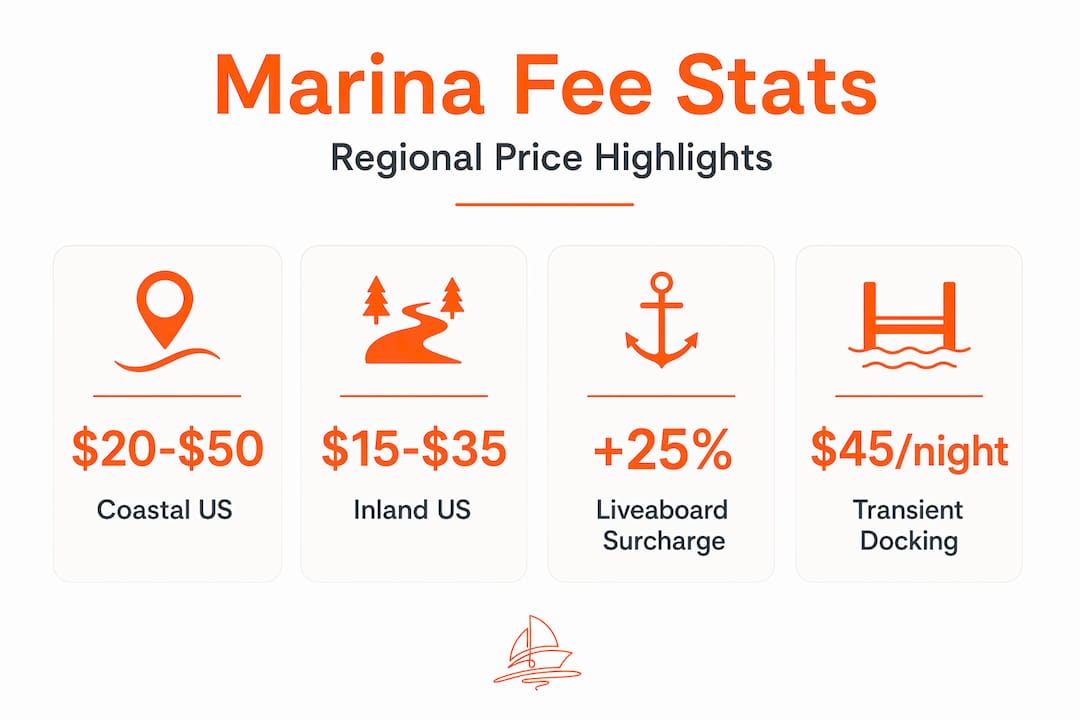
The table below shows how how much marina fees are varies depending on where you dock:
| Region | Monthly rate per foot | Transient rate per foot/night | Notes |
|---|---|---|---|
| New York City | $65–$230 (seasonal) | $2–$5 | Winter storage adds $40–$80/ft |
| California coast | $25–$50 | $1.50–$4 | High demand, limited slip availability |
| Florida coast | $20–$50 | $1.50–$3.50 | Year-round season; hurricane surcharges possible |
| Chesapeake Bay | $15–$35 | $1–$2.50 | Competitive market; good amenities at mid-tier price |
| Gulf Coast | $15–$30 | $1–$2 | Lower demand; fewer premium marinas |
| Inland lakes | $12–$25 | $0.75–$1.75 | Lowest fees; fewer full-service amenities |
The amenity tier matters just as much as location. A full-service marina with fuel docks, a ship's store, on-site mechanics, Wi-Fi, and a pool commands significantly higher rates than a basic dock with water and power. You're often paying for what surrounds the slip, not just the slip itself.
Pro Tip: If you only use your boat on weekends and don't need premium amenities, a lower-tier marina 20 minutes further from shore can cut your annual slip cost by 30% or more.
Hidden costs beyond the slip rental
This is where marina slip rental costs get genuinely surprising, even for experienced boaters. Most boaters underestimate total marina cost because the advertised slip price rarely includes utilities or surcharges.
Electricity: the biggest variable
Electricity is almost never bundled into a base rate. Boston Waterboat Marina charges $40 per day for 30-amp service, $50 per day for 50-amp, and up to $140 per day for 100-amp service. At a 100-amp service rate, that's $4,200 per month in electricity alone. Even at the 30-amp rate, a full month costs $1,200. Electricity pricing can dominate seasonal costs when you're running air conditioning in summer or heating systems in fall.
Most recreational boaters won't hit those extremes, but factoring $50 to $200 per month for electricity is realistic for the average boat with standard onboard systems.
Liveaboard fees and who they affect
If your boat is your home, or your second home, many marinas apply a liveaboard surcharge. Liveaboard fees typically add $100 to $400 per month above the base slip fee. Friday Harbor Marina, for example, charges around $130 per month plus applicable taxes for liveaboard status. This fee covers the marina's added utility load, waste management, and sometimes security resources associated with full-time residents.
Dock equipment and specialty surcharges
Here's a charge most guides don't mention. Some marinas charge extra for dock equipment and services. Traders Cove Marina introduced 2026 rate changes that include up to $1,500 per season for narrow beam boats and $800 per season for frog hook equipment. These are the kind of line items that appear in a rate card buried under the advertised slip price.
Insurance requirements
Marinas require proof of hull and liability insurance, with minimum coverage levels and sometimes specific carrier restrictions. If your current policy doesn't meet a marina's minimum, you'll need to upgrade it. That's an additional annual cost that should be part of any honest marina budget calculation.
Transient docking: a different pricing world
Transient docking works like a hotel stay. You pay more per day, services may be limited, and additional charges for power and water often apply at check-in rather than being bundled into the nightly rate. Transient slips are the right choice for cruising stops, not long-term berthing. But understanding how they're priced prevents bill shock when you pull into an unfamiliar marina for the night.
How to compare and budget marina fees accurately
Knowing the costs is step one. Knowing how to evaluate them against each other is where real savings happen.
-
Convert everything to $/foot/month. Converting all marina fees into this single unit lets you compare a monthly-billed urban marina against a seasonal-package inland marina on equal terms. Divide any seasonal rate by the number of months it covers, then divide by the billable footage.
-
Add your estimated utility costs. Pull your boat's power requirements and estimate monthly electricity use. Add a water fee, pump-out costs, and any anticipated liveaboard charges to get a realistic monthly total.
-
Check the rate card for equipment fees. Ask the marina directly whether frog hooks, dock lines, beam surcharges, or specialty equipment fees apply to your boat type before signing any agreement.
-
Factor in slip size versus boat size. Because marinas charge for the longer of LOA or slip length, understand how slip allocation affects billing. A snug fit in the smallest available slip can save you meaningful money over a season.
-
Negotiate for off-season or annual commitments. Many marinas will discount monthly rates for multi-month or annual commitments, especially at less busy times of year. The worst they can say is no.
-
Compare mooring balls as an alternative. Understanding the difference between slip moorage versus mooring can reveal real savings. Moorings cost less upfront but add time and fuel getting to shore. For boats you use infrequently, a mooring may be the better financial choice.
My take on what boaters consistently get wrong
I've watched boat owners walk into marina agreements with only the slip rate in their heads and walk out three months later completely surprised by their actual bills. The sticker price of a slip is a starting point, not a total.
The single biggest mistake I see is ignoring electricity costs. People treat it as a minor utility and then dock at a full-service marina with a generator-heavy boat and end up with a monthly electricity bill that rivals their slip fee. Get the amp service pricing schedule before you commit. Not after.
The second thing most new boaters miss is the liveaboard designation. Some marinas apply liveaboard fees if your boat is occupied more than a certain number of nights per month, even if you don't consider yourself a liveaboard. Read the definitions in the marina agreement carefully. A boat used heavily on weekends can accidentally trigger that surcharge.
My overall approach now is to ask for the full rate card, not just the slip rate, before any conversation about availability. It filters out the marinas that aren't transparent about their pricing and tells me immediately which ones are worth my time. The most honest marinas publish every fee on one sheet. That transparency is usually a reflection of how they operate in general.
— Sailorix
Find transparent marina pricing with Sailorix
Sorting through marina fees, comparing rate cards, and tracking all the extras shouldn't be a full-time job. Sailorix was built to make boating costs clearer and more manageable from the start.

With a single annual membership of €100, you get access to yacht and boat rentals at roughly 1% service fees, well below the 10–20% most booking platforms charge. Whether you're comparing marina slip rental costs across regions or planning a longer cruising season, Sailorix gives you transparent pricing, real-time availability, and a straightforward way to find options that fit your actual budget. Visit Sailorix to start exploring.
FAQ
What are marina fees exactly?
Marina fees are the charges a marina collects for docking space and associated services. They typically include a base slip rental plus additional costs for electricity, water, pump-outs, and other surcharges depending on the marina and your boat's usage.
How much are marina fees on average?
Average marina fees run from $15 to $35 per foot per month at most US marinas, with coastal and urban locations reaching $50 or more per foot. Inland lake marinas typically sit in the $12 to $25 per foot range.
Are marina fees tax deductible?
Marina fees are generally not tax deductible for personal recreational use. If your boat is used for business purposes, or if you claim it as a second home and it meets IRS requirements, portions of your costs may qualify. Always consult a tax professional for your specific situation.
What factors affect marina fees the most?
The biggest factors affecting marina fees are geographic location, marina amenity level, boat length, and the type of stay. Electricity and liveaboard surcharges can also add significantly to the base slip rate.
What is the difference between transient and monthly slip fees?
Transient slip fees are short-term rates charged per foot per night and are typically higher per day than monthly rates. Monthly slip fees offer a consistent berth at a lower daily cost but require a longer commitment.