

Real-time availability is defined as the continuous, instant updating of resource or inventory status to reflect current conditions as they happen. Unlike batch processing, which can delay data by hours or even days, real-time systems deliver updates within milliseconds. This distinction matters enormously for scheduling, travel bookings, and resource management, where outdated data leads to double bookings, missed opportunities, and frustrated customers. Sailorix, for example, builds its entire boat booking platform on live availability data, so customers always see accurate vessel status before they commit to a reservation.
What is real-time availability, and how does it differ from live data?
Real-time availability and "live" data are not the same thing, even though the terms get used interchangeably. True real-time availability requires strict latency guarantees end-to-end, typically measured in milliseconds to seconds. Many systems marketed as "live" simply refresh on a schedule, which is a meaningful technical difference.
A practical example makes this clear. Plausible Analytics updates certain dashboard metrics every 30 seconds as a balance between server load and visibility. That is near-real-time, not true real-time. For a booking platform or an emergency resource scheduler, a 30-second gap is long enough to cause a double booking or a missed allocation.

The technical term for measuring this gap is end-to-end latency, which covers the full journey from a triggering event (a sale, a cancellation, a check-in) to the moment the updated status appears in the system. Batch processing pipelines can stretch that latency from hours to days. Real-time pipelines collapse it to under one second.
Pro Tip: When evaluating any scheduling or booking platform, ask specifically about end-to-end latency, not just "refresh rate." A 30-second refresh interval is not real-time, regardless of how the vendor labels it.
The distinction also matters for system design. Near-real-time solutions use scheduled pulls, where the system checks for changes at fixed intervals. True real-time systems use event-driven architecture, where every change pushes an update immediately. The push model is faster, but it demands more from the underlying infrastructure.
How does real-time availability work in inventory and resource management?
Real-time inventory management works by treating every transaction as an event that immediately updates a central record. The moment a product is scanned, a seat is reserved, or a boat is booked, the system reflects that change across all connected interfaces. No manual reconciliation. No waiting for a nightly sync.
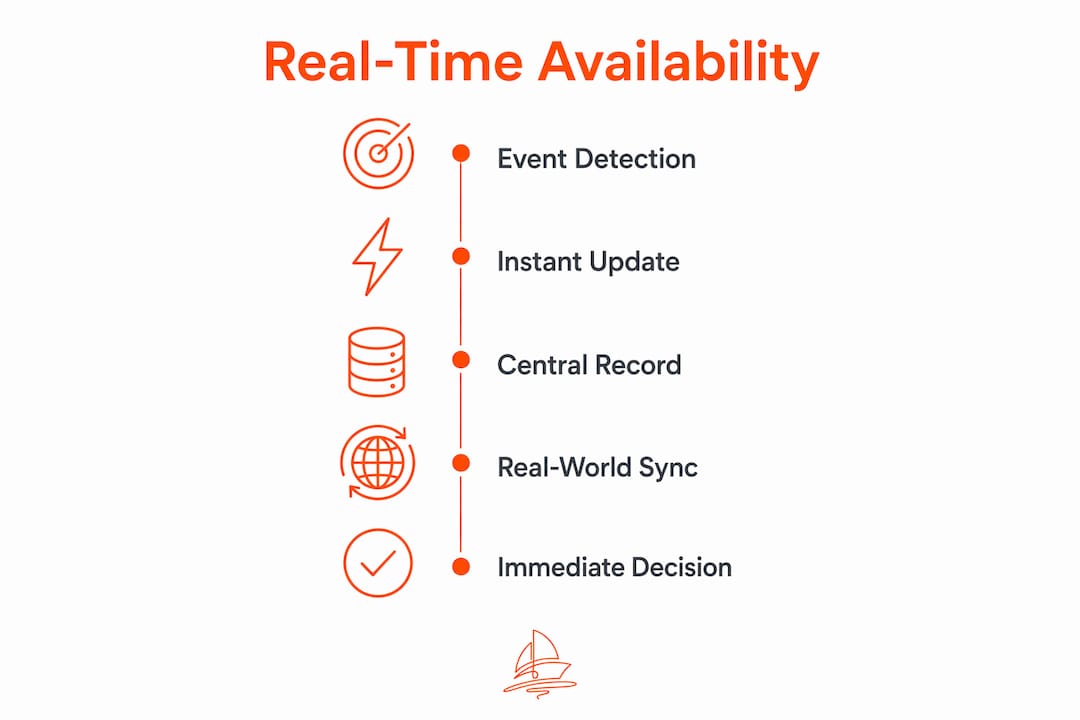
The technical engine behind this is often streaming SQL or event-driven processing. Streaming databases update inventory levels with incremental computations rather than periodic refreshes, reducing overselling to near-zero latency. This is why enterprise logistics platforms can show warehouse stock counts that update the instant a barcode is scanned on the floor.
Accurate real-time availability also requires tracking more than a simple "available" or "unavailable" status. Systems must account for multiple states:
- Available — the resource is confirmed free and can be booked.
- Reserved — a hold is placed but the transaction is not finalized.
- In-transit — the item is moving between locations and temporarily unavailable.
- Incoming — stock is expected but not yet physically present.
Configuring systems to handle all these states prevents "ghost inventory," which is when a system shows a resource as available even though it is already committed elsewhere. Ghost inventory is one of the most common and costly errors in real-time resource allocation.
"Purchasing, warehousing, and ecommerce systems must share data instantly to prevent overselling and keep availability accurate." — Friedman Corp
Physical operations also require a bridge between the real world and the digital record. Barcode and QR scanning syncs physical actions with system data at the moment they happen. Every transaction is recorded immediately at the action point, not entered manually later. This is what makes the difference between a system that is theoretically real-time and one that actually performs that way in a warehouse or marina.
What are the benefits and challenges of real-time availability?
The clearest benefit of real-time data tracking is better decisions made faster. When a scheduler sees current resource status, they assign staff, equipment, or vessels based on fact, not on data that was accurate two hours ago. That accuracy compounds across an organization.
The operational gains are concrete. Transitioning to real-time inventory tracking with barcode scanning can increase stock count efficiency by 3–5 times and reduce manual reconciliation time substantially. That shift moves physical stock counts from monthly, paper-based processes to near-instantaneous digital updates. For a business managing hundreds of SKUs or dozens of bookable assets, that is a significant operational change.
The main challenges fall into two categories:
- System integration. Disconnected systems that do not share a unified database produce false availability data. Purchasing, warehousing, and customer-facing booking tools must all read from the same source of truth. Siloed systems are the single biggest obstacle to genuine real-time status monitoring.
- Resource intensity. Real-time data streams consume more computing power than batch processing. Not every dataset needs real-time treatment. Monthly financial reports, for example, do not require sub-second updates. Selective use of real-time processing preserves infrastructure and cost.
The practical rule is straightforward: use real-time availability where a delay causes a direct business problem (overbooking, missed dispatch, patient scheduling conflict), and use batch processing where timing is not critical. Applying real-time processing indiscriminately wastes resources without adding value.
Real-world applications in scheduling, travel, and logistics
Real-time availability drives decisions across several industries where timing is non-negotiable. The table below shows where it applies and what it prevents.
| Industry | Application | Problem it prevents |
|---|---|---|
| Travel and boating | Instant booking confirmation | Overbooking, customer disputes |
| Workforce management | Live shift scheduling | Understaffing, scheduling conflicts |
| Healthcare | Room and equipment allocation | Delays in patient care |
| Logistics and warehousing | Stock and shipment tracking | Overselling, missed dispatch windows |
| Field services | Technician and parts availability | Wasted site visits, wrong parts |
In travel, the stakes are especially visible. Real-time updates empower customers and managers to make immediate, confident booking choices with current data. When a customer books a yacht through Sailorix, the platform reflects actual vessel availability at that moment, not a cached status from earlier in the day.
Workforce management platforms use the same principle for shift scheduling. A manager who sees live staff availability assigns open shifts in minutes instead of making phone calls to check who is free. The speed gain is real, and so is the reduction in scheduling errors.
In healthcare, real-time resource allocation determines whether an operating room, a ventilator, or a specialist is available for an incoming patient. Batch-updated systems in that context are not just inefficient. They are a clinical risk.
The common thread across all these industries is trust. When customers and operators know that the status they see reflects reality right now, they act with confidence. When they suspect the data might be stale, they hesitate, call to confirm, or abandon the transaction entirely.
Key Takeaways
Real-time availability is defined by sub-second latency and continuous event-driven updates, not by scheduled refresh intervals, and businesses that treat these as equivalent will consistently face overbooking, ghost inventory, and poor customer trust.
| Point | Details |
|---|---|
| Latency defines real-time | True real-time requires sub-second end-to-end latency, not a 30-second dashboard refresh. |
| Multiple states matter | Systems must track reserved, in-transit, and incoming states to prevent ghost inventory errors. |
| Integration is the core challenge | Siloed systems produce false availability data; a single source of truth is required for accuracy. |
| Selective use saves resources | Apply real-time processing only where delays cause direct business problems; use batch elsewhere. |
| Trust drives conversions | Customers who see accurate live availability book faster and abandon transactions less often. |
The shift most businesses are not ready for
Sailorix has watched the boating industry move from static availability calendars to live booking systems, and the gap between those two approaches is wider than most operators expect. The technology is not the hard part. The operational discipline is.
The businesses that struggle with real-time availability are rarely the ones with the wrong software. They are the ones that still record transactions manually after the fact, or that run their booking system and their internal calendar as separate tools. The moment those two records diverge, the "real-time" label becomes meaningless.
The shift that actually works is treating every transaction as an event that must be recorded at the moment it happens, not summarized later. That requires process changes, not just software changes. A marina that scans a vessel out on departure and scans it back on return has real-time data. One that updates a spreadsheet at the end of the day does not, regardless of what platform it uses.
The opportunity for businesses that get this right is significant. Customers who see accurate, current availability book faster. They call less to confirm. They dispute fewer charges. The downstream effect on customer service costs and repeat bookings is measurable. Real-time availability is not a feature. It is an operational standard that separates platforms customers trust from ones they verify manually before committing.
— Sailorix
Sailorix and real-time boat availability
Sailorix applies real-time availability directly to yacht and boat bookings worldwide. Every vessel listed on the platform reflects its current booking status, so customers never waste time inquiring about a boat that is already reserved.
Sailorix members pay €100 per year for access to the full catalog, with service fees of approximately 1% per booking. That pricing model only works because the availability data is accurate. Overbookings and manual corrections would destroy the efficiency the platform is built on. If you are planning a sailing trip or managing a fleet, browse available boats on Sailorix to see live availability in action across thousands of listings worldwide.
FAQ
What is real-time availability in simple terms?
Real-time availability is the instant, continuous updating of a resource or inventory status so that what you see reflects current conditions right now. It relies on sub-second data processing rather than scheduled refreshes.
How does real-time availability differ from near-real-time?
Real-time availability updates within milliseconds of a triggering event. Near-real-time systems, like dashboards that refresh every 30 seconds, introduce a delay that can cause errors in time-sensitive applications like booking or scheduling.
Why do real-time systems sometimes show incorrect availability?
Incorrect availability usually results from disconnected systems that do not share a single source of truth, or from failing to account for stock states like "reserved" or "in-transit." Ghost inventory is the most common symptom of this configuration gap.
Is real-time data always better than batch processing?
Real-time data is better when delays cause direct problems, such as overbooking or missed dispatch. For non-time-sensitive reporting, batch processing is more cost-efficient and places less strain on infrastructure.
How does real-time availability affect travel bookings?
Real-time availability prevents overbooking and gives customers confidence that what they see is accurate. Platforms like Sailorix use live availability data so that every booking reflects the vessel's actual current status at the moment of reservation.