

For a group charter in the U.S., the fastest and most cost-effective route is a membership-enabled booking platform with real-time availability, verified listings, and service fees well below the industry standard. Sailorix fits that description: an annual membership (€100/year) drops service fees to roughly 1%, compared to the 10–20% most platforms charge. For a group splitting costs, that difference shows up immediately in the per-person price.
A few things worth knowing before you search:
- U.S. Coast Guard (USCG) regulations require captained charters to carry a licensed operator; always confirm the captain holds a valid USCG credential before paying a deposit.
- Real-time availability matters more for groups than for solo bookings because you often need multiple boats or a specific large-capacity vessel on a fixed date.
- Verified reviews and transparent line-item pricing are the two features that separate reliable platforms from risky ones.
Pro Tip: Book at least 8 weeks out for peak-season group charters. Last-minute availability exists, but large-capacity boats fill faster than single-seat rentals, and deposit windows close quickly.
Table of Contents
- Why membership-based charter platforms work better for groups
- What to look for on boat charter websites for groups
- How pricing works for group charters and how to lower the total cost
- Questions to ask and red flags to watch for when booking for a group
- Key Takeaways
- Why a membership marketplace makes sense for group charters
- Sailorix membership: book your group charter for less
- Useful sources for group charter planning
Why membership-based charter platforms work better for groups
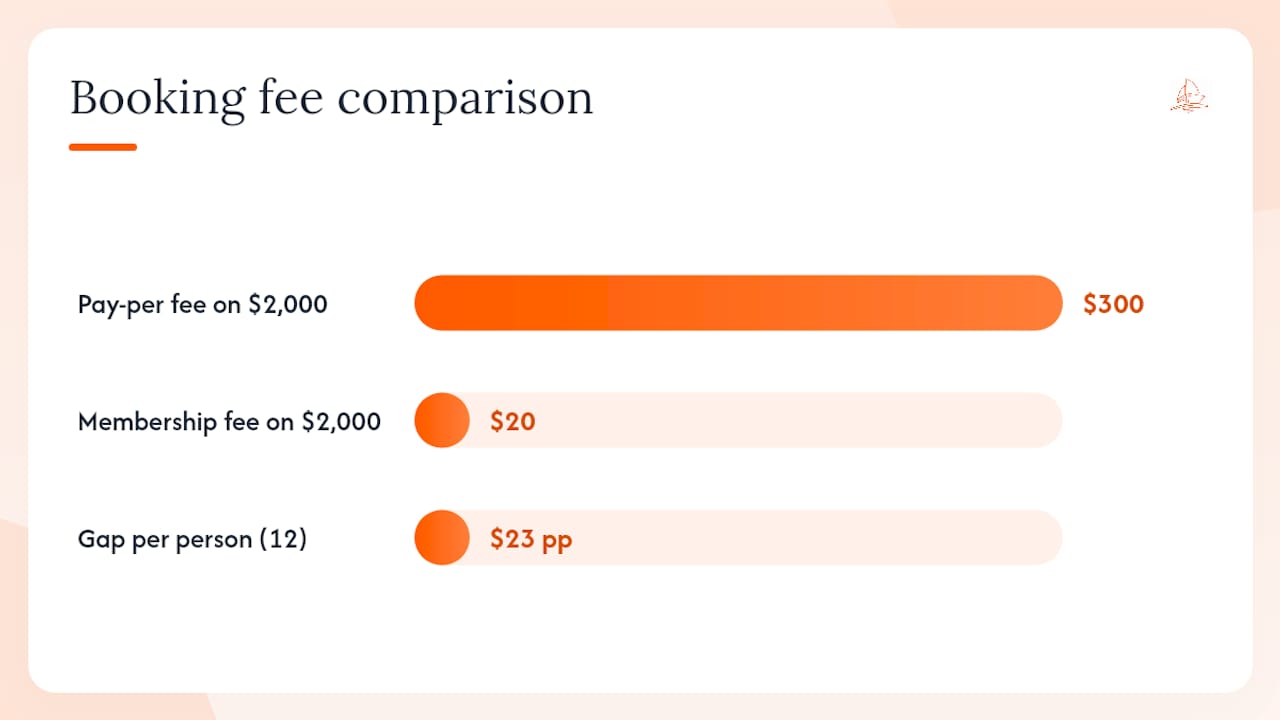
The math is straightforward. On a $2,000 charter, a 15% service fee adds $300. A 1% fee adds $20. Split across 12 people, that gap is $23 per person — enough to cover drinks, fuel, or a gratuity for the captain.
Sailorix's model works exactly this way. The annual membership fee unlocks the reduced service rate on every booking, so groups that charter more than once a year recover the membership cost quickly. For a single large event, the savings on one booking alone often cover the membership.
Real-time availability is the other major advantage. Group coordinators frequently discover that a boat they found last week is gone by the time everyone confirms. Platforms with live inventory let you hold a specific vessel the moment the group commits, rather than discovering a conflict at payment.
Membership vs. pay-per-booking at a glance:
| Feature | Membership model | Pay-per-booking |
|---|---|---|
| Service fee | ~1% (Sailorix members) | 10–20% typical |
| Real-time availability | Yes | Varies |
| Verified listings | Yes | Varies |
| Add-on booking (skipper, gear) | Integrated | Often separate |
| Best for groups | Frequent or large bookings | One-off, small groups |
Beyond fees, group-friendly platforms offer fleet variety: pontoons for calm-water parties, catamarans for offshore stability, and large yachts for corporate events. The ability to book a skipper, early check-in, or provisioning add-ons in the same transaction saves the coordination headache of managing multiple vendors. Clear cancellation terms and insurance options in one place matter too, especially when a group of 20 people has non-refundable travel plans riding on the booking.
What to look for on boat charter websites for groups
Not every charter site is built for groups. Here is what actually matters when you are evaluating platforms for group boat rental services.
Capacity filters and boat types. A site that cannot filter by guest count wastes your time. Look for filters covering pontoons (8–15 guests), party boats (up to 45 guests, as operators like Charleston Party Cat offer), and large yachts or catamarans for events up to 80 guests. Certified capacity, not the photo, is the number that matters legally.
Transparent pricing line items. Base rate is only the start. Confirm whether the listed price includes fuel, cleaning, port/berth fees, captain wages, and taxes. Platforms that bundle these upfront prevent the sticker shock that hits at checkout.
Insurance and trip protection. Some platforms include basic liability coverage; others require you to purchase it separately or through the operator. Know which before you book, and confirm what the damage deposit covers.
Booking controls for groups. Look for deposit rules (typically 25–50% upfront), a written contract template, a clear guest-changes policy, and cancellation terms that specify refund timelines. A platform that cannot produce a written contract is a red flag.
Support quality. Dedicated group support, phone availability, and a named contact for contract questions are worth more than a generic help center when you have 30 people depending on the booking.
Pro Tip: Always ask for the certified passenger capacity in writing, not just what the listing states. Cross-check the captain's USCG license number through the Coast Guard's credential verification system before signing anything.
How pricing works for group charters and how to lower the total cost
Charter pricing has several moving parts. Understanding each one lets you negotiate or substitute intelligently.
Typical fee components:
- Base hire rate (the boat, by the hour or day)
- Fuel (sometimes included, often not)
- Captain/crew wages (at Lake Tahoe operators, for example, captain rates are approximately $175 for a half day and $350 for a full day)
- Cleaning fee
- Service fee (platform charge, 1–20% depending on the platform)
- Taxes and port/berth fees
- Insurance or damage deposit
A quick example. A private party boat charter in Miami starts at roughly $649 for 13–49 guests, while shared cruises run from $49 per person. On a $1,500 private charter with a 15% service fee, the total platform charge is $225. With a Sailorix membership and its ~1% fee, that same booking adds about $15. For 20 people, the difference is roughly $10.50 per person.
Tactics to lower per-person cost:
- Book on weekdays or in shoulder season (spring and fall).
- Split a large group across two smaller boats rather than one oversized vessel; smaller boats often cost less per hour.
- Bring your own food and beverages where the operator permits it (Charleston Party Cat, for instance, is BYOB).
- Use a membership platform for any charter above $1,000 to recover the membership fee in a single booking.
- Confirm whether fuel is included before comparing base rates across operators.
Questions to ask and red flags to watch for when booking for a group
Before you sign anything, get clear answers to these questions:
- What is the certified passenger capacity, and is it documented?
- Does the captain hold a valid USCG Merchant Mariner Credential, and can you provide the credential number?
- What does the cancellation policy cover, and what is the refund timeline?
- Is insurance included, or do I need to purchase it separately?
- What is the damage deposit, and under what conditions is it withheld?
- Can the headcount change after signing, and is there a fee?
- What happens if the operator cancels due to weather or mechanical failure?
Red flags that indicate a risky booking:
- No written contract or a contract that references only verbal agreements
- Payment requested via wire transfer or cash only, with no receipt
- Reviews that cannot be verified or that all appear within a short window
- Vague or missing cancellation terms
- A captain whose license number the operator refuses to provide
- No clear damage deposit policy
For day-of contingency planning: confirm the operator's weather cancellation policy in writing, know the refund process before you board, and have a backup contact at the marina in case of a mechanical issue.
Key Takeaways
The best group charter booking starts with a platform that shows real-time availability, verified listings, and transparent per-line pricing, with a membership model that cuts service fees to roughly 1% for groups spending over $1,000 on a single charter.
| Point | Details |
|---|---|
| Use real-time availability | Platforms with live inventory prevent losing a boat between confirmation and payment. |
| Check all fee components | Base rate, fuel, captain wages, cleaning, and service fees all affect the true per-person cost. |
| Verify USCG credentials | Always confirm the captain's Merchant Mariner Credential number before signing a contract. |
| Book 8+ weeks ahead | Large-capacity boats fill faster than single-seat rentals, especially in peak season. |
| Sailorix membership value | At ~1% service fees vs. the typical 10–20%, a single large group booking often covers the annual membership cost. |
Why a membership marketplace makes sense for group charters
The conventional wisdom in group travel is to go directly to the operator and skip the platform fee entirely. That logic breaks down for groups in two ways. First, direct bookings rarely come with verified reviews, standardized contracts, or integrated insurance options. Second, the time cost of vetting five operators individually, comparing their line-item pricing, and managing separate contracts is real, especially for a group coordinator already managing headcounts and logistics.
A membership marketplace like Sailorix solves both problems. The platform's real-time availability search, verified listings, and add-on management (skipper, equipment, early check-in) handle the coordination layer. The membership fee structure handles the cost layer. For groups, that combination is more valuable than the marginal savings from a direct booking that lacks contract protections.
The group trip planning resources on the Sailorix blog also reflect a genuine understanding of what group coordinators need: activity ideas, logistics frameworks, and capacity planning guidance that most operator pages do not provide.
Sailorix membership: book your group charter for less
Groups that charter boats regularly pay far more than they need to in platform service fees. Sailorix's annual membership (€100/year) drops those fees to roughly 1%, a fraction of what most booking platforms charge. On a single $2,000 group charter, the membership pays for itself.
The process is direct: create a Sailorix account, search by destination, date, and guest capacity, and filter by boat type. Verified listings with real-time availability mean the boat you find is actually bookable. Add a skipper, insurance, or provisioning in the same transaction. For large events, the platform supports multi-boat coordination and provides contract templates that protect the group if plans change.
Pro Tip: If your group has one large event planned this year, join before you book that single charter. The membership fee pays for itself on the service fee savings alone.
Ready to search? Find group charters on Sailorix by capacity and date, and get a clear total cost before you commit.
Useful sources for group charter planning
These resources provide capacity benchmarks, sample pricing, and planning frameworks useful for comparing options before you book.
- Sailorix
- How to Rent a Boat for Events: 2026 Planning Guide
- Group Yacht Trip Ideas for Friends and Families
- Miami Party Boat Rentals & Yacht Charters | Aqua Party Boat
- Lake Tahoe Big Group Boat Rentals, Rent Pontoons & Speedboats
- Charleston Party Boat Cruises | Bachelorette & Events
- Yacht Rental San Diego | Triton Charters
| Operator | Typical capacity | Sample starting price or note |
|---|---|---|
| Aqua Party Boat (Miami) | 13–49 guests | From $649 private; $49/person shared |
| North Lake Tahoe Boat Rental | Varies by vessel | Captain: $175 half day / $350 full day |
| Charleston Party Cat | Up to 45 guests | BYOB; 2-hour charter minimum |
| Triton Charters (San Diego) | Up to 80 guests (events) | Private yacht and ticketed cruise options |
| Sailorix (global) | Varies by listing | ~1% service fee with annual membership |
Use these sources to verify local availability and request quotes. Pricing changes seasonally, so treat any figure here as a starting benchmark and confirm directly with the operator or platform before booking.