
Online payments are what turn a boat reservation from a maybe into a confirmed trip. The role of online payments in boat booking is straightforward: they move money at the moment a traveler commits, which drives conversion, cuts risk, and sets expectations for everything that follows. A large majority of travelers say a seamless digital payment experience matters while traveling, and many have walked away from a purchase entirely because checkout gave them trouble, according to Paysafe's Experience Economy Report. Marketplaces like Sailorix depend on that moment going smoothly, and travelers recognize names like Apple Pay and PayPal because those brands signal a checkout that just works.
Three things happen the instant you pay for a boat online:
- Confirmation. Your reservation locks in instead of sitting in a "pending" inbox.
- Security of funds. The deposit or hold protects the boat owner's schedule and your spot on it.
- Flexibility. Add-ons, insurance, and refunds all route through the same payment rail you already trusted.
Key Takeaways
Online payments determine whether a boat booking converts, how much risk a traveler carries, and how smoothly deposits, add-ons, and refunds get handled.
| Point | Details |
|---|---|
| Payments drive conversion | Many travelers have abandoned a purchase over payment friction, so a smooth checkout directly protects bookings. |
| Expect a staged payment flow | Deposits are due at booking, final balances 30 to 60 days out, with extras and insurance billed separately. |
| Carry a backup payment method | Many travelers plan to use multiple payment methods, which guards against declines and foreign transaction fees. |
| Verify security signals first | Look for tokenization, a visible refund policy, and HTTPS before entering card details. |
| Sailorix keeps fees low | Membership pricing brings service fees to roughly 1%, with staged payments, wallets, and tokenized checkout built in. |
Table of Contents
- Why online payments now shape the boat-booking experience
- What payment flow should you expect when booking a boat?
- Which payment methods work best for booking a boat online?
- How do you know a boat booking checkout is secure?
- A quick checklist before you pay for a boat booking
- How Sailorix handles boat booking payments in practice
- Sources
Why online payments now shape the boat-booking experience
Payment used to be the boring part, a form you filled out after the real decision was made. That's not true anymore. Checkout is now a visible, judged part of the trip itself, not a back office step buried behind the booking calendar.
Many travelers have abandoned a purchase over payment friction, and a large majority call a seamless payment experience important to their trip. Paysafe's research frames this as part of a broader shift: travel spending has become an "experience economy" where convenience at the point of sale carries as much weight as the destination itself, a theme PayPal's own travel research backs up directly.
For someone booking a boat, that shift shows up in three concrete ways:
- Confirmation arrives in seconds instead of after a broker calls you back.
- You stop chasing emails to confirm your deposit actually went through.
- Refund and deposit terms show up before you pay, not after you ask.
Traveler expectations have moved fast enough that mobile wallets and multi-method checkout now influence which platform someone picks in the first place. A boat marketplace that only takes wire transfers looks outdated next to one offering instant booking confirmation the moment a card clears.
What payment flow should you expect when booking a boat?
Most boat bookings follow a staged flow: a deposit at the moment you book, a final balance due before departure, and separate charges for extras. Understanding this sequence in advance keeps you from getting caught off guard by a charge you didn't budget for.
The typical structure breaks down like this:
- A holding deposit due immediately to lock in the boat and dates.
- A final payment due before departure, the timing set by the operator or platform.
- A refundable security deposit authorization, often held rather than charged, released after the trip if there's no damage.
- Separate charges for extras like a skipper, fuel, or equipment rental.
- Optional insurance, usually billed alongside the final balance.
Here's the rough timeline most platforms follow:
- At booking: Deposit charged (commonly 20 to 50% of the total).
- 30 to 60 days before departure: Final balance due.
- Days before checkout: Security deposit authorization placed (not always charged).
- At or near checkout: Add-on charges, such as skipper fees or gear rental, finalized.
This staged approach is common across the industry, and platforms that centralize base rate, extras, and payment on one screen tend to shrink the time it takes to reach confirmation, which matters when you're comparing multiple boats before a trip.
Pro Tip: Before you pay, read the payment schedule line by line and ask support three specific questions: what currency the charge posts in, what the cancellation window looks like, and how many business days a refund takes to land back in your account.
Which payment methods work best for booking a boat online?
There's no single method that wins for every traveler. The right approach for a marketplace is accepting cards, digital wallets, and at least one local or cash-equivalent option, because travelers don't all reach for the same tool at checkout.
Here's how preference tends to split:
- Credit cards remain the default for most bookings, largely for the built-in dispute protections.
- Debit cards appeal to travelers managing a fixed vacation budget.
- Apple Pay and Google Pay are the fastest options on mobile and increasingly the first thing people try.
- PayPal and similar digital wallets work well for travelers who don't want to hand over card details to a marketplace directly.
- eCash and local payment methods matter for international travelers whose home banks don't always play nicely with foreign card networks.
Digital wallet use keeps climbing. A significant share of travelers now use one regularly, and more than half say they feel confident paying with their phone while traveling, per Paysafe's data.
One more thing worth flagging: cross-border card use invites foreign transaction fees and the occasional bank decline triggered by a fraud filter that doesn't recognize a charge from another country. Carry a second method, ideally a different card network or a digital wallet, so one declined transaction doesn't sink your booking window.

How do you know a boat booking checkout is secure?
Security is a deciding factor, not a footnote, in whether travelers trust a marketplace enough to pay. A platform that gets this wrong loses bookings before a boat ever leaves the dock.
Before you enter a card number, check for:
- Tokenization or PCI compliance signals, meaning your card number isn't stored in raw form on the platform's servers.
- A visible refund and dispute policy, not one buried three clicks deep in a terms page.
- HTTPS and standard trust indicators in the browser bar.
- A receipt and booking ID issued immediately after payment, something you can point to if a dispute comes up later.
Tokenization works by swapping your actual card number for a substitute token the payment provider manages, which shrinks how much sensitive data a marketplace has to secure and reduces its PCI-DSS burden, according to Outpayce's guidance from Amadeus. If a charge gets disputed, most card networks give you a defined chargeback window, typically measured in weeks, during which the marketplace and your bank sort out who's responsible. Security perceptions run deep here: Outpayce also found that 76% of travelers won't store payment details with a travel company that's had a public breach, regardless of discount.
Pro Tip: Screenshot your booking confirmation and payment receipt the moment you pay, and save the exact charge amount and date. Contact payments support for anything related to the charge itself; go to the boat owner or host only for questions about the trip.
A quick checklist before you pay for a boat booking
Running through a short pre-check before you hit "pay" cuts your odds of an abandoned booking or a refund headache later.
- Confirm which payment methods the marketplace actually accepts.
- Check what currency the charge will post in and whether foreign transaction fees apply.
- Have a backup payment method ready in case your primary one gets declined.
- Note the exact deposit and final-payment due dates.
- Read the refund policy and any insurance terms before you commit.
- Save your receipt and booking ID somewhere you'll actually find them again.
Pro Tip: Open your mobile wallet app before you start booking and confirm your saved cards haven't expired and are enabled for international or travel use. A stale card is the single most common reason a mobile wallet payment fails at checkout.
How Sailorix handles boat booking payments in practice
Sailorix treats checkout as part of the trip, not a hurdle before it. Confirmation happens fast, membership pricing keeps service fees around 1% instead of the 10 to 20% typical elsewhere, and add-ons show up as clear, separate line items rather than surprise charges.
- A staged deposit and final-payment flow, mirroring the industry-standard timeline.
- Support for cards and digital wallets side by side at checkout.
- Tokenized storage for saved payment methods, so repeat bookings don't mean re-entering card details.
- Transparent receipts and a visible refund policy for every booking.
Members pay roughly 1% in service fees instead of the 10 to 20% common on other marketplaces, with the same staged deposit and final-payment structure travelers already expect.
Readers who want the full membership breakdown can check current pricing transparency directly.
Where boat booking payments go from here
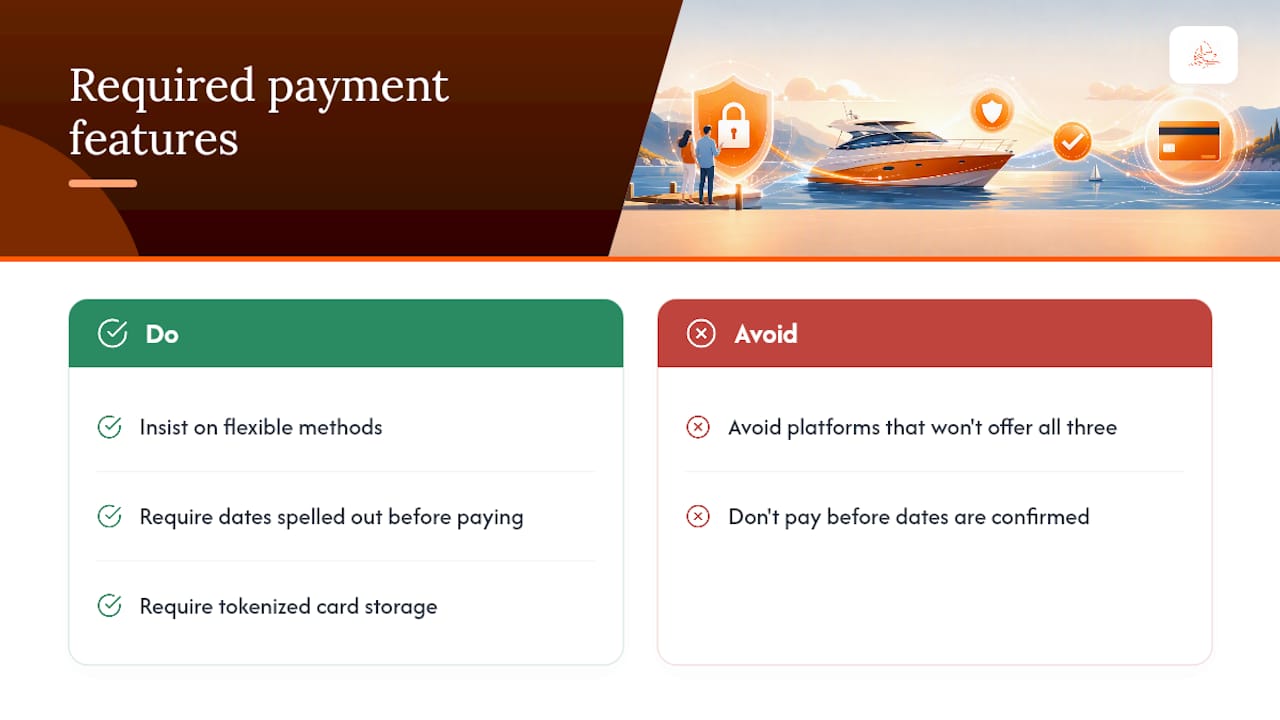
I think payments will keep moving further into the spotlight as the deciding factor in which marketplace travelers trust with a boat trip. Insist on flexible methods, dates spelled out before you pay, and tokenized card storage. A platform that won't offer all three is asking for more trust than it's earned.
What Sailorix does differently at checkout
Most alternatives to Sailorix still run on the old broker-fee model, where service charges of 10 to 20% get buried into the quote you see. Sailorix flips that with a membership structure: pay once a year, then book at roughly 1% in service fees, with the same instant confirmation and staged payment flow covered above.
- Instant confirmation the moment your deposit clears.
- Cards, digital wallets, and stored payment options at checkout.
- Membership-discounted service fees instead of hidden broker markups.
Check current availability and membership pricing on Sailorix before your next booking, and see the fee difference for yourself.
Sources
- The Experience Economy Report 2026 – Summer Travel: Paysafe
- PayPal travel ebook (marketing PDF)
- How can we store travelers’ payment details securely? | Outpayce from Amadeus