
Popular sailing routes are carefully planned passages that combine favorable wind patterns, scenic anchorages, and cultural stops to maximize both safety and enjoyment on the water. The world's most recognized routes, from the Atlantic Rally for Cruisers (ARC) crossing to the Greek Cyclades loop and the British Virgin Islands circuit, each offer a distinct blend of challenge and reward. Whether you're chasing trade winds across an ocean or island-hopping through turquoise shallows, knowing which routes suit your skill level and schedule makes all the difference. This guide covers the top sailing trips worldwide for 2026, with expert tips to help you plan smarter.
1. What are the most popular sailing routes in the world?
The ARC (Atlantic Rally for Cruisers) is the world's most famous ocean sailing event. Organized by the World Cruising Club, it runs annually from Las Palmas in the Canary Islands to Saint Lucia in the Caribbean. Over 450 yachts and 1,600 sailors from 45 countries join each year. That scale makes it the single best introduction to offshore ocean sailing for anyone ready to step beyond coastal waters.
Beyond the ARC, several other routes define global sailing culture:
- World ARC circumnavigation: A full lap of the globe organized by World Cruising Club, covering roughly 26,000 nautical miles across two years with structured stops and local knowledge support at every port.
- The Clipper Route: A westbound circumnavigation following the Southern Ocean's roaring forties, used historically by clipper ships and now by offshore racing events like the Clipper Round the World Race.
- The Magellan Route: A historic eastbound circumnavigation that passes Cape Horn, demanding advanced seamanship and serious offshore preparation.
- Hawaii to Tahiti Pacific crossing: A 2,100-nautical-mile passage through Polynesian waters. The 1976 Hōkūleʻa voyage completed this route using only star navigation, proving that indigenous Polynesian sailing knowledge rivals any modern chart plotter.
- Atlantic homeward leg via Saint Helena: The return passage from the Caribbean to Europe, typically stopping at the remote island of Saint Helena before catching the Azores High northward to Portugal or the UK.
Each of these famous sailing itineraries requires a different level of preparation, but all reward sailors with experiences that coastal sailing simply cannot match.
2. What are the most scenic island circuits for week-long trips?
Week-long sailing vacations work best on circuits with short daily passages, reliable anchorages, and strong cultural appeal. The Mediterranean and Caribbean both deliver this, but in very different ways.
Greek Cyclades loop
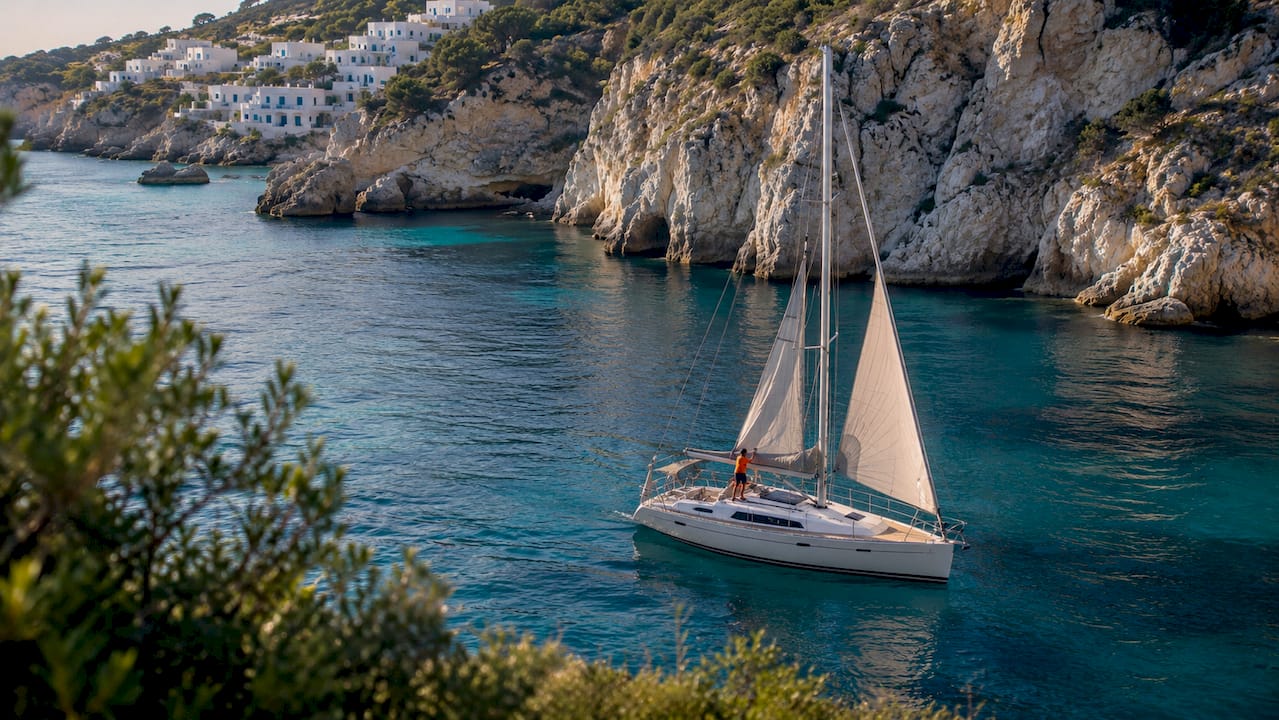
The Cyclades loop is the definitive Aegean sailing circuit. Starting from Athens (Piraeus or Lavrion), sailors typically visit Kea, Paros, Naxos, Santorini, and Mykonos before returning north. Clockwise direction is the standard choice because it keeps the Meltemi wind on a favorable angle for most legs. The Santorini to Mykonos leg alone delivers some of the most iconic sights in sailing without requiring long offshore passages.
Ionian Islands circuit
The Ionian Islands sit on Greece's western coast and lack the strong Meltemi winds that challenge Aegean sailors. Conditions are gentler, anchorages are well-protected, and the scenery, from Corfu to Kefalonia to Ithaca, is outstanding. This makes the Ionian one of the top sailing routes for beginners and families.
Croatian Adriatic
Croatia's Dalmatian coast is one of Europe's most popular yacht routes. Croatian routes typically cover 110–180 nautical miles in a week, with stops at islands like Hvar, Vis, Korčula, and Brač. The combination of clear water, medieval towns, and reliable summer winds makes this a perennial favorite. For logistics on boat rental in the region, Sailorix's guide to renting boats abroad covers the key steps.
British Virgin Islands
The British Virgin Islands holds the title of Sailing Capital of the World. With over 60 islands and cays, short inter-island passages, and sheltered anchorages at spots like The Bight on Norman Island and the Bitter End on Virgin Gorda, the BVI is the easiest place on earth to build confidence as a sailor. Most passages run under 10 nautical miles, so even a half-day of sailing leaves plenty of time to snorkel and explore.
- Start at Road Town, Tortola for provisioning and check-in.
- Sail south to Norman Island for snorkeling at The Caves.
- Head east to Virgin Gorda and the famous Baths rock formation.
- Loop back via Jost Van Dyke for the legendary Soggy Dollar Bar.
- Return to Tortola with a stop at Marina Cay.
Pro Tip: Book BVI charters at least four months in advance for the december through april peak season. Availability drops fast and prices climb sharply after october.
3. How do wind conditions shape the best sailing routes?
Wind is the single most important factor in route planning. The trade winds that power the ARC crossing blow consistently from the northeast between november and february, giving sailors a fast, comfortable downwind run from the Canary Islands to the Caribbean. Experienced sailors avoid northbound early-season Atlantic returns against these same trade winds because the upwind slog is exhausting and slow.
In the Aegean, the Meltemi is the dominant summer wind. It blows from the north or northwest at 15–30 knots from july through september. Sailing clockwise around the Cyclades keeps this wind at your back on the longer legs and reduces the pounding on shorter crossings. Ignoring wind direction on this circuit turns a pleasant vacation into a wet, uncomfortable beat.
"The Grenadines look like paradise on a chart. On the water, winds over 20 knots and Atlantic swells demand real seamanship. Flexible plans are not optional here. They are the difference between a great trip and a dangerous one." — Yachting World
Wind shadows near volcanic islands add another layer of complexity. Near the Pitons in St. Lucia or the peaks of St. Vincent, wind speeds can fluctuate dramatically within a short distance. A sailor might go from 25 knots of breeze to near calm in under a mile. Adjusting your planned stop from Mustique to Bequia, for example, is a common and sensible call when conditions shift.
Pro Tip: Download Windy or PredictWind before any passage. Cross-reference both apps with the local VHF weather forecast every morning. Conditions in island chains change faster than offshore models predict.
4. How to choose the right sailing route for your skill level
Matching a route to your experience is the most practical decision in sailing trip planning. A beginner who books a Grenadines circuit without offshore experience will spend more time stressed than relaxed. The right route feels challenging enough to be memorable but not so demanding that safety becomes a concern.
| Route | Skill Level | Typical Duration | Key Challenge |
|---|---|---|---|
| Ionian Islands, Greece | Beginner | 7–10 days | Light winds in summer |
| British Virgin Islands | Beginner | 7–14 days | Boat traffic near marinas |
| Croatian Adriatic | Intermediate | 7–14 days | Bora wind in winter |
| Greek Cyclades | Intermediate | 10–14 days | Meltemi strength and frequency |
| St. Vincent and the Grenadines | Advanced | 10–14 days | Atlantic swells, wind shadows |
| ARC Atlantic crossing | Advanced | 18–25 days | Ocean passage, self-sufficiency |
| World ARC circumnavigation | Expert | 15–24 months | All ocean conditions |
Key factors to weigh before booking:
- Passage length: Beginners do best with legs under 20 nautical miles. Advanced sailors can handle 100+ nautical mile overnight passages.
- Weather windows: Routes like the Cyclades and Grenadines have defined seasons. Sailing outside those windows increases risk significantly.
- Rally participation: Joining the ARC through World Cruising Club gives first-time ocean sailors structured routes and safety in numbers during long passages. The community support alone is worth the entry fee.
- Budget: Charter costs vary widely by region. The affordable yachting destinations guide from Sailorix breaks down cost-effective options across the Mediterranean and Caribbean.
For a broader look at where to sail worldwide, the Sailorix global sailing destinations guide covers regions from Southeast Asia to Scandinavia with practical detail.
Key takeaways
The most rewarding sailing routes match wind patterns, passage distances, and skill level to deliver both safety and genuine adventure.
| Point | Details |
|---|---|
| Match route to skill level | Beginners thrive in the BVI and Ionian; advanced sailors belong in the Grenadines or on ocean crossings. |
| Wind direction drives route choice | Sailing clockwise in the Cyclades and timing ARC crossings with trade winds reduces effort and risk. |
| Flexibility is non-negotiable | Changing stops due to wind shadows or swell, as in the Grenadines, is smart sailing, not failure. |
| Rallies accelerate learning | Joining ARC with World Cruising Club gives new offshore sailors structure, safety, and community. |
| Week-long routes are highly accessible | Croatian and BVI circuits cover 110–180 nautical miles, making them realistic for most vacation schedules. |
What years of watching sailors choose routes has taught me
Most sailors overestimate how much ground they need to cover. The best sailing trips I have seen are the ones where the crew slows down, picks fewer stops, and actually swims off the boat at anchor. The Ionian Islands circuit is a perfect example. Sailors who rush it to hit eight islands in seven days miss the point entirely. The ones who linger at Ithaca for two nights and sail gently to Kefalonia come back transformed.
The ARC is genuinely special, but not for the reasons most people think. Yes, the trade wind crossing is exhilarating. The real value is the community. Arriving in Saint Lucia alongside 450 other yachts, sharing stories at the dock, and realizing that ocean sailing is within reach for ordinary people with solid preparation. That changes how sailors think about what is possible.
The Grenadines deserve more respect than they get in glossy sailing magazines. They are not a beginner destination dressed up in turquoise water photos. The Atlantic swell wraps around those islands in ways that demand real boat handling. Sailors who go prepared come back with the best stories. Sailors who go underprepared come back early.
My honest advice: pick one region, learn it deeply, and resist the urge to cram in too many destinations. The sailors who do this consistently have better trips than the ones chasing a checklist.
— Sailorix
Plan your next sailing trip with Sailorix
Sailorix makes yacht charter booking straightforward and affordable. The annual membership costs €100 and unlocks access to yacht rentals worldwide with service fees of approximately 1%, compared to the 10–20% charged by most charter platforms. That difference adds up fast on a two-week Mediterranean or Caribbean charter.

Whether you are planning a first Ionian Islands circuit or a full ARC crossing, Sailorix connects you to real-time availability across hundreds of destinations. The platform covers provisioning logistics, route planning resources, and transparent pricing with no hidden fees. Visit Sailorix to browse available yachts and lock in your 2026 sailing itinerary before peak season inventory disappears.
FAQ
What is the most popular sailing route for beginners?
The British Virgin Islands is the most accessible sailing route for beginners. With over 60 islands, short passages, and sheltered anchorages, it builds confidence without demanding offshore skills.
When is the best time to sail the ARC?
The ARC departs Las Palmas in late november to catch the northeast trade winds at their most consistent. Arriving in Saint Lucia typically takes 18–25 days depending on boat speed and conditions.
How long does a typical Mediterranean sailing vacation take?
Most Mediterranean sailing itineraries run 7–14 days. Croatian routes cover 110–180 nautical miles in a week, which allows four to six island stops at a comfortable pace.
What makes the Grenadines challenging for sailors?
Winds over 20 knots and Atlantic swells make the Grenadines demanding. Wind shadows near volcanic peaks also create unpredictable conditions that require flexible itinerary planning.
Do I need to join a rally to sail across the Atlantic?
No, but joining the ARC through World Cruising Club is strongly recommended for first-time ocean sailors. The rally provides structured routing, weather support, and the safety of sailing alongside hundreds of other experienced crews.