

A bareboat or skippered catamaran typically lists between $2,000 and $15,000 per week as a base fee. Crewed motor yachts run $15,000 to $100,000. Superyachts start around $50,000 and climb into the millions. None of those numbers are what you'll actually pay.
- Bareboat/skippered sailing yachts and catamarans: roughly $2,000 to $15,000 per week
- Crewed motor yachts: roughly $15,000 to $100,000 per week
- Superyachts: $50,000 and up, sometimes into seven figures
Destination, season, and how hard you push the itinerary decide where you fall in that range.
Key Takeaways
Yacht charter prices depend far less on the sticker price than on the APA, gratuity, and fee structure layered on top of it.
| Point | Details |
|---|---|
| Base fee isn't the total | Add 25% to 55% on top for APA, gratuity, fuel, and marina fees to reach the real cost. |
| APA runs 25% to 35% | This deposit covers fuel, food, and dockage; unused amounts are refunded after the trip. |
| Gratuity runs 10% to 20% | Calculated on the base fee and paid separately from APA, usually at charter's end. |
| Vessel size drives cost nonlinearly | A 50-meter yacht can list $50,000 to $110,000 weekly; a 90-meter yacht can exceed $1.5 million. |
| Sailorix membership cuts service fees | A $100 annual membership drops booking fees to roughly 1%, versus the industry's typical 10% to 20%. |
Table of Contents
- How Charter Type Changes Your Yacht Charter Prices
- What Do Different Yacht Sizes Cost Per Week?
- What's Included in Your Base Fee, and What Costs Extra?
- How Much Do Destination and Season Change the Price?
- A Worked Example: Turning a Base Fee Into a Real Total
- How Can You Reduce Your Yacht Charter Costs?
- Why Membership Pricing Changes Your Charter Math
- What Do Water Toys, Chefs, and Excursions Add to Your Bill?
- A Note From Sailorix on Comparing Total Cost
- Compare Real Costs With Sailorix Membership Pricing
- Sources
How Charter Type Changes Your Yacht Charter Prices
The biggest lever in yacht charter prices isn't the boat. It's who's driving, who's cooking, and who's paying for the diesel.
Bareboat charters put you at the helm with no crew aboard, and the base fee reflects that: you're renting the vessel, full stop. You cover fuel, provisioning, marina fees, and insurance yourself, which keeps the sticker price low but shifts real work onto you. This model only works if someone on board holds real sailing credentials.
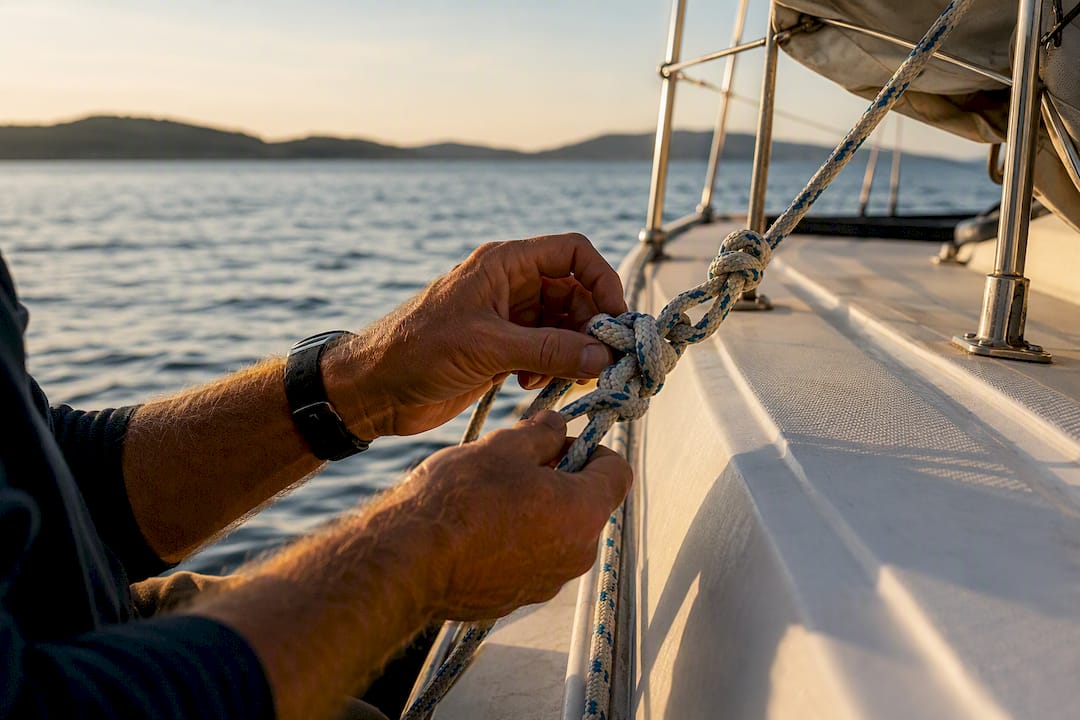
Skippered charters add a professional skipper to a bareboat setup. You still handle provisioning and fuel, but you're not responsible for navigation or docking, which matters in unfamiliar waters like the Aegean or the British Virgin Islands.
Cabin charters (sometimes called cabin-by-cabin) let you book a single cabin on a shared crewed yacht rather than the whole boat, splitting costs across strangers who become your temporary shipmates. It's the closest thing yacht charter prices have to an entry point for solo travelers or couples who don't need six cabins.
Crewed or all-inclusive charters bundle a captain, chef, and deckhands into the base price, and in some Caribbean markets, operators fold fuel, food, and drinks into one flat number too. The Mediterranean tends to favor the opposite: a lower headline rate, then APA and expenses billed separately. That regional split explains a lot of the sticker shock first-time charterers report when comparing quotes across regions.
Pro Tip: Ask upfront whether a quoted rate is "all-inclusive" or "plus expenses." Those two words change your total by tens of thousands of dollars on the same boat.
What Do Different Yacht Sizes Cost Per Week?
Vessel size doesn't move yacht rental costs on a straight line. It moves them on a curve, and that curve gets steep fast once you cross into crewed territory.
A 35 to 45 foot bareboat sailing yacht typically lists $2,000 to $6,000 per week. Step up to a 40 to 50 foot catamaran, and weekly base fees commonly land between $3,500 and $18,000, depending on age, layout, and cabin count. Crewed motor yachts in the 50 to 70 foot range generally run $15,000 to $60,000 weekly once you're paying for a captain, chef, and full service. Cross into superyacht territory, 80 feet and up, and a 50-meter vessel can list $50,000 to $110,000 per week, while anything approaching 90 meters can reach $1.5 million to $2 million weekly.
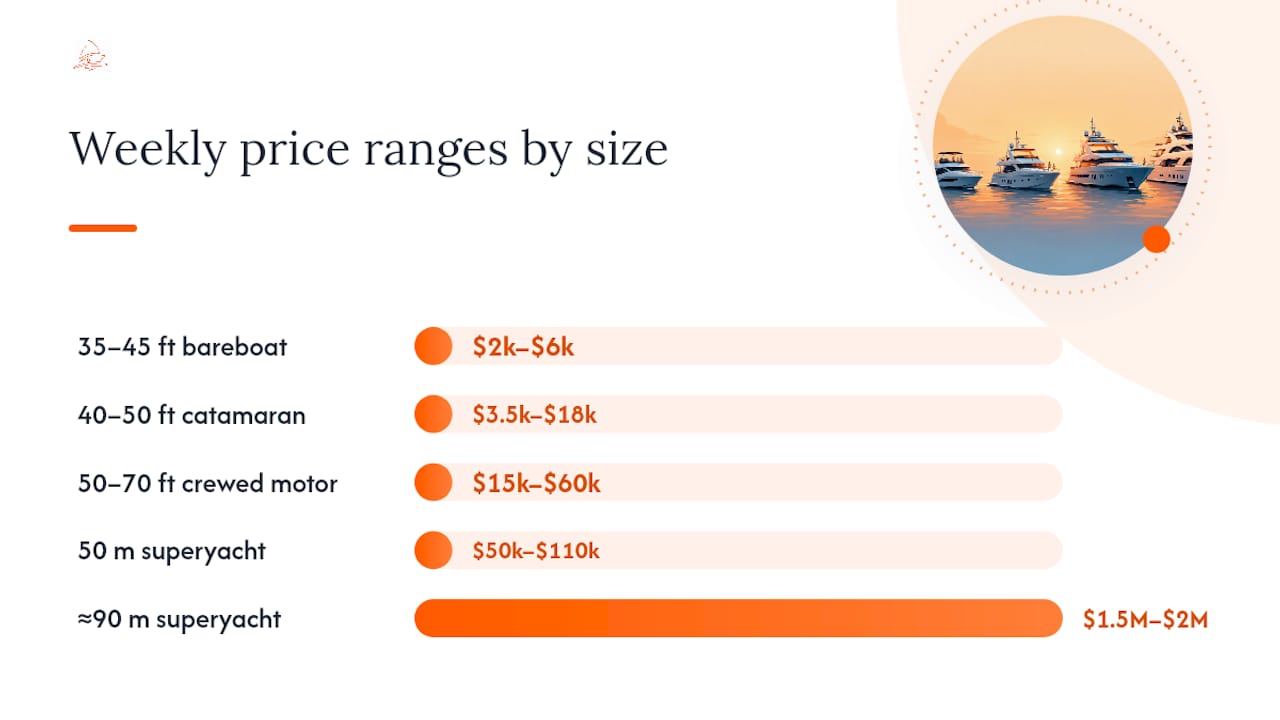
Why the acceleration? Larger yachts carry bigger crews on fixed payroll, burn more fuel per mile, and their owners need to recover a far larger capital investment through charter revenue. A 30 percent size increase can translate to a 60 or 70 percent price jump once you cross a crew-count threshold.
Per-person math changes the picture entirely:
- A group of 4 splitting a $6,000 catamaran week pays roughly $1,500 each, before extras.
- A group of 8 on a $16,000 crewed yacht lands near $2,000 per person.
- A group of 12 on a $30,000 superyacht-adjacent vessel still averages around $2,500 per person, proof that bigger boats often deliver better per-head value than solo sailors assume.
What's Included in Your Base Fee, and What Costs Extra?
The base fee gets you the boat. Almost everything else arrives as a separate line item, and this is where most yacht charter prices quietly double.
- APA (Advance Provisioning Allowance). This runs 25% to 35% of the base fee and covers fuel, food, drinks, dockage, and other running costs incurred during your trip. You pay it upfront as a deposit against actual spend; unused APA is refunded, and overspend gets billed after you disembark. Always ask the broker for an itemized APA statement from a past charter, not just a percentage.
- Crew gratuity. Industry norms sit at 10% to 20% of the base fee, paid in cash or wire at the end of the charter, and calculated on the base fee, not the all-in total.
- Fuel. Motor yachts burn far more than sailing yachts, and a heavy itinerary with long transits can add thousands to your APA draw.
- Marina and port fees. Berthing in high-demand harbors like Monaco or Saint Tropez costs considerably more than anchoring out most nights.
- Provisioning. Groceries, wine, and any special dietary requests get billed through APA and vary widely by region and preference.
- Taxes and VAT. Mediterranean charters often carry VAT on top of the base fee, a cost bareboat charterers in some Caribbean jurisdictions may not face at all.
- Insurance. Some brokers include damage waiver coverage in the base price; others charge it separately, so confirm before signing.
| Cost Component | Typical Range |
|---|---|
| APA | 25% to 35% of base fee |
| Crew gratuity | 10% to 20% of base fee |
| Fuel | Varies by vessel type and itinerary length |
| Marina/port fees | Varies by destination and season |
| VAT/taxes | Region-dependent, common in the Mediterranean |
Get every one of these confirmed in writing before you wire a deposit. The payment schedule a broker sends you should spell out exactly when APA is due and how refunds are processed.
How Much Do Destination and Season Change the Price?
Where and when you sail moves your total almost as much as the boat itself.
High season in the Mediterranean, July and August, pushes both base fees and expenses upward, and Mediterranean charters generally run a 50% to 55% all-in uplift over the base fee once VAT and marina costs are factored in. The Caribbean's high season sits over the winter holidays, but its all-in uplift tends to run lower, closer to 42% to 48%, partly because fewer jurisdictions charge charter VAT.
Booking shoulder season, May/June or September in the Mediterranean, can shave both the base rate and the crowds without sacrificing warm water.
- Ports like Monaco or Portofino carry premium berthing fees that anchor-out itineraries in quieter bays simply avoid.
- Destinations with private shore experiences, like a curated Comino anchorage stop in Malta, add real cost but also real memory value.
- A busy itinerary with daily transits burns more fuel and drains APA faster than a relaxed, anchor-heavy week in one region.
A Worked Example: Turning a Base Fee Into a Real Total
Here's the formula, then the math behind it:
Total = Base fee + (Base fee × APA%) + (Base fee × Gratuity%) + fixed extras
Take a $12,000 weekly catamaran charter for 8 guests, split with a Mediterranean-style plus-expenses model:
- Heavier itinerary scenario: more marinas, longer transits, and a full-service crew push APA toward 35% and gratuity toward 18%, landing your total closer to $19,500, or about $2,438 per person.
- Lighter itinerary scenario: mostly anchoring out, minimal fuel burn, and a 25% APA with a 10% tip brings the total down to roughly $16,650, or about $2,081 per person.
The spread between those two scenarios, nearly $3,000 on the same boat, comes entirely from how you sail it, not what you booked.
How Can You Reduce Your Yacht Charter Costs?
Every dollar you save comes from the same handful of levers, and most charterers only pull one or two of them.
- Shift to shoulder season. Late spring or early fall in the Mediterranean cuts both base fees and the crowd at popular anchorages.
- Favor anchor-out nights over marina stays. Limiting marina dockage is one of the highest-impact ways to shrink both APA draw and fixed fees.
- Choose a catamaran or skippered option over a fully crewed motor yacht if per-person value matters more than onboard service.
- Negotiate APA transparency before booking. Ask for a real itemized APA report from a comparable past charter, not a vague percentage.
- Compare service fee structures across booking platforms, since some brokers charge markups well above the boat's actual list price.
Pro Tip: Before you wire a deposit, get the fuel policy, APA inclusions, refund mechanics, and cancellation terms in writing. Verbal assurances mean nothing once you're mid-charter.
Why Membership Pricing Changes Your Charter Math
If you want the mechanics of APA and gratuity spelled out in more detail, the payment schedule breakdown and charter fee explainer cover exactly how deposits, refunds, and provisioning allowances get handled before you sign anything. For finding better rates directly, the budget charter guide walks through timing and negotiation tactics that stack on top of the membership savings.
What Do Water Toys, Chefs, and Excursions Add to Your Bill?
Optional extras don't show up on the headline price, but they're where a lot of charterers overspend without realizing it.
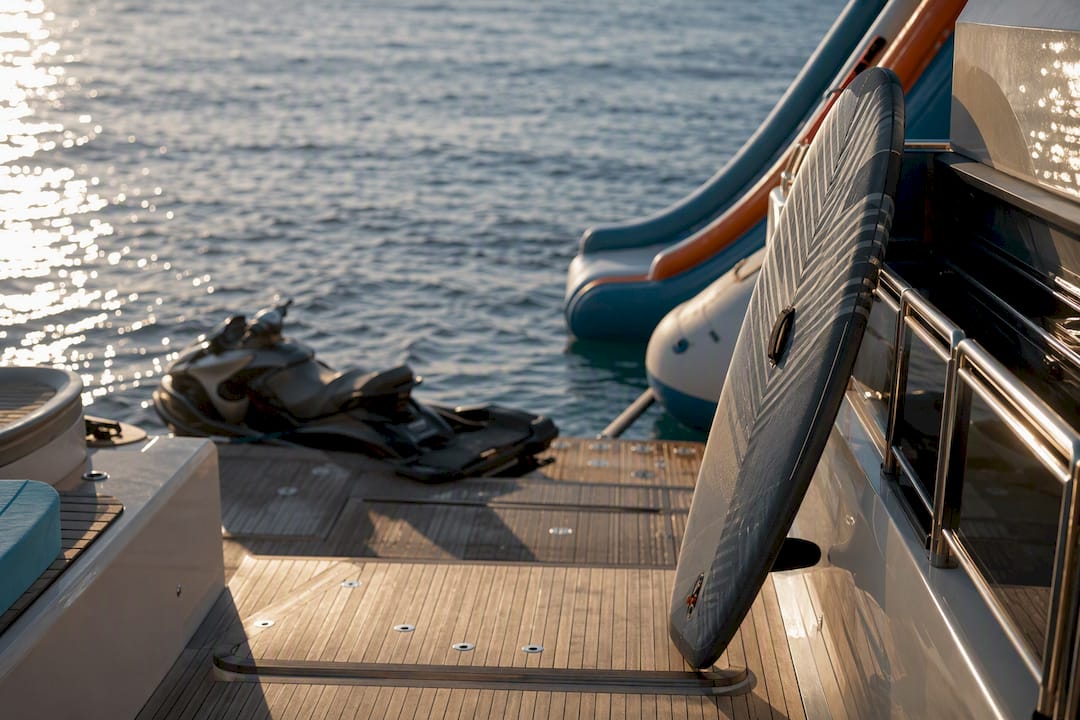
Water toys like jet skis, paddleboards, and inflatable slides sometimes come standard on larger crewed yachts, but on smaller vessels they're often a separate rental, ranging from a couple hundred dollars for paddleboards to several thousand for a jet ski package for the week.
Onboard chefs are usually included on fully crewed charters, but if you're on a bareboat or skippered trip and want a private chef added, expect a meaningful daily add-on, often scaling with the complexity of the menu and number of guests.
Shore excursions vary the most. A guided snorkeling trip might run a modest per-person fee, while a private dinner arranged on land, like the kind of curated evening you'll find through Malta's private shore experiences, can add hundreds of dollars per guest depending on the setting and menu.
None of these are optional in the sense of "skip them and save." Most charterers build at least one or two into the week, and the smart move is pricing them into your APA estimate before you sail, not after the credit card statement arrives.
A Note From Sailorix on Comparing Total Cost
We built Sailorix because too many charterers compare base fees and call it a decision, then get blindsided by APA, gratuity, and marina bills that weren't part of the conversation. That's not a pricing problem. It's a transparency problem.
Before you book anything, ask for the all-in number, not the headline rate. Compare what you'll actually pay, not what looks good in a listing.
— SAILORIX
Compare Real Costs With Sailorix Membership Pricing

That difference compounds every time you charter, which matters if you're planning more than one trip a year or comparing quotes across several boats before committing. Real-time availability search lets you filter by destination and vessel type, so you can weigh a Mediterranean crewed week against a Caribbean catamaran without opening five different broker sites. Check current listings and compare sample itineraries to see what your specific trip would run under membership pricing before you book anywhere else.
Sources
- Yacht Charter Costs & Booking Guide (2026) | Noblexperience
- Yacht Charter Cost by Size: $50K to $2M a Week | YachtsForKings
- Yacht Charter Cost Guide | YATCO