
That's the short version. The details matter more, because a payment schedule that looks simple on paper can trip up first-time charterers who don't know what's included in each installment.
Two things to watch before you sign anything:
- The core payment stack: base charter fee (deposit plus balance), APA, taxes or VAT, crew gratuities, and any broker or platform service fees layered on top.
- The contract that governs it all: most professional brokers use the MYBA charter agreement or a close variant, which standardizes deposit percentages, balance deadlines, and cancellation penalties.
If you'd rather skip the spreadsheet math and shop transparent pricing directly, platforms like Sailorix show real-time availability and fees up front. This matters a lot once you understand how many separate line items are actually involved in a single charter.
Key Takeaways
| Point | Details |
|---|---|
| Deposit range | Expect 30% to 50% of the charter fee due at signing, depending on the broker and booking lead time. |
| Final balance window | The remaining balance, plus APA and taxes, is typically due 4 to 8 weeks before embarkation. |
| APA is separate | Budget 25% to 35% of the charter fee for the APA, wired 1 to 2 weeks before boarding, reconciled after the trip. |
| Gratuity norm | Crew gratuities run 10% to 20% of the base fee, paid separately at disembarkation, not through the APA. |
| Confirm the contract's payment clause | Check deposit percentage, balance deadline, APA timing, and cancellation penalties before signing. |
| Sailorix membership lowers fees | An annual membership drops per-booking service fees to roughly 1%, without altering APA or balance deadlines set by the charter contract. |
Where to Read More on Charter Contracts and Payment Terms
- The MYBA contract standard is the best starting point for understanding how deposit, balance, and cancellation terms are typically structured.
- Balthazar Yachting's charter toolkit breaks down APA and gratuity mechanics in more depth than most broker sites offer.
- Myst Yacht Charters' payment terms page is a useful real-world example of how a working broker structures deposit and balance requirements.
- One80 Travel Protect is worth reviewing before you book if you want to understand what cancellation insurance actually covers.
- For currency and exchange-rate risk specific to charter payments, this piece on yacht operational costs explains how quoted rates can shift before a wire clears.
Table of Contents
- What Does a Typical Yacht Charter Payment Schedule Look Like?
- What Does Each Payment Actually Cover?
- Which Payment Methods Do Yacht Charters Accept?
- What Happens If You Cancel or Miss a Payment?
- What Should You Check in the Charter Contract's Payment Clause?
- Are There Payment Plans or Membership Options That Change the Math?
- How Sailorix Simplifies Charter Payment Timing
- Frequently Asked Questions
- Sources
What Does a Typical Yacht Charter Payment Schedule Look Like?
The exact numbers shift depending on how far out you're booking, but three patterns show up again and again across brokers and operators.
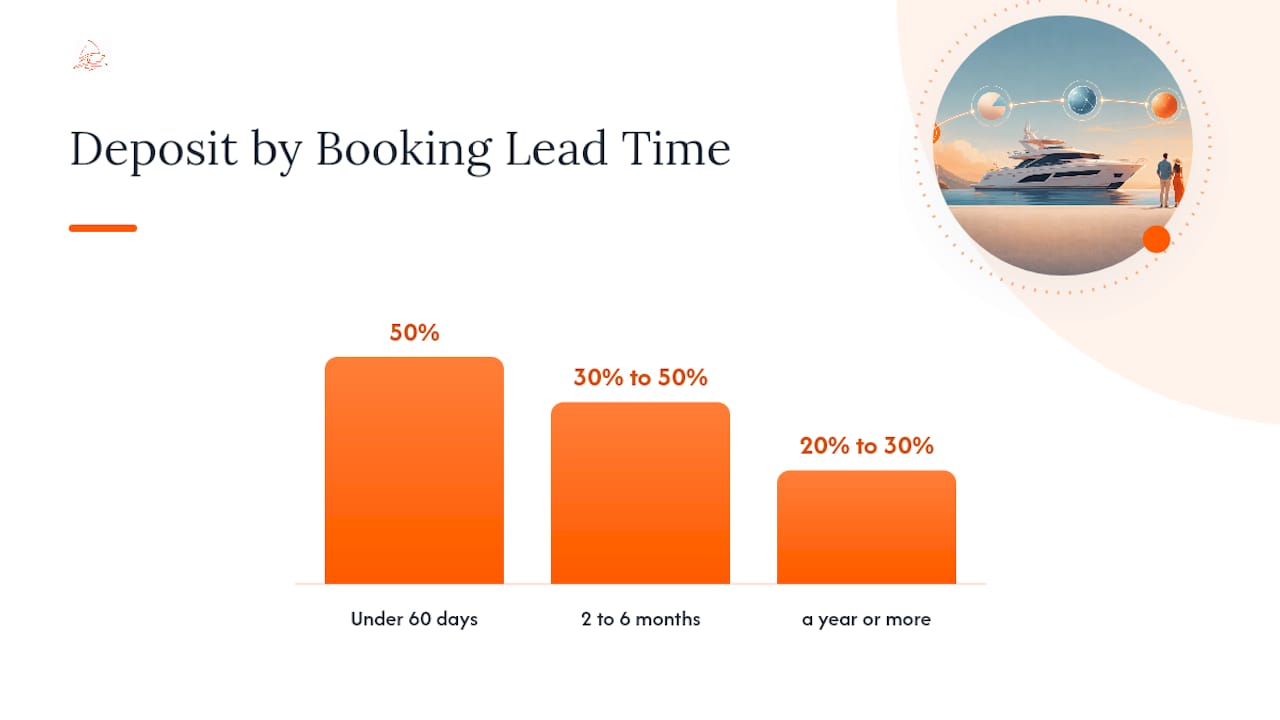
- Short-lead booking (inside 60 days). Expect to pay in full, or close to it, at signing. Some operators will still split it as 50% deposit and 50% due within a week or two, but the closer you get to departure, the less room there is for staged payments.
- Standard booking (2 to 6 months out). This is the classic 50/50 structure: 50% deposit on signing, with the remaining 50%, plus APA and applicable taxes, due 60 days before departure. Some brokers who follow the MYBA structure instead ask for 30% to 50% at signing with the balance due 4 to 8 weeks out, so always check which window your specific contract uses.
- Long-range booking (a year or more out). Some operators will approve a layaway-style plan: 20% to 30% at signing, one or two intermediate installments spaced a few months apart, and a final payment 30 to 60 days before boarding. These staged plans are broker-specific and need explicit language in the contract, not just a verbal agreement.
Day charters run on a different clock entirely. Because they're single-day bookings with no overnight logistics, most operators want full payment at the time of booking or, at minimum, on the day of the charter itself. There's rarely a deposit-and-balance structure at all.
| Booking Lead Time | Deposit | Intermediate Payment | Final Balance Due | APA Timing |
|---|---|---|---|---|
| Under 60 days | 50% | Rare | At signing or shortly after | With final balance |
| 2 to 6 months | 30% to 50% | None typical | 4 to 8 weeks before embarkation | 1 to 2 weeks before boarding |
| a year or more | 20% to 30% | 1 to 2 staged payments | 30 to 60 days before embarkation | 1 to 2 weeks before boarding |
Pro Tip: If you want a staged or layaway-style plan, ask your broker in writing before you sign anything, not after. Most operators will only approve split payments for long-lead bookings, and they'll usually want the request documented as an addendum to the contract rather than a side conversation.
For general strategy on timing your booking to get better rates in the first place, budget charter timing plays into this just as much as the payment structure does.
What Does Each Payment Actually Cover?
The base charter fee pays for the yacht, the crew, and standard equipment. It does not cover fuel, food, dockage, or the little extras that come up every single day on the water. That's what the APA exists for.

The Advance Provisioning Allowance typically runs 25% to 35% of the charter fee, and it functions like an operating account the captain draws from throughout the trip. On high-fuel routes or during peak weeks, that percentage can climb toward 40% to 50%, since provisioning-heavy itineraries burn through fuel and supplies faster than a relaxed coastal cruise.
Here's a rough example. Say you're chartering a yacht for $60,000 for the week. At the end of the charter, the captain provides a full accounting of what was spent from the APA, and any unused balance gets refunded to you.
What typically comes out of the APA:
- Fuel for the yacht and tenders
- Food and beverage provisioning
- Port, marina, and harbor fees
- Special requests like a chef's tasting menu or extra water toys rental
What does NOT come from the APA:
- Crew gratuities
- Marina fines or damage charges tied to guest conduct
- The base charter fee itself, which you've already paid separately
If you want a deeper breakdown of how the charter fee itself is structured before APA and taxes get layered on, this explainer on charter fees walks through it line by line. For a real-world budget example on a specific yacht type, catamaran charter costs show how these percentages play out on an actual weekly rate.
Which Payment Methods Do Yacht Charters Accept?
Bank wire is the default for nearly every charter payment, and for good reason: it's the method operators trust most for large sums, and it's often the only option once you're inside the final 30 to 60 days before departure. Credit cards frequently come with caps or convenience fees, and some operators won't accept them at all for the final balance.
Common methods you'll encounter:
- Bank wire (international or SEPA): the standard for deposits and final balances, especially for larger charter fees.
- ACH transfer: sometimes available for domestic US bookings, though slower than wire.
- Credit card: usable for smaller amounts or deposits, often with a surcharge of 2% to 4%.
- Online payment portals: some brokers and platforms process payments through their own booking systems, which can simplify tracking for split payments among a group.
Currency adds another layer of risk that a lot of first-time charterers overlook. If your charter is priced in euros and you're paying from a USD account, the exchange rate on the day you're quoted may not hold by the time your wire actually clears. Exchange-rate volatility between quote and payment can leave a gap that the operator will expect you to cover, particularly on Euro-denominated charters where rates moved unfavorably in the days between quote and transfer.
Pro Tip: Ask whoever issues your quote for the exchange rate's expiry date in writing. If your wire won't clear before that expiry, request a rate lock or a fresh quote rather than assuming the original number still applies. A few days' delay on a $50,000 wire can swing the balance by hundreds of dollars.
For international wires, have this ready before you initiate the transfer:
- Full beneficiary name and account details
- IBAN and SWIFT/BIC codes
- The exact reference string specified in your contract (missing this can delay reconciliation by days)
What Happens If You Cancel or Miss a Payment?
Cancellation penalties escalate as embarkation gets closer, and they're tied directly to the payment schedule you agreed to. Miss a deadline or cancel late, and you're not just losing convenience. You're losing money that's already gone out the door.
Most contracts treat the initial deposit as non-refundable once it's paid, regardless of when you cancel. Cancel inside the final balance window (typically 30 to 60 days before departure), and you can expect to forfeit the full balance too, not just the deposit.
Missed payments carry their own consequences. Contracts generally include a short cure period, often 5 to 10 business days, during which you can still make the payment before the operator treats it as a default. Miss that window, and the yacht typically goes back on the market, with your deposit forfeited under the same terms as a cancellation.
This is exactly why travel cancellation and interruption insurance gets recommended so often in the charter world. These policies protect deposits and balances against a wide range of cancellation scenarios, from medical emergencies to weather disruptions, and the cost is small relative to what you'd lose forfeiting a five-figure deposit.
At disembarkation, the captain closes out the APA account and refunds whatever wasn't spent, usually within a few days of the trip ending. If you dispute the accounting, most contracts give you a short window, often 48 to 72 hours, to raise questions before the reconciliation is considered final. Currency swings and provisioning estimates are the two most common sources of disagreement at this stage, since both involve numbers that shift after the quote is issued.
Guests who want more detail on their rights around disputed charges or refund timing should read through charter guest rights before a disagreement ever comes up, not after.
What Should You Check in the Charter Contract's Payment Clause?
Before you sign, read the payment section slowly. This is the single most important part of the contract, and it's also the part people skim fastest because it looks like standard boilerplate.
Confirm these items line by line:
- Deposit percentage and due date. Know exactly what's owed at signing and by when.
- Final balance due date and accepted payment method. Wire-only close to departure is common; don't assume your card will work.
- APA amount and payment timing. Confirm the percentage and when it's due relative to boarding.
- Currency. Know whether you're paying in USD, EUR, or another currency, and whether the quote includes an expiry date.
- VAT and applicable taxes. These vary by cruising jurisdiction and are easy to miss if they're buried in a separate clause.
- Cancellation penalties. Understand the exact tiers and deadlines tied to forfeiture.
- Late-payment remedies. Know the cure period and what happens if you miss it.
- Gratuity handling. Confirm whether tips can be prepaid or must be settled in cash or wire at disembarkation.
- Refund mechanics. Know how and when unused APA funds come back to you.
Most professional brokers work from the MYBA contract or a close derivative, which is worth confirming directly, since it tells you which standard practices should already be baked into your agreement. If any of these terms are vague or missing, that's a red flag, not a formality.
Pro Tip: Ask for a redlined copy of the contract along with a standalone payment-schedule appendix if the main text is unclear. A broker who's confident in their terms will have no problem providing both, and it gives you something concrete to reference if a dispute comes up later.
Before signing anything, it also helps to understand pricing transparency standards across the industry, since some operators bundle fees in ways that make apples-to-apples comparison harder than it should be.
How Do Crew Gratuities Fit Into the Payment Schedule?
Gratuities sit entirely outside the APA and the base charter fee. They're a separate line item, and they matter enough to understand before you're standing on the dock with a stack of cash trying to figure out who gets what.
- Industry norms place crew gratuities in the 10% to 20% range of the base charter fee, with 10% commonly cited as a reasonable baseline and 15% to 20% reflecting exceptional service.
- Gratuities typically go to the captain, who distributes the total among the crew based on role and seniority.
- Payment usually happens at disembarkation, in cash or via wire, though some captains will accept a pre-arranged wire transfer if the contract explicitly allows it.
Can gratuity be included in the charter invoice? Usually not. Most contracts keep it separate and expect it to be handled directly with the captain at the end of the trip, so confirm this specifically rather than assuming it's baked into your final balance.
Are There Payment Plans or Membership Options That Change the Math?
Standard broker-managed layaway plans exist, but they're not universal, and they usually come with a small administrative fee tacked onto each installment. The final payment still has to land inside the standard window, typically 30 to 60 days before departure, regardless of how many installments came before it.
Three structures show up most often:
- Broker-managed layaway: equal installments spread over months, small service fee attached, final balance still due on the standard schedule.
- Platform membership models: an annual membership fee unlocks lower per-booking service fees, which changes the total cost equation without necessarily changing APA or balance timing.
- Third-party financing: less common in yacht charter, but available through some high-end brokers for charterers who want to spread costs over a longer period with interest.
Sailorix's membership model falls into that second category. That doesn't change when your APA or final balance is due, since those timing rules come from the charter contract itself, not the booking platform. What it does change is how much you're paying in service fees layered on top of the charter fee, and how clearly those costs show up when you're comparing options. If you're weighing different online charter platforms, fee transparency at the booking stage is worth comparing just as closely as the deposit schedule itself.
What Do Experienced Charterers Wish They'd Known About Payment Timing?
The biggest mistakes charterers make with payment schedules aren't about the percentages. They're about assumptions.
Confirm wire instructions in writing, every single time, and never rely on an email that could have been intercepted or spoofed. Wire fraud targeting charter deposits is a real and documented problem in the industry, and a five-minute phone call to verify banking details before you send $30,000 is cheap insurance.
Never prepay anything, even a small deposit, without a signed contract in hand. A verbal agreement or an informal invoice is not the same as the MYBA-style agreement that actually protects your deposit if something goes wrong.
Get your APA estimate early, ideally before you finalize your itinerary, since a fuel-heavy route through the Mediterranean in August will run a very different APA than a calm week of coastal cruising — for more details, see Private Boat Proposal in Italy. If you're chartering with a group, split payments carefully and document who contributed what. It's a lot easier to sort out a dispute over a missing $2,000 contribution before the trip than after.
Reconcile the captain's APA accounting the moment you disembark, not weeks later over email. Memory fades, receipts get lost, and the window most contracts give you to dispute the final numbers is short, often just a couple of days.
How Sailorix Simplifies Charter Payment Timing
Sailorix is built around one core idea: you shouldn't need a finance degree to figure out what you're actually paying for a charter.

That difference shows up most clearly once you understand how many separate line items go into a single charter, deposit, balance, APA, taxes, gratuity, and service fees. Real-time availability search means you're seeing actual pricing before you commit to anything, not a placeholder quote that changes once you're deep into the booking process. If you're ready to see what a transparent fee structure looks like against your own charter budget, start browsing available yachts on Sailorix and compare the total cost against what a traditional broker markup would run.
Frequently Asked Questions
When is the deposit due for a yacht charter?
How far in advance is the final balance due? Most contracts set the final balance due 4 to 8 weeks before embarkation, though some brokers use a strict 60-day window.
Is the APA included in the charter price? No.
Can gratuities be paid by credit card? Usually not. Gratuities are typically paid in cash or by wire directly to the captain at the end of the charter, separate from the main invoice.
What happens if my payment is late? Most contracts include a short cure period, often 5 to 10 business days, before treating a missed payment as a default that puts the booking at risk.
This article is general information, not a substitute for advice from a qualified financial advisor. Consult a qualified financial professional about your own circumstances before acting on anything here.
Sources
- Payment terms | Myst Yacht Charters
- The charter toolkit: APA, gratuities, contracts | Balthazar Yachting
- Yacht operational costs need careful attention
- Travel insurance products | One80 Travel Protect