

A charter fee is the base amount you pay to rent a yacht or boat for a set period. It covers the vessel itself, the captain, and the crew, along with standard onboard equipment like tenders and water toys. What it does not cover is everything that actually makes the boat move and keeps you fed: fuel, food, port fees, and taxes all sit outside this number.
That distinction trips up first-time charterers constantly. The base fee is the headline figure in every listing, but the true total cost typically runs 1.55 to 1.7 times that amount once you add the Advance Provisioning Allowance (APA), VAT, and crew gratuities. Budget at the headline rate and the final invoice will feel like a surprise.
What is a charter fee, exactly?
The charter fee is the rental cost paid to the yacht owner or operator to secure the vessel for a defined period, usually quoted per week. Think of it as the price of the yacht existing and being available to you, fully crewed and ready to board.
What the charter fee typically includes:
- Use of the vessel for the agreed charter period
- Captain and crew salaries
- Standard onboard equipment (tenders, paddleboards, snorkeling gear, fishing equipment)
- Marine risk and third-party liability insurance
- Normal operational readiness of the yacht
What the charter fee does NOT include:
- Fuel and lubricants
- Food, beverages, and provisions
- Marina and dockage fees
- Port taxes and cruising permits
- VAT or local sales taxes
- Crew gratuities
- Delivery or repositioning fees
The charter fee is the foundation. Everything else is built on top of it, and that "everything else" routinely adds up to a third or more of the total trip cost.
How the full charter cost breaks down

Understanding the charter cost breakdown means looking past the headline rate at five distinct cost layers.
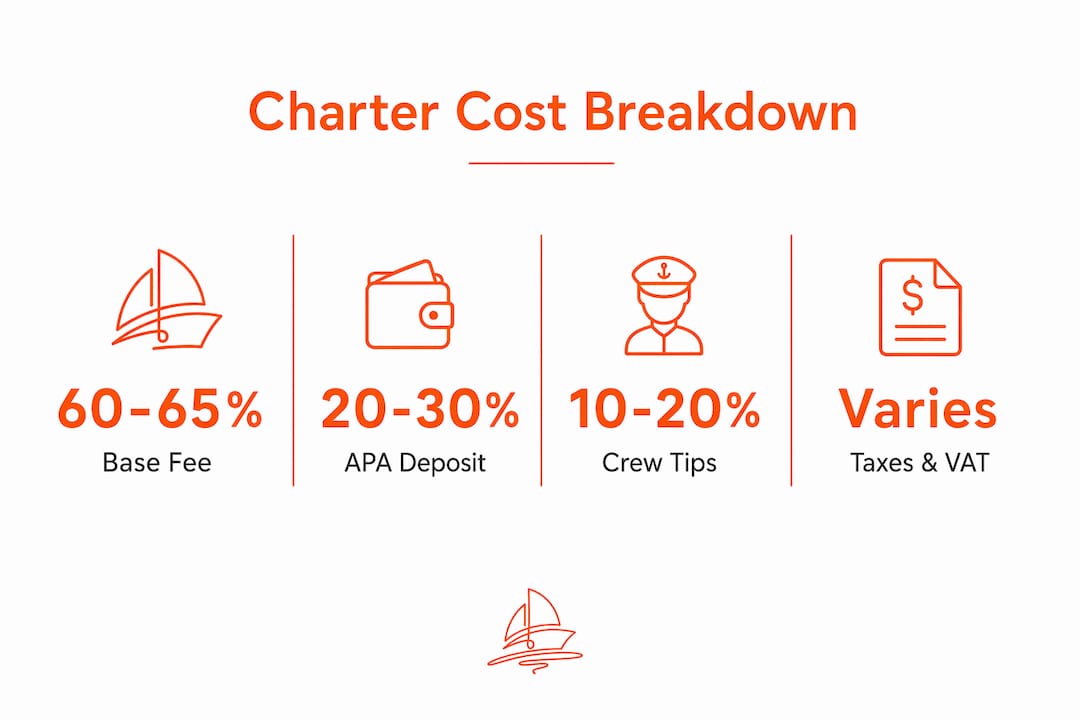
| Cost Component | Typical Amount | Notes |
|---|---|---|
| Base charter fee | 60–65% of total trip cost | Covers yacht, captain, and crew |
| APA (Advance Provisioning Allowance) | 25–35% of base fee | Fuel, food, dockage, port taxes |
| VAT / local taxes | 10–22% of base fee | Varies by country and itinerary |
| Crew gratuities | 10–20% of base fee | Paid in cash to captain at end |
| Delivery / repositioning fees | Varies | Charged when yacht travels to meet you |
The APA explained
The APA is a deposit paid upfront, usually a substantial portion of the base fee, that the captain draws from throughout the charter to cover running costs. Fuel, groceries, marina fees, and port taxes all come out of this fund. At the end of the trip, the captain presents itemized receipts. Unused APA comes back to you; overruns get billed. It is genuinely variable, not a fixed fee: a week anchored off a quiet coast burns far less APA than a port-hopping itinerary through Monaco and Portofino.
Taxes and VAT
VAT is calculated on the base charter fee, and the rate depends entirely on where you embark and how much time the yacht spends in each country's waters. Some countries impose VAT while others do not. Caribbean charters carry no equivalent VAT, though local cruising permits and park fees apply. Always ask your broker to confirm the applicable VAT regime in writing before signing anything, because this single line item can significantly affect the cost.
Crew gratuities
Gratuities are technically discretionary but culturally expected. The standard range is 10–20% of the base charter fee, paid in cash to the captain at the end of the charter, who then distributes it among the crew. Mediterranean charters typically land at 10–15%; Caribbean charters run higher at 15–20%. On a $250,000 base-rate week, that means budgeting $25,000–$50,000 for tips alone.
Pro Tip: Always calculate gratuities on the base charter fee, not the total invoice including APA and VAT. Tipping on the inflated total is not expected and will significantly overshoot the norm.
How charter fees appear in contracts
Charter fee definitions in contracts vary in wording but share a consistent structure: the fee is the amount payable by the charterer to the owner for the use of the vessel and crew during the agreed period. Variable costs like fuel and provisions are defined separately.
Standard agreements like the MYBA Western Mediterranean contract bundle only the yacht and crew into the charter fee. Everything else, fuel, food, dockage, runs through the APA. The CYBA contract used more commonly in the Caribbean takes a different approach, often bundling meals, standard bar, and some fuel into the base rate as an all-inclusive structure.
Key contract components to review:
- The defined charter fee amount and what it explicitly covers
- APA percentage and how overruns are handled
- VAT treatment and which jurisdiction applies
- Cancellation and deposit forfeiture terms
- Delivery and redelivery fee obligations
- Gratuity expectations (sometimes noted as a guideline)
Cancellation policies in charter contracts typically tie deposit forfeiture to timing. A cancellation months before departure may forfeit only the initial deposit; one close to the charter date often forfeits the full charter fee. Non-refundable booking amounts are standard across the industry, so read these clauses carefully before signing.
Payment schedule
The standard payment structure works in three stages, similar to how Bluebird Charter Services details charter fee calculations and structuring in luxury transportation. A 50% deposit confirms the booking at signing. The remaining 50% of the charter fee, plus the full APA, delivery fees, and applicable taxes, is due one month before the charter starts. Any final balance adjustments are settled on the first working day before the charter ends.

Why charter fees vary so widely between yachts
Base charter fees range from roughly $50,000 per week for smaller crewed motor yachts to over $1,000,000 weekly for top-tier superyachts. That spread reflects several compounding factors.
Yacht-specific factors:
- Size and length: A 24-meter yacht and a 60-meter superyacht operate in entirely different cost categories. Larger vessels require bigger crews, more fuel, and higher insurance premiums.
- Age and condition: Newer yachts command premium rates. A recently launched vessel with the latest design and technology will cost more than a comparable older boat.
- Onboard amenities: Submarines, helipads, beach clubs, and custom water toys push rates up sharply.
- Crew size and specialization: A yacht with a private chef, masseuse, and dive instructor carries higher crew costs baked into the base fee.
Seasonal and event-driven factors:
- Peak season in the Mediterranean (july and august) carries the highest rates, often 20–30% above shoulder-season pricing.
- Major events like the Monaco Grand Prix or the Cannes Film Festival spike both charter fees and dockage costs in those regions.
- Caribbean charters typically run 15–25% lower than equivalent Mediterranean yachts at the same size, partly because European VAT does not apply.
Contract structure:
The all-inclusive contract (common in the Caribbean and on smaller sailing yachts in destinations like the British Virgin Islands) bundles meals, standard beverages, and fuel into the base rate. The plus-expenses contract (standard in the Mediterranean under MYBA terms) keeps the base fee lower but adds APA on top. Comparing these two contract types on base fee alone is an apples-to-oranges exercise.
The transparency problem with charter fee pricing
Comparing only base charter fees is genuinely misleading. Total costs including APA, taxes, and fees can inflate the final figure by 55% or more over the headline rate. A $250,000 weekly charter in the Mediterranean becomes roughly $387,500 all-in once APA, VAT, and gratuities are added. Charterers who budget at the headline number routinely feel overbilled when the final invoice arrives.
The multiplier framework is the most practical tool for realistic budgeting. For plus-expenses charters, budget 1.55 to 1.7 times the base fee to estimate the true all-in cost. That range accounts for APA, VAT, and gratuities without requiring you to calculate each line item from scratch.
Common misunderstandings about charter fees:
- Assuming the base fee is the total cost
- Forgetting that VAT is calculated on the base fee, not the APA
- Treating APA as a fixed fee rather than an estimate
- Overlooking delivery fees when the yacht is based in a different port
- Underestimating gratuities on high-value charters
Pro Tip: Ask your broker to provide a written cost estimate showing the base fee, APA percentage, applicable VAT rate, and estimated gratuity range before you sign. A broker who resists providing this in writing is a red flag. Transparent pricing protects both parties and prevents disputes at the end of the charter.
The role of service fees in charter bookings adds another layer most charterers miss. Broker commissions are typically paid by the operator out of the base rate, so they do not appear as a separate line item on your invoice. Platform service fees, however, can range from 10–20% on top of the charter fee depending on where you book.
Key Takeaways
The charter fee is only a portion of what you will actually pay for a crewed yacht charter; budgeting significantly above the base fee gives a more realistic all-in estimate that accounts for APA, VAT, and gratuities.
| Point | Details |
|---|---|
| Charter fee covers the vessel and crew | The base fee pays for the yacht, captain, and crew only; fuel, food, and port fees are separate. |
| APA adds 25–35% on top | The Advance Provisioning Allowance funds all running costs and is settled with receipts at charter end. |
| VAT ranges from 10–22% by country | France charges 20%, Italy 22%, Greece 12%; Caribbean charters carry no VAT but have local permit fees. |
| Gratuities run 10–20% of base fee | Paid in cash to the captain at charter end; Mediterranean tips at 10–15%, Caribbean at 15–20%. |
| Sailorix charges roughly 1% service fees | Sailorix's membership model keeps booking fees near 1%, far below the 10–20% typical of standard platforms. |
The part of charter pricing nobody talks about clearly enough
Most guides explain what a charter fee includes. Fewer explain why the industry structures pricing this way, and almost none address the real problem: the base fee is a marketing number, not a budget number.
Operators quote the base rate because it is the lowest defensible figure. APA is variable, VAT depends on itinerary, and gratuities are technically discretionary, so none of them appear in the headline. The result is a pricing system that is technically accurate and practically misleading at the same time.
The fix is not complicated. Any charterer who asks their broker for a written all-in estimate before signing will get one. The brokers who provide it without being asked are the ones worth working with. The ones who deflect with "it depends on your itinerary" are not wrong, but they are also not helping you plan a budget.
One thing that often gets overlooked: the contract type matters as much as the base rate. A Caribbean all-inclusive charter at $80,000 per week may cost less in total than a Mediterranean plus-expenses charter at $70,000 per week once VAT and APA are added. Comparing headline rates across contract types is how charterers end up confused about why their "cheaper" option cost more.
The charter agreement terms are where the real story lives. Read the cancellation clause, the APA overrun policy, and the VAT treatment before the base rate starts to matter.
Sailorix makes charter fee pricing straightforward
Charter fees are complicated enough without a booking platform adding its own layer of opaque charges on top. Sailorix was built around a different model: a €100 annual membership that gives you access to yacht and boat bookings worldwide with service fees of approximately 1%, compared to the 10–20% that standard booking platforms typically charge.

That difference is concrete. On a $50,000 charter, a 15% platform fee adds $7,500 to your cost before APA, VAT, or gratuities. Sailorix's ~1% fee on the same booking adds roughly $500. The base charter fee, the APA, and the taxes are what they are. The service fee is the one cost you can actually control by choosing where you book.
Sailorix lists yachts and boats globally with real-time availability, and the pricing is transparent from the first search. If you want to save on your yacht booking without sacrificing access to quality vessels, the membership model is worth a look. Visit Sailorix.com to explore available charters and see exactly what you are paying for before you commit.