
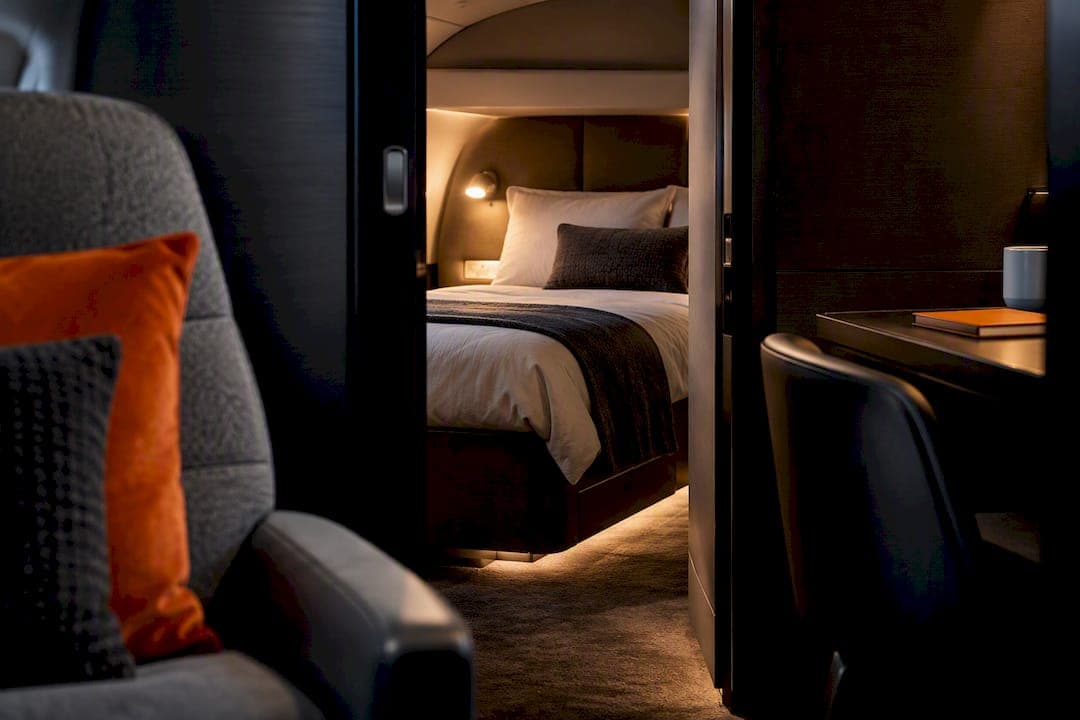
Seating layout, cabin dimensions, lavatory and galley placement, and sleep arrangements decide whether a charter feels effortless or cramped. The same aircraft or yacht model can carry two completely different cabin fits, so you have to request the specifics rather than assume them.
Baggage capacity and interior refurbishment date matter almost as much. The checklist below covers each decision in the order it should come up with your broker or operator.
TL;DR:
- Cabin dimensions, especially ceiling height and aisle width, significantly impact passenger comfort and accessibility during flights or sailing trips.
- Selecting the correct galley and lavatory placement depends on the trip's purpose, with larger groups requiring multiple facilities, and luggage capacity should be verified beyond total volume.
- Cabin refurbishment age affects noise levels, comfort, and in-flight amenities, making recent updates a key consideration for a better experience.
- Passenger count and mission specifics, including sleep needs and luggage, must be clearly communicated to avoid misfit options and ensure regulatory limits are respected.
- Using detailed filtering tools and specifying your needs upfront can streamline booking, preventing disappointment caused by vague or inaccurate listings.
Table of Contents
- What Are the Main Cabin Configurations for Charter?
- How Do Cabin Dimensions Affect Comfort and Access?
- Where Should the Lavatory and Galley Be Located?
- Which Seats Convert to Beds for Overnight Trips?
- Does Cabin Age or Refurbishment Really Matter?
- Why Do Passenger Counts Trigger Regulatory Limits?
- What Should You Ask Before Booking a Cabin?
- How Sailorix Matches Cabin Configurations to Your Trip
- Charter Planning Comes Down to a Few Real Tradeoffs
- Start Your Cabin-Specific Search on Sailorix
- Sources
- FAQ
What Are the Main Cabin Configurations for Charter?
Private jet interiors and charter yachts each use their own vocabulary for cabin layout, but the underlying question is the same: how many people need to sit, work, or sleep, and how much privacy do they need to do it.
On jets, four layouts show up again and again. Double-club seating puts two facing groups of four seats, ideal for groups that want to work or dine face to face. Club plus divan pairs one club section with a sofa-style divan along one wall, which frees floor space and gives at least one flat sleeping surface. Divan-only cabins trade seat count for lounge space and are common on smaller cabins built for two or three passengers. Bench seating rows, often near the back, pack in more bodies for short, dense-load trips rather than comfort-first travel.
Yacht cabins follow a different but equally specific naming system:
- Master cabin: the largest suite, usually amidship or forward on the main deck, with a private bathroom.
- VIP cabin: nearly master-sized, typically the second-best cabin aboard.
- Double cabin: one queen or double bed, standard for couples.
- Twin cabin: two single beds, sometimes convertible to a double.
- Pullman berth: a fold-down third bunk added above a twin or double, useful for children or crew.
- Convertible cabin: seating or a lounge area that reconfigures into sleeping space, common on smaller sailing yachts.
Matching configuration to mission is straightforward once you name the trip. A family of five wants a divan or club setup on a jet and a mix of double, twin, and Pullman cabins on a yacht. A corporate team of eight wants club-plus-divan seating with a forward conference-style zone. Overnight parties need flat-bed convertibility on jets or private ensuite cabins on yachts. Larger groups, whether ten executives or fourteen wedding guests, need to check density limits before assuming any single aircraft or vessel fits everyone.
How Do Cabin Dimensions Affect Comfort and Access?
Ceiling height decides whether adults can stand and move without stooping, and it matters more on longer legs where passengers get up repeatedly. A four to five hour flight in a cabin where you crouch to reach the lavatory wears on people fast; a six-foot stand-up cabin does not.
Floor construction is the less obvious variable. Flat floors run level from nose to tail, which makes walking, boarding, and wheelchair transfer easier. Channel floors dip in the aisle so seats sit slightly raised, which can add headroom at the seat but forces a step up and down at every row. Flat floors generally win for comfort and accessibility, while channel floors offer a modest edge in perceived spaciousness at the seat itself, according to charter interior guidance from StratosJets.
Before confirming a booking, ask for:
- Cabin height and width in inches, not just "stand-up" as a description.
- Floor type, flat or channel, and whether a wheelchair or mobility device needs to board.
- Aisle width, since anything under roughly 18 inches slows meal service and turns boarding into a bottleneck.
Pro Tip: Ask the operator for the cabin cross-section diagram, not just the exterior spec sheet. Sales photos shot with a wide lens routinely make a low cabin look taller than it is.
Where Should the Lavatory and Galley Be Located?
Galley and lavatory placement change how a flight or sail actually feels, not just where the bathroom happens to sit.
- Forward galley versus aft galley. A forward galley keeps crew movement away from a rear meeting or sleeping zone, which matters for business trips where the group wants an uninterrupted work session. An aft galley does the opposite, useful when the front cabin holds the main lounge and you want food prep out of sight.
- Single versus dual lavatories. Heavy jets and larger yachts increasingly offer two lavatories, one of which may include an enclosed shower. Groups over ten passengers, or any trip past six hours, should ask specifically whether a second lavatory exists, since very light jets often carry only a basic enclosed toilet with no sink, as StratosJets notes in its interior comfort breakdown.
- Baggage capacity and stowage. Charter quotes list a external baggage volume in cubic feet, but ski gear, golf bags, or diving equipment can blow past that number fast. Confirm actual stowage dimensions, not just total volume, and ask whether any bags need to ride in the cabin instead of the hold.
Mission type drives galley demand directly. A red-eye repositioning flight needs almost nothing; a full-day charter with an onboard chef needs a galley built for real meal prep, not just coffee and snacks.
Which Seats Convert to Beds for Overnight Trips?
Not every seat that reclines actually goes flat. Club seats on midsize and light jets typically recline to a comfortable angle but stop short of a true flat bed. Divans, by contrast, usually convert into a genuine flat sleeping surface long enough for an adult, which is why club-plus-divan layouts are the standard pick for red-eye or transoceanic charters.
Yachts handle overnight comfort through cabin count rather than seat conversion. Twin cabins with Pullman berths add a third sleeping spot without needing a fourth full cabin, and convertible lounge cabins let smaller yachts sleep more guests than their cabin count suggests on paper.
Before booking an overnight mission, confirm:
- How many seats or divans convert to a flat surface, and their actual length.
- Whether Pullman berths are included in the base charter or cost extra to activate.
- Bedding, linens, and whether any cabin includes an en-suite bathroom versus a shared one.
Dense daytime loading and comfortable overnight sleeping rarely coexist in the same configuration, so decide which one your trip actually needs before you specify passenger count.
Does Cabin Age or Refurbishment Really Matter?
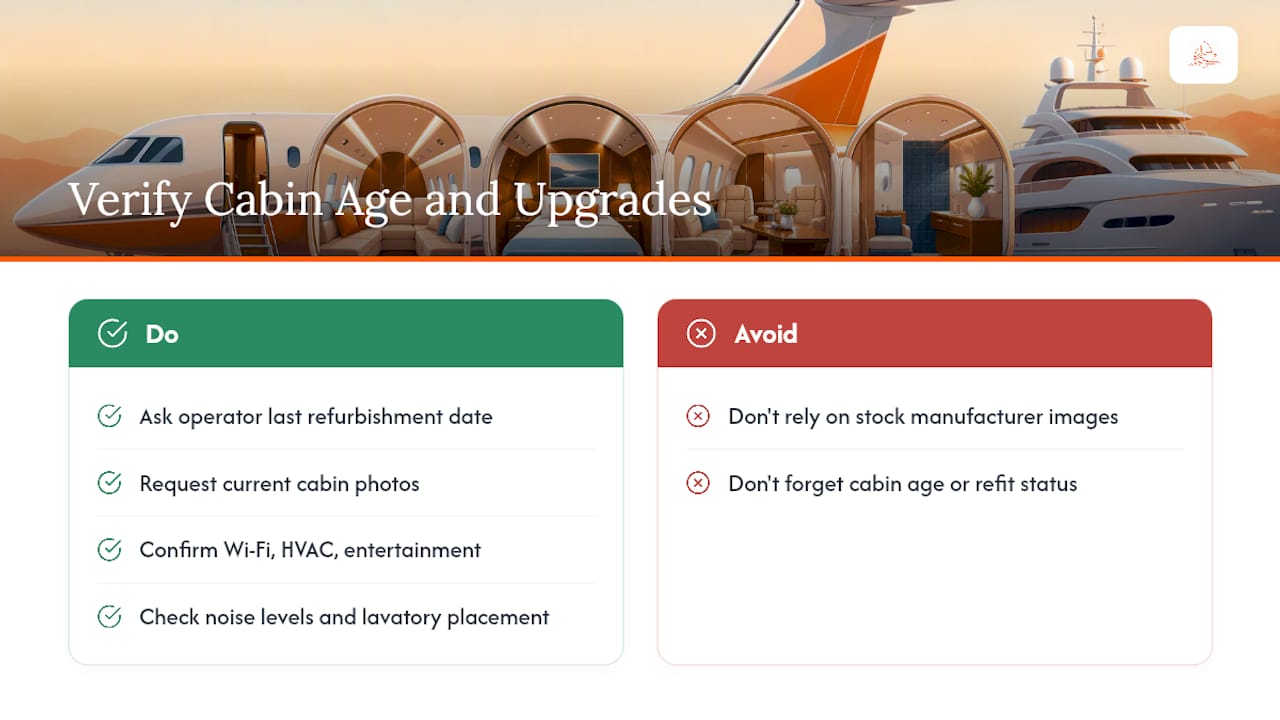
Cabin noise affects both conversation and sleep, and insulation quality varies enormously between an aircraft refurbished last year and one still running its original 2005 interior. Older cabins often carry more airframe and engine noise into the cabin, which turns a working flight into a shouting match over conference calls.
Refurbishment date functions as a reliable proxy for more than cosmetics. Seat mechanics, upholstery wear, and in-flight entertainment reliability all track closely with when the interior was last redone. Industry writers flag cabin age and refurbishment status as one of the details clients most often forget to ask about, alongside noise levels and lavatory placement, according to AvBuyer's charter booking analysis.
Wi-Fi reliability, HVAC performance, and updated entertainment systems are the upgrades that show up first after a refurbishment and matter most to passengers. Ask the operator directly for the last refurbishment date and, where possible, current cabin photos rather than stock manufacturer images. A yacht rental standards guide covers similar verification steps for confirming vessel age and refit status before you commit.
Why Do Passenger Counts Trigger Regulatory Limits?
Seat count is not just a comfort question. Once a jet's cabin crosses certain thresholds, FAA rules change what equipment, crew staffing, and evacuation capability the aircraft must carry.
- Aircraft operating under 14 CFR Part 135, the standard charter rule, face different requirements than those flying under Part 125, which generally applies to larger aircraft.
- Many charter operators cap density around 19 passengers specifically to stay inside a regulatory bracket that avoids stricter crew and equipment rules tied to Part 125.
- Higher-density cabins need more emergency exits and evacuation capacity, which can shrink usable cabin floor space even as seat count rises.
- Larger groups sometimes fit better across two mid-size aircraft than one dense single aircraft, both for comfort and to sidestep exit-count constraints, according to a large group charter planning guide.
For any group approaching 15 to 19 passengers, ask the operator to confirm certified seating capacity in writing, not just a cabin diagram, since sales materials sometimes show maximum density rather than the certified charter configuration.
What Should You Ask Before Booking a Cabin?
Specify your mission in writing before an operator or broker starts sending options. Vague requests get vague aircraft or vessel suggestions back.
- State passenger count and mix. Adults, children, and any mobility needs all change which cabin fits.
- State mission length. A two-hour hop and a six-hour crossing need very different lavatory and galley setups.
- State luggage volume. Ski bags, golf clubs, or dive gear should be listed by dimension, not just count.
- State sleeping requirements. Say explicitly whether anyone needs a flat bed or a private cabin overnight.
- State meeting-space needs. If part of the trip involves work calls, ask for a forward galley and a quiet cabin zone.
Ask the operator directly about seating layout (club, divan, or bench), lavatory and galley placement, floor type, the cabin's last refurbishment date, and whether Wi-Fi and a shower are actually available rather than advertised as optional add-ons.
Watch for red flags in listing photos: stock manufacturer renderings instead of the actual cabin, missing interior dimensions, or vague language like "seats up to" without a certified configuration number.
Pro Tip: Paste a short spec line into every request: "Party of 6, 3-hour mission, need forward-galley layout, flat-floor cabin, Wi-Fi confirmed, refurbished within the last 5 years." Specific requests get specific answers, and vague ones get whatever the operator has sitting idle.
How Sailorix Matches Cabin Configurations to Your Trip
Real-time inventory filtering is the fastest way to shortcut the back-and-forth described above. Instead of emailing five brokers and waiting for cabin diagrams, you filter directly by boat type, cabin count, and availability and see what actually matches your mission.
- Search filters let you narrow results by vessel type, whether a sailing yacht, catamaran, motor yacht, or gulet, before ever contacting an owner.
- Add-on booking covers the details that change comfort most, including skipper requests, early check-in, and equipment needs tied to your cabin plan.
- Service fees are lower than those common elsewhere, helping keep the total cost close to the quoted charter price.
- Membership access opens premium fleet listings that carry more detailed cabin specifications than typical broker inquiries.
Before you search, have your passenger count, mission length, and sleeping requirements written down. The clearer your input, the faster the filters return a vessel that actually fits.
Charter Planning Comes Down to a Few Real Tradeoffs
Every charter decision is a tradeoff between space, capacity, and cost, and pretending otherwise leads to disappointment at boarding. A denser cabin fits more people but sacrifices legroom and sleep quality. More amenities, dual lavatories, a full galley, upgraded Wi-Fi, usually mean a larger aircraft or vessel and a higher price.
Prioritize based on mission, not preference alone. Business trips need quiet, forward-galley layouts. Family trips need flexible sleeping arrangements. Overnight missions need confirmed flat-bed or ensuite cabins, not just "reclining seats." Large groups need a written seating certification, not a sales estimate. Run every quote request through the checklist above before comparing prices.
— SAILORIX
Start Your Cabin-Specific Search on Sailorix
Sailorix gives you a direct way to search charters by the exact cabin details that matter for your trip, rather than relying on a broker's shortlist.

Membership at $100 per year unlocks access to that broader fleet inventory, including the Gold, Platinum, and Diamond program tiers for travelers who charter often enough to want premium fleet access. Before you search, write down your passenger count, mission length, and sleeping needs using the checklist above, then run those filters directly on the platform to see which vessels actually match. That preparation is what turns a search into a booking instead of another round of email back and forth.
Sources
This guide draws on manufacturer cabin data from Dassault Falcon, interior comfort analysis from StratosJets, booking guidance from AvBuyer, and federal aviation rules published in the ECFR. Consult these directly for the most current regulatory detail.
- 10 Less Obvious Cabin Considerations When Booking Jet Charters | AvBuyer
- Choosing a private jet charter cabin interior for comfort | StratosJets
- Falcon 7X charter profile | ExecCharter
- ECFR — 14 CFR Part 135.107
FAQ
What Is the 12-Person Rule on a Yacht?
There is no single universal "12-person rule," but many charter yachts cap overnight guest counts around 12 due to cabin capacity and safety certification limits tied to the vessel's size class. Day-charter guest limits are often higher than overnight limits because sleeping arrangements, not deck space, set the real ceiling. Always confirm the vessel's certified overnight capacity separately from its day-trip capacity before booking.
How Much Does a One-Hour Charter Flight Cost?
Pricing depends heavily on aircraft category, cabin configuration, and positioning costs, so there is no fixed one-hour rate across the industry. Heavier jets with more elaborate cabin zones, like the three-zone layout seen on the Falcon 7X, generally cost more per hour than light jets with simpler bench or club seating. Ask any operator for an all-in quote that includes positioning and fees, not just the flight-hour rate.
What Are the Different Types of Charters?
Charters generally split by mission and duration: one-way flights, round-trip charters, multi-leg itineraries, and day or week-long yacht charters. Private jet charters typically operate under Part 135 rules, while some larger operations fall under Part 125, which carries different crew and equipment requirements. Yacht charters similarly range from bareboat rentals to fully crewed, skippered trips.
What Are the Different Types of Cabins Available?
Jet cabins range from bench and divan-only layouts to club and double-club seating, while yacht cabins include master, VIP, double, twin, Pullman berth, and convertible configurations. Each type suits a different group size and privacy need, covered in detail in the cabin configuration section above. Matching cabin type to your actual passenger mix, rather than booking on price alone, is the single biggest factor in charter satisfaction.