

The owner, charterer, managing operator, or master is legally responsible for keeping an accurate crew list, and it must be prepared before departure. At minimum, the list needs full name, date of birth, nationality, travel document or passport number, and position aboard, plus join and separation dates for any crew changes. The immediate move: build that list now, and arrange to present it ashore, to your agent, or to the Coast Guard or CBP the moment they ask.
TL;DR:
- A crew list must be built and available before departure, containing full names, dates of birth, nationality, document numbers, and crew changes, and must be ready for immediate presentation.
- The obligation to maintain a crew list applies only during overnight passenger voyages, non-origin boardings, long Great Lakes trips, or arrivals from foreign ports, with additional documentation required for foreign arrivals.
- Inspectors cross-check the crew list against supporting documents like passports, seafarer credentials, and medical certificates, and any mismatches can lead to delays or penalties.
- Electronic submissions are common and faster but require a current physical copy onboard, with dual formats recommended for ports with varying requirements.
- Maintaining a secure, reconciled record with clear ownership and history tracking helps avoid compliance issues and proves crew identity during inspections.
Table of Contents
- What Triggers Crew List Requirements Under Federal Law?
- What Fields and Documents Does an Inspector Expect?
- When and How Should You Submit the Crew List?
- How Do You Keep Crew List Records Audit-Ready?
- Building a Crew List Template That Passes Inspection Fast
- What Happens If You Don't Comply?
- What About Visitors, Contractors, and Non-Crew Personnel?
- Can You Submit Crew Lists Electronically?
- How Should You Handle Crew Personal Information?
- Why Most Crew List Advice Misses the Point
- Sources
- FAQ
What Triggers Crew List Requirements Under Federal Law?
Not every vessel needs a formal crew list on every trip. The obligation kicks in under specific, well-defined circumstances, and knowing which one applies to your vessel saves you from either over-documenting or getting caught short at a dock inspection.
46 CFR §122.502 requires a correct list of everyone who embarks and disembarks when a vessel:
- Carries passengers overnight
- Makes a coastwise or ocean voyage where people board or leave somewhere other than the point of origin
- Runs a Great Lakes voyage longer than 300 miles
- Arrives from a foreign port
46 CFR §185.502 sets the parallel rule for small passenger vessels, with identical triggers and the same duty falling on the owner, charterer, managing operator, or master.
Foreign arrivals carry an added layer: CBP Form I-418 demands an alphabetical crew list with date of birth, nationality, travel document number, position, and where each person was engaged, plus the agent's name and address. The list has to stay current for crew changes right up until departure. For vessels calling at international ports, IMO FAL Form 5 often functions as the standard crew declaration, and many foreign port authorities will not accept a homegrown format in its place.
What Fields and Documents Does an Inspector Expect?
A crew list that satisfies the regulation on paper but falls apart under questioning is worse than no list at all. Inspectors are trained to cross-check the list against physical documents in seconds, so mismatches stand out immediately.
The core fields every compliant crew list needs:
- Family name and given name, spelled exactly as they appear on the travel document
- Date of birth
- Nationality
- Travel document or passport number
- Rank or position aboard
- Date joined the vessel
- Date separated, once applicable
Behind each entry, have the supporting paperwork ready to produce: passport or seaman's book, visa or the applicable D classification (or a documented exemption), Merchant Mariner Credential where the role requires one, relevant STCW endorsements, and a current medical certificate such as an ENG1 or equivalent.
CBP's form also asks for a longshore-work declaration for each crew member and requires the master to certify against stowaways. Skip either of these on Form I-418 and the whole submission can bounce back for correction, which is the last thing you want with a departure window closing.
When and How Should You Submit the Crew List?
Timing matters more than most operators assume. A perfectly filled-out list submitted an hour after the Coast Guard asked for it is functionally the same as no list at all.
- Prepare the final version before departure. The master ensures it is complete and accurate, then communicates it ashore, either to the vessel's normal berth contact or to a designated owner or operator representative.
- Confirm your filing method with the agent. Some ports expect a paper copy handed over on arrival; others run entirely through electronic submission to CBP or the local port authority. Ask before you assume.
- Present the list on request. Coast Guard officers and CBP officers can ask for it at any point, and the regulation expects it to be available immediately, not after a phone call to the office.
- Update it the moment crew changes happen in port. A new hire or a departing crew member means an updated list and, where CBP applies, a resubmission of departure information before the vessel leaves.
Building this into your standard port-call checklist rather than treating it as a one-off task is what keeps vessels from getting flagged for late paperwork.
How Do You Keep Crew List Records Audit-Ready?
Regulations tell you what to produce. They don't tell you how to avoid the mismatch between what the crew list says and what your other records show, and that gap is where most compliance headaches start.
Start by assigning clear ownership. Name a primary responsible person and a backup in your safe management system or port-call checklist, typically the master, the agent, and one designated office contact who can step in if the master is unreachable.
From there, run a four-way reconciliation before anything gets filed:
- Crew list against passports and seafarer identity documents
- Crew list against employment and crew-change records
- Crew list against the actual muster aboard
- Crew list against what was actually submitted to the agent or port authority
Retain the final submitted copy, the acceptance receipt or I-418 receipt number, and a running note of every crew addition or separation. Regulatory language repeatedly emphasizes that the list must be available to inspectors on request, which makes that receipt number your best defense if a discrepancy ever gets challenged.
Pro Tip: Keep the I-418 receipt number and submission timestamp in the same voyage file as the signed master certification. If a dispute comes up months later, that single file is what settles it.
Building a Crew List Template That Passes Inspection Fast
Map CBP's I-418 fields and the common IMO fields onto one vessel template, then add administrative fields most operators forget: agent name and address, the I-418 receipt number, a submission timestamp, and a sign-off line.
- Keep two synchronized views: a live operational list and a change-controlled history that timestamps every edit and notes why it was made
- Version clearly, so nobody presents an outdated copy by mistake
- Save acceptance evidence, whether that's an email receipt, a stamped paper copy, or an electronic acknowledgement, directly in the voyage file
This structure turns a routine paperwork task into something an inspector can verify in under a minute.
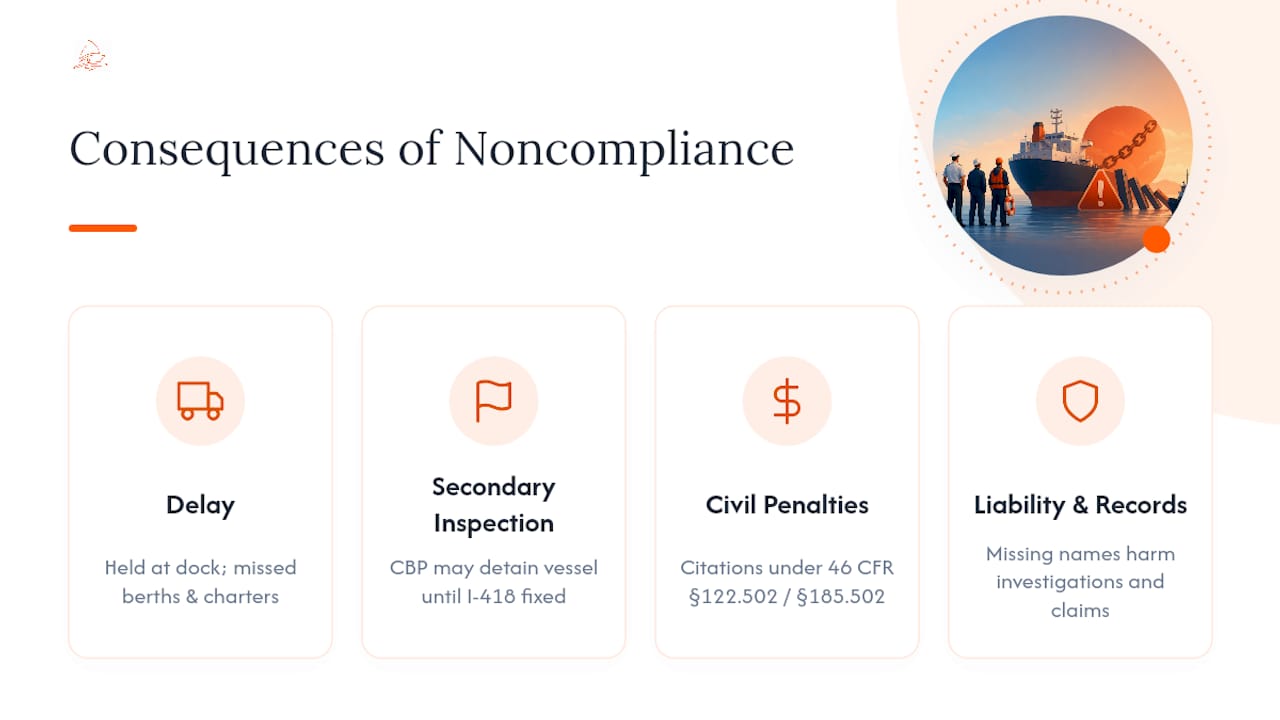
What Happens If You Don't Comply?
Failing to maintain a compliant crew list is not a paperwork inconvenience the Coast Guard or CBP quietly overlooks. It's a documented regulatory failure that follows the vessel.
The most immediate consequence is delay. A vessel without a ready crew list at inspection can be held at the dock while the master scrambles to reconstruct who is aboard, which stalls departure and cascades into missed berth windows, canceled charters, and unhappy passengers. For foreign arrivals, an incomplete or inaccurate I-418 submission can trigger a secondary inspection. CBP officers have discretion to detain the vessel until documentation is sorted out.
Beyond delay, there's exposure to civil penalties. The Coast Guard can cite a vessel for failing to maintain records required under 46 CFR §122.502 or §185.502, and repeated violations tend to draw closer scrutiny on future port calls, not less. For operators running charter fleets, that kind of flag on a vessel's inspection history is the sort of thing that follows the vessel across ownership changes and can complicate future Certificate of Inspection renewals.
There's also a less obvious cost: liability. If a person boards or leaves the vessel and isn't reflected on the crew list, and something goes wrong, that gap in the record becomes a serious problem in any subsequent investigation or claim. A clean crew list is not just a regulatory checkbox. It's the vessel's own paper trail proving who was aboard and when.
What About Visitors, Contractors, and Non-Crew Personnel?
Not everyone who steps aboard is crew, and treating every visitor like a crew member creates unnecessary paperwork. But treating every visitor like a non-entity is worse, and CBP does not make that distinction casually.
Under CBP guidance, anyone boarding a vessel before formal entry, or while the vessel remains under CBP supervision, has to request permission first. That includes on-signing crew who haven't cleared yet, but it also covers surveyors, technicians, and stevedores doing legitimate work aboard. Basic identification, meaning name, date of birth, and an identification document, is required for each of them so CBP can run a risk assessment before they're allowed on or off.
The practical move is to keep a separate visitor log distinct from the crew list itself. The crew list documents who is part of the vessel's complement; the visitor log documents everyone else who had legitimate reason to be aboard during the port call. Mixing the two creates confusion for inspectors trying to verify who's actually crew versus who was there for a maintenance call.
For non-immigrant crew who need to go ashore, the CBP Vessel Inspection Guide also references conditional landing permits, forms like I-95 and I-184, alongside standard visa exceptions for crew. These are separate from the crew list itself but travel alongside it in the same voyage file, since an officer checking one will often ask for the other.
Can You Submit Crew Lists Electronically?
Paper crew lists still work at plenty of ports, but electronic submission has become the default at most that handle regular international traffic. CBP's Vessel Entry and Clearance System, commonly referenced through the VECS agent process, lets agents file crew and passenger information digitally ahead of arrival, which speeds up clearance considerably compared to a paper handoff at the dock.
The catch is that electronic filing doesn't remove the need for a physical, presentable copy aboard the vessel. Coast Guard officers boarding for a routine check may not have access to whatever was filed electronically with CBP, so the master still needs a current, accurate copy available on request, digital or printed.
If your vessel calls at a mix of domestic and foreign ports, the smart approach is running both formats in parallel: an electronic submission where the port or CBP system supports it, and a printed or tablet-accessible version aboard at all times. Confirm with your agent which format the specific port expects before you assume electronic filing alone covers you. Local requirements vary enough that a format that worked at one port can get rejected at the next.
How Should You Handle Crew Personal Information?
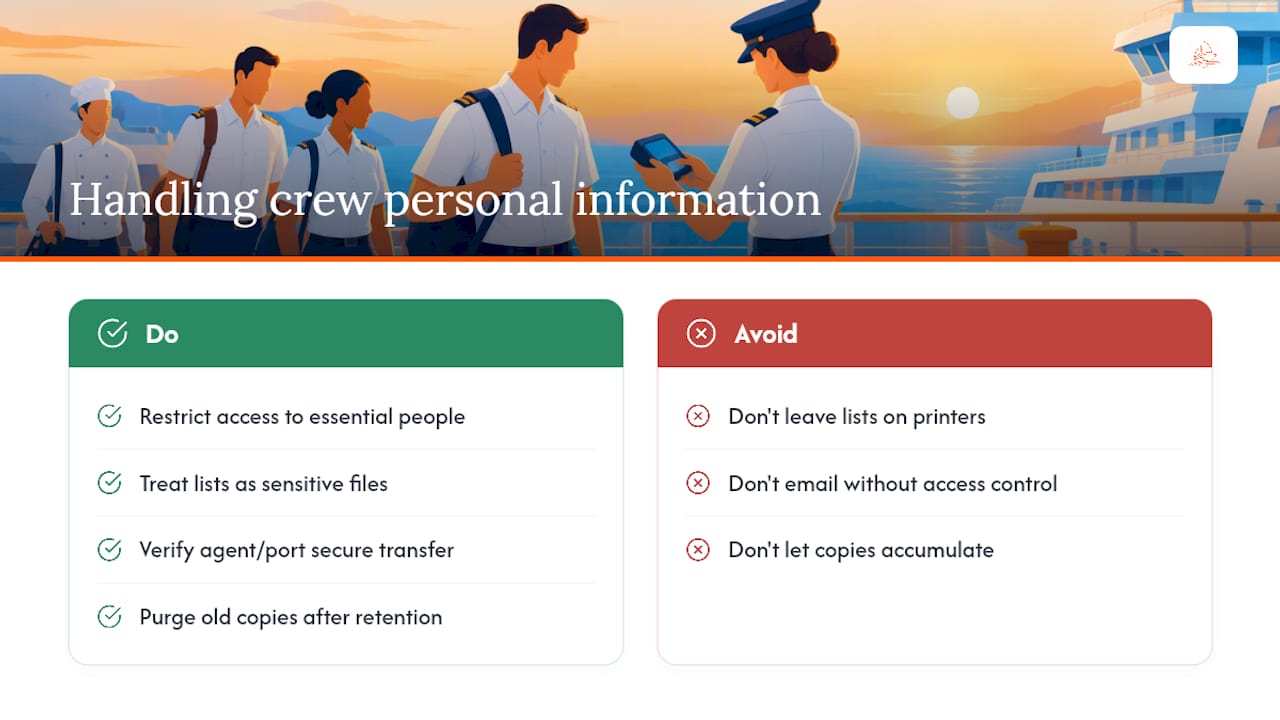
A crew list is, at its core, a compilation of personal identifying information: full names, dates of birth, nationality, and passport numbers for every person aboard. That makes it sensitive data, and treating it carelessly creates a real exposure separate from the compliance question.
The practical risk isn't theoretical. A crew list left on a printer in a marina office, or emailed without any access control to a distribution list nobody's reviewed in months, puts crew members' identity documents in the hands of anyone who happens to see it. Given how much of that data (passport number, date of birth, nationality) is exactly what's needed for identity theft, operators should treat the crew list with the same care as any other file containing personal identifiers.
Limit who has access to the working copy. The master, the agent handling submission, and the designated office contact typically need it; the rest of the shoreside team usually doesn't. When the list is submitted electronically, confirm the agent's or port authority's system handles it securely rather than assuming any file transfer method is fine. And when retention periods end, dispose of old copies deliberately rather than letting them pile up in an inbox or a shared drive indefinitely. The goal isn't to make the crew list harder to produce when an inspector asks. It's to make sure it isn't sitting somewhere it shouldn't be in between those requests.
Why Most Crew List Advice Misses the Point
Most guidance on this topic treats crew list requirements as a form-filling exercise: fill in the boxes, hand it to the agent, move on. That's technically accurate and practically useless, because the regulation was never really the hard part. Anyone can transcribe a passport number onto a template.
What the research behind this checklist actually supports is a different priority. The failure point isn't the list itself, it's the reconciliation behind it. Vessels get flagged not because the crew list is missing but because it disagrees with the muster, the employment record, or what the agent actually submitted. That's a process failure, not a knowledge gap, and no amount of memorizing 46 CFR citations fixes it.
If you take one thing from this checklist, take the four-way reconciliation and the two-view system: an operational list that changes constantly, and a locked history that shows exactly when and why it changed. Regulators don't expect perfection. They expect a paper trail that proves you knew who was aboard, every single time someone asked.
Sources
- eCFR :: 46 CFR 122.502 -- Crew and passenger list.
- 46 CFR § 185.502 - Crew and passenger list.
- CBP Form I-418 (Crew List) and Vessel Inspection Guide
FAQ
Who Is Responsible for the Crew List?
The owner, charterer, managing operator, or master carries the legal duty to maintain a correct crew list under 46 CFR §122.502. In practice, the master handles day-to-day preparation and communicates it ashore, while the agent often manages the CBP submission on the vessel's behalf.
At What Size Does a Yacht Need a Crew?
Crew size isn't set by the crew list itself; it's determined by the vessel's Certificate of Inspection or safe-manning document, which the Coast Guard issues based on the vessel's size, route, and operations. The crew list simply records who is actually aboard, without a specified minimum crew size set by the list itself.
What Documents Are Required for Seafarers?
Each crew member typically needs a passport or seaman's book, a visa or applicable exemption, a Merchant Mariner Credential where the role calls for one, relevant STCW endorsements, and a current medical certificate such as an ENG1. CBP's Form I-418 requires this documentation to match the crew list entry for date of birth, nationality, and travel document number exactly.
What Is a Crew List?
A crew list is the official record of everyone embarking on and disembarking from a vessel, including full name, date of birth, nationality, travel document number, and position aboard. Federal rules under 46 CFR §122.502 and §185.502 require it whenever a vessel meets specific voyage triggers, and CBP requires an expanded version on Form I-418 for foreign arrivals.