

Nautical terms are the specialized maritime vocabulary that sailors, captains, and crew use to communicate precisely and safely at sea. Without this shared language, a simple instruction like "ease the sheet" or "come about" becomes dangerously ambiguous. Resources like the IMO Standard Marine Communication Phrases (SMCP), beginner glossaries from BOATTOMORROW, and certification programs under STCW all confirm that standardized language prevents accidents and keeps crew coordination tight. Whether you are stepping aboard a sailboat for the first time or preparing for your first offshore passage, learning sailing terminology is not optional. It is the foundation of every safe and confident voyage.
What are the core nautical terms every sailor should know?
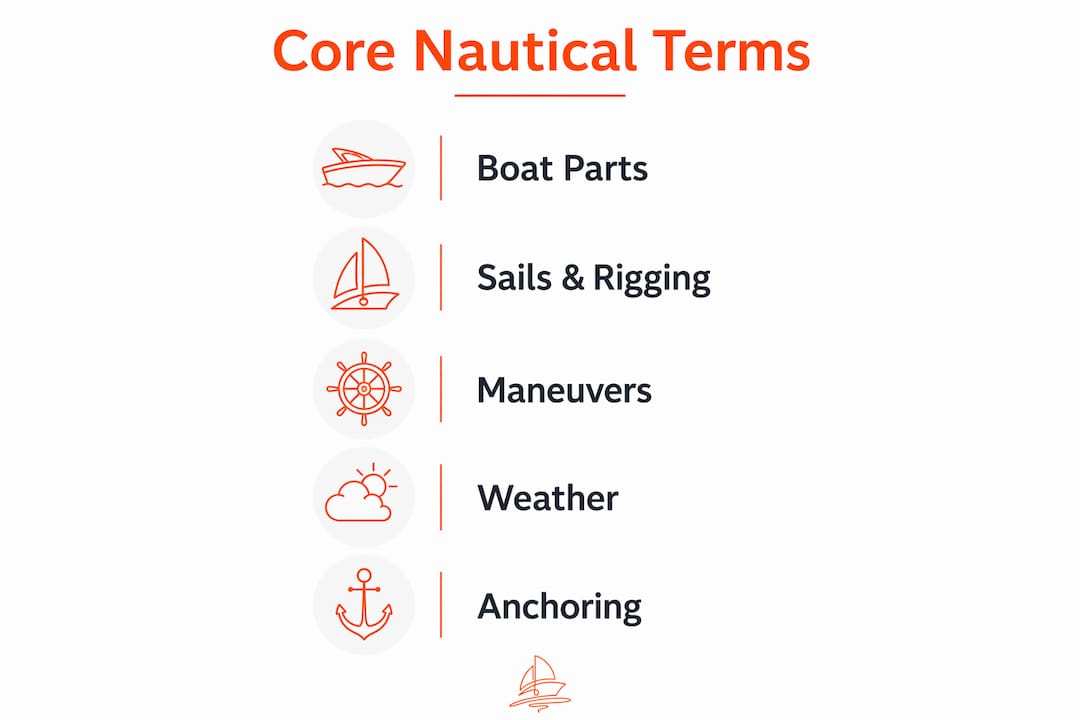
Beginner-friendly vocabulary groups nautical terms into five intuitive categories: parts of the boat, sails and rigging, maneuvers, weather and navigation, and anchoring and mooring. This structure mirrors how you actually use the language on the water. You do not need all 392 terms in the SkipperCheck maritime glossary on day one. You need the right terms for the task in front of you.
Parts of the boat
Every vessel has a defined anatomy, and knowing it lets you respond instantly to any instruction. The bow is the front of the boat, the stern is the rear, port is the left side when facing forward, and starboard is the right. The beam refers to the widest point of the hull, while the keel is the weighted fin running along the bottom that provides stability and prevents sideways drift. The cockpit is the recessed area where the helm and crew typically sit during a passage.
Sails and rigging
The mainsail is the primary sail attached to the mast and boom. The jib or headsail is the forward sail that works in combination with the mainsail to generate drive. Sheets are the lines (ropes) that control sail trim, while halyards are the lines used to raise and lower sails. The boom is the horizontal spar at the base of the mainsail, and a gybe or tack describes turning the boat relative to the wind direction.
Maneuvers, weather, and anchoring
Tacking means turning the bow through the wind so the wind shifts from one side to the other. Gybing is the same turn but with the stern passing through the wind, which is more powerful and requires careful control. Weather terms like windward (toward the wind) and leeward (away from the wind) define your position relative to the breeze at all times. For anchoring, the rode is the chain or line connecting the anchor to the boat, and scope is the ratio of rode length to water depth.
Pro Tip: When you first board a new boat, walk the deck and name every cleat, winch, and line out loud. This physical association locks terminology into memory faster than any flashcard system.
How does the IMO SMCP improve maritime safety?
The IMO Standard Marine Communication Phrases is the globally mandated framework that formalizes maritime English for safety-critical communication at sea. Adopted by the International Maritime Organization and made compulsory under the Standards of Training, Certification and Watchkeeping (STCW) convention, the SMCP replaced older, inconsistent vocabularies that varied by country and shipping company. Any certified seafarer operating internationally must demonstrate competency in this standardized nautical language.
The SMCP structures maritime communication into three distinct domains:
- General vocabulary covers everyday shipboard communication, including helm orders, engine room exchanges, and crew briefings. This is the layer most recreational sailors encounter when they take a VHF radio course.
- On-board communication addresses internal safety procedures, including fire drills, man-overboard protocols, and damage control announcements. Precision here is non-negotiable because seconds matter.
- External communication governs ship-to-shore radio calls, Vessel Traffic Service (VTS) interactions, search and rescue coordination, and port authority exchanges. This is where colloquial sailing terms give way entirely to standardized phrases.
"Nautical terminology acts as a universal language at sea, preventing hazards and ensuring crew coordination." — GJW Direct
The practical gap between casual sailing jargon and SMCP-standard phrases is significant. A recreational sailor might say "we're heading left." A certified officer says "come to port." One is conversational. The other is unambiguous in a radio exchange during a storm, in a second language, with background noise. Understanding this distinction matters even for leisure sailors who interact with commercial traffic, port authorities, or pan-pan emergency calls on VHF Channel 16.
What are the most essential sailing terms for beginners?
Beginners should focus on a foundational set of 50 terms rather than attempting to memorize an entire maritime dictionary. Research from BOATTOMORROW confirms that mastery of these 50 core terms is achievable within three days of active sailing experience. That timeline is realistic because the water teaches the vocabulary faster than any classroom.
The table below compares the most common beginner mistakes against the correct sailing terminology, so you can correct your habits before they become ingrained.
| Common mistake | Correct nautical term | Why it matters |
|---|---|---|
| "The front of the boat" | Bow | Directional instructions depend on this distinction |
| "The back of the boat" | Stern | Crew positioning and docking rely on stern awareness |
| "Turn left" | Come to port | Eliminates confusion when facing different directions |
| "Turn right" | Come to starboard | Same reason. Orientation-independent and universal |
| "The rope" | Line, sheet, or halyard | Each line has a specific function and name |
| "The anchor rope" | Rode | Scope calculations require knowing the correct term |
Using correct terms like port and starboard instead of left and right is critical because left and right depend on which direction you are facing. Port and starboard are fixed to the vessel. This single distinction prevents the most common rookie miscommunication on any boat.
Focusing on task-relevant vocabulary accelerates retention significantly. When you are rigging the boat before departure, learn rigging terms. When you are anchoring, learn anchoring terms. Trying to absorb all 392 terms in the SkipperCheck glossary before your first sail creates cognitive overload and slows practical application.
Pro Tip: Keep a small waterproof notepad in your pocket during your first few sails. Write down every term you hear but do not recognize, then look it up that evening. You will build a personalized vocabulary list tied to real experiences.
How do nautical terms shape boating culture and identity?
Nautical language does not stay on the water. Dozens of common English phrases trace directly back to maritime culture through the ages, and recognizing these origins deepens your appreciation for the vocabulary you are learning. "Knowing the ropes" originally described a sailor's competency with rigging lines. "Taken aback" described sails caught by a sudden wind shift. "Leeway" meant the sideways drift of a vessel and evolved into its modern meaning of extra flexibility or margin.
Among active sailors, correct terminology signals competence and earns respect. The sailing community is tight-knit, and the way you speak on a boat communicates your experience level immediately. Using the wrong term at the wrong moment does not just cause confusion. It can erode trust in a crew situation where trust is everything.
Here are a few nautical phrases that remain alive in everyday conversation:
- "Batten down the hatches" means to secure everything before a storm. On a boat, hatches are literally secured before heavy weather.
- "On an even keel" describes a vessel sailing upright and balanced. Off the water, it means calm and stable.
- "Three sheets to the wind" refers to a boat with loose, uncontrolled sheets flying in the wind. It became slang for someone stumbling drunk.
- "Touch and go" described a vessel briefly grounding on the seabed before floating free. Today it means a precarious or uncertain situation.
Consistent use of correct terminology is a cultural standard that reinforces both safety and professionalism aboard any vessel. Sailors who use precise language are taken seriously. Those who default to landlubber descriptions are politely corrected, usually more than once.
Key takeaways
Mastering nautical terms requires learning the right vocabulary in context, starting with 50 core terms grouped by task, and building toward standardized maritime English for safety-critical communication.
| Point | Details |
|---|---|
| Start with 50 core terms | Beginners can achieve functional fluency within three days of active sailing experience. |
| Group terms by activity | Learning rigging terms while rigging and anchoring terms while anchoring accelerates retention. |
| IMO SMCP sets the standard | Certified seafarers must use SMCP-compliant phrases for radio, safety drills, and port communication. |
| Port and starboard are non-negotiable | These orientation-independent terms prevent the most common miscommunication errors on any boat. |
| Nautical language is living culture | Dozens of everyday English phrases originate from maritime vocabulary, reflecting its deep historical roots. |
Why I think most sailors learn nautical terms backwards
Most beginners approach sailing terminology the way they approached school vocabulary lists: memorize first, apply later. That method works for exams. It fails on the water. At Sailorix, we have watched hundreds of new sailors struggle not because they lacked knowledge, but because their knowledge was disconnected from physical experience.
The terms that stick are the ones you learn while doing. You will never forget what a gybe is after your first uncontrolled one sends the boom swinging across the cockpit. You will not confuse port and starboard again after you call the wrong one during a docking approach. The marine alphabet follows the same principle. Phonetic alphabet fluency comes from radio use, not flashcards.
What I find genuinely underappreciated is the safety dimension of precise language. Vague communication at sea is not just unprofessional. It is dangerous. A crew member who says "watch out on the left" during a gybe is creating a half-second delay in a situation where half a second matters. The sailor who says "gybe ho, ease the mainsheet" gives the crew a complete picture instantly. That is what nautical language is for. It compresses complex physical instructions into words that every trained sailor decodes in real time.
— Sailorix
Ready to sail with confidence?
Building your nautical vocabulary is the first step toward becoming a capable, confident sailor. Sailorix goes beyond boat bookings to support your entire sailing journey, from terminology guides to practical seamanship resources.

At Sailorix, you get access to curated sailing education content alongside the world's most affordable yacht and boat rentals. With a Sailorix membership at just €100 per year, you pay roughly 1% in service fees compared to the 10 to 20% charged by most booking platforms. That means more budget for the experiences that actually teach you sailing. Browse available vessels, explore destination guides, and deepen your maritime vocabulary all in one place.
FAQ
What are nautical terms?
Nautical terms are the specialized vocabulary used by sailors, mariners, and boating enthusiasts to communicate precisely about vessel parts, maneuvers, weather, and navigation. This shared language is critical for safety and crew coordination at sea.
How many nautical terms should a beginner learn first?
Beginners should focus on 50 foundational terms grouped by activity such as rigging, maneuvers, and anchoring. Most sailors achieve working fluency with these terms within three days of active time on the water.
What is the IMO SMCP and who needs to know it?
The IMO Standard Marine Communication Phrases is a globally standardized maritime English framework mandated under the STCW convention for certified seafarers. It covers helm orders, safety announcements, and ship-to-shore communication to eliminate ambiguity in international waters.
Why do sailors use port and starboard instead of left and right?
Port and starboard are fixed to the vessel regardless of which direction crew members are facing, making them orientation-independent. Left and right change depending on the speaker's position, which creates dangerous confusion during fast-moving maneuvers.
Where can I find a comprehensive glossary of sailing terms?
SkipperCheck publishes a glossary of 392 nautical terms covering navigation, VHF radio communication, and yachting vocabulary, making it one of the most thorough references available for modern cruising and sailing terminology.