
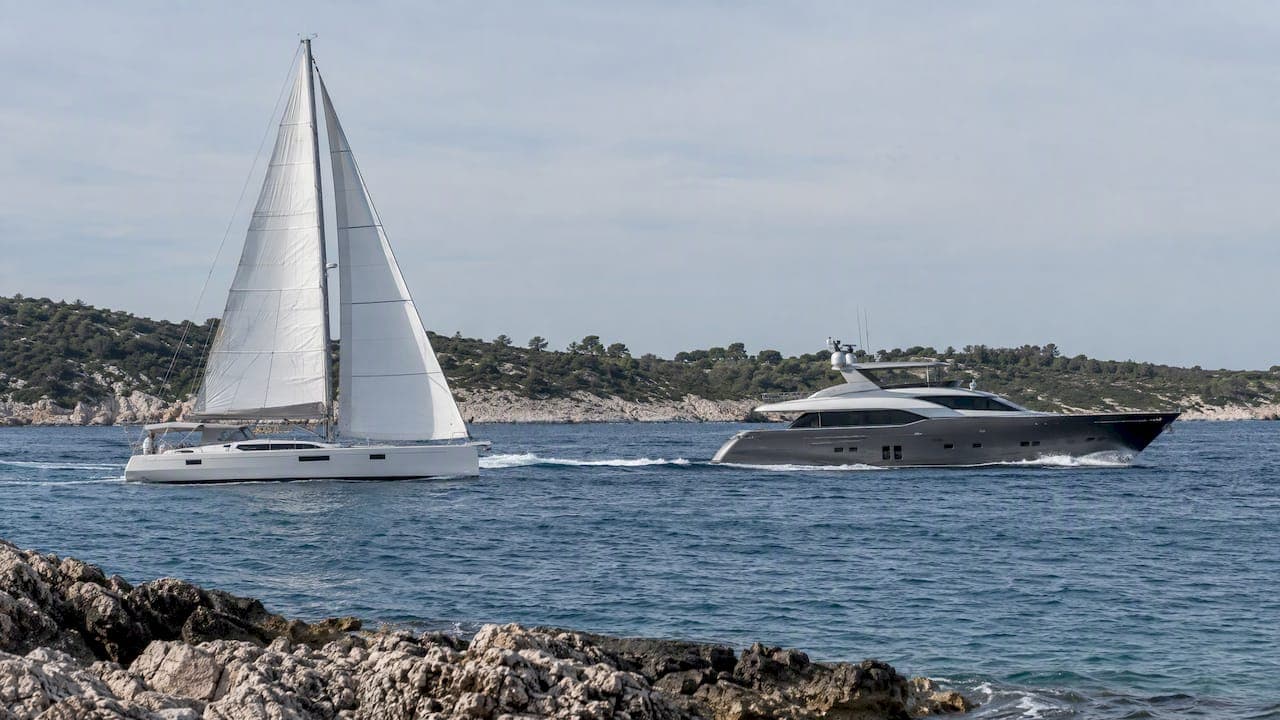
Choose a motor yacht if you want speed, space and a fixed itinerary. Choose a sailing yacht if you want quiet, lower fuel use and the experience of getting there under sail. Both can make a great week on the water. The right one depends on your group, your schedule and how much of the boat you want to run yourself.
This guide compares the two on what charter guests care about: speed, range, comfort, skill, cost and itinerary. It also explains the in-between option, the catamaran, and shows how to book either type without paying heavy service fees.
TL;DR
- Motor yachts are typically faster, roomier and easier to operate, so they suit tight schedules, mixed groups and guests who care most about onboard comfort.
- Sailing yachts run on wind, use far less fuel and suit quiet anchorages, longer relaxed passages and guests who enjoy the sailing itself.
- In US waters, comparable local listings in St. Petersburg, Florida, start around $400 for two hours on a sailboat and above $1,400 on a motor yacht.
- Catamarans, motor sailers and power catamarans sit between the two and often solve the "half the group wants each" problem.
- Whichever you pick, add a skipper if nobody aboard holds sailing or boat-handling experience, and compare service fees before you book.
Table of Contents
- What counts as a sailing yacht and a motor yacht
- Side-by-side comparison
- Speed and range
- Comfort, space and onboard amenities
- Skill, crew and effort
- What each costs in the United States
- Which one fits your trip
- A worked example: six guests, one week
- Booking either type without overpaying on fees
- Perspective
- Find your boat on Sailorix
- Planning checklist before you book
- FAQ
- Sources
What counts as a sailing yacht and a motor yacht
The words overlap, so it helps to fix them first. A yacht is not a legal category with a hard size line. Many people use 14 metres as a rough guide, but there is no legal definition of a yacht. California's boating handbook, for example, describes a yacht as a recreational power or sail vessel usually 40 feet (12.2 m) or more.
The useful difference is propulsion:
- Sailing yacht: driven mainly by sails, with an auxiliary engine for harbors and calm days.
- Motor yacht: driven by engines, generally diesel or petrol, with no reliance on wind.
- Motor sailer: a hybrid that combines motor and sail propulsion, with engines for light wind or precise maneuvering.
On our platform you will see these as sailing yachts, catamarans, motor yachts, motor boats, gulets, power catamarans, rubber boats (RIBs) and luxury motor yachts. For this comparison, think of the first group as "sail" and the others as "power", with catamarans and gulets as hybrids of comfort and wind.
Side-by-side comparison
| Factor | Sailing yacht | Motor yacht |
|---|---|---|
| Propulsion | Wind, plus an auxiliary engine | Engines |
| Speed | Slower, though it can be quick in good wind | Typically faster |
| Fuel use | Low, or none under sail | High |
| Space and amenities | Efficient, built around the sailing experience | Usually more spacious, more amenities |
| Skill needed | Sail trim, weather and tide knowledge | Throttle and close-quarters handling |
| Schedule reliability | Depends on wind | High |
| Typical charter price (US example) | Lower | Higher |
| Best for | Quiet anchorages, active guests | Fixed itineraries, comfort-first groups |
The sections below explain each row, with sources.
Speed and range
Motor yachts are typically faster than sailing yachts, although a sailing yacht can win in favorable conditions. One broker guide reports that sailing yachts cruise at roughly 5 to 8 knots as monohulls and 7 to 12 knots as multihulls. Treat those as planning figures, not promises: wind, sea state and how the crew trims decide the real number.
What the speed means in practice:
- Motor yacht: passage planning is predictable, and travel time can be compressed when the schedule matters. If your week includes a ferry connection, a dinner reservation on another island or a flight home from a specific marina, power gives you margin.
- Sailing yacht: under sail, fuel use is drastically reduced or eliminated, and range depends on provisions, water and crew endurance rather than the fuel tank. That gives more autonomy in remote anchorages, as long as you accept that arrival times flex with the wind.
A simple rule: if you can name the hour you must be somewhere, lean toward power. If you can only name the day, sail is fine.
Comfort, space and onboard amenities
Motor yacht interiors tend to be more spacious and carry more amenities. Think larger saloons, flybridge lounging, bigger sundecks and more room to spread out. Sailing yachts focus more on the sailing experience than on onboard comfort, while motor sailers can offer better comfort than a pure sailboat.
Stability matters here too. A motor yacht does not heel, so dinner stays on the table and guests who worry about leaning have little to fear. A sailing monohull heels under sail, which some guests love and others dislike. A catamaran is the common compromise: sail-powered, wide and flat, with the cockpit and saloon space many groups want. We cover that in our catamaran charter cost guide.

Seasickness and mixed ages are the practical reasons many families land on power or a catamaran. If anyone in your group is anxious about motion, say so when you search, and filter for hull type as well as size.
Skill, crew and effort
Motor yachts tend to be easier to operate. They do not require knowledge of wind patterns, sail trimming or sailing technique. Sailing yachts call for navigation, weather and tide knowledge, boat handling, maintenance and safety skills. Power is simpler to learn, but handling a large motor yacht in a crowded marina is still a skill, especially in wind and current.
The practical answer for most vacationers is the same for both types: hire a skipper. A skipper removes the skill question, handles docking and gives you local knowledge of anchorages. The cost depends on region and season, and our skipper cost guide walks through typical weekly figures and how service fees change the total.
Right-of-way is different too
Under the international and US navigation rules, a power-driven vessel is any vessel propelled by machinery, and a sailing vessel is one under sail with any machinery not in use. That distinction matters: a sailboat with its engine running is treated as a power-driven vessel. If you charter without a skipper, learn these definitions and the give-way rules before you leave the dock.
What each costs in the United States
Power costs more to charter and to run. In St. Petersburg, Florida, local listings show sailboats starting around $400 for two hours while comparable motor yachts are advertised at more than $1,400 for the same time. The same source notes that fuel for the same outing is typically far higher on a motor yacht, and that annual maintenance costs run higher too.
Three cost drivers explain the gap:
- Hire rate. Motor yachts usually carry higher base prices for comparable length because of engines, systems and amenities.
- Fuel. On a day charter or a week, fuel may be billed separately. Sailing yachts only burn it when motoring. Ask whether fuel is included, estimated or settled at the end.
- Extras. Skipper, hostess, dockage, cleaning, insurance options and equipment add to either type.
For concrete budgets, our guides break the numbers down by place and boat size: Miami yacht rental cost by boat size for US power-boat pricing, and yacht charter prices for the wider market. Prices change by season and fleet, so use them to set a range and check live availability for the final number.
Which one fits your trip
The research on this question points the same way. Motor yachts suit fixed schedules and quick transitions between destinations. Sailing yachts suit people who enjoy sailing, want remote anchorages or prefer a quieter cruise.
Choose a motor yacht if
- You have a fixed itinerary, several stops or a hard return time.
- Your group is mixed in age and mobility and wants stability and space.
- You plan a celebration, a corporate outing or a party day where the boat is the venue.
- Nobody wants to participate in sailing and you want air conditioning, generous deck areas and easy swimming platforms.
Choose a sailing yacht if
- You want a quieter, more intimate connection to nature and lower fuel consumption than a traditional motor yacht.
- Part of the group wants to help hoist, trim and steer.
- You are flexible on arrival times and keen on quiet bays rather than busy marinas.
- You want a week-long cruise where the pace is the point.
Choose a catamaran or hybrid if
- You want sail without heeling, plus a big social cockpit.
- Your group includes first-time guests and experienced sailors.
- You want shallow-draft access to anchorages and beaches.
A gulet or power catamaran can also fit groups who want a relaxed pace with extra deck space. Browse these categories by destination and filter by guest count, cabins and dates.
A worked example: six guests, one week
Imagine six adults who want a week of island hopping. Three questions settle the choice in a few minutes:
- Do we have a hard schedule? If you must be at an airport on Saturday morning and want a different island every night, a motor yacht or power catamaran gives you the cushion. If the days are loose, a sailing catamaran works.
- Who will run the boat? With nobody qualified, price a skipper into both options. With one experienced sailor, a sailing yacht is realistic; for a large motor yacht, you will probably still want a professional.
- What matters more, space or soul? If guests will spend most of the day aboard on deck and in the saloon, size and layout rule. If the sailing itself is the trip, choose sail.
Then compare three quotes at equal length and dates: total hire, skipper, fuel and fees. That is when you see which option really costs less for your group.
Booking either type without overpaying on fees
The boat type is only half the cost. Many booking channels add a service fee on top of the charter price, and the fee can change the total as much as the choice between sail and power. We describe the typical market range as 10% to 20%. Our model is different by design: membership costs €100 per year, and members book with a service fee of around 1%. We explain the math in membership vs broker fees, and our skipper guide shows how the fee applies to crew costs too.

A quick example of why it matters. On a charter priced at $10,000 before fees, a 15% service fee adds $1,500, while a 1% fee adds $100. Check what each channel charges and what the final invoice includes, then compare like for like.
Perspective
Most people who ask us about sailing versus motor yachts are really asking about their week, not the boat. Who is coming, how much time they have, and who will run the vessel decide the answer faster than any spec sheet.
Our view is that the best charter is the one matched to the group, then booked at the lowest total cost. That is why we built the platform around real-time availability by destination and boat type, add-ons such as a skipper or early check-in, and a membership model that keeps service fees to around 1%. Our approach is designed so that the money you save on fees goes into the part of the trip you remember: a better boat, an extra day or a skipper who knows the coast.
If you are torn, compare a sailing catamaran and a motor yacht of similar size for the same dates and look at the full price, not only the headline rate. Seeing both side by side usually settles the debate.
SAILORIX
Find your boat on Sailorix
When you know which type suits your group, search availability by destination and boat type on Sailorix. You can compare sailing yachts, catamarans, motor yachts, motor boats, gulets, power catamarans and RIBs, add a skipper or equipment, and see insurance options. Membership is €100 per year, with service fees of around 1% on bookings.

If you want the details of how membership works first, read the membership program information.
Planning checklist before you book
- Group size and cabins: count sleeping berths, not just the stated capacity.
- Experience: decide who is qualified to skipper. If nobody, add a skipper.
- Fuel and extras: ask what is included and what is settled afterward.
- Season and wind: peak summer winds vary by region, so ask about local conditions before choosing sail for a fixed itinerary.
- Insurance and deposit: confirm what the policy covers and the security deposit terms.
- Final price: compare total cost including fees, not the base hire rate alone.
FAQ
Is a sailing yacht or a motor yacht cheaper to charter?
Usually the sailing yacht. In a St. Petersburg, Florida, comparison, sailboat listings started around $400 for two hours against more than $1,400 for motor yachts. Fuel is also much lower under sail. Check the total with skipper, fuel and fees, because those can narrow or widen the gap.
Which is easier for beginners?
A motor yacht is easier to operate, since it does not require sail trim or knowledge of wind patterns. Even so, large vessels are harder to dock than they look. First-time charterers on either type are best served by hiring a skipper.
Is a motor yacht faster than a sailing yacht?
Typically yes. Motor yachts are generally faster, though sailing yachts can be quicker in favorable conditions. A motor yacht also holds a predictable pace, which helps with fixed schedules.
What is a good option for a group that disagrees?
A catamaran or a motor sailer. Catamarans give wide, stable living space with sail propulsion, and motor sailers combine motor and sail. Compare a few on the same dates and see which layout fits.
Does a sailboat with the engine on count as a sailing vessel?
No. Under the navigation rules a sailing vessel is one under sail with propelling machinery not in use. Once the engine is running, it is treated as a power-driven vessel.
Sources
- What's the Difference Between a Yacht and a Boat?
- The Language of Boating, California Division of Boating and Waterways
- Types of yachts: motor yachts, sailing yachts, catamarans and more
- Detailed Guide to Yacht Types
- Motor Yacht vs. Sailing Yacht: Which Is Right for You?
- Motor Yacht vs Sailing Yacht in Florida Waters
- Navigation Rules, US Coast Guard Navigation Center