
Chartering a catamaran weekly base rates vary widely depending on whether you go bareboat or crewed, boat size, and sailing destination. Bareboat charters in Florida or the U.S. Virgin Islands start considerably lower, often $3,500–$8,000 per week for a 40–50 ft boat. Platforms like Sailorix surface real-time availability across these destinations and charge roughly 1% in service fees versus the 10–20% typical of traditional brokers, which meaningfully affects your net cost.
Here's how the tiers break down at a glance:
- Under 50 ft bareboat (4–8 guests, no crew): $3,500–$9,000/week in Florida/Keys or USVI
- 50–65 ft crewed catamaran (6–10 guests, captain + chef): $20,000–$45,000/week in the Caribbean or Bahamas
- 65–80 ft crewed catamaran (8–12 guests): $45,000–$75,000/week
- 80 ft+ flagship crewed cat (10–12 guests, full crew): $75,000–$100,000+/week
High season in the Caribbean (mid-December through April) typically adds a significant premium over shoulder-season rates. Crew gratuity generally runs around 15–20% of the base charter fee, paid directly to the crew at the end of the week. Neither figure is optional in practice.
Key Takeaways
| Point | Details |
|---|---|
| Base rate is not the trip cost | Add 40–60% above base for APA, gratuity, taxes, and marina fees on most crewed charters. |
| All-inclusive simplifies budgeting | Caribbean charters bundle crew, meals, and fuel; gratuity (15–20% of base) is still paid separately. |
| Size drives price more than destination | Moving from a 50 ft to a 65 ft vessel roughly doubles the weekly base rate across all regions. |
| Season adds 20–30% at peak | Caribbean mid-December through April and Mediterranean July–August carry the steepest premiums. |
| Sailorix lowers service fees to ~1% | Versus the 10–20% charged by traditional brokers, the membership saves thousands on a single booking. |
Table of Contents
- How is catamaran charter pricing structured?
- What do catamaran rental prices look like by size and destination?
- What extras do you need to budget for beyond the base rate?
- Bareboat vs. crewed catamaran: which one fits your budget and skills?
- How does seasonality affect catamaran hire fees?
- How do you get a firm quote and lower your total cost?
- What most planners get wrong about catamaran charter budgeting
- Sailorix makes catamaran charter pricing transparent and affordable
- Sources
How is catamaran charter pricing structured?
Two pricing models dominate the market, and confusing them is the single fastest way to under-budget a trip.
All-inclusive charters bundle the yacht, crew (captain and chef at minimum), meals, standard bar provisions, fuel for normal cruising, and basic water toys into one weekly rate. This model is standard in the Caribbean, particularly in the BVI, USVI, and Bahamas. What it usually does not include: crew gratuity, port taxes, premium alcohol, and specialty excursions. Budgeting is simpler because most day-to-day costs are already absorbed, which often makes all-inclusive packages better value for groups splitting the cost across 8–10 guests.
Plus-expenses (APA) charters quote a base fee covering the yacht and crew only. The charterer then funds an Advance Provisioning Allowance, typically about a quarter to a third of the base charter fee, as a working float. The captain draws from it throughout the week to pay for fuel, provisioning, marina fees, docking, and any other running expenses. At the end of the charter, unused APA is refunded; overages are charged to the charterer. This model is standard in the Mediterranean, including Greece, and appears on some U.S. domestic routes. Crewed catamaran pricing breakdowns confirm that Caribbean all-inclusive charters and APA-based Mediterranean charters represent the two dominant regional patterns.
Common inclusions and exclusions under each model:
- All-inclusive typically covers: crew wages, meals, house wine and beer, standard soft drinks, fuel within a set cruising range, basic snorkel gear and paddleboards
- All-inclusive typically excludes: gratuity, premium spirits, scuba diving, port/customs fees, and any provisioning upgrades the guests request
- APA model covers from the float: fuel, marina fees, provisioning (food and drink), mooring fees, customs/clearance, and port taxes
- APA model: charterer pays separately: gratuity, any activities booked outside the float, and overages above the APA amount
Understanding how charter fees are constructed before you compare quotes saves real money because a $28,000 all-inclusive Caribbean week and a $28,000 APA-based Greek week are not the same price.
Pro Tip: When a broker or platform gives you a base rate, ask immediately: "Is this all-inclusive or plus-expenses?" Then request a sample APA breakdown from a recent charter on that vessel. A captain who can't produce one is a yellow flag.
What do catamaran rental prices look like by size and destination?
Size drives price more than almost any other single variable. Longer hulls mean more cabins, more crew, more fuel, and higher insurance costs. Here are the four practical size classes and what they cost across the destinations most relevant to U.S. planners.
Size classes and typical guest capacity
- Under 50 ft (4–8 guests, 2–4 cabins): entry-level bareboat or lightly crewed; most common in Florida/Keys and USVI day-charter markets
- 50–65 ft (6–10 guests, 4–5 cabins): the sweet spot for most group charters; captain + chef standard on crewed versions
- 65–80 ft (8–12 guests, 5–6 cabins): premium crewed territory; full crew of 3–4 common
- 80 ft+ (10–14 guests, 6–8 cabins): flagship category; full crew, dedicated chef, water-sports platform
Luxury catamaran charter price tiers place the ranges at roughly $15,000–$20,000/week for under-50 ft vessels, $25,000–$45,000/week for the 56–67 ft class, and $75,000–$100,000/week for 77–80 ft flagships.
Weekly base rate ranges by destination
Caribbean and Bahamas rates are typically all-inclusive. Mediterranean (Greece) rates are typically plus-expenses (APA). U.S. domestic rates are mostly bareboat or lightly crewed. Greek figures are in euros as commercially denominated.
Caribbean 56–62 ft crewed cats average $30,000–$45,000/week; the same size class in the Bahamas runs $33,000–$50,000/week; in Greece, €28,000–€42,000/week plus APA. These figures reflect 2024–2025 crewed charter market data and are consistent with 2026 market approximations.
For day charters or short trips, daily catamaran rental benchmarks put small catamarans at $500–$900/day and larger models at $700–$4,000/day, which is useful when comparing a 3-day charter against a full-week booking.
Sample budget scenario: 8 guests, 58 ft crewed cat, BVI, peak season
- Base weekly rate: $35,000 (all-inclusive Caribbean)
- Crew gratuity (18%): $6,300
- Port taxes and customs (BVI): approximately $500–$800
- Premium alcohol and extras: $500–$1,500
- Scuba diving or guided excursions: $400–$1,200
- Total estimated trip cost: $42,700–$44,800
- Per-person cost (8 guests): approximately $5,340–$5,600
Pro Tip: For a Mediterranean APA charter, add 25–35% of the base rate as your APA float, before you calculate gratuity. A €32,000 Greek week becomes roughly €40,000–€43,000 all-up before you board the plane.
What extras do you need to budget for beyond the base rate?
The base charter fee is rarely what you actually pay. Here is every line item that commonly appears on a final invoice, with typical ranges where the data supports them.
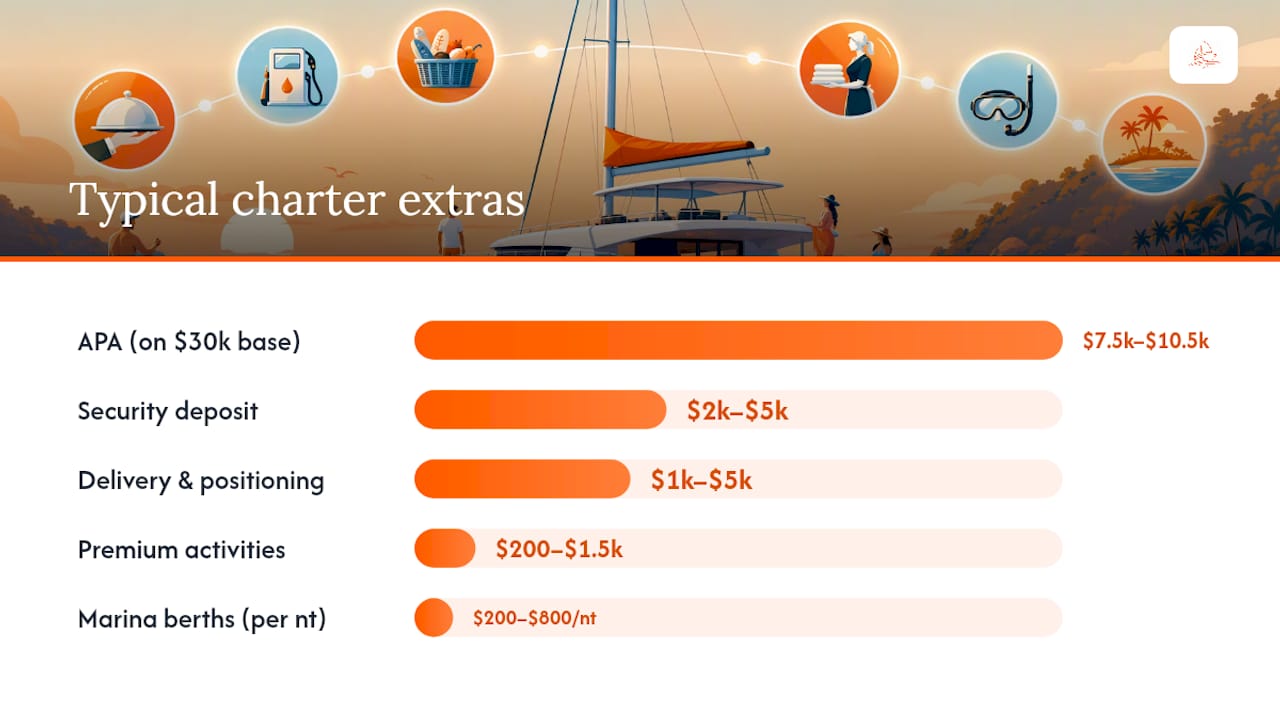
Advance Provisioning Allowance (APA): Typically 25–35% of the base charter fee on APA-model charters. Paid upfront before departure. The captain manages it as a running expense account. Any unspent balance is returned at the end of the week; overages are charged to the charterer's card on file. On a $30,000 base, that means $7,500–$10,500 deposited before you step aboard.
On a $35,000 charter, budget $5,250–$7,000. This is not included in the base rate and is not optional by convention.
Taxes and local fees: U.S. domestic charters (Florida, USVI) are subject to state or territory taxes and harbor fees. Foreign-flag vessels operating in U.S. waters face additional compliance requirements. Caribbean island groups like the BVI and USVI each have their own port entry fees, customs clearance charges, and cruising permits, typically $200–$800 per week depending on itinerary.
Fuel surcharges: All-inclusive charters usually cover fuel within a defined cruising range. Longer legs or motor-heavy itineraries can trigger fuel overages. APA charters draw fuel from the float, but heavy motoring in the Greek islands can exhaust the APA faster than expected.
Marina and mooring fees: Mooring ball fees in the BVI run roughly $30–$50/night per ball. Marina berths in popular ports (Gustavia, St. Barts; Mykonos) can run $200–$800/night and are almost never included in the base rate.
Security deposit: Bareboat charters require a damage deposit, typically $2,000–$5,000, held against the credit card and released after the vessel inspection. Crewed charters may require a smaller deposit or none at all.
Delivery and positioning fees: If you want a vessel delivered to a non-base port, or if you book a one-way itinerary, expect a delivery fee covering crew repositioning and fuel. These vary widely but can add $1,000–$5,000 to the total.
Premium activities: Scuba diving, private guides, helicopter transfers, and specialty dining ashore are never included and should be budgeted separately at $200–$1,500+ depending on the activity.
Understanding how service fees, taxes, and gratuities interact across regions prevents the most common budgeting shock: arriving at the dock with a number that's $8,000 short of what the captain expects.
Pro Tip: At the end of the charter, ask the captain for a full APA reconciliation spreadsheet showing every transaction. Reputable operators produce this automatically. If yours doesn't, request it before you settle the final balance.
Bareboat vs. crewed catamaran: which one fits your budget and skills?
The cost difference between bareboat and crewed charters is significant, but the decision isn't purely financial.
Bareboat charters put you in command. You rent the vessel, handle navigation, provisioning, and anchoring yourself. Most charter companies require proof of sailing competency (a recognized license such as ASA 104 or equivalent, or a sailing résumé), and a skipper can be hired separately if you fall short. Bareboat rates are substantially lower: a 45 ft catamaran in the USVI or Florida Keys runs $3,500–$9,000/week. The security deposit is higher, typically $2,000–$5,000, and you carry more responsibility for damage. Insurance is either provided by the charter company (with a deductible) or purchased separately. Yacht charter documentation and insurance checklists outline the standard requirements for bareboat qualification and deposit schedules.
Crewed charters include a professional captain and at minimum a chef/mate. The crew handles navigation, cooking, provisioning, and boat maintenance. You show up, sail, eat, and enjoy. The price premium is real: a comparable 50 ft crewed cat costs roughly 3–5 times the bareboat rate for the same vessel, largely because you're paying for two to four salaries, provisioning, and a higher service standard. The upside is that crewed charters work for guests with zero sailing experience and deliver a genuinely different quality of experience.
Bareboat vs. crewed: key decision factors
| Factor | Bareboat | Crewed |
|---|---|---|
| Weekly cost (50 ft, Caribbean) | $8,000–$15,000 | $25,000–$45,000 |
| Sailing experience required | Yes (license or résumé) | None |
| Provisioning responsibility | Charterer | Crew/captain |
| Privacy and flexibility | High | Moderate (crew aboard) |
| Ideal group profile | Experienced sailors, budget-conscious | Mixed groups, luxury seekers, families |
| Security deposit | $2,000–$5,000 | Minimal or none |
Three questions to steer your decision
- Does anyone in your group hold a recognized sailing certification or have documented offshore experience? If not, crewed is your only realistic option unless you hire a skipper.
- Is your group comfortable sharing the boat with two to four crew members living aboard? Crewed charters are intimate; the crew sleeps in a forward cabin and is present throughout.
- Is your priority cost-per-person or quality of experience? A bareboat split 8 ways can run under $1,500/person/week. A crewed charter split the same way runs $3,500–$5,600/person/week but delivers a meaningfully different trip.
For groups researching how vessel size and guest count affect logistics, the cabin configuration matters as much as the price tier.
How does seasonality affect catamaran hire fees?
Timing your charter is one of the highest-leverage decisions in the entire budget.
High-season windows by region:
- Caribbean (BVI/USVI, Bahamas): mid-December through April. Christmas/New Year weeks command the steepest premiums and are often sold a full year in advance.
- Mediterranean (Greece, Croatia): July and August. The Ionian and Aegean are packed; prices peak and availability tightens sharply.
- U.S. Northeast (New England, Chesapeake): June through August, with July 4th week carrying a holiday surcharge.
- Florida/Keys: Winter and spring (December–April) are peak; summer is shoulder season with lower rates and manageable weather.
Holiday surcharges for Christmas/New Year and July 4th weeks are typically built into the base rate rather than added as a line item, but they're real: a Caribbean week that costs $32,000 in February might run $40,000–$42,000 for the same vessel over New Year's.
Itinerary-driven cost factors:
- Remote anchorages like the Exumas in the Bahamas add delivery or positioning fees if the vessel's home base is Nassau or Marsh Harbour
- One-way itineraries (e.g., Tortola to St. Martin) require crew repositioning and typically add $1,000–$3,000 to the total
- Long repositioning legs between island groups can consume APA float faster than a standard loop itinerary
Practical flexibility levers:
- A Saturday start instead of the standard Saturday-to-Saturday can sometimes unlock a lower weekly rate
- Booking shoulder season (May–June in the Caribbean; September–October in the Mediterranean) often saves 15–25% versus peak
- Accepting a vessel that's already positioned in your destination eliminates delivery fees entirely
How do you get a firm quote and lower your total cost?
Getting an accurate quote requires more specificity than most first-time charterers expect. A vague inquiry gets a vague range; a detailed brief gets a number you can actually budget against.
Step-by-step quote request checklist
- Exact dates (start and end, including preferred embarkation port)
- Guest count and cabin configuration (number of adults, children, couples vs. singles)
- Provisioning preferences (full board, half board, or self-provisioned)
- Fuel assumptions (daily motoring hours or expected miles)
- Pricing model preference (all-inclusive or APA)
- Add-ons required (skipper for bareboat, diving equipment, water toys)
- Budget ceiling (helps the broker or platform filter to realistic options)
Timing strategy
Book 6–12 months ahead for peak-season weeks on popular vessels. The best 56–62 ft crewed cats in the BVI and Bahamas fill by March for the following December. For shoulder-season or last-minute bookings, a 1–3 month window can yield discounts on unsold inventory, though vessel selection narrows significantly.
Cost-reduction tactics that actually work
- Choose shoulder season. A May Caribbean week or a June Greek week saves 15–25% versus the July/August peak with only a modest weather tradeoff.
- Request an itemized APA sample. Ask the broker for a real APA reconciliation from a recent charter on the same vessel. It tells you exactly how the captain spends the float and whether the quoted APA percentage is realistic.
- Compare all-inclusive vs. APA on total cost. Run both models to their all-up number before deciding. An APA-based quote can look cheaper until you add the float, gratuity, and marina fees.
- Book insured or refundable deposits when booking more than 6 months out. Price volatility and schedule changes are real; a refundable deposit costs slightly more upfront but protects a large outlay.
- Use a low-fee platform. Traditional broker commissions run 10–20% of the base rate. Sailorix's membership model charges roughly 1% in service fees, which on a $35,000 charter translates to a meaningful difference in net cost.
For deeper tactics on saving on yacht bookings, the mechanics of timing and platform selection compound quickly across a multi-week trip.
Pro Tip: When comparing quotes from different sources, always ask for the "all-up" number: base rate + APA (if applicable) + gratuity + taxes + estimated marina fees. Two quotes at the same base rate can differ by $8,000–$12,000 all-up depending on the model and destination.
What most planners get wrong about catamaran charter budgeting
The most consistent budgeting error we see at Sailorix is treating the base charter rate as the trip cost. It isn't. A €32,000 Greek week becomes €45,000–€51,000 before anyone books a flight.
Caribbean all-inclusive charters are genuinely simpler to budget, but even there, planners routinely forget gratuity. On a $38,000 charter, that's $5,700–$7,600 in cash the crew expects at the end of the week. Forgetting it doesn't just affect your budget; it affects the crew's livelihood and your reputation as a charterer.
The other common mistake is over-estimating what the APA covers. The float is for running expenses, not for premium experiences. Scuba diving, helicopter transfers, and private dining ashore come out of your pocket, not the captain's float. Budget those separately.
Sailorix's membership model and real-time availability search address a different but related problem: the opacity of broker pricing.
Sailorix makes catamaran charter pricing transparent and affordable
Catamaran charter cost research takes time, and the gap between a quoted base rate and the real all-up number catches most planners off guard.

That's a week of provisioning, crew gratuity, or a scuba diving package. The annual membership fee is €100, and it pays for itself on the first booking. Search available catamarans, compare all-inclusive and APA options side by side, and request a firm quote on Sailorix with your exact dates and guest count today.
Sources
A note on these figures: All price ranges are 2026 market approximations based on published charter market data and platform listings. Actual pricing varies by vessel, operator, season, and itinerary. Always request a firm, itemized quote from your charter company or platform before committing a deposit.