

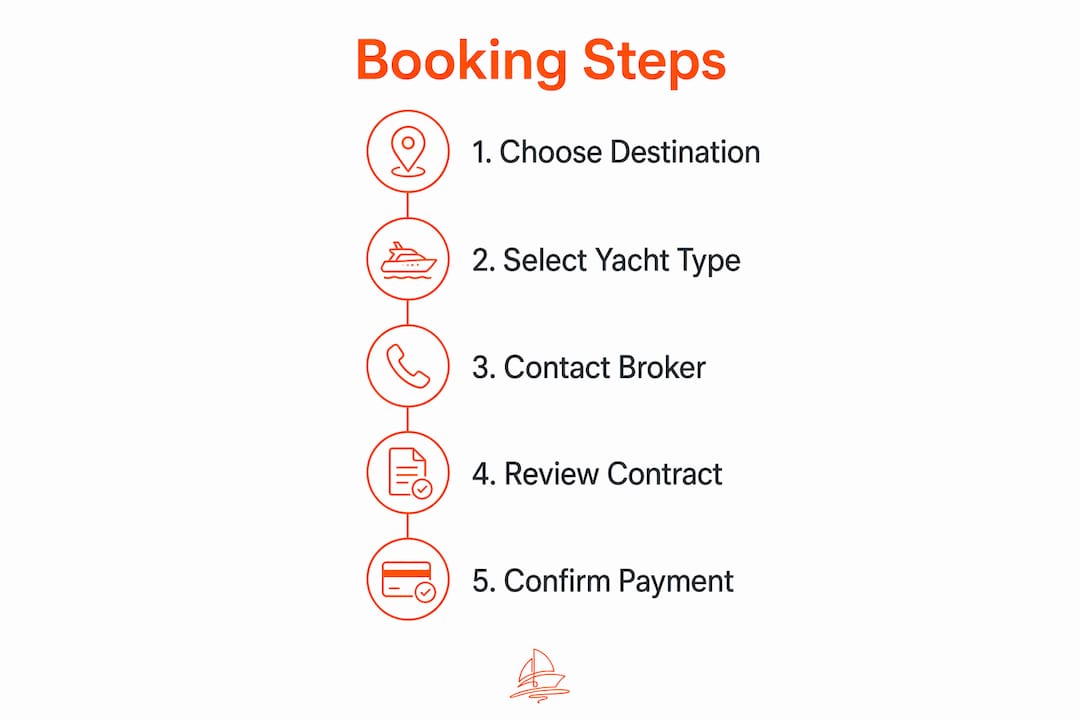
Booking a yacht means arranging a private vessel charter tailored to your destination, group size, and vacation budget. The yacht charter process covers five clear stages: destination selection, yacht type, broker engagement, contract review, and payment. First-timers often underestimate costs like the Advance Provisioning Allowance (APA) and crew gratuity, which can add 30–50% on top of the base charter fee. This guide walks you through every stage so you arrive at the dock confident, not confused.
How to book a yacht: choose your destination and vessel first
The destination you pick determines your budget, your sailing window, and the type of yacht that makes sense. Getting this decision right before you browse listings saves weeks of back-and-forth.
Match your destination to the season
The Mediterranean is best from may through october, with peak demand running june through august. The Caribbean peaks from december through april. Book 6–12 months in advance for either peak window to secure the best yachts and itineraries. Off-season bookings typically need only 3–6 months of lead time, and you will find better pricing and more availability.

Destination also affects difficulty. The Greek islands suit beginners with their protected waters and short passages. The BVI (British Virgin Islands) is another classic first-timer destination. Croatia and Turkey offer moderate conditions with stunning coastlines and lower base charter fees than France or Monaco.
Sailing vs. motor yachts: which one fits your trip?
The yacht type decision comes down to experience, pace, and budget. Here is a direct comparison:
| Yacht Type | Best For | Typical Cost Range | Experience Needed |
|---|---|---|---|
| Sailing yacht (bareboat) | Experienced sailors, budget-conscious groups | Lower base fee | Sailing certification required |
| Sailing yacht (skippered) | Beginners who want to learn | Moderate | None |
| Motor yacht (crewed) | Luxury travel, larger groups | Higher base fee | None |
| Catamaran (crewed) | Families, stability seekers | Moderate to high | None |
A bareboat charter means you captain the vessel yourself. A skippered charter adds a professional captain. A fully crewed charter includes captain, chef, and deck crew. Chartering a yacht for groups of 6–12 is often more cost-effective than a cruise or hotel because you pay per vessel, not per person. That math changes everything for larger groups.
Pro Tip: If your group has four or more people, run the per-person cost comparison against a comparable cruise before assuming a yacht is out of reach. You may be surprised.
Why should you work with a yacht charter broker?
A yacht charter broker is the professional who sits between you and the vessel owner, handling vetting, negotiation, and paperwork on your behalf. Skipping a broker to save money is one of the most common first-timer mistakes.
Brokers act as a concierge for the sea, providing vessel vetting, contract negotiation, and itinerary customization. Their commission is built into the charter price, meaning you pay the same whether you use one or not. The protection and expertise come at no extra cost to you.
Here is what a reputable broker delivers:
- Vessel vetting: Brokers inspect safety records, maintenance logs, and crew certifications before recommending a yacht.
- Off-market access: Many premium yachts are never listed publicly. Brokers access these through industry networks.
- Contract protection: Brokers flag unfavorable cancellation clauses and negotiate on your behalf before you sign.
- Dispute resolution: If something goes wrong on the water, your broker advocates for you with the owner.
- Itinerary planning: Experienced brokers know which anchorages are crowded in August and which hidden bays are worth the detour.
Platforms with personalized trip-planning assistance reduce risk and deliver better outcomes than purely automated aggregators. That human layer matters when you are committing thousands of dollars to a week at sea.
Pro Tip: Ask any broker two questions before hiring them: "What crew have you personally sailed with on this vessel?" and "What itinerary would you recommend for our group in this region?" Their answers reveal whether they know the product or are just reading a listing.
You can also explore yacht brokerage explained to understand how brokers are licensed and compensated before your first conversation.
What costs should you expect when booking a yacht?
The base charter fee is only the starting point. Most first-timers budget for the headline number and get blindsided by the additional costs that follow. Here is the full picture.
The APA: the cost most people miss
The Advance Provisioning Allowance (APA) is a prepaid fund that covers fuel, food, docking fees, and port taxes during your charter. APA typically runs 20–30% of the base charter fee and must be paid weeks before departure. Misunderstanding the APA is the single most common cause of budget overruns in yacht chartering. If your base fee is $10,000, budget an additional $2,000–$3,000 for APA before you add anything else.
Crew gratuity and regional norms
Crew gratuity is expected and follows regional norms. Standard gratuity runs 10–15% in the Mediterranean and 15–20% in the Caribbean, paid in cash at the end of the charter. This is not optional. A crew of three working a week-long charter earns their gratuity through long hours and personalized service.
| Cost Component | Typical Amount | Notes |
|---|---|---|
| Base charter fee | Varies by vessel and region | The headline price you see listed |
| APA | 20–30% of base fee | Prepaid, reconciled at charter end |
| Crew gratuity | 10–20% of base fee | Cash, paid at departure |
| Cancellation insurance | $100–$400 | Strongly recommended |
| Provisioning extras | Variable | Specialty food, alcohol, excursions |
How to save 10–30% on your rental
Mid-week yacht rentals save 10–30% compared to weekend bookings because demand drops sharply from monday through thursday. If your schedule allows flexibility, shifting your start day from saturday to tuesday can fund your crew gratuity. For more strategies, the Sailorix guide on saving on yacht bookings covers timing, negotiation, and platform fee comparisons in detail.
Pro Tip: Always ask your broker for an itemized cost estimate that includes APA, gratuity, and provisioning before you sign anything. A reputable broker provides this without hesitation.
How to review and finalize your charter contract
The contract stage is where most first-timers rush. Reading it carefully takes two hours. Fixing a problem after signing can take months.
The standard payment structure requires a 50% deposit at signing with the balance due 60–90 days before departure. That timeline matters because it determines when your money is at risk. Once the balance is paid, your exposure is total unless you have cancellation insurance.
Cancellation insurance costs $100–$400 and protects your deposit if weather, mechanical failure, or a force majeure event cancels the trip. It is one of the highest-value purchases in the entire booking process. Force majeure clauses vary widely between contracts, so do not assume your deposit is protected without reading the specific language.
"The contract is not a formality. It is your only protection if the vessel breaks down the morning of departure or a storm closes the port."
Before you sign, check every one of these items:
- Cancellation policy: What percentage do you lose at 90 days out? At 30 days? At 7 days?
- Force majeure definition: Does it cover government travel restrictions or only weather?
- Security deposit terms: How much is held, when is it released, and what triggers a deduction? The Sailorix resource on security deposit practices explains industry norms clearly.
- APA reconciliation: How are unspent funds returned, and within what timeframe?
- Substitution clause: Can the owner swap your vessel for a different one without your approval?
The full booking workflow from destination selection through final payment follows a logical sequence. Understanding each step before you start prevents the most expensive surprises.
Key takeaways
Booking a private yacht charter requires early planning, a clear budget that includes APA and gratuity, a vetted broker, and a contract you have read line by line.
| Point | Details |
|---|---|
| Book early for peak seasons | Reserve 6–12 months ahead for Mediterranean and Caribbean peak windows. |
| Budget beyond the base fee | Add 20–30% for APA and 10–20% for crew gratuity to your total cost estimate. |
| Use a charter broker | Brokers provide vetting, contract protection, and off-market access at no extra cost to you. |
| Read the contract carefully | Check cancellation policy, force majeure, security deposit terms, and APA reconciliation before signing. |
| Buy cancellation insurance | A $100–$400 policy protects your deposit against weather, mechanical failure, and force majeure events. |
What first-timers get wrong about yacht booking
After watching hundreds of first-time charterers go through the booking process, the pattern is consistent. People spend 80% of their research time on the yacht photos and 20% on everything else. That ratio should be reversed.
The yacht is the least likely thing to disappoint you. The crew, the itinerary, and the contract are where the real experience lives. A stunning 60-foot sailing yacht with an indifferent captain and a poorly planned route will lose to a modest 45-foot catamaran with an experienced crew who knows every hidden anchorage in the region.
The other mistake I see constantly is treating the APA as a surprise rather than a budget line. Experienced charterers build the APA into their first calculation. First-timers discover it after they have already committed emotionally to a vessel they cannot actually afford.
My honest advice: get quotes from at least two or three brokers before committing. Not because brokers are untrustworthy, but because the comparison teaches you what questions to ask. The broker who gives you the most detailed cost breakdown upfront is almost always the one worth working with.
Yacht chartering is genuinely accessible for anyone willing to plan carefully. The process is not complicated. It just requires that you treat it like the significant purchase it is.
— Sailorix
Start your yacht booking with Sailorix
Sailorix makes the yacht rental process straightforward for first-timers and experienced charterers alike. The platform offers real-time availability, transparent pricing, and a membership model that keeps service fees at roughly 1%, far below the 10–20% charged by most booking platforms.

For €100 per year, Sailorix members access exclusive rates on yachts and boats worldwide with no hidden markups buried in the checkout process. Whether you are planning a week in the Greek islands or a weekend on the water closer to home, Sailorix connects you directly to verified vessels at the lowest market prices. Explore yacht rentals on Sailorix and start building your itinerary today.
FAQ
How far in advance should i book a yacht charter?
Book 6–12 months ahead for peak seasons like the Mediterranean in summer or the Caribbean in winter. Off-season charters typically need 3–6 months of lead time.
What is the APA in a yacht charter?
The Advance Provisioning Allowance (APA) is a prepaid fund covering fuel, food, docking fees, and port taxes. It typically equals 20–30% of the base charter fee and is paid before departure.
How much does it cost to rent a yacht per week?
Base charter fees vary widely by vessel size, region, and season. Budget an additional 20–30% for APA and 10–20% for crew gratuity on top of whatever base fee you see listed.
Do i need a broker to book a private yacht?
A broker is not legally required, but their commission is built into the charter price regardless. Using one gives you contract protection, vessel vetting, and dispute resolution at no extra cost.
What should i check before signing a yacht charter contract?
Review the cancellation policy, force majeure clause, security deposit terms, APA reconciliation process, and any vessel substitution clause before signing. Consider purchasing cancellation insurance for $100–$400 to protect your deposit.