
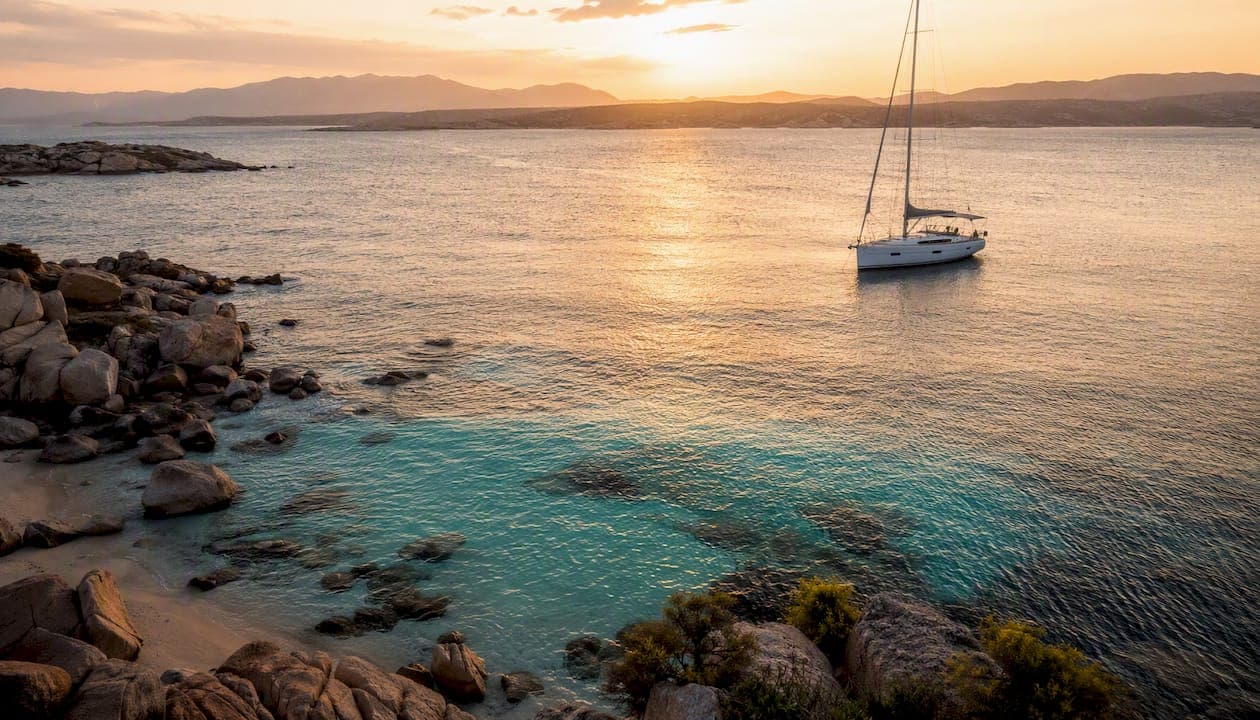
The best Sardinia sailing itinerary for most charterers is the 7-day Costa Smeralda and La Maddalena loop, starting and ending in Cannigione. Short passages (rarely more than 15 nautical miles), world-class anchorages, and reliable marina support at every major stop make it the most forgiving and rewarding route for both first-timers and experienced crews. Alternatives include shorter or longer versions that adjust island stops and extend to other parts of Sardinia according to schedule and interests.
Quick logistics verdict: Cannigione is the sharpest embarkation base for the 7-day loop. A medium-sized monohull is practical for this route; a catamaran is advisable for crews of four or more planning to anchor out most nights. Skippered charter is worth the cost for first-time multi-day crews; experienced sailors with an ICC can go bareboat.
Key Takeaways
The 7-day Costa Smeralda and La Maddalena loop from Cannigione is the most practical and rewarding Sardinia sailing itinerary for multi-day charterers, with short legs, top anchorages, and full marina support.
| Point | Details |
|---|---|
| Best base and route | Cannigione is the sharpest starting point for the 7-day Costa Smeralda and La Maddalena loop. |
| Arrive early at anchorages | Popular spots like Cala Corsara fill by noon in peak season; target arrival before 11 AM. |
| Park rules matter | La Maddalena National Park bans anchoring in Posidonia meadows; obtain the overnight permit before entering. |
| Shoulder seasons win | May, June, September, and October offer the best balance of weather, availability, and uncrowded anchorages. |
| Book via Sailorix | Sailorix's €100 annual membership cuts service fees to roughly 1%, saving real money on a week-long Sardinia charter. |
Table of Contents
- What does a Sardinia sailing itinerary look like day by day?
- Charter logistics: bases, marina facilities, and what things cost
- How anchoring and mooring work in Sardinia
- When is the best time to sail Sardinia?
- Safety, park rules, and crossing to Corsica
- Your pre-departure booking and packing checklist
- Which itinerary fits your crew?
- Book your Sardinia charter through Sailorix
- Sources
What does a Sardinia sailing itinerary look like day by day?
The 7-day Costa Smeralda and La Maddalena route is the itinerary most charter skippers and independent sailors converge on, and for good reason: every leg is short enough to leave the dock at 9 AM and be anchored by early afternoon, leaving real time ashore.
7-day classic route
Day 1: Cannigione to Cala di Volpe (8 nm) Leave Cannigione marina after the charter briefing and motor or sail south along the Costa Smeralda. Cala di Volpe offers a well-protected anchorage with good holding in sand. The famous Hotel Cala di Volpe sits on the hillside above; the beach bar is worth the dinghy ride ashore. Anchor in 4–6 meters or pick up a private buoy if available.
Day 2: Cala di Volpe to Cala Corsara, Spargi (14 nm) This is the longest leg of the week, crossing north toward the archipelago. Cala Corsara on the island of Spargi is one of the finest anchorages in the Mediterranean: turquoise water, white sand, and a natural bowl that blocks most swell. Full-day excursion operators include it as a primary stop for good reason. Arrive before 1 PM in July or August to secure space. Anchor in 5–8 meters over sand; holding is excellent.
Day 3: Cala Corsara to Budelli (6 nm) A short hop to Budelli, home of the famous Spiaggia Rosa (Pink Beach). Landing on the beach itself is prohibited under La Maddalena National Park rules, but you can swim to it from the boat and admire the pink-tinged sand from the water. Buoys are available in the cove; anchoring directly off the beach is restricted. Skippered catamaran excursions typically stop here alongside Spargi and Santa Maria, which tells you these three islands form the core of the archipelago experience.
Day 4: Budelli to Santa Maria Island (4 nm) The shortest leg of the trip. Santa Maria has a spectacular double beach, one on each side of a narrow isthmus, and the snorkeling off the eastern point is exceptional. Anchor in the northern bay in 4–6 meters over sand. No marina; this is a pure anchor stop. Pick up provisions in La Maddalena the following day.
Day 5: Santa Maria to La Maddalena town (7 nm) La Maddalena town is the social hub of the archipelago. The marina fills fast in summer, so call ahead or arrive by noon. Fuel dock, water, provisioning supermarkets within walking distance, and a string of restaurants along the waterfront. Spend the afternoon walking the old town and the evening at a seafood restaurant on Via Amendola.
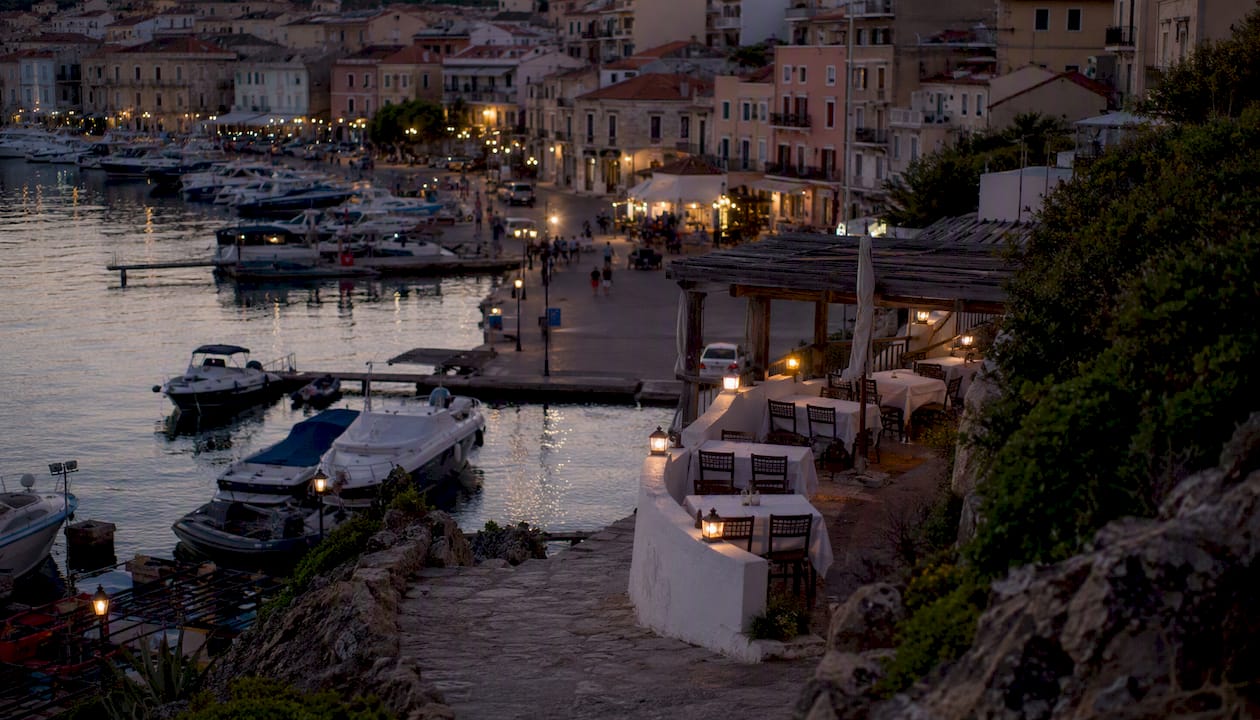
Day 6: La Maddalena to Palau (5 nm) Cross the short channel back to the Sardinian mainland at Palau. The town is relaxed, the marina is well-run, and it's a good base for a half-day hike to Capo d'Orso (the famous bear-shaped granite rock). Fuel up here if you didn't in La Maddalena.
Day 7: Palau to Cannigione (10 nm) A gentle final sail south along the coast, passing Porto Pollo (a kite-surfing hotspot) and back to Cannigione for checkout. Most charters require return by 5 PM.
5-day condensed option
Skip Cala di Volpe on Day 1 and sail directly to Spargi (22 nm, about 4 hours). Combine Budelli and Santa Maria into one day. This compresses the outer islands into three nights and leaves two nights in La Maddalena and Palau. You lose the Costa Smeralda coast but keep every major archipelago highlight.
10-day extended option
After the 7-day loop, add a southward leg: Cannigione → Olbia → Tavolara Island (spectacular limestone monolith, anchor in the bay) → Villasimius → Cagliari. Alternatively, head west: Alghero's old town and the Neptune's Grotto sea caves are worth two nights. The sailing routes in Sardinia extend well beyond the north, but the north is where the charter infrastructure is densest.
Charter logistics: bases, marina facilities, and what things cost
Choosing your embarkation base
Cannigione is the top pick for the 7-day loop. The marina is well-organized, charter companies are based here, and it sits at the southern entrance to the La Maddalena channel. Provisioning supermarkets are a short walk away. The town itself is quiet, which suits a Day 0 arrival.
Olbia / Porto Rotondo suits crews flying into Olbia Costa Smeralda Airport (OLB) who want to avoid a transfer. The marina at Porto Rotondo is upscale and well-serviced, but berthing fees are higher. Add a half-day sail north to reach the archipelago.
Portisco / Cala dei Sardi sits between the two and works well for crews who want to start with a Costa Smeralda coastal sail before heading into the archipelago. Less crowded than Porto Cervo, more facilities than a small cove anchorage.
Marina facilities and provisioning
Most marinas on the 7-day route offer:
- Fuel docks (diesel and petrol) at Cannigione, La Maddalena, and Palau
- Fresh water at all three main marinas; carry a 20-liter jerry can for anchor-only nights
- Provisioning supermarkets within walking distance in Cannigione, La Maddalena, and Palau
- Laundry at Cannigione and La Maddalena marinas
- Basic mechanical assistance at Cannigione and La Maddalena
The outer islands (Spargi, Budelli, Santa Maria) have no facilities. Carry enough food and water for two full days when you leave La Maddalena heading into the archipelago.
Typical costs to budget
- Berthing fees: roughly €30–€80 per night at mid-range marinas (Cannigione, Palau); Porto Cervo and Porto Rotondo run significantly higher
- La Maddalena National Park permit: required for overnight stays in the park; fees vary by boat size and season
- Buoy fees: €15–€30 per night at managed buoy fields in the archipelago
- Fuel: budget for two full tank fills over 7 days depending on motoring conditions
- Provisioning: a well-stocked boat for four people for 7 days typically runs €300–€500 at local supermarkets
- Tourist tax: some municipalities charge a small nightly fee per person
For budget charter planning, booking early and comparing membership-based platforms can cut service fees significantly.
How anchoring and mooring work in Sardinia
Seabed and scope
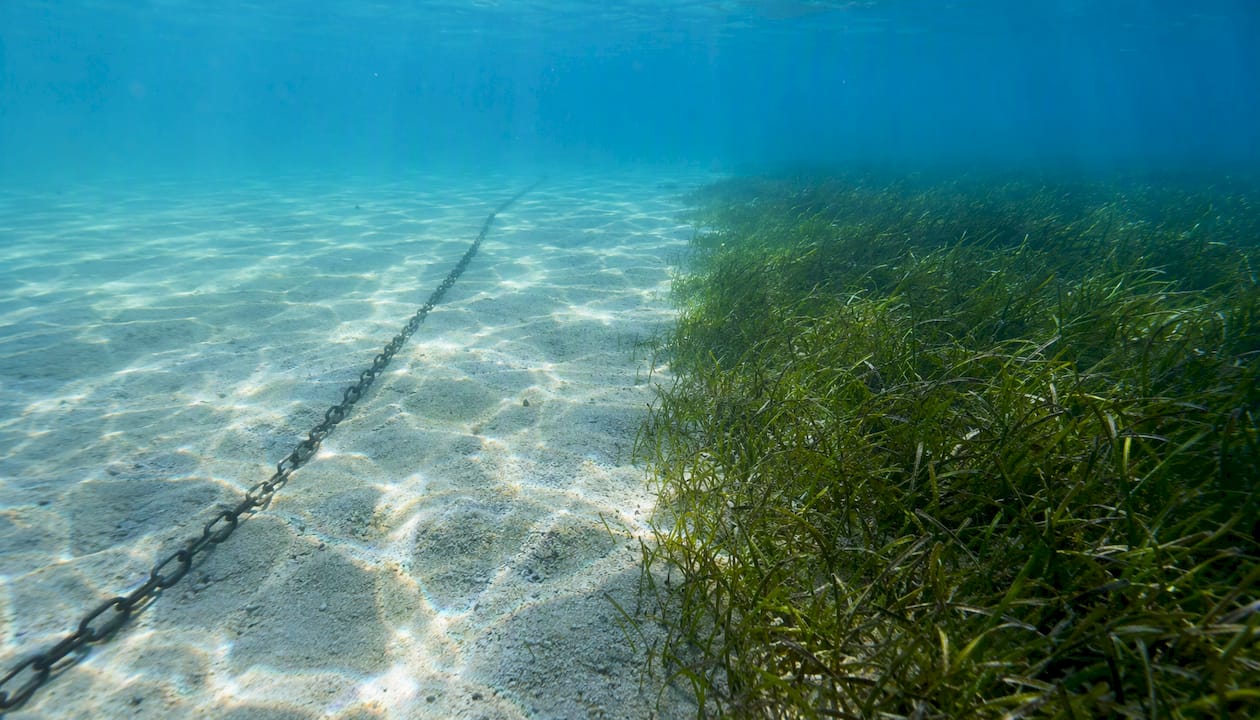
Sardinia's anchorages split between sand (excellent holding, common in the archipelago coves) and Posidonia oceanica seaweed meadows (poor holding, and anchoring in them is illegal in protected areas). When you see the characteristic dark patches on the chart plotter, move to a sandy gap. A scope of 4:1 to 5:1 is standard in calm conditions; increase to 6:1 or 7:1 if the Mistral is forecast.
La Maddalena National Park rules
The park covers the entire archipelago. Key restrictions:
- No anchoring in Posidonia meadows anywhere in the park
- Spiaggia Rosa (Budelli) is a no-landing zone; swimming access only
- Speed limits of 5 knots within 300 meters of shore in most park zones
- Overnight anchoring in certain coves requires a park permit or use of designated buoys
- Penalties for violations can reach several hundred euros
The park's protected status is strictly enforced in peak season, with patrol boats active from June through September.
Buoy fields and marina timing
Managed buoy fields operate at Cala Corsara, the Budelli area, and several other popular coves. Buoys are first-come, first-served unless you book through the park's system. In July and August, popular anchorages like Cala Corsara fill by noon.
Pro Tip: Arrive at popular anchorages by 10:30–11 AM in peak season. Overnight boats leave in the morning, and day-trip excursion boats arrive after noon. That two-hour window is your best shot at a prime spot.
For marina berths in La Maddalena and Palau in July and August, call ahead the morning of your arrival. VHF Channel 9 is the standard working channel for most marinas in this area.
When is the best time to sail Sardinia?
May and June are the sweet spot. Temperatures are warm (22–26°C), anchorages are uncrowded, marinas have availability, and the Mistral is manageable. Water temperature is cooler than August but perfectly swimmable by mid-June.
July and August bring peak crowds, peak prices, and peak wind. The Mistral can blow 25–35 knots through the Bonifacio Strait with little warning, pinning boats in harbor for a day or two. Anchorages fill by midday. That said, the water is at its warmest and the atmosphere is electric. If you sail in August, build buffer days into the itinerary.
September and October rival May and June for conditions. The Mistral settles, crowds thin dramatically after the first week of September, and marina rates drop. Water stays warm through October. This is the best sailing season for crews who want the full experience without the August pressure.
Wind patterns to know: The Mistral (from the northwest) is the dominant wind in the north. It accelerates through the Bonifacio Strait between Sardinia and Corsica and can reach gale force with little warning. Thermal sea breezes (from the west and southwest) develop most afternoons in summer, typically 10–18 knots, and make for pleasant afternoon sailing. Check Windy or PredictWind the evening before each passage.
Safety, park rules, and crossing to Corsica
Safety equipment checklist
Before leaving the dock, confirm:
- Life jackets (one per person, plus one spare) and harnesses for offshore passages
- VHF radio (fixed and handheld), with Channel 16 monitored at all times underway
- Flares (in-date), fire extinguisher, and bilge pump
- First aid kit including seasickness medication, wound care, and any personal prescriptions
- EPIRB or PLB registered to the vessel
- Paper charts as backup to chartplotter (electronics fail)
Emergency contacts: The Italian Coast Guard (Guardia Costiera) monitors VHF Channel 16 and can be reached by phone at 1530 from Italian waters. The nearest hospitals to the route are in Olbia (Ospedale Giovanni Paolo II) and La Maddalena (Ospedale Paolo Merlo).
Crossing to Bonifacio, Corsica
The Bonifacio Strait is only 7 nm wide but carries some of the strongest currents and most unpredictable wind acceleration in the western Mediterranean. If you want to cross:
- Carry valid passports for all crew (France/EU border)
- File a crew list (zarpe) with Italian port authorities before departure
- Call Bonifacio port on VHF Channel 9 for berth availability
- Cross in the morning before thermal winds build; the strait is calmer before 10 AM
- Expect 2–3 knot currents; plan your course accordingly
The crossing adds roughly 14 nm round-trip and fits naturally into a 10-day itinerary. On a 7-day loop, it's possible as a day trip from Palau but adds pressure to the schedule.
Your pre-departure booking and packing checklist
Before you book
- Confirm charter type: bareboat (requires ICC or equivalent sailing qualification) or skippered
- Read the charter contract: check the security deposit amount, fuel policy (full-to-full is standard), and damage waiver terms
- Book the La Maddalena National Park permit if your charter company doesn't handle it
- Arrange travel insurance that covers sailing and medical evacuation
- Pre-order provisioning through the charter base or a local delivery service if arriving late
Embarkation day checks
- Walk the boat with the charter agent: note any existing damage on the handover form
- Test engine start, bilge pump, VHF, and navigation lights before leaving the dock
- Confirm tender (dinghy) is inflated and outboard starts
- Check fuel and water tank levels; fill both before departure
- Download offline charts to your chartplotter or tablet (Navionics works well for this area)
- Buy a local SIM or confirm your US carrier's Italy roaming plan; signal is good near towns, patchy in the outer islands
What to pack for Sardinia
- High-SPF sunscreen (SPF 50+) and reef-safe formulas for the park zones
- Polarized sunglasses (essential for reading the water depth by color)
- Foul-weather jacket and fleece for evening passages and Mistral days
- Non-marking sailing shoes or deck shoes
- Small cash (euros) for island bars, beach kiosks, and buoy fees
- Reusable water bottles; most marinas have potable water
- Snorkeling gear; the archipelago's visibility regularly exceeds 20 meters
For a complete first-charter walkthrough, the beginner's yacht rental guide covers paperwork and what to expect on handover day.
Which itinerary fits your crew?
The 7-day classic suits first-time multi-day charterers almost perfectly. Legs stay under 15 nm, marina nights in La Maddalena and Palau give the crew a chance to regroup, and the archipelago delivers the kind of anchorages that make people book again the following year. The route is forgiving enough that a skipper can adjust for weather without losing the highlights.
The 5-day version works for short-break sailors who know what they want: the outer islands, the pink beach, the turquoise water. You skip the Costa Smeralda coast, but that's a fair trade for a tighter schedule.
The 10-day extended route is for crews who have done the north and want more. The west coast (Alghero, Bosa) is dramatically different in character, with fewer charter boats and more rugged coastline. The south (Villasimius, Cagliari) adds a city stop and some of Sardinia's best diving.
On boat choice: a 38–42 ft monohull is the practical default. It fits in any marina berth, handles the Mistral comfortably, and costs less to charter. A catamaran makes sense for groups of six or more, or for crews who plan to anchor out every night and want the stability and deck space. Catamarans offer shallower drafts that open up coves a monohull can't enter, which matters in the archipelago. The trade-off is marina cost: cats often pay double the monohull rate at busy marinas.
For crews booking their first multi-day charter, a skippered option removes the navigation stress entirely and lets everyone enjoy the trip from day one.
Book your Sardinia charter through Sailorix
Sardinia charters book out fast, especially for July and August departures from Cannigione. Sailorix gives you real-time availability across the full fleet, from 38 ft monohulls to large catamarans, with filters for skippered charters, add-on provisioning, and early check-in. The annual membership costs €100 and drops service fees to roughly 1%, compared to the 10–20% most booking platforms charge. On a week-long Sardinia charter, that difference is real money back in your pocket for buoy fees, park permits, and waterfront dinners.
Search by embarkation base (Cannigione, Olbia, Portisco), select your boat type, add a skipper if you want one, and request provisioning delivery before you arrive. The whole process takes under 15 minutes. Start your search at Sailorix and check availability for your chosen dates before the summer fleet sells out.
Sources
- Sardinia Sailing Itinerary: Maddalena Archipelago and ...
- Sailing Sardinia
- Boat Trip La Maddalena: Full Day Itinerary | Motonave Garibaldi II
- Deluxe Catamaran to La Maddalena Archipelago – Turquoise Sea, Hidden Coves & Flavors On Board - GO Sardinia - Escursioni in Sardegna e Corsica
- Leopardcatamarans