

Most sailors know the mast of a sailboat holds the sails up. That is technically true and almost entirely unhelpful. The mast is the structural spine of your entire rig, a carefully engineered spar that manages compression loads, transmits wind forces, and determines how well your boat points upwind. It also carries navigation lights, radio antennas, and wind instruments. Getting it wrong means sluggish performance at best and a catastrophic dismasting at worst. This guide covers everything from mast anatomy and materials to maintenance inspections, rig tuning, and advanced troubleshooting.
Table of Contents
- Key takeaways
- What the mast of a sailboat actually does
- Mast and rigging maintenance before the season
- Rig tuning: shroud tension, rake, and bend
- Advanced inspection and troubleshooting
- Preparing your mast for a full sailing season
- What I have learned from years of watching rigs fail
- Explore your next sailing adventure with Sailorix
- FAQ
Key takeaways
| Point | Details |
|---|---|
| The mast is structural, not decorative | It manages compression, transmits sail forces, and supports critical onboard systems. |
| Material choice matters for performance | Aluminum balances cost and weight well; carbon fiber offers superior stiffness for racers. |
| Pre-season inspection saves lives | Check for broken strands, rust at swages, and cracked fittings before every sailing season. |
| Rig tuning requires sailing, not just wrenches | Static checks are a starting point; a short upwind test reveals true mast behavior under load. |
| Replace standing rigging proactively | Wire rigging should be replaced after 10 to 15 years regardless of visual appearance. |
What the mast of a sailboat actually does
Think of the sailing mast not as a pole but as a loaded column under constant competing forces. Wind pushing against the sails generates sideways and forward loads that travel through the rig and compress the mast from top to bottom. Rigging supports reduce the mast's unsupported length, which directly lowers its buckling risk. The stays and shrouds absorb lateral wind forces while creating the critical compression that keeps the whole spar upright.
Beyond structural duty, the mast also supports navigation lights, radio aerials), wind instruments, and lookout positions. Ignoring any one of these roles when planning a mast inspection or replacement leads to problems that show up at the worst possible moment, usually offshore and in deteriorating weather.
Key components of a sailboat mast
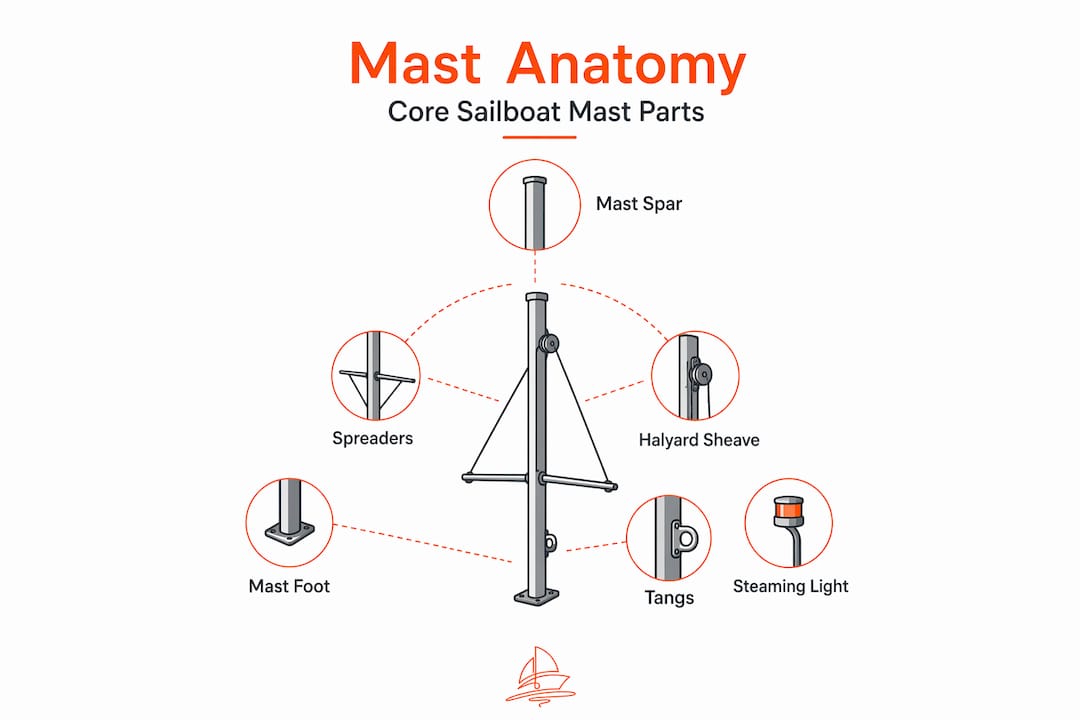
Every mast, regardless of material or configuration, shares a set of core components you should know by name.
The spar is the main vertical tube or solid rod. At the mast foot, it connects to a stepped base either on deck or in the keel. At the masthead, it terminates in a cluster of sheaves, exits for halyards, and attachment points for the forestay and backstay. Spreaders extend horizontally from the spar to widen the angle of the shrouds, giving them better mechanical leverage to resist lateral loads. The boom, a horizontal spar attached at the mast's lower section, controls the foot of the mainsail and is a part of the rig most beginners overlook until it swings across the cockpit unexpectedly.
Mast types and materials compared
The mast type you sail with depends on your boat's design and intended use.
| Mast type / material | Best use case | Key trade-off |
|---|---|---|
| Single aluminum mast (sloop) | Cruising, daysailing | Affordable, easily repaired, heavier than carbon |
| Carbon fiber mast | Racing, performance cruising | Stiff and light but expensive and harder to repair |
| Wooden mast | Classic and traditional vessels | Beautiful, repairable, requires more maintenance |
| Ketch (two masts) | Long-distance ocean cruising | Spreads sail area, adds flexibility; more rigging to maintain |
| Schooner (two masts, foremast shorter) | Traditional blue-water voyaging | Complex sail plan, distinctive appearance |
Aluminum dominates modern production sailboats because it strikes a practical balance between weight, cost, and corrosion resistance. Carbon fiber masts for sailboats have gained serious ground among racers because a lighter mast lowers the boat's center of gravity and reduces pitching in waves. Wooden masts remain alive in the classic boat world, where character and tradition outweigh the appeal of low-maintenance engineering.
Mast and rigging maintenance before the season
The overwhelming majority of mast and rig failures are not sudden. Many problems start with progressive, invisible damage during winter storage: slow corrosion under swage fittings, micro-cracking at stressed points, and moisture working into wire strands season after season. By the time something looks wrong, it may already be dangerous.
A thorough pre-season inspection covers these areas:
- Standing rigging: Look for broken wire strands, rust weeping from swage fittings, bent or missing cotter pins, and excessive play at any terminal fitting.
- Turnbuckles: Clean them, re-grease the threads, and confirm that both ends are properly locked with cotter pins or seizing wire.
- Mast groove and sail track: Run your hand along the full length. Bent or cracked sections will bind your sail slides and can tear a sail under load.
- Furling systems: Check foil sections for alignment and bearing for free rotation. A sticky furler at the start of a tack is a real hazard.
- Halyards: Inspect where they pass over the masthead sheave and along any fairleads. The outer sheath hides internal strand damage, so feel for stiffness and kinks rather than just looking.
Pro Tip: For swaged wire terminals, grip the fitting between your thumb and forefinger and gently flex the wire as it exits the swage. A healthy wire feels smooth and consistent. Any crunchiness or movement at the exit point means the wire may have broken strands inside. Replace it before going sailing.
One number worth taking seriously: preventive rig replacement after 10 to 15 years is the professional standard, even when wire looks fine externally. Salt, cyclic loading, and fatigue work invisibly. Replacing rigging before failure is far less expensive than losing a mast at sea. You should also schedule a professional sail and rig visit every few years to catch what you cannot see from deck level.
For a deeper dive into materials and structural considerations, the Sailorix boat mast guide covers selection, maintenance, and inspection strategies in detail.
Rig tuning: shroud tension, rake, and bend
A well-tuned rig is quieter, faster, and safer than a poorly tuned one. Most sailors understand shroud tension vaguely, but three distinct variables actually determine how your mast behaves under sail. Rig tuning involves checking mast drop, lateral alignment, mast bend, and shroud tension as a connected system, not four separate tasks.
Here is a practical tuning sequence:
- Confirm mast drop. With the boat in calm water and no sail up, use a halyard as a plumb line to check that the mast base sits on center athwartships. Adjust the mast heel if needed before touching any standing rigging.
- Set lateral alignment. Tension port and starboard shrouds to equal values. Sight up the track from the foot of the mast to confirm it stands straight, with no lean to either side.
- Adjust mast rake. Rake is the forward or aft lean of the mast. More rake shifts the sail's center of effort aft, which reduces weather helm. Measure it by letting a weighted halyard hang free and measuring from the masthead plumb point to a reference on deck.
- Balance mast bend. Mast bend affects sail shape dramatically. Too much bend flattens the mainsail; too little creates a full, powerful shape. Too tight lower shrouds keep the bottom mast too straight; backstay tension controls bend at the top.
- Set forestay tension. A sagging forestay lets the jib belly off to leeward in a breeze. Pre-tension the backstay to bring it tight, then check again under sail.
Shroud tension is recommended at roughly 10 to 20 percent of breaking load depending on position. Upper shrouds carry more load than lowers. Guessing at this number by feel is how people overtighten and overload their spars. A good Loos gauge costs less than a marina call for a tow.
Pro Tip: After completing your dock-side tuning, go sailing on a close-hauled course in 12 to 16 knots. On each tack, watch the lee shrouds. They should be just barely slack, not completely floppy. If they go loose too early or the mast develops an S-curve, your tension settings need refinement. Testing rig under sail is the only way to confirm the setup is actually working.

Advanced inspection and troubleshooting
The masthead deserves its own section because it is the one place most sailors never go. The masthead carries critical rigging terminals, halyard sheaves, antennas, and lights, making it a single point of failure for your entire rig. Failing sheaves can chew through a halyard under load, and a chewed halyard at the top of the mast is not something you want to discover mid-passage.
Common failure symptoms to look for during a thorough audit:
- Flat spots on masthead sheaves: Run your finger around the sheave groove. A flat spot means the sheave was not rotating freely, and the halyard was sliding rather than rolling. Replace the sheave.
- Bearing stiffness: Spin each sheave by hand. It should turn freely. A sheave that barely moves is about to start grinding through your running rigging.
- Swage cracking: At every swage fitting on the standing rigging, look for hairline cracks running along the barrel. Rust staining below a swage fitting is often a sign the interior wire has already begun corroding.
- Pin and clevis integrity: Every pin needs its cotter pin, split ring, or seizing to be fully intact. A missing cotter pin on a forestay toggle is a slow-motion dismasting waiting to happen.
- Mast pumping: If the mast visibly pumps fore and aft in moderate chop, the rigging is too loose overall. This dynamic loading fatigues the spar and rigging at an accelerated rate.
Pro Tip: If you cannot go aloft yourself, hire a professional rigger with a bosun's chair or a mast camera system at the start of each season. The cost is trivial compared to replacing a mast or, worse, experiencing a failure offshore.
Swage and terminal failure is often hidden from sight; the tactile flex check at the exit point of each swage is one of the most reliable tools in your inspection arsenal.
Preparing your mast for a full sailing season
Good preparation at the dock means fewer problems at sea. Use this checklist as your framework, and keep a written record of every setting and finding for next season.
| Inspection item | Recommended frequency | Notes |
|---|---|---|
| Visual rig inspection | Every season | Check all shrouds, stays, and fittings |
| Tactile swage flex test | Every season | Feel for internal broken strands |
| Standing rigging replacement | Every 10 to 15 years | Regardless of external appearance |
| Masthead inspection aloft | Every 2 to 3 years | Use bosun's chair or professional rigger |
| Professional rig audit | Every 3 to 5 years | For offshore passages, more frequent |
| Halyard replacement | Condition-based | Inspect annually, replace when stiff or frayed |
Beyond the checklist, carrying spare parts on board is a practice that separates experienced sailors from optimistic beginners. A spare halyard, a selection of shackles, extra cotter pins, and a length of dyneema can turn a potentially trip-ending failure into a 20-minute fix. Record your turnbuckle settings by counting the number of exposed threads on each one after tuning. That record lets you recreate the same rig setup after the mast comes down for winter storage.
When planning an offshore passage, take the boat on a pre-departure upwind test run in conditions close to what you expect. Behavior under load, especially any unexpected movement at the masthead or unusual sounds from the rigging, tells you more than any dock-side inspection.
What I have learned from years of watching rigs fail
In my experience, the sailors most likely to have a mast problem are not the inexperienced ones. They are the experienced ones who have not had a problem in a long time. Familiarity breeds complacency. I have watched riggers find cracked swages on boats whose owners described them as "always maintained." The cracks were there all along. They just were not looking for them.
What I have found actually separates prepared sailors from the rest is the willingness to treat a mast inspection as genuinely consequential, not just a box to check before launch. Static dock checks reveal a lot, but the real picture emerges once you are sailing upwind in a moderate breeze and watching what the rig actually does under compression. An S-bend you missed at the dock becomes obvious when the sails are up.
There is also a performance angle that gets overlooked. Holistic rig tuning, including mast bend, rake, and alignment, has a bigger effect on boat speed than most sailors realize. A well-tuned rig is not just safer. It is genuinely more fun to sail. The boat responds better, tracks straighter, and points higher. That is worth the time it takes to do it right.
— Sailorix
Explore your next sailing adventure with Sailorix
Whether you are fine-tuning your knowledge before your first charter or preparing a passage-making yacht for offshore work, Sailorix is built for sailors who take their time on the water seriously.

Sailorix gives you access to a global fleet of yachts with a simple membership model at €100 per year, unlocking bookings with service fees around just 1%. That means more of your budget goes toward the sailing itself, and less disappears into middlemen. The Sailorix blog covers everything from detailed technical guides to destination sailing tips, so you always have reliable resources alongside your booking. Start exploring at sailorix.com and see what sailing on your terms actually looks like.
FAQ
What is a mast on a sailboat?
The mast is the vertical spar that supports the sails and carries rigging loads, navigation lights, and antennas. It works as a loaded column under compression, held upright by stays and shrouds.
How tall is a typical sailboat mast?
Mast height varies widely by boat size and rig type. A 30-foot sloop typically carries a mast of around 45 to 50 feet above deck, while racing yachts push significantly taller to maximize sail area.
How often should you replace sailboat standing rigging?
Professionals recommend replacing wire standing rigging every 10 to 15 years regardless of visual condition, since internal corrosion and fatigue are not visible from the outside.
What does the boom do on a sailboat?
The boom is a horizontal spar attached to the mast that controls the foot of the mainsail. Adjusting the boom angle changes the sail's shape and trim, directly affecting boat speed and pointing ability.
Can you tune a sailboat mast without going aloft?
You can complete most shroud tension and rake adjustments from deck, but a full inspection of the masthead sheaves, terminals, and halyard exits requires going aloft or using a professional rigger with a camera system.