

You finally found the perfect yacht. The base price looks reasonable. Then the invoice arrives and it's 40% higher than expected. This scenario plays out constantly for first-time charterers, and the culprit is almost always the same: service fees they never saw coming. Understanding the role of service fees in charter bookings is not optional if you want to budget accurately. This article breaks down what these fees are, why they exist, how they stack up, and exactly how to manage them before you sign anything.
Table of Contents
- Key Takeaways
- The role of service fees in charter bookings
- How service fees impact your total cost
- Managing service fees before you book
- Commission models vs. service fee models
- Preparing for total cost reality
- My take on service fee transparency
- Why Sailorix makes charter fees simple
- FAQ
Key Takeaways
| Point | Details |
|---|---|
| Service fees are separate from base price | Mandatory extras like fuel, cleaning, and taxes can raise your total cost by 30 to 40%. |
| Last-minute bookings cost more | Booking within 10 days can trigger a 20% premium; within 48 hours, that jumps to 50%. |
| Not all fees are legitimate | Charges for orientation or safety briefings are a red flag for predatory pricing. |
| Itemized fees offer flexibility | Separated variable costs let you pay only for what you actually use. |
| All-inclusive can save money | Bundled packages cost 15 to 20% more upfront but often less than à la carte extras. |
The role of service fees in charter bookings
When you book a charter, the price you see first is the base charter fee. Think of it as the rental cost for the vessel itself, nothing more. Every other operational cost lives in a separate category, and that is where service fees come in.
A service fee in yacht rental is a catch-all term for charges that cover the services, logistics, and resources required to run your trip. These fall into two buckets:
- Platform or intermediary fees: Charged by the booking platform or travel advisor to cover the labor of finding, coordinating, and confirming your charter. With the growth of non-commissionable fares, advisors can no longer rely purely on supplier commissions, so they charge explicit fees instead.
- Operational extras: Charged by the charter operator directly. These include fuel, end-of-trip cleaning, port and marina fees, tourist taxes, linen, and provisioning.
Why are these not rolled into the base price? Because variable costs like fuel and docking fluctuate based on how far you sail and where you stop. A flat all-inclusive price would force every client to prepay for services they might never use.
Pro Tip: Ask your operator to send you a complete list of mandatory extras before you commit. Any operator who hesitates to provide this list in writing is worth reconsidering.
How service fees impact your total cost
Here is the number most people miss: mandatory extras can add 30 to 40% on top of the base charter fee. On a $3,000 weekly bareboat rental, that is an extra $900 to $1,200 before you even factor in food or activities.

A real cost comparison
| Cost Component | Base Quote Only | With Full Service Fees |
|---|---|---|
| Base charter fee | $3,000 | $3,000 |
| Fuel | Not included | $300 to $600 |
| End cleaning | Not included | $150 to $250 |
| Linen and towels | Not included | $100 to $200 |
| Tourist tax | Not included | $50 to $150 |
| Port and marina fees | Not included | $200 to $400 |
| Estimated total | $3,000 | $3,800 to $4,600 |
The variance is not trivial. And this table does not yet account for one of the most overlooked cost drivers: booking timing.
Bookings made within 10 days of departure can carry a 20% last-minute premium. Wait until 48 hours out and that penalty can reach 50%. A $3,000 charter booked two days before departure could cost $4,500 before a single mandatory extra is added.
Beyond timing, here are the hidden charges that most commonly catch charterers off guard:
- Orientation or handover fees: You should never pay for this. Charging for safety briefings is a textbook sign of a predatory operator. It should always be included.
- Fuel surcharges: Some operators quote a "full tank to full tank" policy but calculate the fuel charge at a premium rate.
- Security deposits: Not a fee exactly, but deposits of $1,000 to $5,000 held on your card can affect your available credit for the entire trip.
- Skipper gratuity: If you charter with a professional skipper, a 10 to 15% tip on their daily rate is standard practice but rarely mentioned upfront.
Understanding the impact of fees on charter bookings means looking past the headline number and asking for the full cost picture every single time.
Managing service fees before you book
The good news is that most service charges in yacht rentals are predictable once you know what to ask. You are not helpless here. A structured approach before booking protects your budget and removes the anxiety of surprise charges.
-
Request a full itemized quote in writing. Ask the operator or platform to break out every mandatory charge separately from the base fee. If they provide only a lump sum, push back. Operators who work transparently expect this question.
-
Check the contract for late fees and penalties. Look specifically for language about minimum booking hours, cancellation windows, and surcharges for late returns. These are commonly buried in the fine print.
-
Evaluate whether all-inclusive pricing makes sense for your trip. All-inclusive packages typically cost 15 to 20% more than the base price, but for shorter or simpler trips that number is often lower than adding the à la carte extras yourself. Run the math for your specific itinerary.
-
Book early to avoid premium pricing. The window between 10 and 30 days before departure typically offers the best combination of availability and standard pricing. The sweet spot varies by destination and season, but booking at least two weeks out almost always avoids last-minute surcharges.
-
Compare at least three operators on total cost, not headline price. One operator might list a $200 lower base rate but charge $400 more in mandatory extras. You will only catch this by asking for complete breakdowns from each.
-
Know which fees are negotiable. Cleaning fees and linen charges often have some flexibility, particularly for longer bookings. Fuel and port fees rarely do. Knowing this distinction helps you focus your negotiation where it can actually move.
Pro Tip: For tips on common booking mistakes that cost you money before the boat even leaves the dock, that resource is worth a read before you sign anything.
Commission models vs. service fee models
Understanding charter service fees also means understanding the business model behind the company you book through. This is not just academic. It directly affects how fees show up in your quote and whether the pricing is transparent.
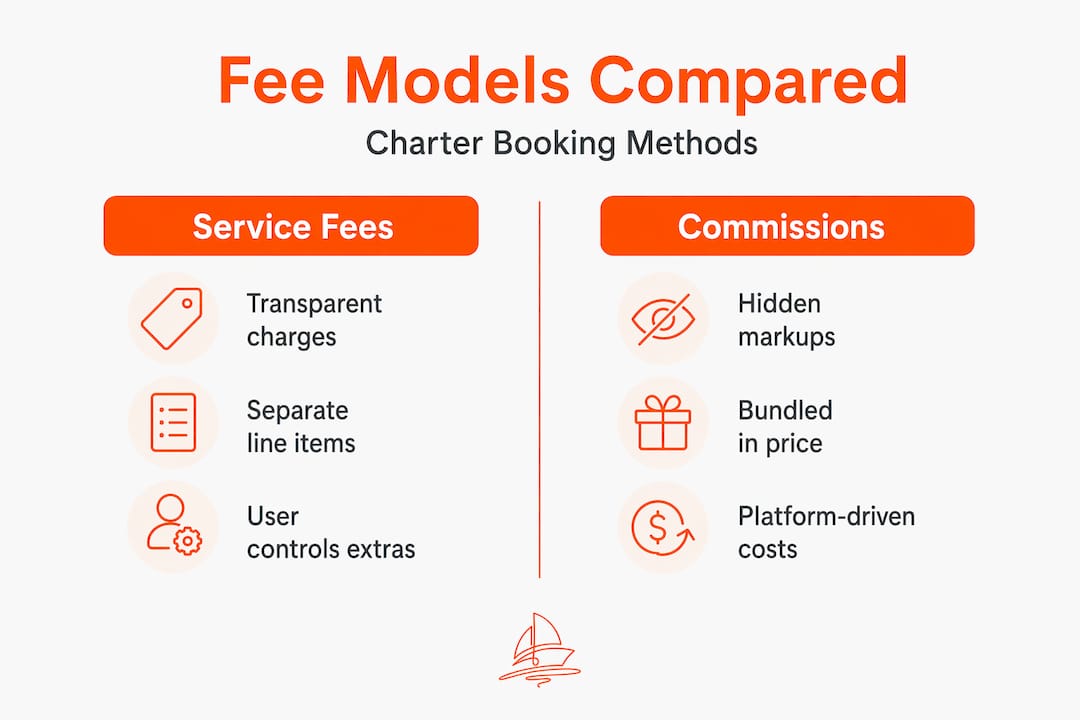
Traditionally, charter platforms and travel advisors earned commissions paid by the charter operator. The client saw a single price. But as non-commissionable fare growth compresses commissions, advisors and platforms increasingly charge you, the client, an explicit service fee to cover their planning and coordination work.
Here is what this shift means in practice:
- Commission-based model: The advisor or platform earns a percentage from the operator. You may see no explicit service fee, but the operator's price often bakes that commission in. Less transparent but feels simpler to the buyer.
- Service fee-based model: The platform charges you directly, usually a percentage of the base booking. More transparent about where the money goes, but adds a visible line item to your invoice.
- Hybrid model: Many modern platforms do both. They take a reduced operator commission and charge the client a smaller explicit fee. This is increasingly common and, when disclosed clearly, is actually the most honest structure.
The role of service fees in boat rental platforms is shifting from invisible markup to explicit charge. Neither model is inherently better, but the explicit fee model at least puts the cost where you can see and question it. Platforms that show you a clear total cost breakdown before you commit are the ones worth trusting with your charter budget.
Preparing for total cost reality
By now, the picture of how fees affect charter pricing should be clear. But clarity only helps if you act on it. A few final points to carry into every future booking conversation:
- Research and verify all fees before any deposit changes hands. A verbal assurance is not a guarantee.
- Read the full contract, not just the pricing summary. Specific fee terms live in the detailed clauses, not the headline offer.
- Budget a minimum of 30 to 40% above the base charter price to cover all likely mandatory extras. For crewed charters, budget more.
- Some fees are genuinely legitimate. Fuel, cleaning, and port charges exist because they are real operating costs. Do not confuse fair fees with predatory ones.
- For guidance on maximizing booking value through member-only access and smarter fee structures, resources like this can change what you pay significantly.
The charterers who avoid budget surprises are not lucky. They ask better questions, read more carefully, and compare total costs instead of headline prices.
My take on service fee transparency
I've seen thousands of charter bookings go sideways not because the base price was wrong, but because nobody told the client what was coming. What I've learned watching this play out repeatedly is that fee opacity is not accidental. It is a feature of business models that benefit from confusion.
Here is my honest opinion: the industry's habit of advertising low base rates and burying mandatory extras is a trust problem, not just a pricing problem. First-time charterers leave feeling deceived even when every charge was technically disclosed somewhere in the contract. That is a failure of presentation, not legality.
What I've found actually works is treating fee disclosure as a filter, not just a budgeting tool. Operators who proactively send you a full fee breakdown before you ask are telling you something real about how they do business. Operators who resist or give vague answers are showing you something equally real.
The choice between itemized fees and all-inclusive pricing is not about which is cheaper. It is about which model fits how you like to travel. If you want control and predictability, all-inclusive is worth the small premium. If you are experienced and want to optimize for actual usage, an itemized structure gives you that flexibility. But you have to understand the structure first. Neither option works for you if you are reading it for the first time on the final invoice.
— Sailorix
Why Sailorix makes charter fees simple
Surprise fees are frustrating enough when you understand them. They are worse when a platform adds its own layer of unexplained charges on top. Sailorix was built specifically to remove that problem.

With Sailorix, the platform service fee is approximately 1%, compared to the 10 to 20% that most competitors charge. That difference is not small. On a $5,000 charter, it is the difference between paying $50 and paying $1,000 just for the booking layer. The annual Sailorix membership costs €100 and unlocks that near-zero fee rate for every booking you make through the year. You see the full cost breakdown before you commit, with real-time availability and transparent pricing baked into every listing. For charterers who book more than once a year, the membership pays for itself on the first trip.
FAQ
What is a service fee in yacht rental?
A service fee in yacht rental covers costs beyond the base charter rate, including fuel, cleaning, port fees, tourist taxes, and any intermediary platform or advisor charges. These fees can add 30 to 40% on top of the quoted base price.
Why are service fees listed separately from the charter price?
Variable costs like fuel and marina fees depend on your actual route and usage. Separating them from the base price lets you pay for what you actually use rather than prepaying for services you might not need.
How much should I budget above the base charter rate?
Budget at least 30 to 40% above the base charter fee to cover mandatory extras. For crewed or luxury charters, budget higher and factor in skipper gratuity as well.
Are orientation fees ever legitimate?
No. Safety briefings and boat handovers should always be included at no extra charge. Any operator who charges a separate orientation fee is signaling that additional nickel-and-dime charges are likely to follow.
How do late bookings affect charter service fees?
Booking within 10 days of departure can add a 20% premium to your total cost. Booking within 48 hours can raise that premium to 50%. Booking at least two weeks in advance consistently avoids these surcharges.