

A service fee is a mandatory additional charge applied on top of a base price to cover the operational and administrative costs a business incurs when delivering or facilitating a service. You see service fees on concert tickets, hotel bills, restaurant checks, and payment processing invoices. They are not tips, and they are not taxes. Understanding the difference protects your wallet and helps you compare real costs across providers before you commit.
What is a service fee and how does it differ from tips and taxes?
A service fee is defined as an additional charge businesses apply separately from the base price to recover costs like payment processing, customer support, and system upkeep. Merriam-Webster defines a service charge as a fee charged for a particular service in addition to standard fees, and explicitly distinguishes it from a tip. That distinction matters legally, financially, and practically.
Here is how the three charges break down:
| Charge type | Who sets it | Mandatory? | Goes to |
|---|---|---|---|
| Service fee | Business | Yes | Business operations |
| Tip (gratuity) | Customer | No | Service worker (discretionary) |
| Tax | Government | Yes | Government revenue |
The IRS draws a sharp line between service fees and tips. According to IRS guidance, a charge is classified as a service charge rather than a qualified tip when payment is mandatory, the amount is fixed, and the employer controls who receives it. This affects how businesses report income and how workers are taxed. A restaurant that automatically adds 20% to a large-party bill is collecting a service charge, not a tip, even if the line item says "gratuity."
Key distinctions to keep in mind:
- Service fees are non-negotiable and set by the business to cover specific costs.
- Tips are voluntary. The customer decides the amount and the recipient.
- Taxes are government-imposed and calculated as a percentage of the transaction value.
- A service fee can appear alongside both a tip line and a tax line on the same bill, making the total look significantly higher than the advertised price.
The practical implication is straightforward. When you see a service fee on a bill, the business is telling you that a specific cost exists and is being passed to you directly. When you leave a tip, you are rewarding a person. When you pay tax, you are funding public services. Conflating the three leads to overpaying, under-tipping, or both.
In what industries and contexts are service fees commonly applied?
Service fees allocate costs that are incurred per transaction and appear across hospitality, event ticketing, online payments, and transportation. Businesses apply them in specific contexts for specific reasons, and recognizing those contexts helps you anticipate charges before they appear on your final bill.
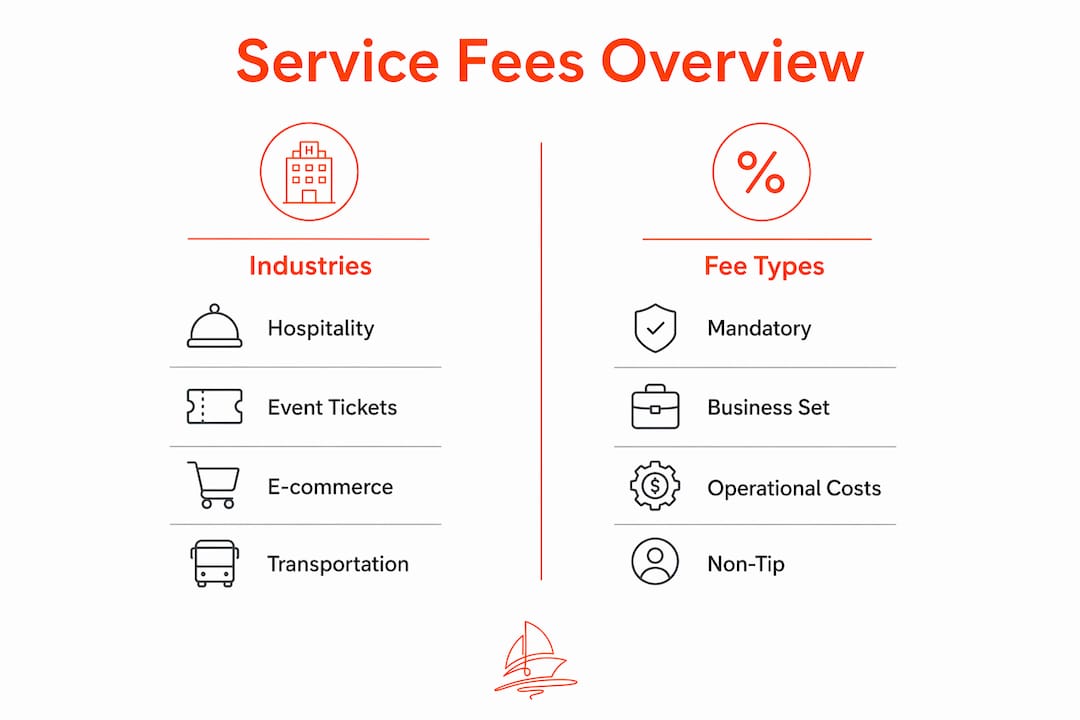
Restaurants and hospitality add service charges most often for large parties, private dining rooms, or all-inclusive resort packages. A hotel might charge a daily "resort fee" covering pool access, Wi-Fi, and gym use. These fees are separate from room rates and taxes, and they are mandatory regardless of whether you use the amenities.
Event ticketing is where service fees draw the most consumer frustration. Platforms charge per-ticket fees covering payment processing, fraud prevention, and platform maintenance. A $50 concert ticket can become $72 after a service fee, an order processing fee, and a facility charge. Each line item represents a real cost, but the cumulative effect feels opaque when the base price was advertised alone.

Payment processing and e-commerce apply service fees to cover the cost of accepting credit cards, managing chargebacks, and maintaining secure transaction infrastructure. Stripe, PayPal, and similar processors charge merchants a percentage per transaction. Many merchants pass that cost to customers as a checkout service fee.
Transportation and logistics, including charter bookings and boat rentals, routinely add service fees on top of base rental rates. These cover booking platform maintenance, insurance coordination, and customer support. Sailorix has written a detailed breakdown of service fees in charters that explains exactly what those charges fund.
Why do businesses itemize fees instead of raising base prices? Separating service fees from base prices is often a deliberate commercial strategy to offer a lower advertised price while recovering costs transparently. It also allows businesses to adjust fees independently as operating costs change without repricing their entire catalog.
Pro Tip: When comparing providers, always calculate the total price including all fees before deciding. A lower base price with a 15% service fee often costs more than a slightly higher base price with a 3% fee.
What do recent regulations say about service fees?
The Federal Trade Commission's 2025 Rule on Unfair or Deceptive Fees sets the clearest regulatory standard yet for how businesses must disclose mandatory charges. The FTC rule requires truthful, clear disclosure of the total price including all mandatory fees, and it prohibits vague labels like "service fee" without explanation. This means a business cannot simply list a fee without telling you what it covers.
The rule initially targets live-event tickets and short-term lodging, but the FTC frames its fee-disclosure principles as broadly applicable. The agency's position is that misrepresenting fees constitutes an unfair or deceptive practice, regardless of industry. That framing gives consumers a legal basis to challenge unclear charges.
Here is what the regulatory framework now requires of businesses:
- Disclose the total price upfront, including all mandatory fees, before the customer reaches checkout.
- Label fees accurately. A fee called "service fee" must actually cover a service-related cost, not function as hidden profit.
- Avoid drip pricing, the practice of revealing fees one at a time during checkout to make the initial price look lower.
- Communicate refundability. If a service fee is non-refundable, that must be stated clearly before purchase.
- Apply consistent standards across online and in-person transactions.
"The FTC's recent regulatory stance clarifies that businesses cannot hide fees behind vague terms and must communicate their nature clearly to consumers." — FTC Guidance on Fee Disclosures
The IRS adds another layer. IRS criteria for distinguishing service charges from tips affect payroll tax obligations for employers. When a business collects a mandatory service charge and distributes it to employees, that amount is treated as wages, not tips, and is subject to standard payroll withholding. Employees cannot claim the same tax treatment on service charges that they can on direct tips. This distinction affects take-home pay for workers in hospitality and food service.
Spotting a potentially deceptive service fee is easier now that you know the rules. If a fee appears only at checkout, carries a vague label, or is not explained when you ask, those are signals worth questioning.
How to evaluate service fees as a consumer
Consumers should focus on the total price including all service fees rather than the advertised base price to accurately compare offerings. That single habit eliminates most of the confusion that service fees create.
Here is a practical framework for evaluating any service fee you encounter:
- Ask what the fee covers. A legitimate service fee funds a specific cost. If the business cannot explain it, that is a red flag.
- Check whether it is mandatory or optional. Some fees, like a hotel resort fee, are mandatory. Others, like a packaging upgrade fee, may be optional. Know which is which before you pay.
- Compare total costs, not base prices. Two boat rental companies might advertise the same daily rate. One charges a 15% service fee; the other charges 1%. The total cost difference on a week-long charter is significant. Sailorix explains exactly how low service fees affect your final cost in boat rentals.
- Look for drip pricing. If fees appear one by one during checkout rather than upfront, the provider may be using a pricing strategy designed to obscure the real total.
- Know your rights. Under the FTC's 2025 rule, businesses in covered sectors must disclose total prices including fees before you commit. If they do not, you can file a complaint with the FTC.
Pro Tip: Screenshot the fee breakdown before completing any booking. If the final charge differs from what was displayed, that documentation supports a dispute with your credit card provider or the FTC.
One more consideration: service fees are not always negotiable, but the decision to use a provider is. When a platform charges 18% in service fees on a boat rental and a competitor charges 1%, the fee structure itself is a product differentiator worth factoring into your choice.
Key takeaways
Service fees are mandatory, business-set charges that cover operational costs and are legally distinct from tips and taxes under both IRS and FTC guidelines.
| Point | Details |
|---|---|
| Service fee definition | A mandatory charge added to a base price to cover administrative or operational costs. |
| Distinct from tips and taxes | Tips are voluntary; taxes are government-imposed; service fees are set by the business. |
| FTC 2025 disclosure rule | Businesses must disclose all mandatory fees upfront and cannot use vague labels. |
| IRS classification | Mandatory employer-controlled charges are service charges, not tips, and are taxed as wages. |
| Consumer best practice | Always compare total prices including fees, not base prices alone. |
The fee transparency problem no one talks about enough
Service fees have become one of the most effective tools for making prices look lower than they are. I have watched this pattern accelerate across every sector Sailorix operates in. A charter platform advertises a yacht at €500 per day. By the time you reach checkout, a 15% service fee, a booking fee, and an insurance coordination fee have added €120 to the total. The base price was real. The total was never what you expected.
The frustrating part is that most of those fees cover legitimate costs. Payment processing, platform maintenance, and customer support are not free. The problem is not that fees exist. The problem is that they are revealed too late in the process to influence the decision you already made emotionally when you saw the base price.
What I find most telling is that the businesses with the most transparent fee structures tend to have the most loyal customers. When you know exactly what you are paying and why, trust follows. The FTC's 2025 rule is a step in the right direction, but regulation alone does not change culture. Consumers who demand total-price transparency before committing create the market pressure that actually shifts behavior.
My advice: treat any platform that hides fees until checkout as a signal about how they will handle problems after you book. Fee transparency is a proxy for operational integrity.
— Sailorix
Book smarter with Sailorix and pay less in fees

Sailorix was built specifically to solve the service fee problem in boat and yacht rentals. Most booking platforms charge 10 to 20% in service fees on every transaction. Sailorix charges approximately 1%. For €100 per year, a Sailorix membership gives you access to yacht and boat rentals worldwide at the lowest market prices, with full fee transparency before you confirm any booking. You see the total cost upfront, including what the service fee covers, so there are no surprises at checkout. If you are serious about booking a yacht without paying a premium for the privilege, Sailorix is the most cost-effective way to do it.
FAQ
What is the service fee definition in simple terms?
A service fee is a mandatory charge added on top of a base price to cover the costs a business incurs when delivering or facilitating a service. It is set by the business, not the government, and is not discretionary like a tip.
What is the difference between a service fee and a tip?
A service fee is mandatory and controlled by the business. A tip is voluntary and determined by the customer. The IRS classifies them differently for tax purposes, with service charges treated as wages rather than gratuities.
Are service fees regulated by law?
The FTC's 2025 Rule on Unfair or Deceptive Fees requires businesses in covered sectors to disclose all mandatory fees clearly and upfront. Hiding fees or using vague labels constitutes an unfair or deceptive practice under federal law.
Can a service fee be refunded?
Refundability depends on the business's policy and must be disclosed before purchase under FTC guidelines. Many service fees are non-refundable, particularly in event ticketing and short-term lodging.
Why do companies charge service fees instead of raising base prices?
Businesses separate service fees from base prices to keep advertised prices lower while recovering specific operational costs. This is a deliberate pricing strategy that makes base prices more competitive while attributing costs like payment processing or platform maintenance to individual transactions.