

Marina access is the authorized and practical ability to use a marina's docking spaces, facilities, and services for your vessel. It covers far more than simply motoring up to a dock. From slip licenses and security gates to tidal windows and ADA-compliant gangways, marina access is a layered system of permissions, physical infrastructure, and operational rules that every boater needs to understand before leaving the harbor. Whether you are renting a yacht for the first time or shopping for a permanent slip, knowing how access works will save you time, money, and real frustration on the water.
What is marina access and what does it actually include?
Marina access is defined as the combination of legal permission and physical entry that allows a boater to use a marina's berthing spaces and related facilities. Slip license terms typically grant licensees 24/7 access to their assigned berth while reserving the marina's right to restrict entry for safety, maintenance, or rule violations. That distinction matters: you may hold a valid slip license and still find yourself locked out during a dredging operation or a security review.
The core components of marina access break down into four categories:
- Berthing spaces. Slips are the designated parking spots for boats. They are assigned by vessel size, beam, and draft, and your slip number is the key to everything else at the facility.
- Utilities and services. Marina amenities bundled with access typically include shore power (30A or 50A), freshwater hookups, pump-out stations for holding tanks, and fuel docks. For boats with holding tanks, pump-out access is both a legal requirement and a practical necessity in most U.S. coastal jurisdictions.
- Common areas. Restrooms, showers, laundry facilities, and parking lots are part of the access package at most full-service marinas. Access to these areas may require a separate key fob or PIN code.
- Operational permissions. Contractors, guests, and liveaboards each operate under different permission tiers. Contractor access at many marinas requires proof of insurance and advance registration, and the marina can revoke that access at its discretion.
Pro Tip: Read your slip license before you sign it. Look specifically for clauses about guest access, liveaboard restrictions, and the marina's right to reassign your slip during events or maintenance periods.
Understanding marina facilities at this level of detail separates boaters who arrive prepared from those who spend their first hour at the dock hunting for the shower code.
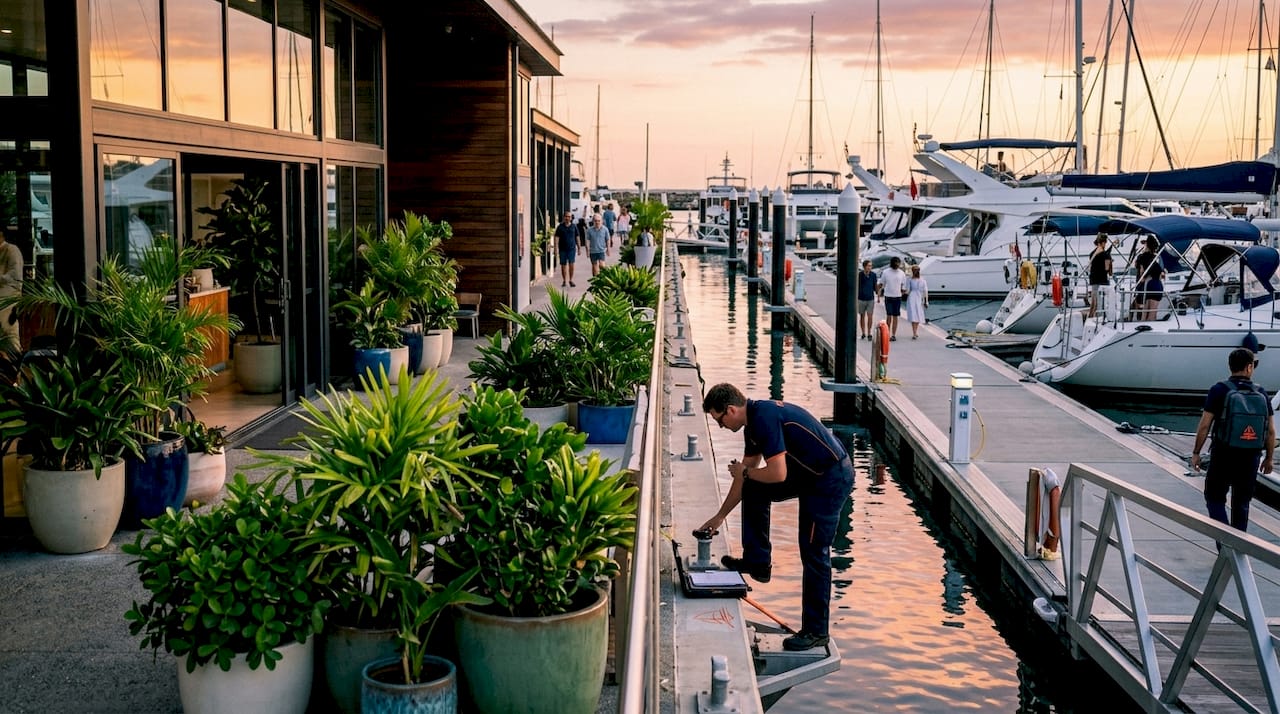
How do marinas control and manage access?
Marinas use a tiered security model to manage who enters, when, and under what conditions. The specific controls vary by facility type, but the logic is consistent across public and private marinas alike.
- Gated entry with ID verification. Many marinas restrict dock access to cardholders. A U.S. military marina, for example, requires CAC or Military ID cards for 24/7 dock access. Civilian marinas typically issue key fobs or PIN codes tied to your slip license.
- Check-in at the marina office. Visiting boaters at public marinas follow a structured arrival process. The Port of Everett Marina, the largest public marina on the West Coast, directs guests to check in at the harbormaster's office, pay transient fees, and then proceed to the assigned slip. Skipping this step does not just risk a fine. It can mean your vessel is moved or denied power hookup.
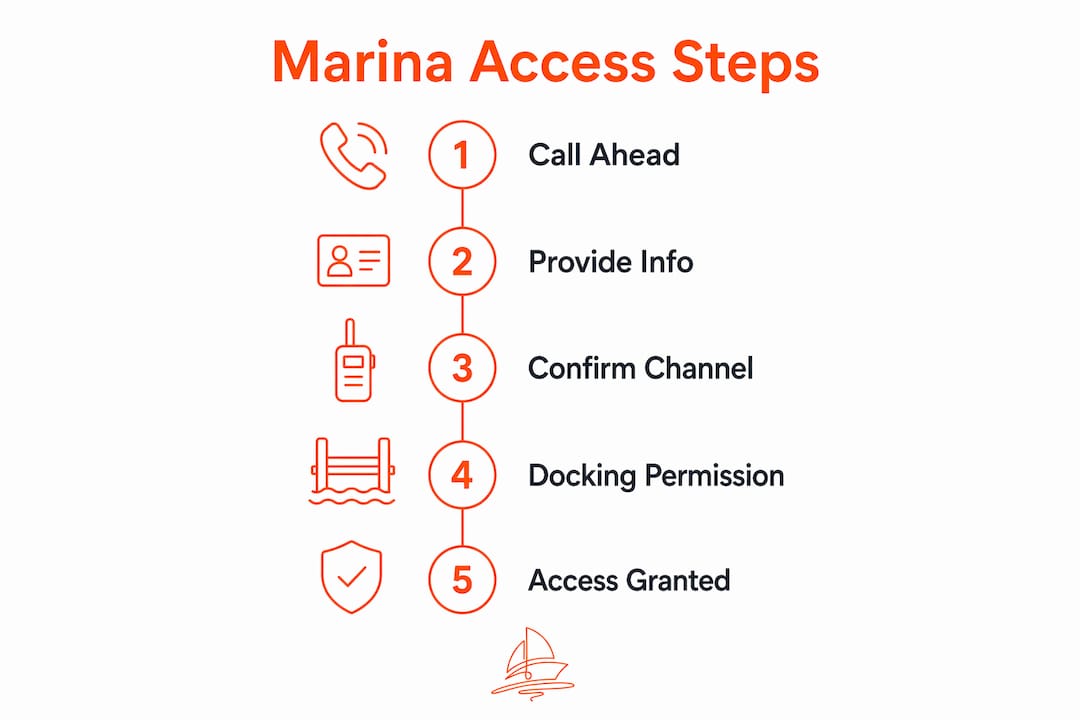
- VHF radio communication. Many larger marinas assign slips via VHF Channel 16 or a designated working channel before you even enter the harbor. Calling ahead on the radio is standard protocol and gives the dock staff time to prepare your berth.
- Slip and license verification. Long-term slip holders must keep their license current and their vessel registration up to date. Marine registration best practices recommend maintaining copies of all documentation aboard, since marina staff may request proof of ownership or registration during check-in or annual slip renewal.
- Member-only and restricted access tiers. Some marinas operate yacht clubs or private membership programs that layer additional access privileges on top of standard slip licenses. These may include priority slip assignments, guest dock access, and access to clubhouse facilities.
Pro Tip: When visiting a new marina, call ahead on VHF or by phone to confirm the check-in channel, office hours, and whether reservations are required. Lack of knowledge about check-in steps can delay slip assignment even when space is available.
Marina access regulations at this level reflect a genuine operational need. Docks are expensive infrastructure, and marinas protect them by knowing exactly who is on them at all times.
How physical and environmental factors affect marina access
Administrative permissions are only half the story. Physical and environmental conditions determine whether your vessel can actually enter or exit a marina at any given moment.
Tidal variation is the most significant factor at coastal marinas. Water depth at the entrance channel and inside the basin fluctuates with the tide cycle, and vessels with deeper drafts face real grounding risk during low water. Many marinas install tidal gate systems to hold water inside the basin at a navigable level regardless of the external tide. These gates extend the usable access window and protect vessels from sitting on the bottom during extreme low tides.
The consequences of gate failure are serious. At QEII Marina in Guernsey, gate failure or low tide can leave over a third of the marina's vessels aground due to the resulting water level drop. That figure illustrates how dependent modern marina operations are on functioning gate infrastructure. A single mechanical failure translates directly into restricted vessel movement and potential hull damage.
| Environmental factor | Effect on access | Common mitigation |
|---|---|---|
| Low tide | Reduces water depth at entrance and inside basin | Tidal gates, dredging, tide tables |
| Gate failure | Drops internal water level, grounds vessels | Redundant gate systems, emergency contractors |
| Storm surge | Raises water levels, stresses dock lines | Floating dock systems, storm protocols |
| Silting | Reduces channel depth over time | Regular dredging programs |
Environmental factors add complexity that goes well beyond administrative permissions. Boaters planning visits to tidal marinas should always check the local tide tables and confirm the marina's gate status before arrival.
What accessibility considerations apply to marina access?
Marina access is not only a question of boats and water. The Americans with Disabilities Act (ADA) requires that marinas provide accessible routes for all users, and the requirements are more specific than most boaters realize.
ADA-compliant marina access requires a continuous accessible route from the parking area through the marina office, along the dock, and down the gangway to the vessel. The critical word is continuous. A single flight of stairs anywhere along that route breaks ADA compliance, even if the gangway itself meets every technical specification. This is the most common accessibility failure at older marina facilities.
The specific elements that must meet ADA standards include:
- Parking and arrival zones. Accessible parking spaces with proper signage and curb cuts connecting to the marina entrance.
- Gangways and ramps. Gangways must meet slope requirements, and floating docks must be stable enough for wheelchair users to board safely.
- Restrooms and shower facilities. At least one accessible restroom must be on the continuous accessible route, not across a separate staircase or gravel path.
- Dock edge protection. Cleats, dock boxes, and edge barriers must not obstruct the accessible path along the finger pier.
The hardest part of ADA compliance in a marina context is route continuity. Missing links in the accessible route from parking through restrooms and docks to the water are the most frequent violations cited during facility reviews. For boaters with mobility considerations, calling ahead to confirm the accessible route is complete is a practical step that prevents a wasted trip.
How to access a marina as a visiting or new boater
Arriving at an unfamiliar marina without a plan is one of the most common boat booking mistakes new boaters make. The process is straightforward once you know the steps.
- Research the marina before departure. Confirm the approach channel depth, any restricted zones, and the VHF working channel. The marina's website or a cruising guide like Active Captain will have this information.
- Call ahead or radio in. Contact the harbormaster by phone or VHF at least 30 minutes before arrival. Provide your vessel name, length, beam, and draft. Request a slip assignment and confirm the check-in procedure.
- Follow the entrance channel. Stick to marked channels and reduce speed to no-wake as soon as you see the posted signs. Prop wash from a fast-moving vessel damages dock lines and neighboring boats.
- Check in at the office before doing anything else. At marinas like Port of Everett, visiting boaters check in at the office, pay transient fees, and receive their slip assignment before proceeding to the dock. Heading straight to an open slip without checking in is the fastest way to create a conflict with marina staff.
- Understand the fee structure. Transient fees are typically charged per foot of vessel length per night. Marina fees vary significantly by location, season, and amenity level. Ask about included services: some marinas bundle power and water into the nightly rate; others charge separately.
- Learn the marina's rules on arrival. Quiet hours, pump-out schedules, and guest policies differ by facility. Reading the posted rules at the dock box takes five minutes and prevents avoidable friction with neighboring slip holders.
Pro Tip: Familiarize yourself with the marine phonetic alphabet before your first VHF radio call. Clear communication on the radio speeds up slip assignment and signals to marina staff that you know what you are doing.
Key takeaways
Marina access is a permission and logistics system that combines slip licenses, security controls, tidal conditions, and ADA-compliant routes to determine how and when boaters can use a facility.
| Point | Details |
|---|---|
| Access is permission-based | Slip licenses define your rights, including 24/7 entry and guest or contractor restrictions. |
| Check-in is mandatory | Visiting boaters must check in at the office before proceeding to a slip, regardless of available space. |
| Tides affect entry windows | Gate systems and tidal conditions directly limit when vessels can enter or exit coastal marinas. |
| ADA compliance requires full route continuity | A single stair or barrier anywhere from parking to the dock breaks accessible route compliance. |
| Preparation prevents delays | Calling ahead, knowing VHF protocols, and understanding fees eliminates most first-visit friction. |
Why marina access deserves more attention than most boaters give it
Most boaters think about marina access the way they think about a hotel check-in: show up, hand over a card, get a key. That mental model fails the moment something goes wrong. I have seen experienced sailors turned away from a slip because their vessel registration had lapsed, and I have watched a first-time charterer spend two hours at the wrong dock because they did not know the check-in channel.
The permission layer is what catches people off guard. Marina access is an ecosystem of permissions, security controls, and operational constraints, not a single gate you pass through. When you understand that your slip license is a conditional agreement rather than a guaranteed right, you start asking better questions before you book: What are the guest policies? Is the entrance channel dredged? Does the marina have a functioning tidal gate?
The environmental layer adds another dimension that no amount of paperwork prepares you for. Tides do not care about your reservation. A gate failure at the wrong moment can strand your vessel for hours. Boaters who treat marina access as a logistics problem to be solved, rather than a formality to be assumed, consistently have better experiences on the water.
My honest recommendation: before committing to any marina, whether for a weekend visit or a long-term slip, spend 20 minutes reviewing the facility's license terms, checking the tidal range at the entrance, and confirming the accessible route if anyone in your group has mobility needs. That 20 minutes is the difference between a smooth arrival and a stressful one.
— Sailorix
Plan your next marina visit with Sailorix

Sailorix is a global boat booking platform built for boaters who want straightforward access to quality vessels at transparent prices. For €100 per year, members unlock yacht and boat rentals worldwide with service fees of approximately 1%, compared to the 10 to 20% charged by most booking platforms. Whether you are planning your first marina visit or your fiftieth, Sailorix gives you real-time availability, clear pricing, and the tools to book with confidence. Explore boat rentals and find your next departure point today.
FAQ
What does marina access mean for a visiting boater?
Marina access for a visiting boater means the right to temporarily use a marina's slip, utilities, and facilities after completing check-in and paying transient fees. The process typically involves contacting the harbormaster by VHF or phone, receiving a slip assignment, and checking in at the office before docking.
How do I access a marina for the first time?
Call the marina ahead of arrival on VHF Channel 16 or by phone, provide your vessel dimensions, and follow the harbormaster's instructions for slip assignment and check-in. Visiting boaters at public marinas like Port of Everett check in at the office, pay fees, and then proceed to their assigned slip.
What are the main marina access points?
Marina access points include the entrance channel, security gates to the dock area, and the gangway connecting the dock to individual slips. Each point may have its own access control, from depth restrictions at the channel to key fob gates at the dock entrance.
Are marinas required to be ADA accessible?
Yes. Marinas open to the public must provide a continuous accessible route from parking through the office, restrooms, and docks to the water. A compliant gangway alone is not sufficient if any part of the route contains stairs or other barriers.
What is a slip license and how does it affect marina access?
A slip license is a contractual agreement granting a boater the right to use a designated berth and associated marina facilities. License terms define access hours, guest permissions, contractor rules, and the marina's right to restrict or reassign access for safety or maintenance reasons.