

Expect to pay roughly 1.3 to 1.7 times the headline base rate once you add everything up. A crewed catamaran quoted at a moderate weekly base rate typically lands closer to a higher all-in range once fuel, provisioning, and tips are added, while a motor yacht base rate similarly increases substantially after these extras. The biggest budget-busters are the Advance Provisioning Allowance, fuel on motor yachts, taxes in Mediterranean waters, and the customary crew gratuity, all of which sit outside the quoted base rate.
TL;DR:
- The final cost of a yacht charter typically exceeds the base rate by 30% to 70% due to extras like fuel, taxes, gratuities, and provisioning allowances.
- Mediterranean charters often operate on a plus-expenses model, requiring separate payments for fuel, VAT, and onboard costs, unlike Caribbean all-inclusive rates.
- Booking during shoulder seasons and early for peak months can significantly lower the total expense and increase availability for desirable yachts.
- Group costs per person decrease as the group size increases, with maximum licensed capacity generally around 12 guests for standard yachts; larger groups often split across multiple vessels.
- Requesting a transparent, written all-in estimate before booking helps prevent unexpected charges and simplifies comparing different yacht options.
Table of Contents
- What Does a Group Yacht Charter Cost by Vessel Type?
- Every Line Item That Turns a Base Rate Into an Invoice
- How Much Does Each Person Actually Pay?
- Three Sample Group Charter Budgets You Can Copy
- How to Avoid Surprise Charges on a Group Charter
- Why Transparent All-In Pricing Should Be the Standard
- Book Your Group Charter Without the Hidden Fees
- Sources
- FAQ
What Does a Group Yacht Charter Cost by Vessel Type?
Base rates vary widely according to vessel type, location, and season, which can lead to unexpected differences in final charges for groups without detailed budgeting. A rough sense of the headline numbers helps you figure out where your group actually fits before you start requesting formal quotes.
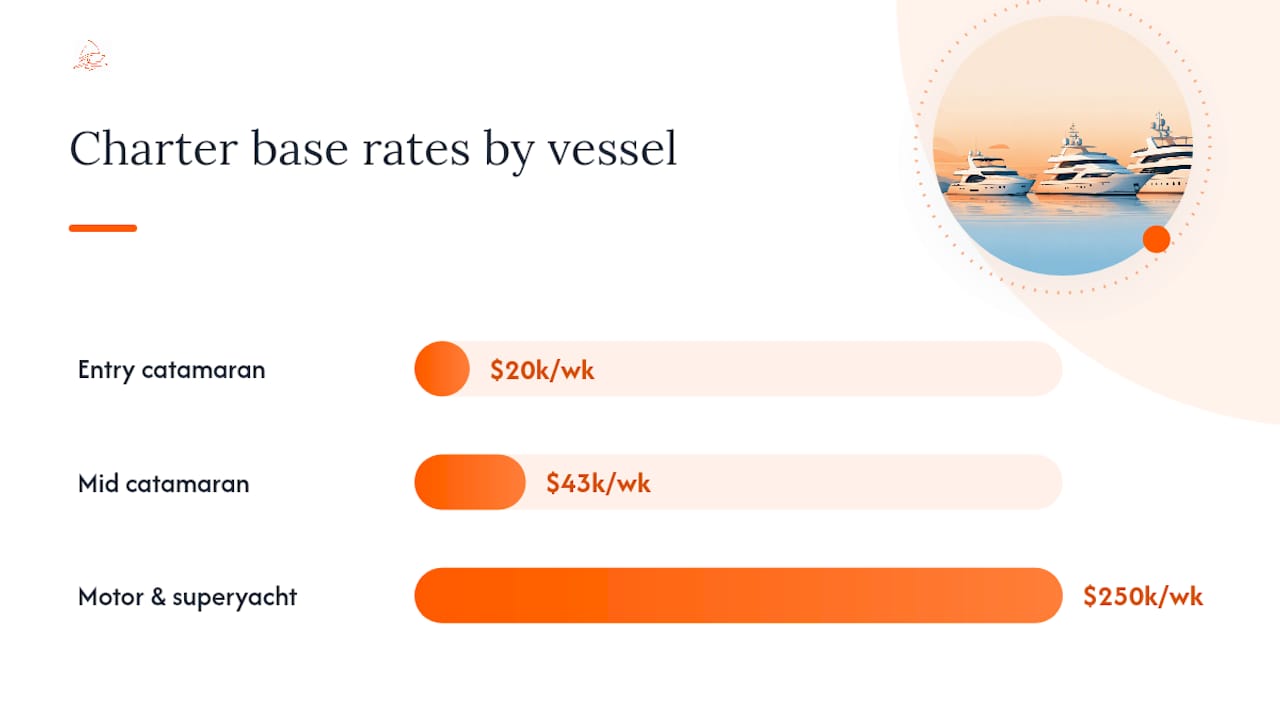
- Entry-level crewed catamarans: roughly $15,000 to $25,000 per week, often marketed with all-inclusive Caribbean pricing that folds in food and drink.
- Mid-range crewed catamarans: $25,000 to $60,000 per week, with the higher end common in the Caribbean's peak winter season.
- Crewed motor yachts: starting around $50,000 and climbing past $450,000 per week for larger vessels, almost always on a plus-expenses basis rather than all-inclusive.
- Superyachts: $50,000 to $450,000-plus per week depending on size, age, and amenities, per Uncompromised Travel's charter intelligence.
Region shapes the contract type as much as it shapes the price. Caribbean operators commonly quote all-inclusive rates that already fold in food, drink, and fuel for a set itinerary, while Mediterranean charters more often run on a plus-expenses model, where you pay the base fee plus a separate allowance for everything consumed onboard. That single difference in contract structure explains why two "similar" quotes from different regions can look wildly apart on paper and still cost about the same in the end.
Season influences pricing as well, with peak weeks such as major holidays in the Caribbean and summer months in the Mediterranean generally commanding noticeably higher base rates than shoulder seasons, and availability on popular yachts becoming more limited. Booking six to nine months out for peak dates isn't just about securing the boat. It also locks in a rate before demand pricing kicks in.
Every Line Item That Turns a Base Rate Into an Invoice
The base charter fee covers the yacht and crew for the contracted days. It does not cover fuel, food, dockage, the Advance Provisioning Allowance, taxes, or gratuity. That gap between "quoted price" and "final invoice" is where most charter budgets go wrong, and it's why industry cost breakdowns treat the base rate as only the starting line.
Here's what typically adds to the base rate:
- Advance Provisioning Allowance (APA): a pre-funded expense account generally estimated to be around 25% to 35% of the base charter fee on plus-expenses charters, used by the captain for provisions and operating costs.
- Fuel: billed through the APA on motor yachts and can swing significantly based on itinerary and engine hours.
- Port and marina fees: vary by destination and season, often modest on a sailing itinerary but substantial in high-demand Mediterranean anchorages.
- VAT and national taxes: applied differently by country. Mediterranean charters frequently carry VAT that Caribbean itineraries don't.
- Crew gratuity: customarily 10% to 20% of the base charter fee, paid in cash at the end of the trip.
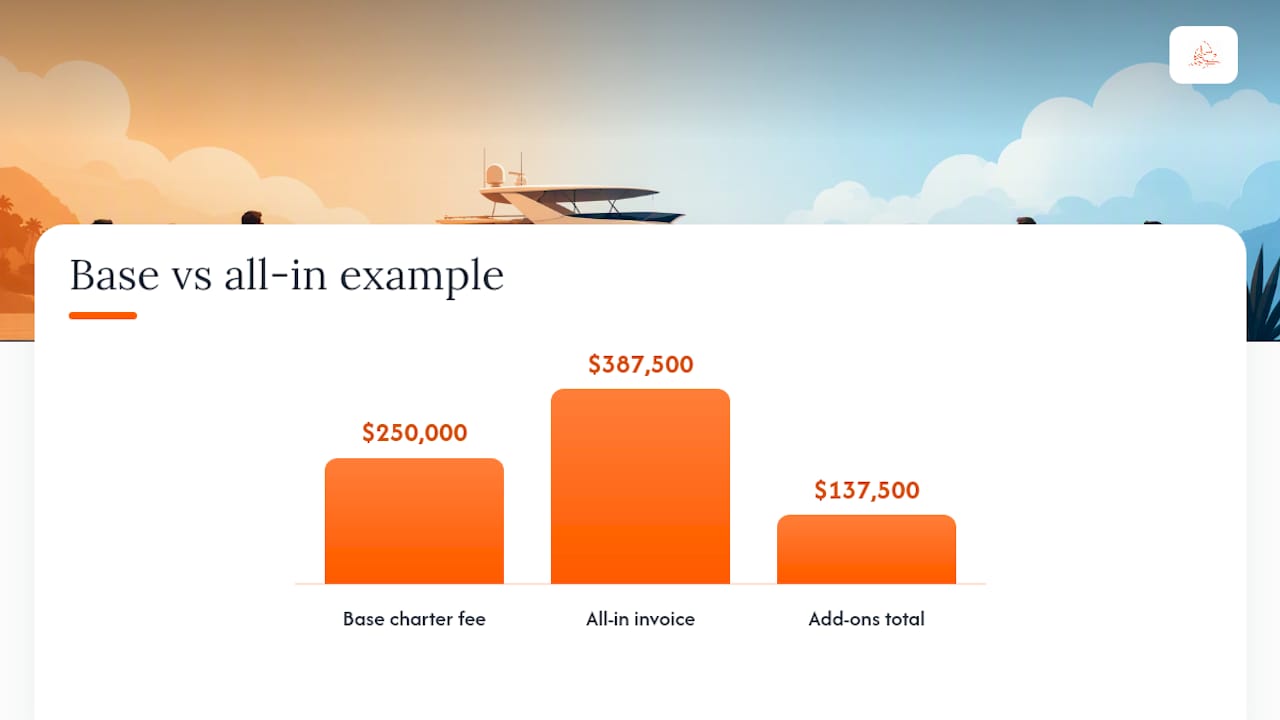
One statistic worth building your whole budget around: a $250,000 base week can become roughly $387,500 all-in, a multiplier near 1.55×, once APA, VAT, fuel, and gratuities are layered on.
The APA itself works like an escrow account. The captain keeps itemized receipts throughout the trip, refunds unused funds afterward, and bills you for any overrun. That's why the contract you sign matters as much as the number on the quote: CYBA-style all-inclusive agreements (common in the Caribbean) bundle most of this into one price, while MYBA-style plus-expenses contracts leave the APA and gratuity as separate line items you settle after the fact. Ask for a written all-in estimate before you compare two quotes side by side. A cheaper base rate on a plus-expenses contract can easily end up costing more than a higher all-inclusive quote once the math is done.
How Much Does Each Person Actually Pay?
Splitting a charter fee by headcount is where the abstract number becomes real money owed by each guest, and the math changes a lot depending on group size.
- Six guests on a $30,000 all-in catamaran week: $5,000 per person, plus incidentals like shore excursions.
- Eight to ten guests on a $50,000 to $80,000 all-in catamaran charter: roughly $5,000 to $8,000 per head, a range Vital Charters cites as typical for a week-long Caribbean trip.
- Twelve guests, the maximum most commercially licensed yachts can carry, on a motor yacht running $100,000-plus all-in: often $8,000 to $12,000-plus per person depending on the vessel.
- Sixteen or more guests: requires either a much larger (and far pricier) passenger vessel or two smaller yachts sailing the same itinerary.
That twelve-guest ceiling isn't arbitrary. It comes from SOLAS passenger-vessel regulations that most crewed charter yachts are licensed under, and pushing past it usually means booking one of the rare, purpose-built vessels certified for more passengers, which carry a steep base-rate premium. For groups of 13 to 20, a tandem charter, two yachts cruising the same route together, usually pencils out cheaper per person than chasing a single large-capacity vessel, and it gives everyone more cabin space to spread out.
Three Sample Group Charter Budgets You Can Copy
Real numbers help more than percentages, so here are three scenarios built on typical peak-season pricing.
| Scenario | Base rate | APA (30%) | Gratuity (15%) | Taxes/fees | All-in total | Per person |
|---|---|---|---|---|---|---|
| 6 guests | $30,000 | Included | $4,500 | Minimal | ~$36,000 | $6,000 |
| 10 guests, Mediterranean motor yacht, plus-expenses | $70,000 | $21,000 | $10,500 | VAT ~12% | ~$110,000 | $11,000 |
| 16 guests, tandem catamarans (two boats, 8 each) | $50,000 total | $15,000 | $7,500 | Minimal | ~$72,500 | $4,530 |
A few things stand out once you line these up side by side:
- The tandem option, splitting 16 guests across two smaller catamarans, actually beats the per-person cost of the single ten-guest motor yacht, mostly because it avoids VAT and a heavier plus-expenses load.
- Caribbean all-inclusive pricing keeps the math simple: what you see is close to what you pay, minus gratuity.
- Mediterranean plus-expenses charters need the widest cushion in your budget, since APA, VAT, and fuel all stack on the same trip.
Treat these as planning ranges, not quotes. Actual pricing shifts with the specific yacht, exact dates, and any add-ons your group wants.
How to Avoid Surprise Charges on a Group Charter
Get everything in writing before you sign anything. Ask the broker or operator for a full breakdown: base rate, contract type (all-inclusive versus plus-expenses), the assumed APA percentage, how VAT is calculated, and the gratuity assumption baked into their estimate. Requesting an itemized all-in figure is the single most effective way to keep the final invoice from surprising anyone.
Timing and destination choice save real money too:
- Book shoulder season (late spring or early fall in most regions) for meaningfully lower base rates and better availability.
- Favor Caribbean all-inclusive vessels over Mediterranean plus-expenses contracts when your group wants predictable, one-number budgeting.
- Assign one person to manage the group kitty and reconcile the APA refund after the trip. Someone needs to own that math.
- Compare booking platforms before committing. Service fees on the booking itself vary and add up on a large group charter.
That five-point swing on a $70,000 charter is $3,500, easily enough to change who can afford to come.*
If you're managing group costs, a resource like CrewsCanvas's guide to splitting trip expenses is worth a look before payments start moving between guests.
Why Transparent All-In Pricing Should Be the Standard
Most sticker shock comes from comparing a bare base rate to an all-in figure without realizing it. That's not a pricing problem, it's a disclosure problem, and it's fixable if brokers and platforms would just show the math up front. Sailorix built its membership model around that idea: a low, flat service fee instead of the 10% to 20% markups baked into many booking channels, so groups can see closer to the real cost before they commit.
— SAILORIX
Book Your Group Charter Without the Hidden Fees
Most booking channels tack on service fees of 10% to 20%, buried inside a quote that already includes APA, taxes, and gratuity guesswork.

That matters most for groups splitting costs across six, ten, or sixteen guests, where a few percentage points in fees can mean hundreds of dollars per person. Sailorix's membership programs give you tiered access to real-time availability across catamarans, motor yachts, and superyachts worldwide, and its core platform lets you compare vessels and request transparent all-in estimates before you commit. Check current availability for your dates and group size, and see what an honest fee structure actually saves you.
Sources
Budgeting figures and multipliers in this article draw on the 2026 Luxury Yacht Charter Cost Index, Uncompromised Travel's charter intelligence guide, and Vital Charters' group charter planning guide, each covering APA norms, regional rate differences, and group-size logistics in more depth.
- The 2026 Luxury Yacht Charter Cost Index | Uncompromised Travel
- Private Yacht Charter Intelligence | Uncompromised Travel
FAQ
How much is a 3-day charter on a yacht?
A three-day crewed catamaran charter often runs $9,000 to $15,000 all-in for a smaller group, roughly proportional to the weekly rates but with a higher effective daily cost since fixed crew and provisioning expenses get spread across fewer days. Motor yacht weekend charters typically start higher, often $15,000 to $30,000 for three days depending on size and region.
What is the 12-person rule on a yacht?
Most commercially licensed crewed yachts are certified under SOLAS passenger-vessel rules to carry a maximum of 12 guests. Exceeding that limit legally requires chartering a yacht specifically certified for a higher passenger count, which comes at a steep price premium, or booking a tandem charter with two vessels instead.
Can you charter a yacht for 20 people?
Yes, but rarely on a single standard crewed yacht. For groups above the 12-guest limit, the common solutions are a tandem charter of two yachts sailing the same itinerary or booking one of the rare large-capacity vessels certified for higher passenger counts.
How much does yacht ownership and maintenance actually cost compared to chartering?
Ongoing ownership and maintenance costs for a large yacht are widely reported running into the tens of millions annually for the biggest superyachts, far beyond what any group charter costs. Chartering avoids that entirely. Groups pay only for their week on the water, which is why charter remains the practical option for anyone without a full-time crew and marina slip to maintain.
What's the fastest way to get an accurate group charter budget?
Multiply the base rate by roughly 1.3 to 1.7 depending on whether the contract is all-inclusive or plus-expenses, then divide by your headcount. For an exact figure, request a written all-in estimate through a platform like Sailorix, which lists real-time availability and pricing before you commit to a booking.