
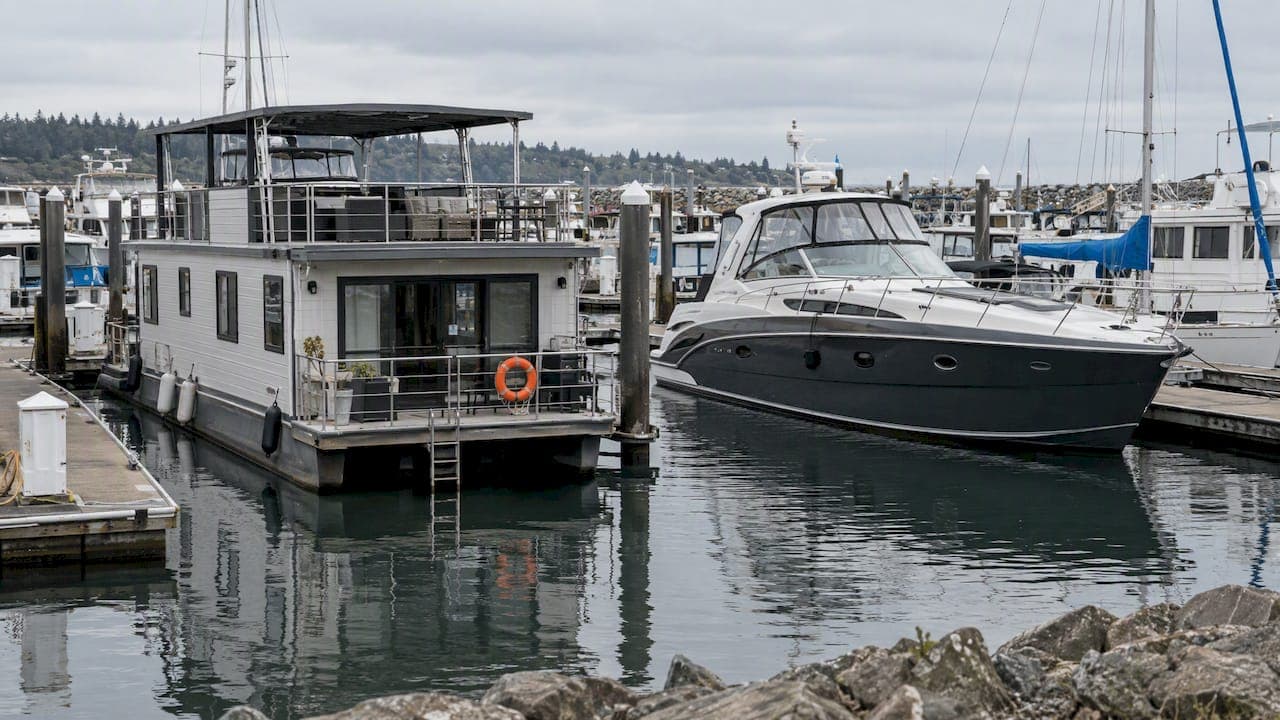
A houseboat is built to be lived in, usually on calm inland or protected water. A yacht is built to be used for pleasure and to go somewhere, and it usually offers more range, more speed and more sea-handling ability. If you want a floating cabin for a lake week, look at a houseboat. If you want to cover distance, cross open water or host guests in comfort, look at a yacht. The details below help you choose, and they matter most if you are paying by the day.
TL;DR
- Purpose: houseboats are floating homes you can move. Yachts are recreational vessels where the voyage matters as much as the stay.
- Water: most houseboats suit lakes, rivers and protected coastal water. Yachts are generally the better fit for open water.
- Cost: owning either is expensive. For a few weeks a year, renting or chartering usually costs far less than owning.
- Safety: houseboats carry a specific carbon monoxide risk around the swim platform and rear deck. Ask about detectors before you book.
- Our take: decide by trip type first, then by price. A charter lets you test the style before committing to buy.
Table of Contents
- What counts as a houseboat, and what counts as a yacht
- Houseboat vs. yacht at a glance
- Layout, comfort and daily life aboard
- Can a houseboat go in the ocean?
- What each one costs
- Safety: the houseboat issue people overlook
- Is a houseboat worth it for living aboard?
- How to choose between a houseboat and a yacht
- Our perspective
- Book a yacht without the broker markup
- FAQ
- Sources
What counts as a houseboat, and what counts as a yacht
The words overlap in casual speech, but boating authorities draw a line. California's boating-basics guide describes a houseboat as more house-like than boat-like, and says many are essentially motorized platforms with living accommodation. The same guide defines a yacht as a power or sail vessel used for recreation and pleasure rather than work. The term usually suggests a boat of at least 40 feet (12.2 m), although racing boats may be called yachts at any size.
That gives you two different starting points. A houseboat starts from the question "how much living space can this hull carry?" A yacht starts from "how well does this vessel carry people somewhere, in comfort?"
Boat Trader's guide puts it plainly: houseboats are meant to be functional homes on the water, while boats and larger yachts may only accommodate overnight stays. Yachts can be very comfortable, but the home is a byproduct of the vessel. In a houseboat, the vessel is a byproduct of the home.
Houseboat vs. floating home
The search results for this topic often mix in floating homes, so it is worth separating them. A cruising houseboat is self-propelled. A floating home is a stationary residence that may have no standard propulsion at all and is meant to stay permanently moored, as Boatwork's ownership guide explains. If you want to go somewhere, you want a cruising houseboat or a yacht, not a floating home.
Houseboat vs. yacht at a glance
| Factor | Houseboat | Yacht |
|---|---|---|
| Main purpose | Living and relaxing on the water | Recreation, cruising, entertaining |
| Typical shape | Boxy, house-like structure to maximize indoor space | Hull shaped for travel, whether sail or power |
| Best water | Lakes, rivers, protected coastal areas | Coastal and open water, depending on the design |
| Speed and range | Modest; many are platforms with motors | Greater, depending on type |
| Living space | Full galley, decks, dining area, sleeping for four or more is common | Varies a lot; space is traded for sea-keeping |
| Marina or mooring | Often kept dockside | Marina berth, anchorage or mooring |
| Typical rental use | Lake or river vacation, a few nights at a dock | Day charter, weekly cruise, events |
Layout, comfort and daily life aboard
Walk onto a houseboat and it feels like a small apartment. According to U.S. News, houseboats look more like homes than yachts and are designed to maximize interior space. Boat Trader says most have a full galley, decks, dining accommodations and sleeping quarters for four or more. For a family that wants to cook, sit around a table and spread out, that is the appeal.

Yachts, trawlers and some sailboats can also have enough room to live below deck, but the experience is different. Space is shaped by hull design and by what the boat must do at sea. A sailing yacht gives up headroom and galley size for performance. A motor yacht gives you more room, but you are still on a vessel designed to move through waves.
Hull design is part of this. Houseboat hulls come in many forms, including V, catamaran, trimaran, pontoon and flat-bottom, and most are displacement hulls. California's guide notes that housecruisers have hulls better suited to higher speed and small waves on protected waters than basic houseboat platforms. That is why two boats both called houseboats can behave so differently.
What a day looks like
On a houseboat, the day is slow. You move a short distance, anchor or tie up in a cove, swim off the back, cook and stay put. On a yacht, a day often includes a passage: you leave a harbor, cover several miles or more, stop for lunch at anchor, and reach a different place by evening. Neither is better. They answer different holiday questions.

Can a houseboat go in the ocean?
Usually not by choice. Most houseboats are intended for calm lakes, rivers and protected coastal waters, and the same houseboat that is comfortable on a reservoir may be a poor choice outside a harbor. Some robust designs handle rougher conditions, but that is the exception, and the boat's builder or the rental company should tell you in writing what water it is rated for.
The broader point is seaworthiness. The Port of Los Angeles, for example, requires vessels in its recreational marinas to be seaworthy: structurally sound, weatherproof, watertight and safely towable in an emergency. Marinas can refuse a vessel that does not meet that standard, so a tired houseboat is harder to place than a sound yacht.
Two practical rules follow:
- Match the boat to the water. If your route includes open coast, tide races or long crossings, choose a yacht or power catamaran built for it.
- Check the weather window, not just the boat. Even a capable vessel is a poor choice in the wrong conditions.
Nor can houseboats be turned into sailboats. Their build, weight and wind resistance are wrong for sailing, so if sailing is part of the dream, you want a sailing yacht or catamaran from the start.
What each one costs
Prices vary widely by size, age, region and season, so treat the figures below as orientation, not quotes.
Buying and owning
U.S. News Money reports 2023 average prices for a new 20-foot boat of $40,000 to $60,000, and typical annual ownership costs of $3,000 to $7,500, covering items such as insurance, storage or marina fees, maintenance and fuel. For yachts, Galati Boat Sales figures reported by U.S. News Money put purchase prices at $500,000 to $2.5 million for yachts under 50 feet and $2 million to $6 million for 50 to 70 feet.
Houseboats sit in a different place on the cost curve. Boatwork estimates annual houseboat ownership at $10,000 for budget setups up to $45,000 for premium setups, counting financing and depreciation, with moorage the biggest line. If you own a conventional home and finance the houseboat, Boat Trader notes the interest may be deductible because it can qualify as a second home. Ask a tax professional about your situation before relying on that.
Marina costs catch many first-time owners. Our guide to what marina fees are explains what a berth typically includes and what is billed on top.
Renting and chartering
For most people, this is the sensible way in. Houseboat rentals can be modest: Florida Rambler reports Key West-area houseboat rentals starting at about $170 per night, and warns that cleaning fees, the boat's condition, its exact location and whether it sits on a mooring or at a marina can change both the real cost and the experience. Read the full price breakdown before you book anything.
Yacht charters scale with size, crew and destination. We break the numbers down in what you'll actually pay for a yacht charter, and for a specific market in our Miami yacht rental cost guide. Beyond the base price, budget for items like fuel, a skipper or crew and port charges. Our piece on mooring fees outside your base charter price covers one that surprises many first-time charterers.
The break-even question
Ownership costs such as moorage, maintenance and depreciation accrue whether the boat moves or not. Boatwork's analysis says that if you would use a vessel only a few weeks per year, renting or chartering is typically more cost-effective than owning. If your honest plan is a week or two on the water each summer, renting each time keeps your money flexible and lets you try different boats.
Safety: the houseboat issue people overlook
Houseboats have a specific hazard that deserves a plain warning. The U.S. Coast Guard has warned that houseboats can accumulate lethal levels of carbon monoxide near swim platforms and rear decks because of generator exhaust, which makes those areas hazardous for passengers while engines are running.
The same circular says not to run engines or auxiliary generators on boats with enclosed accommodation spaces unless they have a functioning marine CO detector meeting ABYC A-24. Before you book or buy:
- Ask whether the boat has working marine CO detectors, and look for them on board.
- Do not let anyone swim or sit near the swim platform or back deck while a generator or engine is running.
- If a detector alarms, shut down the source, get everyone into fresh air and call for help. If anyone has headaches, dizziness or nausea, seek medical care.
This applies to any boat with enclosed living space, yachts included. It is simply more prominent on houseboats because of how they are laid out and used.
Is a houseboat worth it for living aboard?
It can be, with open eyes. U.S. News lists the trade-offs: berth fees, limited storage, plumbing inconvenience and maintenance, and marina rules that may limit full-time residence. The same article notes that yachts, trawlers and sailboats can provide living quarters too, and that marinas may restrict or permit onboard residence depending on their rules.
That last point is the first thing to settle. Before you fall for any boat as a home, get the marina's liveaboard policy in writing.
If you are buying, BoatUS recommends making the purchase contingent on a satisfactory survey, sea trial, financing and marine insurance, and says to budget for registration, sales tax, insurance, marina or storage, maintenance and equipment. Treat it like any major financed purchase: verify ownership and liens, get the survey, and confirm insurance before you close.
How to choose between a houseboat and a yacht
Work through these questions in order.
- Where will you be? Calm lake or river: a houseboat is a natural fit. Coast, islands or open water: choose a yacht.
- How far do you want to go? If the plan is "park and relax," a houseboat works. If you want a different anchorage every night, a yacht serves you better.
- How many days a year? Under a few weeks, rent or charter. Many months, ownership starts to make sense, but run the full annual cost first.
- Who is coming? A big group wanting a kitchen and shared deck space may prefer a houseboat. Couples and small groups wanting range and style often prefer a yacht, catamaran or motor boat.
- Do you want to sail? Then neither a houseboat nor a motor yacht is the answer. Look at sailing yachts and catamarans.
Our perspective
We see the same pattern from travelers again and again: people compare houseboats and yachts as if they were buying one for life, when most of them want a great week or a great day on the water. For that, the right move is to rent the type of boat that matches the trip, and to keep the fees low, because fees are where a charter budget quietly leaks.
The typical charter or broker setup adds 10% to 20% in service fees. Our membership model works the other way: you pay an annual membership and then a service fee of around 1% on bookings. That difference grows with the size of the boat. On a larger yacht, it can be worth more than the membership itself, as we show in our comparison of membership and broker fees.
We will be straightforward about our focus. Our fleet categories are sailing yachts, catamarans, motor yachts, motor boats, gulets, power catamarans, R.I.B.s and luxury motor yachts. If your dream is a lake houseboat with a full kitchen, check what is available before you plan around us. If it is a yacht, a catamaran or a motor boat on the coast, that is exactly where we can help, and chartering one first is the cheapest way to learn whether you would ever want to own.
— SAILORIX
Book a yacht without the broker markup
If a yacht is what you decided on, SAILORIX Membership costs €100 per year and gives you access to bookings with a service fee of around 1%, compared with the 10% to 20% commonly charged elsewhere. You can search by destination and boat type, see real-time availability, and add extras such as a skipper, early check-in or equipment, plus insurance options. The membership program page explains how it works.

If you are still working out your budget, start with our guide to finding budget yacht deals, then compare boats once you know your dates and group size.
FAQ
What is the main difference between a houseboat and a yacht?
A houseboat is designed mainly as a floating living space, often with a boxy, house-like structure and generous interior room. A yacht is a power or sail vessel used for recreation and pleasure, usually 40 feet or longer. In short, a houseboat optimizes for living space, and a yacht optimizes for cruising and comfort at sea.
Can a houseboat go in the ocean?
Most are not built for it. Houseboats are generally intended for lakes, rivers and protected coastal waters, and some sturdier designs handle rougher conditions. Ask the builder or rental company what water a specific boat is rated for before planning any coastal route.
Is it cheaper to rent a houseboat or a yacht?
Usually a houseboat, especially for a short stay: one Key West-area example starts at about $170 per night, though extra fees and location change the real total. Yacht charters cost more and vary with size, crew and destination. Compare the full price, including fuel, crew, mooring and cleaning, not just the headline rate.
Is renting better than owning?
For a few weeks of use a year, usually yes. Moorage, maintenance and depreciation continue whether you use the boat or not, so ownership only pays off with heavy, regular use. Renting also lets you try different boat types first.
Are houseboats safe?
They can be, with attention to one risk. The Coast Guard warns that carbon monoxide from generator exhaust can build up near the swim platform and rear deck, so keep people away from those areas while engines run, and make sure working CO detectors are on board.
Sources
- THE LANGUAGE OF BOATING, California Department of Boating and Waterways
- Houseboats: A Complete Guide, Boat Trader
- Houseboat Costs: What It Really Costs to Own (2026), Boatwork
- Buying a Floating House or Houseboat?, U.S. News
- How Much Does It Cost to Buy a Boat Versus a Yacht?, U.S. News Money
- Key West houseboat rentals, Florida Rambler
- Boating Safety Circular 86, U.S. Coast Guard
- Boat Buyers Guide, BoatUS
- Port of Los Angeles recreational marina rules