
Book early, match the boat to your actual plan, confirm skipper qualifications, verify every cost line before signing, buy appropriate insurance, and inspect the vessel at handover before you leave the dock. Those six actions cover the core of any solid boat reservation strategy. Before you browse a single listing, it also pays to know which U.S. authorities set the rules: the U.S. Coast Guard oversees boating safety education, NASBLA coordinates state-level regulations, and BoatUS is the go-to membership organization for practical boating guidance. Get those anchors in place and the rest of the process becomes far more manageable.
Quick priorities before you book:
- Book early. Peak-season slots fill fast, especially in popular coastal destinations.
- Match the boat to your plan. A pontoon for a lazy afternoon is a different animal than a center-console for fishing.
- Confirm skipper or license requirements for the state you're boating in.
- Get an itemized cost quote covering base rate, fuel, cleaning, and deposit.
- Buy the right insurance or damage waiver before you step aboard.
- Verify the operator's reputation through recent reviews and references.
- Inspect and photograph the vessel at handover, before casting off.
Key Takeaways
Crew reputation and itinerary fit determine charter quality more reliably than vessel photos, and booking 3–6 months ahead for peak U.S. season protects both your choice and your deposit.
| Point | Details |
|---|---|
| Book early | Aim for 3–6 months ahead in peak U.S. coastal season; 6–12 months for crewed Mediterranean charters. |
| Match boat to plan | Decide the experience first (fishing, lounging, overnight), then choose the vessel category and layout. |
| Verify crew and licenses | Ask for USCG license numbers, recent references, and confirm state-specific certification requirements. |
| Confirm full costs in writing | Request an itemized quote covering base rate, fuel, cleaning, deposit, and cancellation terms before signing. |
| Sailorix membership | Sailorix members pay roughly 1% in service fees per booking, with real-time availability and built-in document and preference-sheet workflows. |
Table of Contents
- What are the essential boat booking tips for a smooth reservation?
- How do you choose the right boat for your trip?
- What do boat rentals actually cost, and when should you book?
- Skippered vs. bareboat vs. crewed: which option fits you?
- What should you inspect before leaving the dock?
- What are the most common boat booking mistakes?
- What matters more than photos when choosing a charter?
- Sailorix makes these tips easier to act on
- Sources
What are the essential boat booking tips for a smooth reservation?
The booking sequence runs: decide your basics, search by activity and capacity, ask pre-booking questions, confirm skipper details, sign the contract and pay the deposit, submit documents, then confirm embarkation logistics. That flow rarely changes whether you're renting a 22-foot deck boat for a day or a crewed catamaran for a week.
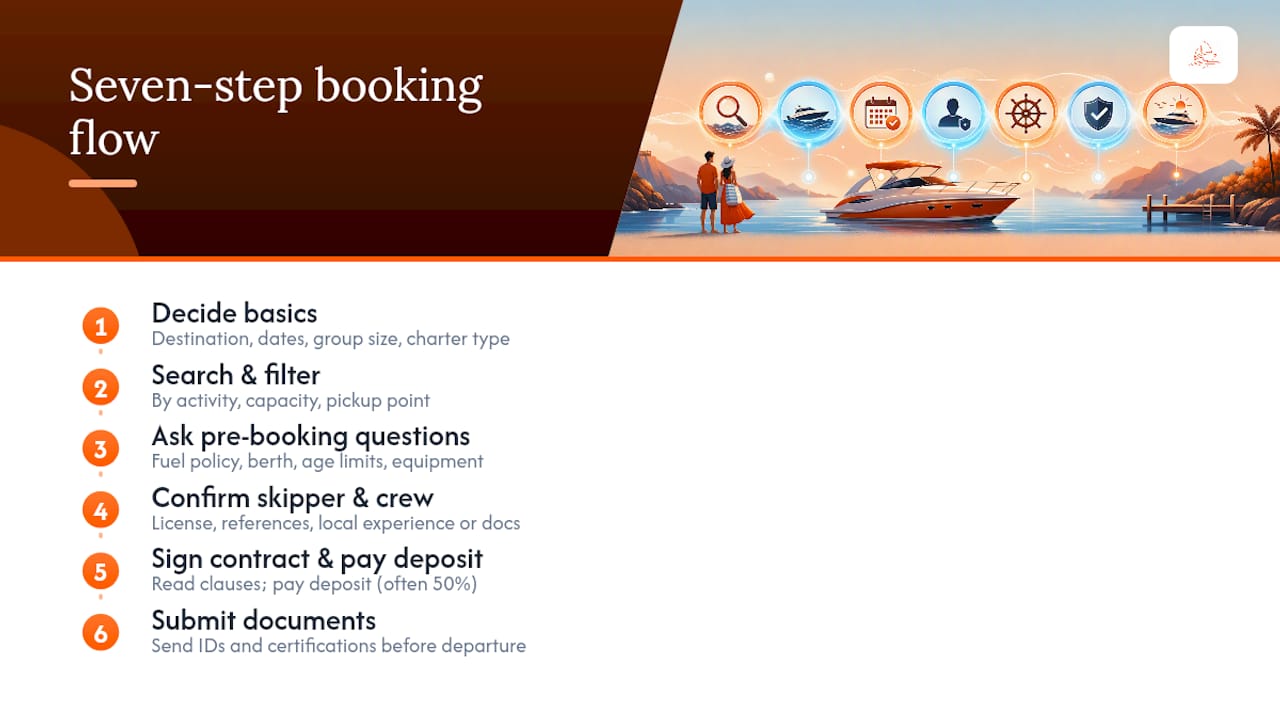
Step 1: Decide your basics. Lock in your destination, dates, group size, and charter type (bareboat, skippered, or crewed) before you look at a single photo. Changing these mid-search wastes time and can push you toward the wrong vessel.
Step 2: Search and filter by activity, capacity, and pickup point. Discover Boating's rental guide puts it plainly: match the boat type to the activity first. Pontoon for relaxed gatherings, center-console for island-hopping, catamaran for stability and space.
Step 3: Ask pre-booking questions. Before you pay anything, get answers on fuel policy (included or metered?), berth availability, age limits for operators, and what equipment is included. Many operators use live-calendar booking engines; verify availability online and then confirm with a human contact to avoid double-booking.
Step 4: Confirm skipper and crew details. If you're hiring a captain, ask for their license number, references, and local experience. If you're going bareboat, confirm what documentation the operator requires from you.
Step 5: Sign the contract and pay the deposit. The Seafarer's charter guide notes that crewed charters commonly use a MYBA-style agreement with a 50% deposit at signing. Read every clause before you wire anything.
Step 6: Submit documents. Send IDs, boating certifications, and any required licenses well before the departure date. Last-minute document issues are one of the most avoidable causes of delayed boarding.
Step 7: Confirm embarkation logistics. Get the marina address, parking details, check-in time, and the name of your contact on the day. A missed check-in window can cost you hours of charter time.
Timing: For peak-season bookings in popular U.S. coastal areas (Florida Keys, the Chesapeake, the Pacific Northwest), aim to book 3–6 months out. For crewed Mediterranean charters, ShermansTravel's first-timer guide recommends 6–12 months ahead.
Pro Tip: Ask two quick questions to test an operator's transparency: "Can you send me a fully itemized quote including all fees?" and "What happens to my deposit if the boat is unavailable on the day?" An operator who hesitates on either one is telling you something.
How do you choose the right boat for your trip?
The single deciding factor is the experience you want on the water, not the boat's appearance in photos. Decide what the day looks like first, then let that narrow the category.
Common rental categories and what they're best for:
- Pontoon boat. Flat deck, stable, easy boarding. Best for relaxed daytime gatherings, swimming stops, and groups with kids or older guests.
- Center-console / deck boat. Open layout, good range, easy to fish from. Best for island-hopping, snorkeling runs, and light fishing.
- Day cruiser. Small cabin, some shade and seating. Best for half-day or full-day outings where comfort matters but overnight stays aren't planned.
- Sailboat / catamaran. Catamarans offer exceptional stability and deck space. Best for overnight passages, groups who want to sail, and anyone prone to seasickness on a monohull.
- Small motor yacht. Enclosed cabin, galley, heads. Best for multi-day trips or groups that want hotel-level comfort on the water.
Capacity vs. comfort is a distinction most first-timers miss. A boat rated for 12 passengers can legally carry 12, but 8 people will be far more comfortable on that same vessel if you're packing coolers, gear, and shade needs. BYRBO's boat rental guide makes the point well: capacity and layout matter more than the headline guest number.
Layout details worth checking before you book:
- Cabin count vs. actual berths (a "4-cabin" boat may sleep 6, not 8)
- Number of heads (bathrooms) relative to group size
- Galley access and refrigeration for longer days
- Storage for soft luggage (hard-sided suitcases are a problem on most charter boats)
- Shade coverage and a swim ladder for warm-weather trips
| Boat type | Best for | Stability | Space | Typical activity |
|---|---|---|---|---|
| Pontoon | Relaxed groups | High | Wide open deck | Swimming, socializing |
| Center-console | Active outings | Moderate | Functional | Fishing, island-hopping |
| Day cruiser | Comfort day trips | Moderate | Cabin + cockpit | Sightseeing, dining |
| Catamaran | Overnight/sailing | Very high | Generous | Passages, snorkeling |
| Motor yacht | Multi-day comfort | High | Full interior | Extended cruising |
What do boat rentals actually cost, and when should you book?
Three cost pillars every renter must verify: the base charter rate, the add-on charges (fuel, port fees, cleaning, provisioning), and the security deposit plus insurance or damage waiver. Miss any one of them and the final bill will surprise you.
Common extra charges to ask about before signing:
- Fuel policy. "Full-to-full" (you return it full) vs. metered consumption vs. a flat fuel allowance.
- Cleaning fee. Often $75–$250 for day rentals; higher for overnights.
- Provisioning / APA. On crewed charters, an Advance Provisioning Allowance covers food, fuel, and port fees; typically 25–35% of the base rate.
- Marina and port fees. Vary widely by destination; always ask if they're included.
- Gratuity. On crewed charters, 10–20% of the base rate is standard but rarely mandatory.
- Late return penalty. Usually charged per hour; confirm the rate in writing.
- Damage waiver or insurance premium. Separate from the security deposit.
Security deposits are typically held as a card authorization rather than a charge, released after the vessel is inspected on return. The hold amount varies by boat size and operator, but day-rental holds commonly run $500–$2,500. Some operators offer a deposit-insurance product that reduces the card hold to a smaller premium paid upfront.
Cancellation policy is the clause most renters skip. Get it in writing: what percentage is refundable at 30 days out, at 14 days, and at 48 hours? Some operators offer trip-cancellation insurance as an add-on worth considering for expensive bookings.
Negotiation tips: Ask for an itemized quote, not a single total. Confirm in writing whether captain fees, fuel, and berth charges are included or extra. The Seafarer notes that a clear, itemized quote is the best defense against surprise fees. For online bookings, compare the service fee percentage across platforms before committing.
Booking timeline: 3–6 months ahead for peak U.S. coastal season (June–August, holiday weekends). Shoulder season (April–May, September–October) allows 4–8 weeks' notice in most markets.
Skippered vs. bareboat vs. crewed: which option fits you?
Hire a captain when you're unfamiliar with local waters, your group wants to relax rather than navigate, or state regulations require demonstrated competency to operate the vessel. That covers most first-time renters.
Qualification and documentation norms:
- Bareboat. You operate the vessel yourself. Many U.S. operators require proof of boating experience, a USCG-approved safety course completion card, or a state-issued boater education card.
- Skippered charter. The operator provides a licensed captain. You need no personal certification, but confirm the captain's USCG license class and local experience.
- Crewed charter. Captain plus additional crew (chef, mate). Standard for larger yachts and multi-day passages.
U.S.-specific rules vary by state. Florida, for example, requires boaters born after January 1, 1988, to carry a Boater Education ID Card. Florida's state boating regulations set age limits, temporary certificate rules, and other operator requirements renters must verify before booking. Some states accept a temporary boater certificate for nonresidents; resources like takemyboattest.com illustrate how that process works for Florida. Always check the rules for the specific state where you'll be on the water.
Pro Tip: A local skipper does more than steer. They know which anchorages are protected when the afternoon wind picks up, which restaurants have dinghy docks, and which channels to avoid on a falling tide. To verify credentials quickly: ask for their USCG license number, request two recent charter references, and search their name on the USCG license lookup tool before you confirm.

What should you inspect before leaving the dock?
Inspect, test, and document everything before you leave the dock. Once you cast off, any pre-existing damage or missing equipment becomes your problem to prove.
Numbered handover checklist:
- Lifejackets. Count them, check sizes, confirm one per person plus throwable.
- Fire extinguisher. Check the pressure gauge and expiration date.
- Flares / EPIRB. Confirm they're present, in date, and stowed accessibly.
- Navigation lights. Test port, starboard, and stern lights before dusk.
- Bilge pump. Test the automatic and manual switch.
- Battery charge. Check the house and start battery levels.
- Fuel level. Photograph the gauge; confirm it matches what the contract states.
- VHF radio. Power on, test channel 16, confirm squelch works.
- Horn. Test it.
- Anchor and rode. Confirm length and condition of chain/line.
- Mooring lines and fenders. Count and inspect for wear.
- Heads and pumps. Flush each head; confirm no blockage.
- Refrigeration. Confirm it's cold before loading provisions.
- Included toys / equipment. Paddleboards, snorkel gear, kayaks — count and inspect each item.
Walk-through inspection steps:
- Photograph the fuel gauge and any pre-existing damage with time-stamped photos.
- Note scratches, dents, and worn gelcoat on the hull and note them on the handover form.
- Ask the crew or operator to demonstrate the bilge pump, VHF, and any unfamiliar systems.
- Confirm the complete rental checklist matches what's physically on the boat.
Safety before departure:
- Save local Coast Guard and marina emergency numbers in your phone.
- Check weather radar immediately before departure, not just the morning forecast.
- Share a float plan (departure point, destination, expected return time, number of passengers) with a contact ashore.
Pro Tip: At handover, say this to the operator: "I'd like to walk through the boat together and note any existing damage on the contract before I sign the acceptance form." Most operators expect it. Those who resist it are giving you a warning sign worth heeding.
What are the most common boat booking mistakes?
The single most common mistake is choosing a boat based on photos and price alone, without reading the contract or verifying what's actually included.
Mistakes and how to stop them:
- Not reading the contract. Read every clause, especially cancellation, deposit forfeiture, and damage liability. If something is unclear, ask in writing before signing.
- Underestimating extras. Fuel, APA, cleaning, and marina fees can add 30–50% to the base rate. Always request an itemized quote.
- Failing to verify the skipper or crew. Ask for license numbers and references before confirming a crewed booking.
- Ignoring weather windows. A forecast checked the morning of departure is not enough. Monitor conditions 48–72 hours out and know the operator's weather-cancellation policy.
- Packing hard luggage. Hard-sided suitcases don't fit in most charter boat storage. Soft duffels only.
- Booking too late in peak season. Popular boats in high-demand destinations are gone months in advance. Waiting until two weeks out leaves you with whatever's left.
- Skipping the pre-departure inspection. Any damage you don't document before leaving the dock is damage you may be charged for on return.
For a deeper look at common booking errors and how to prevent them, the Sailorix blog covers the most frequent administrative and logistical pitfalls renters encounter.
What matters more than photos when choosing a charter?
Crew reputation and itinerary fit typically determine the quality of a charter far more than the vessel's appearance in listing photos. A stunning boat with an indifferent crew is a mediocre trip. A modest boat with an experienced, attentive captain who knows the local waters is usually a great one.
ShermansTravel's first-timer charter guide makes this point directly: service level and itinerary suitability often define the actual charter experience. Here's how to assess both before you book:
Evaluating crew reputation:
- Ask for two or three references from charters in the past 12 months, not older.
- Read recent reviews on multiple platforms; look for patterns (consistent mentions of punctuality, local knowledge, and responsiveness) rather than isolated five-star ratings.
- Ask the captain directly: "What's your favorite anchorage in this area and why?" A specific, enthusiastic answer signals genuine local knowledge.
Itinerary flexibility:
- Confirm whether the itinerary is fixed or adaptable to weather and group preferences.
- Ask what happens if a planned stop is inaccessible due to conditions.
- Find out whether the crew accommodates dietary restrictions and provisioning preferences before departure.
Provisioning and preference sheets:
- Many crewed charter operators send a preference sheet before the trip covering food, drinks, dietary needs, and activity preferences. Fill it out in detail. Operators who use these sheets tend to run more personalized, higher-quality experiences.
- Confirm crew professionalism standards with the operator before signing.
Pro Tip: When reading reviews, filter for mentions of how the crew handled a problem, not just how smooth the trip was. A captain who managed a mechanical issue calmly or rerouted around bad weather without drama is worth more than one who got lucky with perfect conditions.
What Sailorix has learned from thousands of bookings
The strongest single piece of advice: verify the crew before you fall in love with the boat. Sailorix has seen renters book on photos alone, arrive at the dock, and find a vessel that matches the listing but a crew that doesn't match the expectations. The fix is simple. Before confirming any crewed booking, request at least two recent references and ask one direct question about local knowledge. That 10-minute step changes the outcome more reliably than any other part of the booking process.
Members who use Sailorix's preference-sheet workflow and pre-boarding verification checklist consistently report fewer disputes at handover and more personalized experiences on the water. The system works because it forces the right questions early, when there's still time to adjust.
Sailorix makes these tips easier to act on
Most of the friction in boat booking comes from scattered information: fees buried in fine print, availability that isn't actually live, and no clear way to submit documents or preferences before departure. Sailorix is built to remove that friction.

Real-time availability search means you're looking at actual open dates, not a calendar that requires a follow-up call to confirm. Contract transparency, deposit-insurance options, verified crew contacts, and a built-in preference-sheet workflow are all part of the platform, so the steps outlined in this guide become a checklist you can complete in one place rather than across five separate emails.
Ready to book your next trip at a fraction of the usual fees? Explore Sailorix membership and see current availability for your destination.
Sources
Check these three resources before booking any rental in the United States:
- Everything You Need To Know Before Chartering Your First Yacht — ShermansTravel
- Renting a Boat: Boat Rentals guide | Discover Boating
- Uscgboating
- Myfwc
Before departure, pull a current weather radar check and verify local conditions. State rules change; always confirm current requirements directly with the relevant state agency rather than relying on third-party summaries.