

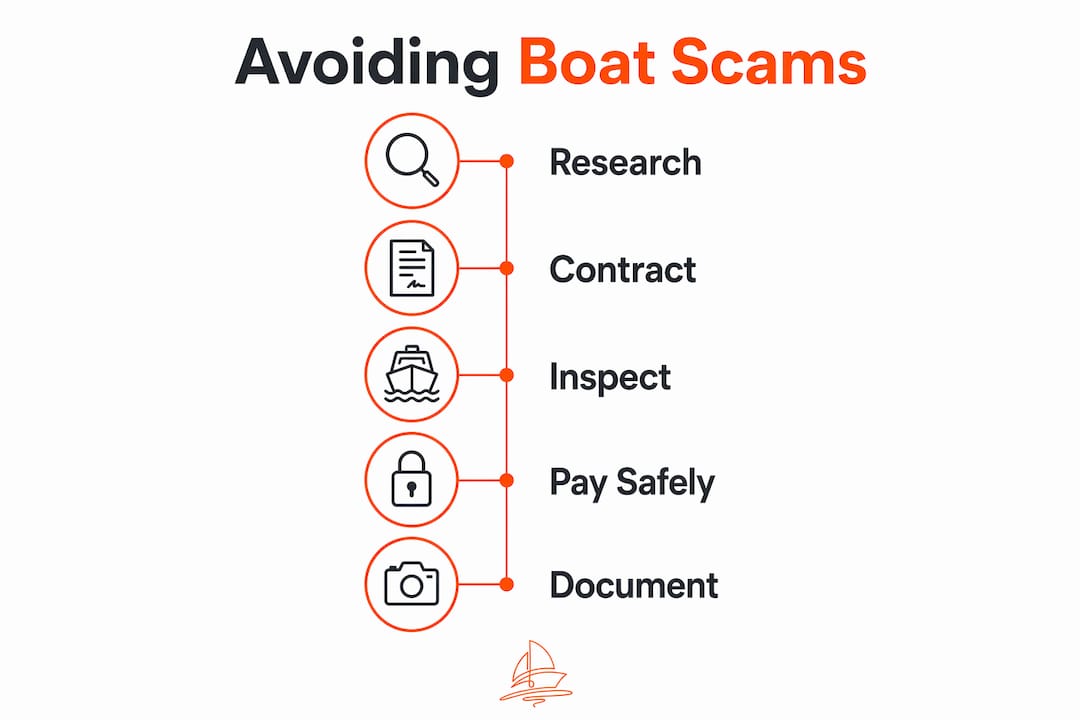
Avoiding boat rental scams comes down to five actions: verify the company's reputation, read every line of the rental agreement, inspect the vessel before you leave the dock, confirm insurance coverage, and pay through a platform with dispute protection. Renters who skip even one of these steps regularly end up disputing fraudulent damage charges or losing deposits to operators who were never legitimate to begin with. Here is what to do at each stage.
Quick checklist before you book:
- Confirm the company has verifiable reviews on third-party platforms
- Read the full rental agreement, including damage liability clauses
- Photograph the boat thoroughly before and after your rental
- Verify insurance coverage type and what it actually covers
- Pay only through platforms that offer dispute resolution
- Walk away from any operator who pressures you to pay fast or off-platform
Table of Contents
- How to avoid boat rental scams by researching the company first
- What should you look for in a boat rental agreement?
- How should you inspect the boat and verify insurance coverage?
- What are the red flags in boat rentals and how do you pay safely?
- What should you do if accused of damage or targeted by a scam?
- How do fraud networks target boat renters and what stops them?
- Why should you use official rental platforms or verified brokers?
- Key Takeaways
How to avoid boat rental scams by researching the company first
The single fastest way to filter out fraudulent operators is to check their reputation before you contact them. Look for reviews on Google, Yelp, or the Better Business Bureau, and pay attention to patterns rather than individual complaints. One bad review about a rude attendant is noise; three reviews mentioning surprise damage charges after return is a pattern worth taking seriously.
Beyond reviews, a legitimate rental company will have a physical address, a working phone number, and proof of insurance available on request. Ask directly for their insurance certificate and their state boating license. Operators who stall, deflect, or claim those documents are "internal only" are waving a red flag. You can also verify boat availability and check for professional conduct signals before committing to any booking.
- Check Google, Yelp, and the Better Business Bureau for patterns in reviews
- Request proof of insurance and a valid operating license before booking
- Confirm the company has a physical address and reachable customer support
- Be cautious of prices that seem far below the local market rate
- Avoid operators with no verifiable history or only a social media presence
What should you look for in a boat rental agreement?
Rental agreements are where most hidden fees and fraudulent damage claims originate. Read the entire document before signing, not just the price summary. Pay close attention to the damage liability section: vague language like "renter is responsible for any damage" with no defined cap or inspection process is a setup for inflated post-rental charges.
Well-drafted rental agreements clearly spell out renter liability, fees, and damage policies, protecting both parties from disputes. If the contract you receive does not meet that standard, ask for clarification in writing before you sign. Always request a signed copy for your own records.
- Read every clause, especially damage liability, deposit terms, and cancellation rights
- Identify any fees not included in the quoted price, such as fuel surcharges or cleaning fees
- Ask about the refund policy and the exact conditions that trigger deposit forfeiture
- Flag vague damage language and request specific definitions before signing
- Keep a copy of the signed agreement throughout your rental period
How should you inspect the boat and verify insurance coverage?
Walk around the entire vessel before you accept it. Note every scratch, dent, and mechanical issue, no matter how minor. Reputable operators document boat condition with time-stamped photos before and after rental as standard practice, and you should do the same independently. Use your phone to shoot a short video that captures the date and time, covering the hull, deck, engine compartment, and all safety equipment.
Safety equipment is not optional. The U.S. Coast Guard requires all vessels to carry a properly fitting, USCG-approved life jacket for every person aboard, along with fire extinguishers, sound signaling devices, and navigation lights. Confirm all of it is present and functional before you leave the dock. On the insurance side, ask the operator specifically what their policy covers, what the deductible is, and whether you as the renter carry any residual liability.
- Photograph or video the entire vessel with visible timestamps before departure
- Confirm all U.S. Coast Guard-required safety gear is present and in working condition
- Ask the operator to walk you through the boat's controls and safety equipment
- Request a pre-rental safety briefing that covers local hazards and operating rules
- Verify the insurance policy type, coverage limits, and your liability as the renter
Pro Tip: Ask the rental company to co-sign a written condition checklist at pickup. If they refuse, that refusal itself is documentation you can use later.

What are the red flags in boat rentals and how do you pay safely?
Fraudulent operators follow recognizable patterns. Pressure to pay quickly, requests to move the transaction off-platform, and unusually low prices are the three most common warning signs. Coordinated fraud networks have been documented testing systems with small transactions before completing higher-value bookings, particularly during peak summer boating seasons. Rushing you past due diligence is exactly how those schemes work.

Pay through established booking platforms that include payment dispute resolution. Avoiding manual bank transfers or external payment apps without dispute protection is one of the most direct ways to reduce your fraud exposure. If a transaction goes wrong on a credit card processed through a legitimate platform, you have a clear path to dispute it. A wire transfer to a private account gives you almost nothing to work with.
Strong customer authentication (SCA), including multi-step verification at checkout, is now standard practice on reputable boat rental platforms. If a booking site does not ask for any identity verification, treat that as a warning sign rather than a convenience.
- Book through platforms that offer integrated payment protection and dispute resolution
- Never send money via wire transfer, Zelle, Venmo, or cash to an operator you cannot verify
- Expect and welcome multi-factor authentication at checkout as a security feature
- Walk away from any operator who asks you to complete the transaction outside the platform
- Be skeptical of prices that are dramatically lower than comparable rentals in the same area
Statistic callout: Advanced fraud prevention tools helped one major boat rental platform achieve a 30% increase in chargeback win rate by cross-referencing IP addresses, device fingerprints, and phone numbers to identify fraudulent accounts.
What should you do if accused of damage or targeted by a scam?
Stay calm and go straight to your documentation. Pull up the photos and video you took at pickup and compare them directly against whatever damage the operator is claiming. If the alleged damage does not appear in your pre-rental footage, say so in writing immediately and request the operator's own pre-rental documentation.
Dispute any questionable charge with your payment provider as soon as possible. Credit card issuers and platform payment systems both have formal dispute processes, and your timestamped evidence is exactly what those processes are built around. For common boat rental booking mistakes that leave renters vulnerable, preparation before the rental is always cheaper than fighting a false claim after.
If you believe you have been defrauded, report the incident to the Federal Trade Commission at ReportFraud.ftc.gov, your state's attorney general office, and the U.S. Coast Guard if the scam involved safety misrepresentation. Consumer protection agencies and maritime authorities are the right contacts for renters seeking legal recourse after a fraudulent rental.
- Compare your pre-rental photos and video directly against any damage accusation
- Request the operator's own pre-rental condition documentation in writing
- File a dispute with your credit card issuer or platform payment system promptly
- Report fraud to the FTC, your state attorney general, and the U.S. Coast Guard as appropriate
- Keep all written communication with the operator as evidence throughout any dispute
How do fraud networks target boat renters and what stops them?
Fraud in the boat rental space has grown more organized. Documented cases show coordinated networks of fraudsters running small test transactions across multiple accounts to identify vulnerable platforms, then executing higher-value scams once a system's defenses are mapped. These spikes in fraudulent activity tend to cluster around popular boating destinations during the summer season.
Platforms that invest in machine learning and global fraud data networks can cross-reference IP addresses, device fingerprints, and phone numbers to flag suspicious accounts before any money moves. When a platform detects a high-risk user, requesting a government-issued ID for verification has proven effective at catching fake identities and shutting down fraudulent accounts early.
Friendly fraud, where a renter disputes a legitimate charge by claiming the rental was unsatisfactory, is also a documented risk for operators. Signed inspection checklists and photo documentation protect both sides of that equation. For renters, the same documentation that protects operators from false claims also protects you from false accusations.
Pro Tip: Always insist on booking through the platform's official payment portal. Platforms with integrated fraud detection tools offer a layer of protection that no private arrangement can replicate.
Statistic callout: Using advanced fraud detection, one leading boat rental marketplace achieved a 30% chargeback win rate increase by presenting financial institutions with linked account data and digital footprints tied to fraudulent transactions.
Why should you use official rental platforms or verified brokers?
Official booking platforms and verified brokers offer protections that private or informal arrangements simply cannot. Payment dispute resolution, identity verification, transparent fee disclosure, and documented rental terms are all built into reputable platforms by design. When something goes wrong, you have a paper trail, a support team, and a formal process.
Sailorix operates as a verified global boat booking platform with transparent pricing and low service fees, giving renters a clear record of every transaction. Booking through a platform like Sailorix also means your rental terms, payment history, and communication are all stored in one place, which matters enormously if you ever need to dispute a charge or report an incident. The same principle applies across the travel rental space: booking best practices for verified rental platforms consistently reduce fraud exposure compared to informal arrangements.
Before you book any vessel, run through the complete rental checklist to confirm you have covered every verification step. A few minutes of preparation before you sign anything is the most reliable fraud prevention available.
Key Takeaways
Preventing boat rental fraud requires verifying the company, reading the contract, documenting the vessel, securing payment, and knowing exactly how to respond if something goes wrong.
| Point | Details |
|---|---|
| Research before booking | Check third-party reviews and request proof of insurance and a valid operating license. |
| Read the full agreement | Identify damage liability clauses, hidden fees, and cancellation terms before signing. |
| Document the vessel | Take timestamped photos and video of the entire boat before and after your rental. |
| Pay through protected platforms | Use booking platforms with dispute resolution; avoid wire transfers or off-platform payments. |
| Act fast if accused | Compare your pre-rental documentation against any claim and file a dispute with your payment provider promptly. |