
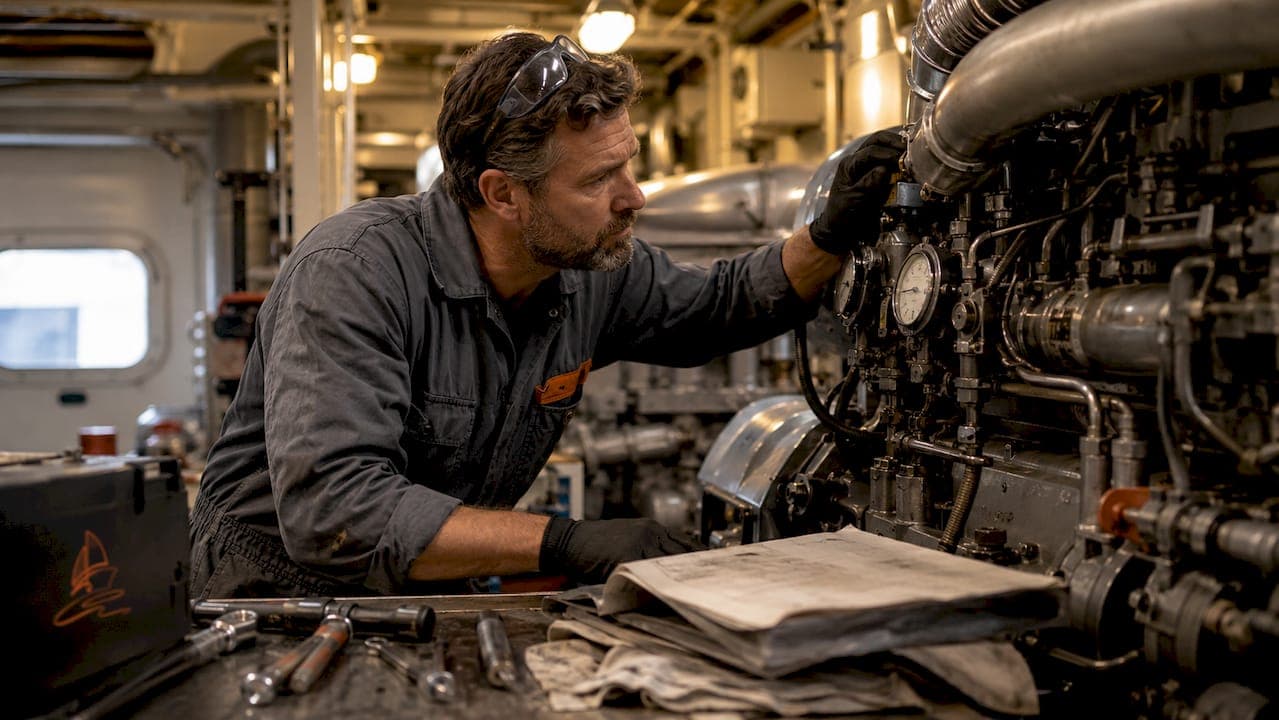
Marine diesel engines are defined as compression-ignition internal combustion engines built specifically for sustained, high-torque propulsion in marine vessels. They power everything from small recreational fishing boats to large commercial offshore vessels, and they operate under EPA Tier 4 and IMO Tier III emission standards that set strict limits on nitrogen oxides and particulate matter. Choosing the right engine, maintaining it correctly, and understanding its core technologies directly determines how long your vessel runs reliably and how much it costs to operate.
What are marine diesel engines and how do you choose the right one?
Engine selection starts with hull type, not horsepower preference. Industry guidelines specify horsepower-to-tonnage ratios by hull category: displacement hulls need 3–5 HP per ton, semi-displacement hulls need 8–12 HP per ton, and planing hulls need 15–25 HP per ton. These ratios exist because each hull type operates at a fundamentally different speed-to-resistance relationship.
Vessel size narrows the power band further. Small fishing boats typically require 150–300 HP, midsize vessels fall in the 300–600 HP range, and large commercial or offshore boats need 600+ HP to maintain operational loads. Matching power to actual load keeps the engine running in its designed duty cycle.

The most common mistake boat owners make is oversizing. Oversized engines on displacement hulls cause wet stacking, a condition where unburned fuel and carbon accumulate in the exhaust system because the engine never reaches the temperature needed for complete combustion. Wet stacking clogs exhaust components and accelerates internal wear. An engine that runs at 40% load most of the time is being destroyed slowly.
| Hull Type | HP per Ton | Typical Vessel Size | Power Range |
|---|---|---|---|
| Displacement | 3–5 HP/ton | Sailboats, trawlers | 150–300 HP |
| Semi-displacement | 8–12 HP/ton | Express cruisers | 300–600 HP |
| Planing | 15–25 HP/ton | Sport boats, offshore | 600+ HP |
Pro Tip: Before selecting an engine, document your typical load profile. Include crew weight, fuel and water capacity, gear, and average sea conditions. An engine sized for your real operational load will outlast one sized for peak theoretical demand.
What technologies define modern marine diesel performance?
Modern marine diesel engines use two primary combustion systems: direct injection and common-rail injection. Common-rail systems maintain fuel at very high pressure in a shared rail and inject it in multiple precise bursts per combustion cycle. The Yanmar 12AYM series uses direct injection combined with turbocharging and intercooling to achieve outputs from 882 to 1,340 kW at 1,850–1,940 rpm. That combination of technologies delivers high power density without proportionally increasing engine size or weight.
Key technologies found in current marine propulsion systems include:
- Turbocharging: Forces more air into the combustion chamber, increasing power output without enlarging the engine block.
- Intercooling: Cools the compressed air from the turbocharger before it enters the cylinder, increasing air density and combustion efficiency.
- Common-rail injection: Delivers fuel at pressures exceeding 1,800 bar in multiple injections per cycle, reducing noise and improving fuel burn.
- Selective Catalytic Reduction (SCR): An aftertreatment system that injects a urea-based solution into the exhaust stream to convert nitrogen oxides into harmless nitrogen and water, meeting EPA Tier 4 and IMO Tier III standards.
- Electronic Control Units (ECUs): Monitor fuel delivery, timing, and engine load in real time, replacing purely mechanical governor systems.
- Variable geometry turbocharging: Adjusts turbocharger vane angles to maintain boost pressure across a wider RPM range, improving low-speed torque.
The Volvo Penta D3-110 illustrates how these technologies combine in a production engine. It uses an aluminum block with variable geometry turbocharging and electronic vessel control, making it well suited for displacement and semi-displacement hulls where quiet, fuel-efficient operation matters more than peak horsepower.
Emission aftertreatment systems like SCR add complexity but also deliver a measurable benefit. EPA Tier 4 fuel efficiency innovations lower operating costs by reducing fuel consumption while meeting environmental mandates. The regulation that looks like a compliance burden actually pays back in lower fuel bills over the engine's service life.
How to maintain marine diesel engines and prevent common failures
Maintenance intervals for marine diesel engines are not one-size-fits-all. Premium engines like the Caterpillar 3512E use tiered maintenance schedules based on duty cycles, with intervals ranging from 250 to 1,000 hours depending on the task. An engine running continuous commercial duty needs more frequent attention than one used for weekend cruising.
The turbocharger is the most vulnerable component in a marine diesel. Neglecting oil changes and cooling system upkeep causes premature turbocharger failure, the most common mechanical breakdown in marine diesel engines. The turbo spins at up to 150,000 rpm and depends entirely on clean, pressurized oil for lubrication. Dirty oil destroys turbo bearings within hours of contamination.
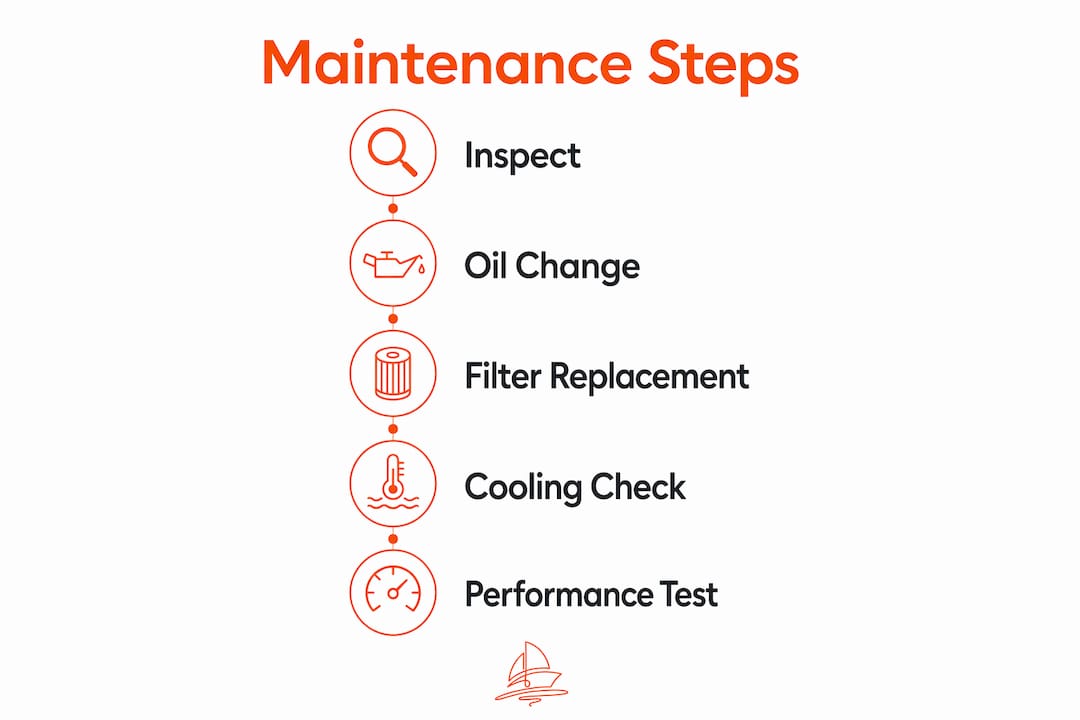
Follow this maintenance sequence to protect your engine:
- Engine oil and filter: Change at every 250-hour interval or annually, whichever comes first. Use the viscosity grade specified for your operating temperature range.
- Fuel filters: Replace primary and secondary filters every 250 hours. Water contamination in marine fuel is common and destroys injection components.
- Cooling system: Flush and inspect the heat exchanger, impeller, and thermostat every 500 hours. Salt deposits restrict flow and cause overheating.
- Turbocharger inspection: Check for shaft play and oil leaks at every 500-hour service. A turbo with measurable shaft play needs replacement before it fails catastrophically.
- ECU diagnostic scan: Run a full electronic diagnostic at every major service interval. Modern engines with digital control units log fault codes that reveal developing problems before they become failures.
- Belts and hoses: Inspect visually at every oil change and replace on a calendar schedule regardless of apparent condition.
Operating conditions change everything. A vessel working in tropical saltwater needs more frequent cooling system checks than one operating in temperate freshwater. Adjust your intervals to match your actual environment, not just the manufacturer's baseline.
Pro Tip: Keep a physical engine log with date, hours, and every service performed. When a problem develops, that log tells a mechanic exactly what has been done and when. It also protects resale value by proving the engine was maintained correctly.
How do you maximize fuel efficiency and diesel engine performance?
Fuel efficiency in marine diesel engines comes down to one principle: match the engine's torque curve to the propeller's load curve. Marine gear ratios are critical to transferring torque efficiently from the engine to the propeller. A mismatched gear ratio forces the engine to work outside its designed RPM band, burning more fuel for less thrust.
Diesel engines dominate offshore and commercial applications because of their strong low-RPM torque. That torque advantage is only realized when the propeller pitch and diameter are correctly matched to the engine's peak torque RPM. A propeller that is too coarse prevents the engine from reaching its rated RPM. A propeller that is too fine lets the engine over-rev without delivering adequate thrust.
Practical steps for improving fuel efficiency and engine performance:
- Stay in the correct RPM band. Running below the manufacturer's minimum continuous RPM causes wet stacking. Running above rated RPM accelerates wear on every moving component.
- Monitor fuel consumption per nautical mile, not just per hour. Speed changes have a disproportionate effect on consumption because drag increases with the square of speed.
- Check propeller condition regularly. A bent or fouled propeller increases fuel consumption measurably and puts asymmetric load on the shaft and bearings.
- Use ECU data. Modern engines report fuel flow, load percentage, and exhaust temperature in real time. Use that data to identify inefficient operating patterns.
Emission-compliant engines built to EPA Tier 4 standards deliver better fuel economy than older pre-regulation engines. The technology required to meet the standards, specifically precise injection timing and aftertreatment systems, also produces more complete combustion. Compliance and efficiency move in the same direction.
Key Takeaways
Marine diesel engines deliver reliable, high-torque propulsion only when correctly sized for hull type, maintained on duty-cycle-based intervals, and operated within their designed RPM bands.
| Point | Details |
|---|---|
| Match engine to hull type | Use HP-per-ton ratios: 3–5 for displacement, 8–12 for semi-displacement, 15–25 for planing hulls. |
| Avoid oversizing | Oversized engines cause wet stacking, clogged exhausts, and accelerated wear on displacement hulls. |
| Prioritize turbocharger care | Clean oil and a functioning cooling system prevent the most common marine diesel failure. |
| Use ECU diagnostics | Digital fault codes reveal developing problems before they become expensive breakdowns. |
| Align propeller to torque curve | Correct gear ratio and propeller pitch are the fastest way to recover lost fuel efficiency. |
What I've learned about marine diesel engines after years on the water
The conventional advice says buy the most powerful engine your budget allows. That advice is wrong for most boat owners. After working with vessels across displacement, semi-displacement, and planing configurations, the pattern is clear: the owners with the fewest problems run engines at 70–80% of rated load, not 100%. An engine that never gets pushed hard lasts longer, burns cleaner, and costs less to maintain.
The shift to electronic controls and common-rail injection has made modern marine diesels more efficient and more complex at the same time. Owners who learned on purely mechanical engines sometimes resist the ECU diagnostic tools, treating them as optional extras. They are not optional. The ECU is the earliest warning system available, and ignoring it is the equivalent of removing the oil pressure gauge.
Emission regulations get criticized as burdensome, but the technology they forced into production, specifically SCR systems and precision injection, genuinely lowers long-term operating costs. The owners who complain loudest about compliance costs are often the same ones paying the highest fuel bills with older, pre-regulation engines.
At Sailorix, we see boat owners across every vessel category, and the ones who get the most from their engines share one habit: they treat maintenance as an investment, not an expense. A well-maintained diesel engine can run reliably for 10,000 hours or more. A neglected one rarely makes it past 3,000.
— Sailorix
Plan your next voyage with Sailorix
Understanding your engine is only part of the equation. Knowing where to take your vessel, and how to get there affordably, matters just as much.

Sailorix gives boat owners and marine enthusiasts access to yacht and boat rentals worldwide through a membership model built around transparency. For €100 per year, members book vessels with approximately 1% service fees, far below the industry standard of 10–20%. Whether you are planning a coastal passage on a diesel-powered trawler or chartering a performance cruiser, Sailorix connects you to real-time availability at honest prices. Visit Sailorix to browse available vessels and see how straightforward boat booking can be.
FAQ
What is a marine diesel engine?
A marine diesel engine is a compression-ignition engine built for sustained, high-torque propulsion in boats and ships. It uses heat from compressed air to ignite fuel, without a spark plug, making it more fuel-efficient and durable than gasoline alternatives for continuous operation.
How much horsepower does a marine diesel engine need?
Power requirements depend on hull type and vessel size. Displacement hulls need 3–5 HP per ton, semi-displacement hulls need 8–12 HP per ton, and planing hulls need 15–25 HP per ton, with small fishing boats typically requiring 150–300 HP.
What causes wet stacking in a marine diesel engine?
Wet stacking occurs when an oversized engine runs at too low a load, preventing the combustion chamber from reaching operating temperature. Unburned fuel and carbon accumulate in the exhaust system, clogging components and reducing engine life.
How often should you service a marine diesel engine?
Service intervals vary by duty cycle, but most marine diesels require oil and fuel filter changes every 250 hours and cooling system inspection every 500 hours. Engines operating in harsh saltwater conditions or under continuous commercial load need more frequent checks.
What emission standards apply to marine diesel engines in 2026?
Marine diesel engines in the United States must meet EPA Tier 4 standards, while vessels operating internationally are subject to IMO Tier III regulations. Both standards limit nitrogen oxide and particulate emissions and require aftertreatment systems like Selective Catalytic Reduction on larger engines.