

Mast types are defined by three core variables: stepping method, rigging configuration, and construction material. Each variable directly shapes how a sailboat performs, how the rig loads the hull, and how much maintenance the vessel demands over its lifetime. The two primary classifications are deck-stepped and keel-stepped masts, with stayed and free-standing rigs forming a second layer of distinction. Understanding these different mast designs is the foundation of any serious mast selection guide, whether you're buying a cruiser, commissioning a build, or evaluating a used yacht.
What are the main mast types on sailboats?
The two dominant mast types in sailing are deck-stepped and keel-stepped, and the structural difference between them is more significant than most sailors realize at first glance.
A deck-stepped mast sits on a fitting mounted directly on the deck. It functions as a pinned compression column, transferring its entire vertical load down through a compression post to the keel structure below. This design keeps the mast out of the cabin, which means a drier interior and simpler access for stepping and unstepping. Sailors who race on inland lakes or trailer their boats frequently favor deck-stepped rigs for exactly this reason.
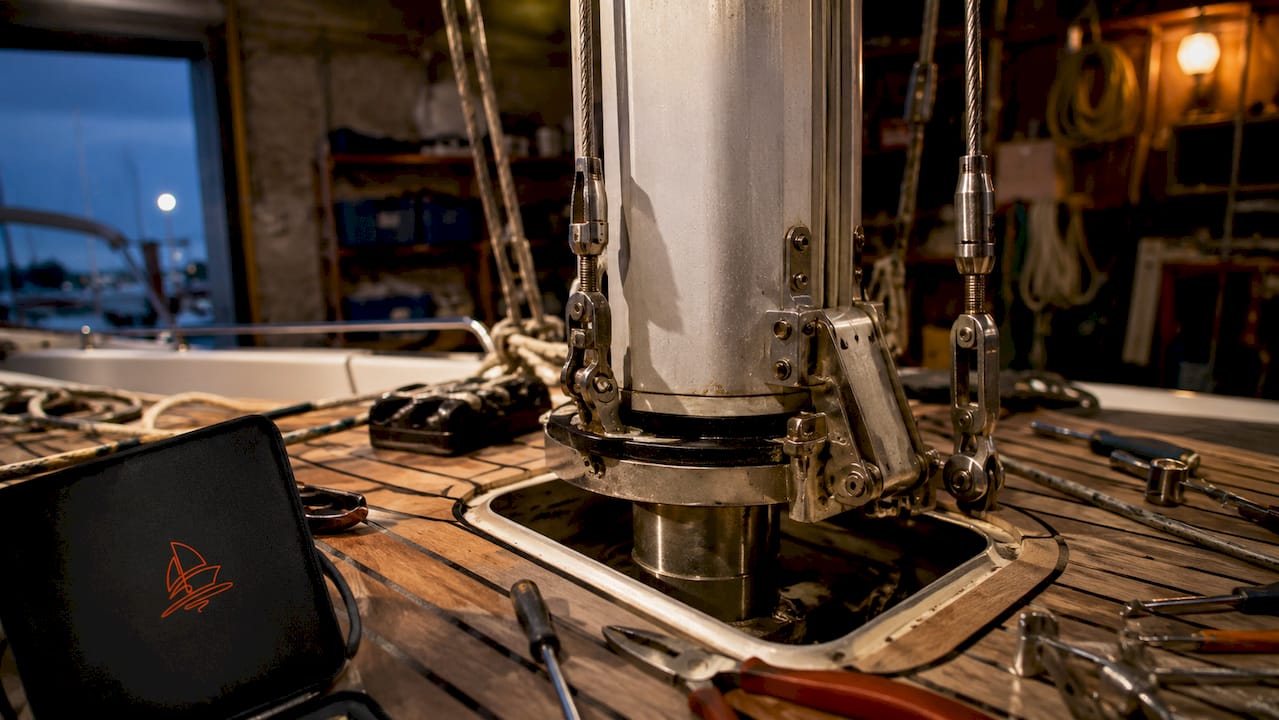
A keel-stepped mast passes through the deck and seats directly on the keel. It behaves as a propped cantilever, supported at two points: the keel step and the deck partners. That dual support reduces the unbraced length of the mast, which translates to greater structural rigidity and finer control over sail shape. Offshore cruisers and bluewater sailors tend to prefer this arrangement for its stability in heavy conditions.
The distinction matters beyond engineering theory. Your choice between these two types affects cabin layout, maintenance routines, failure modes, and even how you tune your sails upwind.
How do deck-stepped and keel-stepped masts compare?
The mechanical profiles of these two designs diverge in ways that show up in everyday sailing and long-term ownership.
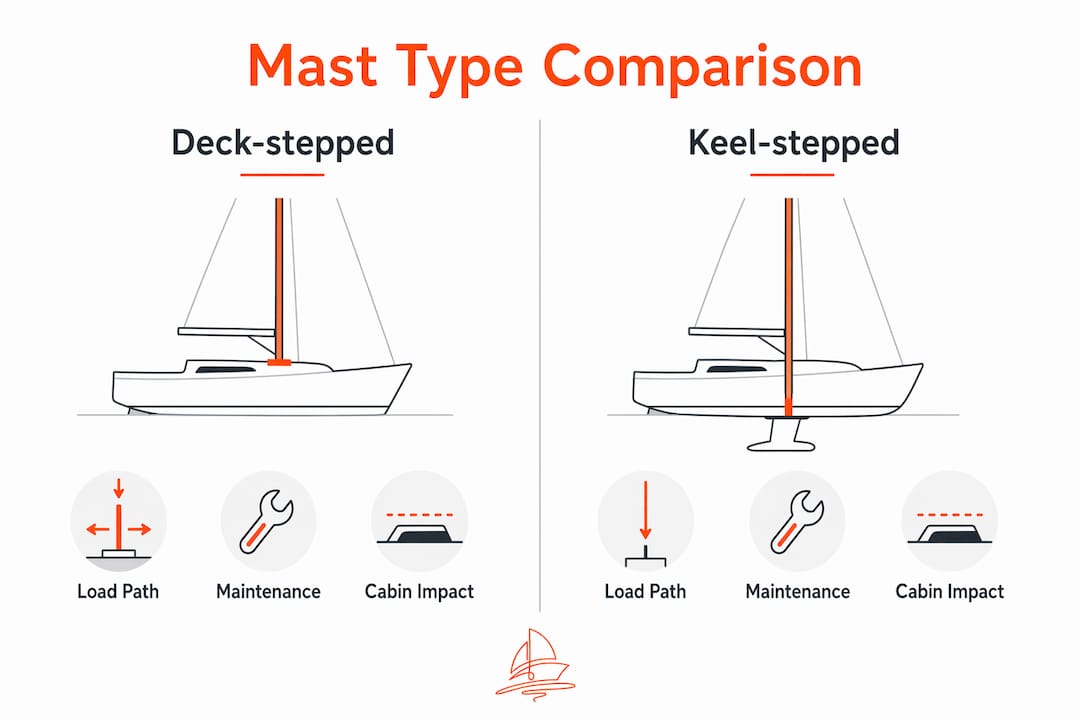
Structural load and rigidity
A keel-stepped mast gains lateral support from the deck partners, which shortens its effective unsupported span. This gives it a mechanical advantage for pre-bending. Using deck wedges and backstay tension, you can control mast pre-bend to flatten or deepen the mainsail with precision. Deck-stepped masts can be tuned, but they lack the same lever arm for pre-bend adjustments.
Maintenance and moisture
Deck-stepped masts offer a clear advantage: the cabin stays dry. There is no hole through the deck, so no mast boot to maintain and no water pathway into the bilge. Keel-stepped masts require a mast boot at the deck partners, and that seal must be inspected and replaced regularly. Water that enters through the boot or down internal halyards collects at the keel step and needs a drainage system to prevent bilge flooding.
The less obvious risk sits under the deck-stepped mast. Moisture can infiltrate the deck core around the compression post, and over time the core material crushes under load. The result is deck sag and rig tension loss, a failure mode that develops slowly and often goes undetected until significant damage has occurred.
Pro Tip: Tap the deck around the base of a deck-stepped mast with a plastic mallet every season. A hollow sound signals moisture in the core, and catching it early saves a costly repair.
Comparison at a glance
| Feature | Deck-stepped | Keel-stepped |
|---|---|---|
| Load path | Compression post to keel | Direct to keel via mast step |
| Structural rigidity | Moderate | High |
| Cabin moisture risk | Low | Higher without proper boot maintenance |
| Sail shape control | Good | Superior pre-bend capability |
| Stepping logistics | Easier, faster | More complex, requires crane or lift |
| Failure mode | Deck core compression | Mast boot failure, bilge flooding |
What other mast designs and rig configurations exist?
Beyond the stepping method, the rigging plan defines a second layer of mast classification. The three main categories are stayed masts, free-standing masts, and rotating masts.
Stayed masts
Stayed masts are the standard on the vast majority of production sailboats. Shrouds and forestays carry the lateral and fore-and-aft loads, converting the mast into a compression column subject to buckling limits. Because the standing rigging absorbs so much of the load, the mast itself can be lighter and more slender than a free-standing equivalent. The tradeoff is complexity: more components, more potential failure points, and more tuning required.
Free-standing masts
Free-standing masts carry all loads within the spar itself, with no shrouds or stays. They require a unique hull structural design to handle the bending moments transferred directly to the deck and keel. Carbon fiber has made free-standing masts more practical on modern performance boats and certain cruising designs like the Freedom rig. The absence of standing rigging simplifies the deck and reduces windage, but the mast section must be significantly stiffer and heavier to compensate.
Rotating masts
Rotating masts can pivot on their axis to align with the sail's chord line, reducing turbulence at the luff. They appear most often on catamarans and high-performance dinghies. Rotation improves aerodynamic efficiency, but it adds mechanical complexity at the mast base and requires careful integration with the boom and sail track.
Key characteristics of each rig type:
- Stayed masts: Lighter spars, more tuning options, standard on most cruisers and racers
- Free-standing masts: No standing rigging, higher structural demands on the spar and hull
- Rotating masts: Aerodynamic gain, common on multihulls, requires specialized fittings
- Masts with side struts: Rare on modern designs, used historically to reduce shroud angles on narrow hulls
What materials are used in different mast designs?
Material choice is inseparable from mast type. The same rig configuration performs very differently depending on whether the spar is wood, aluminum, or carbon fiber composite.
Wood
Wooden masts are the oldest form and still appear on classic and traditional vessels. They are heavy, prone to rot, and susceptible to warping with moisture changes. Wooden masts tend to warp and rot, which demands regular varnishing, inspection, and occasional section replacement. Solid wooden masts are rare on working sailboats today, though hollow wooden spars built from laminated sections remain popular in the classic yacht restoration community.
Aluminum
Aluminum became the modern standard from the 1960s onward. It offers strong corrosion resistance, accepts rigging hardware cleanly, and can be extruded into consistent profiles at relatively low cost. Aluminum masts work well with both deck-stepped and keel-stepped configurations and are compatible with all standard rigging systems. The main limitation is weight aloft, which affects stability and roll characteristics on performance boats.
Pro Tip: Inspect aluminum masts annually for electrolytic corrosion at the base, especially where the mast contacts stainless steel fittings. A thin layer of lanolin or corrosion-inhibiting grease at contact points significantly extends service life.
Carbon fiber composites
Carbon fiber masts deliver the best strength-to-weight ratio available. A carbon spar can be 30–50% lighter than an equivalent aluminum mast, which lowers the center of gravity and improves both stability and upwind performance. The cost is substantially higher, and carbon requires careful inspection for delamination and impact damage that may not be visible on the surface. Carbon masts pair naturally with free-standing designs and high-performance stayed rigs on racing yachts.
Key material considerations for your mast selection guide:
- Wood: Traditional aesthetic, high maintenance, limited to classic restorations
- Aluminum: Cost-effective, durable, standard on cruising and club racing boats
- Carbon fiber: Lightest option, highest performance, significant cost premium
- Trussed and built-up sections: Used on larger vessels where single-extrusion spars are impractical
How do you choose and maintain the right mast type?
Selecting the right mast type starts with matching the rig to your sailing profile. A weekend racer on sheltered water has different priorities than a bluewater cruiser planning a Pacific crossing.
Follow this inspection and selection framework:
- Assess the compression post. On deck-stepped boats, the compression post is the most overlooked structural element. Owners frequently miss early deck core damage beneath the step, which compromises rig tension and mast alignment before any visible symptoms appear. Push firmly on the deck around the base and look for flex.
- Inspect the mast boot on keel-stepped rigs. The boot seal at the deck partners degrades with UV exposure and movement. Replace it every two to three seasons, and check that the internal drainage path from the mast cavity to the bilge is clear.
- Check rig tension with a calibrated tension gauge. Shroud tension affects mast bend, forestay sag, and upwind sail shape. Tension that is too low causes excessive forestay sag; tension that is too high overloads the chainplates and deck fittings.
- Evaluate stepping logistics for your use case. Converting a keel-stepped mast to deck-stepped requires significant structural modification and is generally not recommended. Choose the right type at the outset rather than planning a retrofit.
- Schedule a professional rig survey every three to five years. A qualified rigger will identify fatigue cracks at swage fittings, pin wear at chainplates, and early signs of mast section corrosion that a visual inspection from deck level will miss.
Pro Tip: When evaluating a used boat, always ask for the rig survey history. A boat with no documented rig inspection in the past five years carries hidden risk, regardless of how clean the mast looks from the dock.
The mast tuning process also varies by type. Keel-stepped masts allow physical pre-bend adjustments that directly shape the mainsail's draft position, giving performance-oriented sailors a meaningful tuning tool. Deck-stepped masts rely more heavily on backstay tension and shroud adjustment to achieve similar results.
Key Takeaways
The right mast type depends on your stepping method, rig configuration, and material choice, and each decision has direct consequences for performance, maintenance, and long-term structural integrity.
| Point | Details |
|---|---|
| Stepping method defines load path | Keel-stepped masts act as propped cantilevers; deck-stepped masts transfer load through a compression post. |
| Keel-stepped offers superior sail control | Pre-bend via deck wedges and backstay tension gives finer mainsail shape adjustment. |
| Deck-stepped demands core inspection | Moisture in the deck core under the compression post causes sag and rig tension loss. |
| Material choice affects weight and cost | Carbon fiber saves significant weight aloft; aluminum balances cost and durability for most sailors. |
| Rig surveys prevent costly failures | A professional inspection every three to five years catches fatigue and corrosion before they become emergencies. |
The mast decision most sailors get wrong
Most sailors focus on rig type when choosing a boat and treat the mast stepping method as an afterthought. That is the wrong priority. The stepping method determines how the entire rig loads the hull, how the boat behaves in a knockdown, and what your maintenance calendar looks like for the next decade.
Keel-stepped masts have a real safety advantage that rarely gets discussed: if a stay fails offshore, the mast is far less likely to go over the side immediately. The keel step and deck partners hold it in column long enough to react. A deck-stepped mast with a failed shroud has nothing to keep it upright. That difference matters on a bluewater passage.
The other misconception I see constantly is that free-standing masts are low maintenance because they have no standing rigging. The standing rigging is gone, but the structural demands on the hull are higher, and the mast section itself requires more careful inspection for fatigue. You trade one maintenance category for another.
My honest recommendation: match the mast type to the sailing you actually do, not the sailing you imagine doing. A keel-stepped aluminum mast on a well-built cruiser will outlast and outperform a carbon free-standing rig on a boat whose owner never leaves the marina. The best mast type is the one you understand, inspect, and maintain correctly.
— Sailorix
Sailorix resources for sailors who take rigging seriously
Choosing the right mast type is one of the most consequential decisions in sailboat ownership, and getting it right requires more than a single article.

Sailorix publishes in-depth sailing guides covering everything from yacht mast essentials to rig tuning and materials selection, written for sailors who want real technical depth. Beyond guides, Sailorix gives members access to yacht bookings worldwide at roughly 1% service fees, far below the industry standard. For €100 per year, you get both the knowledge base and the platform to put it to use. Visit Sailorix to explore the full resource library and see available boats in your sailing region.
FAQ
What is the difference between deck-stepped and keel-stepped masts?
A deck-stepped mast sits on the deck and transfers load through a compression post, while a keel-stepped mast passes through the deck and seats directly on the keel, acting as a propped cantilever with greater structural rigidity.
Which mast type is better for offshore sailing?
Keel-stepped masts are generally preferred for offshore sailing because their dual support points provide superior rigidity and reduce the risk of the mast falling if a stay fails.
Can you convert a keel-stepped mast to deck-stepped?
Converting a keel-stepped mast to deck-stepped requires significant structural modification to the deck and hull, and the change is generally not recommended due to cost and integrity concerns.
What is the best material for a sailboat mast?
Aluminum is the standard choice for most cruising and club racing boats due to its balance of cost, durability, and corrosion resistance. Carbon fiber offers better performance at a significantly higher price.
How often should a sailboat mast be inspected?
A professional rig survey every three to five years is the standard recommendation, with annual owner inspections covering shroud tension, mast boot condition, and compression post integrity.