

A mast boat is a sailing vessel defined by its mast, a tall vertical spar that supports the sails and holds the entire rig together. Without a properly designed and maintained mast, no sailboat can perform safely or efficiently. The mast is not just a pole. It is a structural column that transfers wind load through the rigging into the hull, making its design, material, and condition central to every decision you make on the water. This guide covers the main mast types and components, maintenance schedules, and performance trade-offs every sailor needs to understand.
What are the main types of yacht masts?
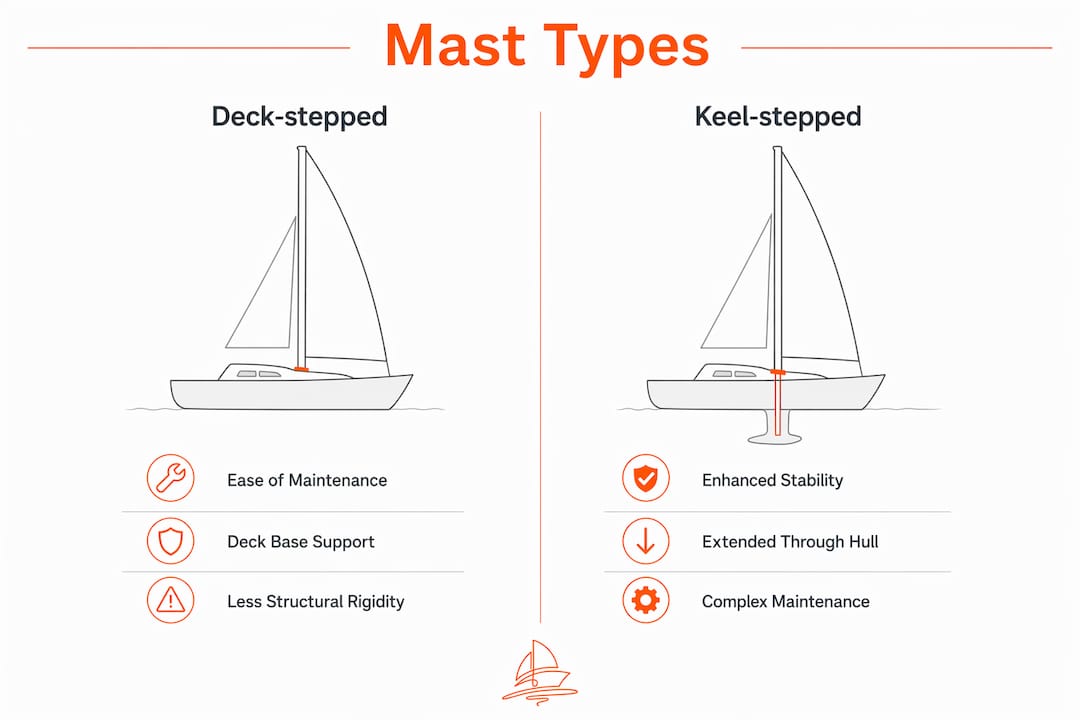
The two primary mast configurations on any sailing vessel are deck-stepped and keel-stepped masts. Each works on a different structural principle, and that difference shapes everything from how you tune the rig to how often you inspect it.
Deck-stepped masts act as pinned compression columns, meaning the base sits on the deck and the mast transfers load straight down into a reinforced deck structure. Keel-stepped masts, by contrast, pass through the deck and seat directly on the keel, functioning as propped cantilevers with far greater lateral support. That extra support lets keel-stepped masts carry lighter, more slender spars and resist forestay sag more effectively. The structural difference is not cosmetic. It determines how the boat handles heavy weather and how much tuning flexibility you have.
| Feature | Deck-stepped | Keel-stepped |
|---|---|---|
| Structural behavior | Pinned compression column | Propped cantilever |
| Lateral support | Lower | Higher |
| Maintenance access | Easier to raise and lower | Requires cabin access |
| Water intrusion risk | Lower | Higher (mast boot required) |
| Tuning flexibility | Moderate | Advanced |
| Best suited for | Daysailers, trailerable boats | Offshore and bluewater cruisers |
The choice between these two types involves a fundamental trade-off between ease of maintenance and structural rigidity. Deck-stepped masts win on convenience. Keel-stepped masts win on performance and safety in demanding conditions.
Pro Tip: If you trailer your boat or frequently step and unstep the mast, a deck-stepped configuration saves significant time and reduces the risk of damage during the process.
What components make up a sailboat mast and its rigging?
Understanding sailboat mast components is the fastest way to spot problems before they become failures. The rig divides into two categories: standing rigging, which is fixed and holds the mast up, and running rigging, which moves and controls the sails.
Standing rigging includes the forestay, backstay, shrouds, spreaders, turnbuckles, and chainplates. Running rigging includes halyards, sheets, and control lines. Each component has a specific failure mode, and knowing those modes tells you exactly where to look during an inspection.
- Forestay and backstay: These fore-and-aft wires carry the highest tension loads. Inspect for broken strands, swage cracks, and toggle wear at both ends.
- Shrouds: Lateral wires that prevent the mast from falling sideways. Check where they attach to chainplates and spreader tips, since those are the highest-stress points.
- Spreaders: Horizontal struts that widen the shroud angle and increase lateral support. Look for cracks at the root fitting and corrosion where the spreader meets the mast.
- Turnbuckles: Threaded fittings that adjust wire tension. Lanolin is the recommended lubricant for annual treatment because it resists saltwater and does not trap abrasive particles the way synthetic greases do.
- Chainplates: The deck or hull fittings that anchor the shrouds. Hidden corrosion here causes sudden, catastrophic failures. Remove and inspect them every few years.
- Halyards: Running rigging like halyards fails primarily through chafe and wear. Core damage in synthetic halyards can develop unseen inside the sheath. Run the line through your hands under light tension to feel for soft spots.
Pro Tip: Photograph every fitting, chainplate, and swage terminal at the start of each season. Side-by-side comparison across years reveals corrosion and crack progression that a single inspection will miss.
How should you maintain a mast boat's mast and rigging?
Maintenance is the single most important factor in rig longevity. A well-maintained rig on a 20-year-old boat is safer than a neglected rig on a 5-year-old one.
The first rule is timing. Inspections must happen dockside with good light and zero rig tension. Checking rigging while the boat is loaded or underway makes hairline cracks and subtle deformation nearly impossible to detect. Schedule a dedicated inspection day at the start and end of each sailing season.
Inspection and replacement schedule:
- Annual visual inspection: Walk the entire rig from deck level. Use binoculars to examine the masthead, spreader tips, and upper shroud terminals. Look for rust streaks, broken strands, and bent fittings.
- Every 5 years, dye penetration testing (DPT): This non-destructive test reveals surface cracks in aluminum extrusions and stainless steel fittings that are invisible to the naked eye. DPT every 5 years is the industry standard for aluminum and carbon masts.
- Every 5–10 years, ultrasonic testing (UT): Ultrasonic testing detects internal delamination in carbon masts and subsurface fatigue in aluminum spars. This is the only reliable way to assess internal integrity without disassembly.
- Every 7–15 years, full standing rigging replacement: Industry experts recommend replacing standing rigging preventatively on this schedule because internal wire fatigue is invisible until the wire fails. On a 38-foot boat, a full replacement typically costs $3,000–$6,000. That cost is small compared to a dismasting at sea.
- Ongoing halyard inspection: Feel halyards under tension every season. Replace any line with soft spots, fraying, or visible sheath damage.
Rig tension is equally critical. Proper rig tuning prevents mast bend asymmetry, reduces premature fatigue, and eliminates compression failure risk. A practical field check for forestay tension on a typical 12-meter sailboat with 1x19 wire rigging is pushing the forestay sideways at mid-span. Correct tension allows only 15–20 mm of deflection under hand pressure. More movement means the rig is too slack.
Pro Tip: Keep a physical maintenance log aboard the boat. A professional rigger can assess your rig's history in minutes when you have dates, photos, and tension readings recorded. That record also protects you if you ever sell the boat.
How does mast design affect sailing performance?
Mast design is not just a structural question. It directly controls how your sails set and how the boat responds in different wind conditions.
Mast stiffness determines how much the spar bends under load. A stiffer mast holds the mainsail flatter, which suits upwind sailing in strong breeze. A more flexible mast allows controlled bend, which opens the upper leech and depowers the sail in gusts. Keel-stepped masts give you more tuning range because the base is fixed and you can apply pre-bend through the backstay adjuster without risking mast instability.
The risks of improper tension are concrete:
- Too little tension: The forestay sags excessively, the jib belly distorts, and the boat loses pointing ability upwind.
- Too much tension: Compression loads spike, accelerating fatigue in swage terminals and chainplates. In extreme cases, over-tensioned rigs have caused chainplate failures.
- Asymmetric tension: Unequal shroud tension causes the mast to lean off-centerline. The mast bends toward the slack side under load, creating uneven stress that shortens rig life significantly.
Mast design also affects safety in heavy weather. A keel-stepped mast that loses a shroud is less likely to fall immediately because the keel step provides a secondary support point. A deck-stepped mast with a failed shroud has no such backup. Sailors who regularly sail offshore or in exposed waters should factor this into their mast design choice from the start.
Carbon masts add another dimension. The benefits of carbon masts include dramatically lower weight aloft, which reduces the boat's center of gravity and improves stability. Carbon also allows greater stiffness-to-weight ratios than aluminum, giving performance sailors precise sail shape control without the mass penalty. The trade-off is cost and the need for ultrasonic testing to detect internal delamination.
How to install and step a mast safely
Stepping a mast is a straightforward process when done methodically. Rushing it or skipping steps causes bent spreaders, damaged wiring, and in the worst cases, injury.
- Prepare all rigging before the mast goes up. Attach shrouds, forestay, and backstay to the mast while it is still horizontal. Threading wires through a standing mast is difficult and creates unnecessary risk.
- Inspect the mast step and partners. Clean the mast step socket and check for corrosion or cracking. For keel-stepped masts, verify the step plate is secure and the partners (the deck opening) are reinforced and undamaged.
- Use a crane or gin pole with a rated load capacity. Never estimate the weight of a mast. Aluminum masts on a 35-foot boat can weigh 150 pounds or more. A crane with a known safe working load is not optional.
- Seal the mast boot immediately after stepping. On keel-stepped masts, mast boots seal the deck penetration point and require careful fitting. Use a purpose-made boot with a stainless steel clamp and inspect it every season, since mast movement stresses the seal over time.
- Tune the rig before sailing. Set initial tension, then take the boat out and check for mast lean and forestay sag under sail. Return to the dock and adjust. Never sail with an untuned rig.
Pro Tip: Lubricate the mast step socket with lanolin before stepping the mast. It prevents galvanic corrosion between the aluminum mast and any steel or bronze fittings in the step, and it makes unstepping far easier at the end of the season.
Key takeaways
A well-maintained, properly tuned mast is the single most critical factor in sailboat safety and performance, requiring scheduled inspections, correct tension, and timely replacement of standing rigging.
| Point | Details |
|---|---|
| Mast type determines performance | Keel-stepped masts offer superior tuning range and lateral support; deck-stepped masts prioritize convenience. |
| Replace standing rigging on schedule | Industry experts recommend full replacement every 7–15 years to prevent invisible internal fatigue failures. |
| Inspect dockside with zero load | Hairline cracks and subtle damage only appear under good light with no rig tension applied. |
| Use non-destructive testing | DPT every 5 years and UT every 5–10 years are the standard for aluminum and carbon masts. |
| Document everything | Seasonal photos and a physical maintenance log help riggers assess history and catch progressive damage. |
What I've learned from watching rigs fail
The sailors who lose masts at sea almost never had a sudden, unpredictable failure. They had a failure they did not see coming because they were not looking. A broken strand at a swage terminal, a chainplate with hidden crevice corrosion, a mast boot that had been weeping for two seasons. Every one of those failures left evidence. The evidence just went uninspected.
At Sailorix, we have seen this pattern repeatedly across the boats that come through our platform. The boats with well-documented maintenance histories sail confidently. The boats without them carry risk that the owner cannot quantify.
The conventional wisdom says to inspect your rig once a year. That is the minimum, not the standard. The sailors who get the most out of their rigs inspect twice a year, photograph every fitting, and call a professional rigger every three to four years for a full survey. That cadence costs less than one dismasting, and it costs far less than the anxiety of not knowing what is holding your mast up.
Mast design knowledge is not just for naval architects. When you understand why your keel-stepped mast handles differently from a deck-stepped one, you make better decisions about tension, tuning, and when to reef. That knowledge is part of being a competent sailor, not an optional extra.
— Sailorix
Plan your next sail with Sailorix
Sailorix connects sailors with yachts and boats worldwide through a membership model that keeps costs honest. For €100 per year, you access bookings with approximately 1% service fees, far below what most booking platforms charge.

Whether you are chartering a boat to test a new mast configuration or looking for expert sailing resources before your next passage, Sailorix gives you the tools to make informed decisions. The platform covers a wide range of vessel types, from daysailers to bluewater cruisers, with real-time availability and transparent pricing. If you want to go deeper on rigging and maintenance before you book, the Sailorix sailing blog covers practical pre-charter checks that apply directly to mast and rigging condition.
FAQ
What is a mast boat?
A mast boat is a sailing vessel equipped with a mast, a vertical spar that supports the sails and transfers wind load through the rigging into the hull. The mast is the structural core of the entire sailing rig.
How often should you replace standing rigging?
Industry experts recommend replacing standing rigging every 7–15 years, depending on use and conditions. A full replacement on a 38-foot boat typically costs $3,000–$6,000.
What is the difference between deck-stepped and keel-stepped masts?
Deck-stepped masts sit on the deck and act as compression columns, making them easier to raise and lower. Keel-stepped masts pass through the deck to the keel, providing greater lateral support and more tuning flexibility for offshore sailing.
How do you check forestay tension without instruments?
Push the forestay sideways at mid-span with your hand. On a typical 12-meter sailboat with 1x19 wire rigging, correct tension allows only 15–20 mm of deflection. More movement indicates the rig is too slack.
What are the benefits of carbon masts over aluminum?
Carbon masts are significantly lighter, which lowers the boat's center of gravity and improves stability. They also offer a higher stiffness-to-weight ratio, giving sailors more precise sail shape control, though they require ultrasonic testing to detect internal delamination.