

Reviews are the single most reliable tool you have for reducing risk before you book a yacht. They convert vague interest into confident action by surfacing what staged photos and marketing copy never will: how the captain actually behaves under pressure, whether the safety equipment is current, and whether the boat smells like it was cleaned last month or last year.
Before you read another listing, scan for these signals first:
- Crew and captain mentions — look for specific names and behaviors, not just "great crew"
- Safety and handling notes — any mention of life jackets, briefings, or how the skipper handled rough conditions
- Cleanliness details — "spotless cabin" beats a generic five-star rating every time
- Review recency — prioritize reviews from the past 90 days; boats and operators change
- Verified-booking badges — confirms the reviewer actually chartered the vessel
- Photo timestamps — guest-uploaded photos often reveal current vessel condition better than listing images
Pro Tip: Start with the most recent three reviews and search for the word "captain" or "crew." If those words don't appear in any review, that's a gap worth noting.
Table of Contents
- How do reviews influence yacht-booking decisions?
- What should you look for in yacht reviews?
- Which platform trust signals actually matter?
- How do you spot fake or biased yacht reviews?
- How do you combine reviews with official U.S. verification?
- How does Sailorix approach reviews and transparency?
- Pre-booking checklist and questions to ask operators
- Why do reviews affect confidence so differently for yacht charters?
- How do video and multimedia reviews add value?
- How do cultural differences shape review interpretation?
- Key Takeaways
- The part of yacht reviews most travelers get wrong
- Sailorix: verified reviews with pricing you can actually trust
- Sources and further reading
How do reviews influence yacht-booking decisions?
Reviews reduce hesitation. For high-value experiential bookings like yacht charters, detailed recent feedback on crew professionalism, safety, and cleanliness converts interest into immediate action in a way that no amount of glossy photography can replicate.
The mechanism is straightforward: reviews fill the information gap between what an operator claims and what actually happens on the water. A 2022 meta-analysis published in Marine Sciences Journal found a strong positive correlation between eWOM (electronic word-of-mouth) credibility and booking intention, with trust in feedback moderating the decision process. In plain terms: when reviews feel credible, people book faster and with less price resistance.
Three behavioral effects stand out:
- Lower price sensitivity — travelers who read strong, detailed reviews are less likely to shop around for a marginally cheaper option
- Shorter decision time — a listing with 80 recent, specific reviews closes faster than one with 200 generic ratings
- Earlier reservations — for events like anniversaries or corporate charters, confident reviews push travelers to lock in dates weeks ahead of their original timeline
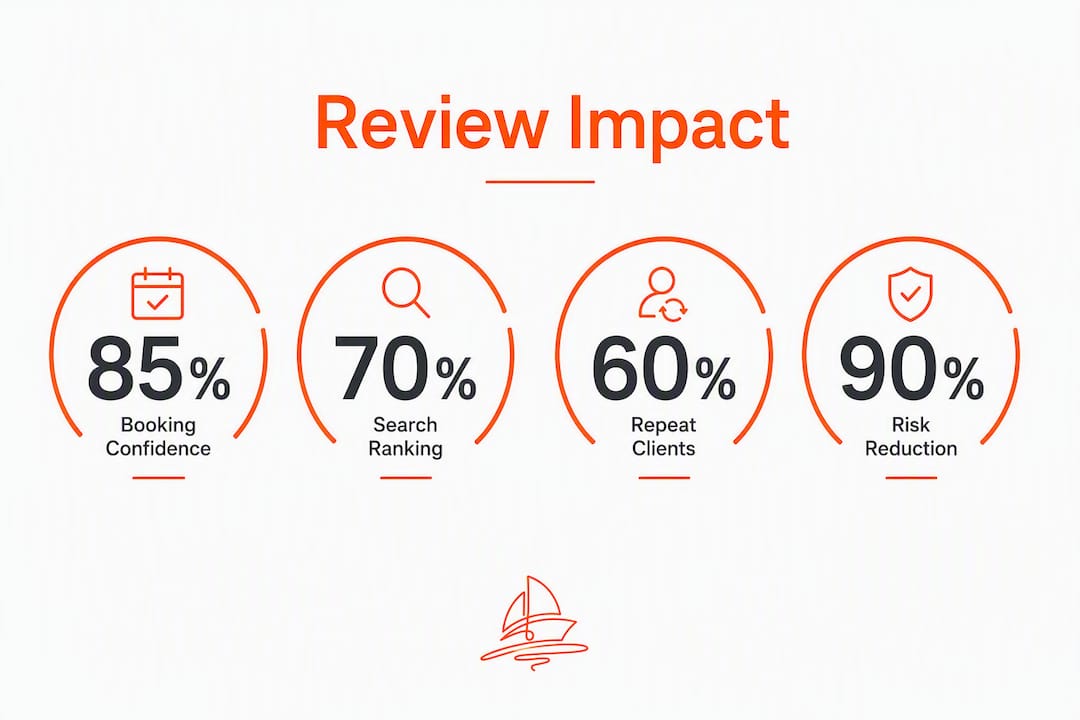
Reviews also affect search visibility. Listings with higher ratings and more review volume tend to rank better in map-pack and search results, which means the operators you discover first are often already pre-filtered by social proof.
What should you look for in yacht reviews?
The most predictive review signals are crew and captain comments, safety handling, cleanliness, equipment condition, and recency. A listing's photos are often staged; the review section is where you find the day-of reality.

Here's a prioritized checklist to apply when scanning any yacht listing:
| Signal | Green flag | Red flag |
|---|---|---|
| Crew/captain | "Captain Mike was patient and knowledgeable" | "Staff seemed distracted" or no crew mention |
| Safety | "Full safety briefing before departure" | No safety mention across 20+ reviews |
| Cleanliness | "Boat was spotless, galley stocked" | "Smelled musty," "sticky surfaces" |
| Equipment | "Snorkel gear in perfect condition" | "One life jacket was torn" |
| Recency | Reviews within the past few months | Last review was 8 months ago |
| Reviewer profile | Families, anglers, or groups similar to yours | All reviewers are single-trip accounts with no history |
Pay attention to reviewer profiles. A family of four and a solo angler will notice different things. If your trip is a corporate outing, look for reviews from groups. And operators with many recent reviews in major hubs provide a stronger predictive signal than a small cluster of perfect five-star ratings.
Pro Tip: A strong average rating with detailed reviews beats a perfect score with very few short ones. Perfect scores with no specifics are a warning sign, not a selling point.
Which platform trust signals actually matter?
The highest-impact signals are verified-booking badges, review volume and velocity, owner responses to negative feedback, and cross-platform consistency. Platforms that surface both positive and negative feedback and respond publicly earn long-term user trust because transparency beats a suspiciously perfect score.
Here's how to prioritize:
- Verified-booking tags — confirms the reviewer paid and chartered; unverified reviews carry more risk of manipulation
- Owner responses — an operator who replies thoughtfully to a complaint signals accountability; silence or defensiveness signals the opposite
- Review velocity — a listing gaining five to ten reviews per month is actively operating; one with no new reviews in six months may have gone dormant or declined in quality
- Cross-platform consistency — check the same operator on Google and on the booking platform; a 4.8 on one and a 3.1 on another is a red flag worth investigating
For U.S. travelers, Google reviews are often the best starting point for discovery because they aggregate local search intent and tend to include reviewer location data. Once you've shortlisted operators, go deeper on the booking platform's native review system for charter-specific detail.
How do you spot fake or biased yacht reviews?
Reviews are powerful but imperfect. Manipulation exists, and the patterns are recognizable once you know what to look for.
Common red flags:
- Clusters of short, generic five-star reviews posted within days of each other ("Amazing experience! Highly recommend!" repeated verbatim)
- Overly similar language across multiple reviewers, suggesting templated or incentivized responses
- Timing spikes — a sudden burst of reviews after a long gap, especially if the operator recently received a negative review
- Defensive or dismissive owner replies to legitimate complaints, rather than acknowledgment and resolution
- No reviewer history — accounts with one review, no profile photo, and no other activity
Cross-check tactics: compare review timestamps against the operator's booking calendar if visible, check reviewer profiles for activity on other listings, and look at photo timestamps in guest-uploaded images. Operational variance on large marketplaces is real — a listing's photos and copy can misrepresent vessel condition, making the review section your most accurate day-of benchmark.
How do you combine reviews with official U.S. verification?
Always pair review signals with documentary verification. Virginia DWR guidance recommends using reviews alongside confirmation of licenses and insurance to verify operator legitimacy and safety. That approach applies across U.S. states.
Pre-booking verification checklist:
- Confirm the operator holds a valid business registration in their state
- Request proof of liability insurance in writing before you pay
- Verify the skipper's qualifications (USCG-licensed captain for vessels carrying passengers for hire)
- Ask about state-compliant vessel registration and check that the boat's registration numbers are current and visible
- Confirm safety equipment: life jackets for all passengers, fire extinguisher, flares, and a functioning VHF radio
- Ask whether a safety briefing is standard — reviews that mention briefings are a positive corroborating signal
Reviews can confirm or contradict claimed safety practices. If an operator's listing says "full safety briefing included" but no review in 50 mentions it, that's a discrepancy worth asking about directly.
Pro Tip: Send a pre-booking message asking for proof of insurance and the captain's USCG license number. A legitimate operator will provide both without hesitation. Hesitation is your answer.
How does Sailorix approach reviews and transparency?
Sailorix combines verified-review signals with transparent pricing and a membership model that removes the financial friction that often pushes travelers toward under-vetted operators.
What to expect from Sailorix's review displays:
- Verified-booking badges on reviews from confirmed renters
- Visible review timestamps so you can assess recency at a glance
- Owner verification as part of the listing process, reducing the risk of fraudulent operators
- Optional insurance add-ons bookable directly, so you're not left sourcing coverage separately
- Transparent pricing with approximately 1% service fees for members, versus the 10–20% typical elsewhere
Pro Tip: When browsing Sailorix listings, filter by most recent reviews first. An operator with strong recent velocity and owner responses to any negative feedback is a safer bet than one with a higher average score built on older reviews.
Pre-booking checklist and questions to ask operators
A short script and checklist cuts through ambiguity and prevents the surprise fees and staffing issues that reviewers most often flag after the fact.
Step-by-step checklist:
- Confirm passenger capacity and whether the listed capacity matches your group size
- Verify crew experience and whether a licensed captain is included or optional
- Ask for the full price breakdown including fuel, docking fees, and gratuity expectations
- Confirm the cancellation and weather policy in writing
- Request recent on-board photos (not listing photos) or ask the operator to share a short video
- Verify docking and parking logistics — reviewers frequently flag this as a pain point
- Ask how the operator collects reviews — operators who request feedback while guests are still on board tend to have more detailed, authentic review histories
Message template to send operators:
"Hi, I'm considering booking [vessel name] for [date]. Could you confirm: (1) the captain's USCG license number, (2) proof of liability insurance, (3) what's included in the price vs. charged separately, and (4) your cancellation policy if weather prevents departure? Thank you."
Contingent checks to add if relevant:
- Ask for examples of how they've handled past complaints (cross-reference with their review responses)
- Request confirmation of charter guest rights and what recourse you have if the vessel doesn't match the listing
- Verify parking or water-taxi logistics if the marina is remote
Why do reviews affect confidence so differently for yacht charters?
Yacht charters carry a different psychological weight than a hotel booking. The financial stakes are higher, the experience is less familiar to most travelers, and the consequences of a bad operator — a poorly maintained vessel, an unprofessional captain, a safety incident — are more serious than a disappointing room view.
This is why reviews on yacht platforms act as social proof in a particularly acute way. They reduce the perceived risk of an unfamiliar, high-cost, physically immersive experience. A traveler who has never chartered a yacht is essentially trusting a stranger with their safety and their vacation budget. Detailed reviews from people in similar situations — families, first-timers, corporate groups — provide the vicarious experience that makes that trust feel earned rather than assumed.
The result: travelers who read three or more detailed, recent reviews before booking report significantly higher satisfaction, partly because their expectations are calibrated to reality rather than marketing copy.
How do video and multimedia reviews add value?
Text reviews describe; video reviews show. A 60-second clip of the cabin, the deck, and the view from the water tells you more about actual vessel condition than any written description. Guest-uploaded photos with timestamps are similarly valuable because they're harder to stage and more likely to reflect current conditions.
When evaluating multimedia reviews, look for:
- Deck and cabin footage showing cleanliness and equipment storage
- Crew interaction clips that reveal communication style and professionalism
- Departure and docking footage — these moments expose how well the captain handles the vessel under real conditions
- Photo timestamps that align with recent review dates, confirming the images reflect current state
Operators who encourage on-board photo and video sharing tend to have more transparent review profiles. If a listing has 80 reviews and zero guest photos, that absence is worth noting.
How do cultural differences shape review interpretation?
For international yacht bookings, cultural context matters more than most travelers realize. Reviewers from different countries apply different standards and express criticism differently.
Northern European and American reviewers tend to be direct: a problem gets named explicitly. Reviewers from cultures with higher deference norms may describe the same problem obliquely — "the experience was different from what we expected" can mean the boat was in poor condition. Japanese reviewers, for example, often rate experiences higher than their written comments suggest, a pattern documented in hospitality research.
Practical implications:
- When reading reviews for a charter in the Mediterranean or Southeast Asia, weight the written content more heavily than the star rating
- Look for reviews from travelers whose context matches yours — an American family's review of a Greek island charter will calibrate expectations more accurately than a review from a local day-tripper
- Be cautious of listings where all reviews come from a single nationality or region, which may indicate the operator markets exclusively to one audience and lacks broader accountability
Key Takeaways
Reviews are the most reliable risk-reduction tool available to yacht travelers, but they work best when combined with documentary verification and a clear pre-booking checklist.
| Point | Details |
|---|---|
| Prioritize recent, detailed reviews | Reviews from the past 90 days with crew and safety mentions predict experience more accurately than aggregate scores. |
| Verify beyond the rating | Always confirm USCG licensing, insurance, and state registration alongside review signals before paying. |
| Spot manipulation early | Clusters of generic five-star reviews, no reviewer history, and timing spikes are reliable red flags. |
| Use the pre-booking script | A direct message asking for license number, insurance proof, and price breakdown filters out unreliable operators fast. |
| Sailorix surfaces verified reviews | Sailorix displays verified-booking badges, review timestamps, and transparent pricing so travelers can assess operators without guesswork. |
The part of yacht reviews most travelers get wrong
The conventional wisdom says: find the highest-rated listing and book it. That advice misses the most important variable — what kind of reviews built that rating, and when they were written.
A 4.9 average assembled from 14 reviews over three years tells you almost nothing about the boat you'll step onto next month. An operator can change ownership, let maintenance slide, or swap out a great captain for a mediocre one, and that rating won't move for months. Meanwhile, a listing with a 4.6 average and 90 reviews in the past year, including a few honest three-star complaints with thoughtful owner responses, is giving you a live signal.
The other thing travelers underestimate: negative reviews, read carefully, are often more useful than positive ones. A complaint about parking logistics or a slow response to a weather cancellation tells you exactly what to ask about before you book. A complaint about crew professionalism with no owner response tells you something more serious. The absence of any negative reviews at all — on a listing with hundreds of bookings — should make you more skeptical, not less.
Sailorix: verified reviews with pricing you can actually trust
Most travelers spend hours cross-referencing reviews across platforms, then discover the service fee at checkout adds 15% to a price they thought was final. Sailorix is built around the opposite model: an annual membership of €100 gives you access to global yacht and boat rentals with approximately 1% service fees, real-time availability, and review systems that surface verified-booking badges and recent timestamps front and center.

You get optional insurance add-ons bookable directly through the platform, skipper and equipment customization, and a fleet that spans destinations worldwide. The review filters prioritize operators with strong recent performance, so you're not sorting through outdated ratings manually.
If you're ready to book with confidence, browse verified yacht listings on Sailorix and use the review filters to find operators with recent, verified feedback before you commit.
Sources and further reading
These sources back the recommendations in this guide and are worth consulting directly for verification:
- Virginia DWR — What to look for when renting a boat — U.S. state guidance on pairing reviews with licensing and insurance checks before booking
- Marine Sciences Journal — eWOM credibility and booking intention meta-analysis — 2022 academic research on how review trust moderates charter booking decisions
- The impact of online reviews on boat business bookings — industry analysis of how reviews fill the information gap between marketing and reality
- The role of customer reviews in selecting a boat rental platform — explains why platforms showing both positive and negative feedback earn more long-term trust
- The power of reviews for marine businesses — covers review velocity, search visibility, and how operators can improve review authenticity
- FareHarbor — QR codes and on-board review capture — explains why on-board review requests produce more detailed, authentic feedback
- How to avoid boat rental scams — practical companion guide for combining review signals with regulatory verification
- Boat registration decal regulations — all 50 states — state-by-state reference for confirming a vessel's registration is current and lawful