

Ship terminology is the standardized vocabulary used to describe vessel parts, directions, and operations for safe and effective maritime communication. Without it, a crew member asking for help "on the left side near the front" creates dangerous ambiguity. With it, "port bow" communicates the exact location in two words. Professional maritime glossaries document between 392 and 999 terms covering everything from hull structure to collision regulations. That range reflects how deep nautical language runs, and why both enthusiasts and working professionals benefit from mastering it systematically.
What are the fundamental ship terminology terms for direction?
Directional terms form the foundation of all onboard communication. Every other piece of nautical language builds on knowing where you are relative to the vessel.
The six core orientation terms are:
- Bow: The front of the ship. All directional references use the bow as the fixed reference point.
- Stern: The rear of the ship. Movement toward the stern is described as "aft."
- Port: The left side of the ship when facing the bow. Port is always left, regardless of which direction you are facing onboard. Navigation lights on the port side are red.
- Starboard: The right side of the ship when facing the bow. Starboard lights are green.
- Amidships: The middle section of the vessel, both lengthwise and widthwise.
- Windward and leeward: Windward is the side facing the wind; leeward is the sheltered side away from it. These terms serve as crucial navigation indicators beyond simple description.
The distinction between "aft" and "after" trips up many newcomers. "Aft" describes a direction or movement toward the stern. "After" modifies a noun, as in "the after deck," meaning the deck located toward the stern. They are not interchangeable.
Pro Tip: To remember port vs. starboard, note that "port" and "left" both have four letters. That single mnemonic eliminates the most common directional error at sea.
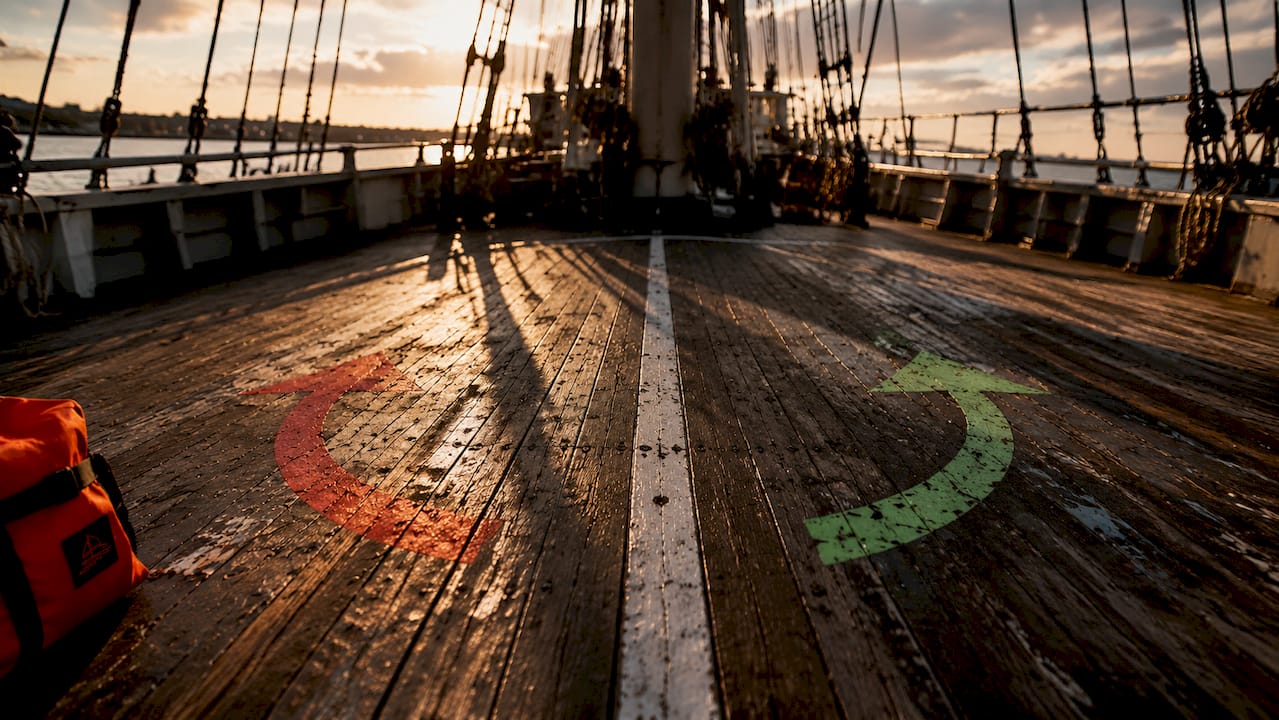
Navigation lights reinforce these terms visually. Port shows red, starboard shows green as of mid-2026, a standard that applies globally under COLREG. When you see a red light approaching at night, the other vessel's port side is facing you.
What are the main structural components of a ship?
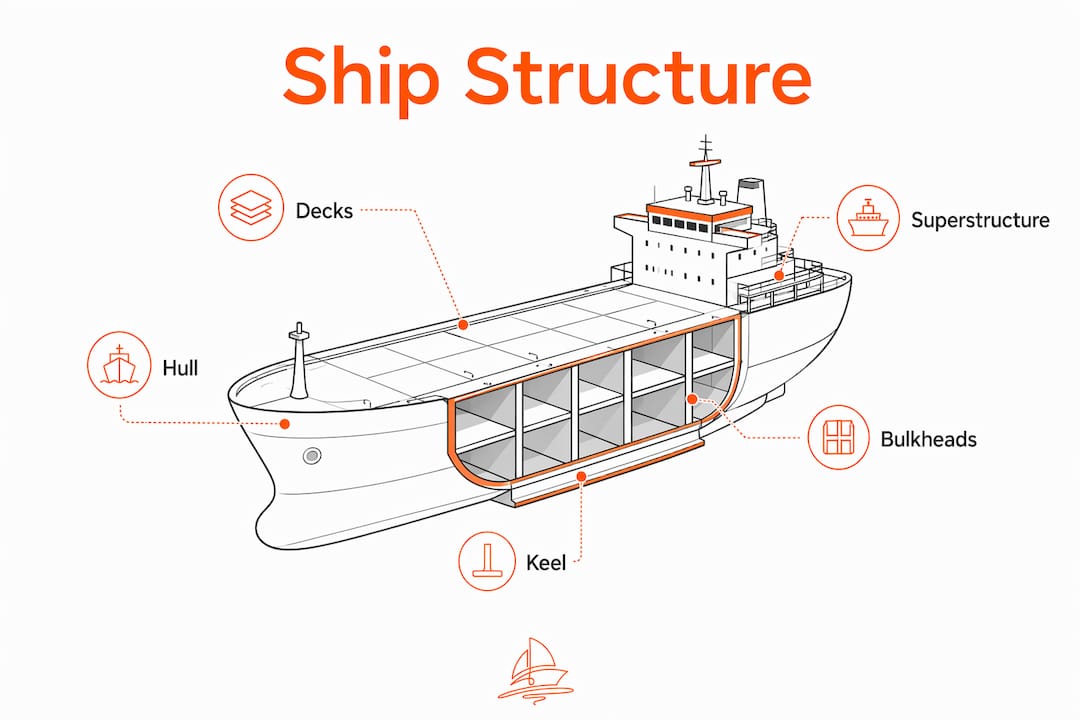
A ship's structure is a layered system where each component serves a specific load-bearing or operational role. Understanding these parts lets you communicate precisely during inspections, repairs, and cargo operations.
The primary structural elements are:
- Keel: The keel runs along the bottom centerline of the hull from bow to stern. It is the ship's backbone, providing longitudinal strength and resisting sideways drift. Without a keel, a vessel would be structurally unstable and difficult to steer.
- Hull: The watertight outer shell of the ship. It includes the hull plating, which transfers loads from cargo and sea pressure to the internal frame.
- Frame: Longitudinal and transverse members that give the hull its shape and distribute structural stress. Think of frames as the ribs of the vessel.
- Decks: Horizontal platforms that divide the ship into levels. Large vessels carry up to six or seven decks, each reinforcing hull integrity and supporting layered cargo arrangement.
- Holds and tanks: Interior spaces below the main deck used for cargo, ballast water, or fuel storage.
- Superstructure: Everything built above the main deck, including the bridge, crew quarters, and navigation equipment.
| Component | Primary function |
|---|---|
| Keel | Backbone; provides longitudinal stability |
| Hull plating | Watertight shell; transfers structural loads |
| Frame | Internal skeleton; distributes stress |
| Decks | Structural reinforcement; supports cargo layers |
| Superstructure | Houses bridge, crew spaces, and navigation gear |
One structural feature worth knowing in detail is the bulbous bow. This rounded projection sits below the waterline at the front of many commercial ships. The bulbous bow improves fuel efficiency by 10–15% by modifying wave patterns around the hull. That efficiency gain is significant enough that most modern cargo ships and tankers include one by design.
Pro Tip: When reviewing a vessel's condition report, always distinguish between the stern and the transom. The stern is the entire rear section of the ship. The transom is the flat, vertical surface that closes off the stern. Confusing them leads to miscommunication during repair estimates.
Decks do more than provide walking surfaces. Decks interconnect with bulkheads to maintain hull strength across multiple layers. On a large container ship, this network of decks and bulkheads is what keeps the vessel rigid under the stress of heavy seas and uneven cargo loads.
How does specialized maritime vocabulary support navigation and efficiency?
Beyond basic parts and directions, professional nautical language covers the systems and roles that keep a vessel operating. These terms appear in logbooks, VHF radio calls, and maintenance orders every day.
Key operational terms include:
- Rudder: The movable blade at the stern that steers the ship by deflecting water flow. The rudder works in conjunction with the propeller to control heading.
- Helm: The steering mechanism, whether a wheel or tiller, that controls the rudder. "Taking the helm" means assuming steering control.
- Bilge keel: A fin welded along the lower sides of the hull to reduce rolling in heavy seas. Unlike the main keel, bilge keels do not extend below the hull bottom.
- Mooring equipment: Lines, cleats, bollards, and winches used to secure a vessel to a dock or another ship. Knowing the correct term for each piece speeds up docking operations and prevents miscommunication.
- Bosun: The officer responsible for the deck crew, rigging, and maintenance of deck equipment. The title comes from "boatswain," shortened through oral tradition.
- Coxswain: The person who steers a small boat or lifeboat, often in charge of its crew. Pronounced "cox-un," not phonetically as written.
COLREG terminology and VHF communication terms are integrated into professional maritime vocabulary to support global navigation rule compliance. When a vessel broadcasts its position or intention on VHF Channel 16, the language used follows COLREG conventions. A crew member who does not know terms like "give way vessel" or "stand-on vessel" cannot respond correctly to a collision avoidance situation.
The term "bosun" illustrates how nautical jargon evolved from oral pronunciation among crews who could not read. Diverse sailors from different countries simplified complex English words into phonetic shortcuts. Those shortcuts became the standard. This history explains why so many nautical terms look nothing like they sound.
What nuances and common confusions exist in ship terminology?
Precision in nautical language is not pedantic. Misusing a term during a maneuver or repair can create real safety risks.
The most common source of confusion is the absolute frame of reference for port and starboard. Confusing port and starboard during maneuvers creates serious safety risks because these terms do not change based on where you stand. If you face the stern, port is still the vessel's left side relative to the bow, which is now behind you. Many beginners instinctively flip the terms when they turn around. That instinct is wrong and dangerous.
Other frequent points of confusion:
- Bow vs. bulbous bow: The bow is the entire forward section of the hull. The bulbous bow is a specific underwater protrusion below the waterline. They are related but not the same thing.
- Aft vs. after: "Aft" is a direction. "After" is an adjective. "Head aft" means move toward the stern. "The after cabin" means the cabin located toward the stern.
- Stern vs. transom: The stern is the whole rear of the vessel. The transom is the flat panel that closes the stern. A vessel can have a rounded stern with no transom at all.
- Windward vs. upwind: Windward describes the side of the vessel facing the wind. Upwind describes a direction relative to the wind's origin. They are related concepts but apply differently in navigation and sailing.
"Nautical language blends cultural influences and functional needs. Terms like 'windward' and 'leeward' serve as crucial navigation indicators beyond simple description. Mastering these distinctions is not about memorizing a glossary. It is about building a mental model of the vessel that works the same way for every person on board."
The evolution of terms like "bosun" from "boatswain" shows that nautical language developed through phonetic simplification across multilingual crews. That history is useful context. It explains why the written form of a term and its spoken form often diverge, and why pronunciation matters as much as spelling in professional settings.
Pro Tip: When learning new nautical terms, practice using them in full sentences rather than memorizing definitions in isolation. Saying "secure the mooring line to the port cleat" builds faster recall than repeating "port means left" as a standalone fact.
Key Takeaways
Mastering ship terminology requires learning directional terms, structural components, and operational vocabulary as an integrated system, not as isolated definitions.
| Point | Details |
|---|---|
| Directional terms are absolute | Port and starboard never change relative to the bow, regardless of where you stand onboard. |
| Structure has a hierarchy | The keel supports the hull, frames shape it, and decks reinforce it across multiple layers. |
| Operational terms enable safety | COLREG and VHF vocabulary connect ship terminology directly to collision avoidance and legal compliance. |
| Language evolved from practice | Terms like "bosun" came from oral simplification, so pronunciation and spelling often differ. |
| Precision prevents incidents | Misusing terms like aft vs. after or stern vs. transom causes miscommunication during repairs and maneuvers. |
Why I think most people learn ship terminology the wrong way
Most guides hand you a list of 400 terms and tell you to memorize them. That approach fails because isolated definitions do not stick. The brain retains vocabulary when it connects to a physical or operational context.
At Sailorix, we work with sailors at every level, from first-time renters to experienced skippers. The pattern we see repeatedly is that people who learn terminology in context, while actually on a vessel or planning a real trip, retain it far better than those who study from a glossary alone. Knowing that the keel prevents sideways drift means something different when you are standing on a boat in a crosswind.
The other mistake is treating nautical language as a static subject. Maritime vocabulary is alive. COLREG updates, new vessel designs, and evolving crew communication practices all shape how terms are used. The bulbous bow, for example, is a relatively modern design feature that required new vocabulary to describe it accurately. Professionals who stay current with operational terminology communicate more confidently and make fewer costly errors during handovers and repairs.
My honest advice: start with the six directional terms, learn the five core structural components, then add operational vocabulary as you encounter real situations. That sequence builds a mental model of the vessel that makes every new term easier to place and remember.
— Sailorix
Sailorix: where maritime knowledge meets real boating
Knowing your way around nautical language is the first step. Putting it to use on the water is the next one.
Sailorix gives maritime enthusiasts and professionals access to yachts and boats worldwide through a membership model that costs €100 per year. That membership unlocks bookings with roughly 1% service fees, far below the industry standard. Whether you are a seasoned skipper looking for your next charter or a newcomer ready to apply what you have learned about boat terminology on the water, Sailorix connects you to real vessels at transparent prices. Browse available boats at sailorix.com and take your maritime knowledge off the page.
FAQ
What is ship terminology?
Ship terminology is the standardized vocabulary used to describe vessel parts, directions, crew roles, and operational procedures. It supports clear communication and safe navigation across all maritime contexts.
What does port and starboard mean on a ship?
Port is the left side of the ship relative to the bow, marked by red navigation lights. Starboard is the right side, marked by green lights. Both terms are absolute and do not change based on the observer's position.
What are the basic structural parts of a ship?
The core structural parts are the keel, hull, frame, decks, holds, and superstructure. The keel runs along the bottom centerline and acts as the vessel's backbone, while decks reinforce hull integrity across multiple layers.
Why do sailors use port and starboard instead of left and right?
Port and starboard are fixed relative to the vessel's bow, so they remain unambiguous regardless of which direction a crew member faces. Left and right shift with the observer's orientation, creating dangerous confusion during maneuvers.
What is a bosun on a ship?
A bosun, short for boatswain, is the deck officer responsible for the crew, rigging, and maintenance of deck equipment. The shortened title developed through oral tradition among multilingual crews who simplified the original pronunciation.