

Sails are tensile structures designed to convert wind energy into forward motion, and the types of sails you choose determine how your boat performs across every point of sail. The four primary sail categories are mainsails, headsails, spinnakers, and specialty sails. Modern sailboats rely primarily on mainsails and headsails, with spinnakers added for downwind light-air work. Understanding sail geometry, rig type, and construction method is the foundation of every smart sail selection decision. This guide covers all of it, from basic shapes to deployment systems, so you can match the right sail to your boat and sailing style.
What are the main types of sails?
The mainsail is the principal sail on any modern sailboat. It attaches to the mast and boom, and its shape drives the boat upwind more than any other sail. Performance cruisers and racing catamarans increasingly use square-top mainsails to maximize roach area, which is the curved section of the sail that extends beyond a straight line from head to clew. More roach means more sail area and more power in light air.

Headsails are the sails set forward of the mast, and they come in two main forms: jibs and genoas. A jib is a non-overlapping headsail that stays within the foretriangle. A genoa is larger and overlaps the mast, generating more power but requiring more effort to tack. For a deeper look at how genoas perform across different wind angles, the genoa sail guide on the Sailorix blog covers the specifics in detail.
Spinnakers are downwind sails built for speed in light to moderate air. They come in two forms:
- Symmetrical spinnakers are flown from a pole and work best on a dead downwind run. Racing sailors favor them for their raw power in light air.
- Asymmetrical spinnakers are tacked to the bow or a bowsprit and work across a broader range of angles, making them more versatile for cruising.
- Code Zero sails sit between a genoa and an asymmetrical spinnaker. They are designed for close reaching in light wind and are common on performance cruisers.
- Storm sails are small, heavy-duty sails built for survival conditions. A storm jib and trysail replace the working headsail and mainsail when winds exceed safe limits.
Pro Tip: If you sail short-handed, an asymmetrical spinnaker with a snuffer sock is far easier to manage than a symmetrical spinnaker with a pole. You can launch and douse it solo in under two minutes once you practice the sequence.
How does sail geometry affect performance?
Sails are categorized by geometry into four main shapes: triangular, quadrilateral, square, and lateen. Each shape suits a different rig and sailing condition. Triangular sails dominate modern fore-and-aft rigs because they are efficient upwind and easy to control with a small crew.
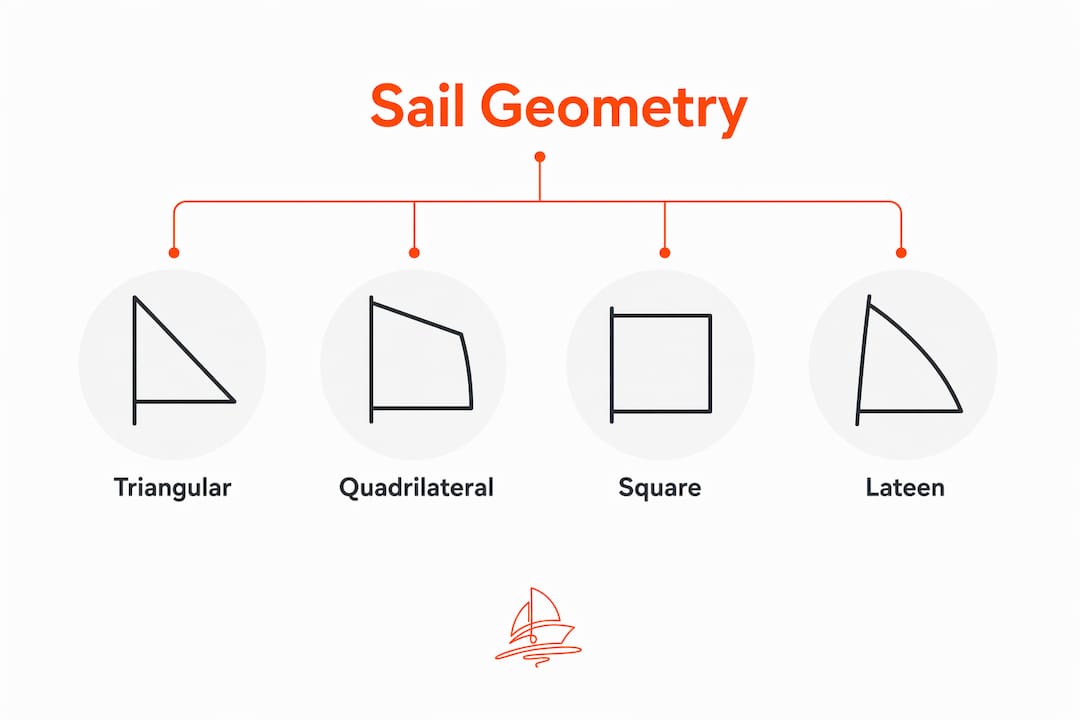
Square sails are quadrilateral sails set perpendicular to the mast. They were the standard on tall ships for centuries because they excel downwind in trade winds. Square rigs are rare on modern pleasure boats but still appear on traditional vessels and tall ship replicas.
The table below shows the major rig types and their associated sail shapes:
| Rig type | Sail shape | Best use |
|---|---|---|
| Bermuda (Marconi) | Triangular | Upwind performance, modern cruising |
| Gaff rig | Quadrilateral | Traditional cruising, character boats |
| Square rig | Square | Downwind trade wind passages |
| Lateen rig | Triangular (oblique) | Mediterranean and coastal sailing |
| Junk rig | Battened quadrilateral | Self-tending, short-handed offshore |
| Spritsail | Quadrilateral | Dinghies and traditional small craft |
Fore-and-aft rigs, which include Bermuda, gaff, and lateen configurations, keep the sail aligned with the boat's centerline. This makes them efficient across a wide range of wind angles, from close-hauled to a broad reach. Square rigs, by contrast, are most powerful when the wind is directly behind the boat and lose efficiency when sailing across the wind.
The mast type and configuration directly shapes which sail plan a boat can carry. A fractional rig, for example, places the forestay below the masthead, which changes the geometry of the headsail and affects how the rig bends under load.
Cross-cut vs. tri-radial: which construction is right for you?
Sail construction method determines how well a sail holds its shape over time, and the two dominant methods are cross-cut and tri-radial. Cross-cut sails use horizontal panels aligned with the warp threads of the fabric. This orientation is durable and cost-effective, making cross-cut the standard choice for coastal cruising and budget-conscious sailors.
Tri-radial construction aligns each panel with the load paths running from the sail's three corners: head, tack, and clew. This means the strongest threads in the fabric run directly along the lines of greatest stress. The result is better shape retention over thousands of miles, which is why tri-radial construction is the preferred choice for long-distance cruising and racing.
Material choice compounds the effect of construction method. The two most common options are:
- Woven polyester (Dacron): Affordable, forgiving, and easy to repair. Dacron suits cruising sailors who prioritize durability over performance. It stretches more than laminates, which means the sail shape changes as wind pressure increases.
- Laminated fabrics (Hydranet and similar): These bond multiple layers of film and fiber to create a sail that holds its shape under load. Hydranet combines a woven Dyneema grid with a polyester base, giving it the durability of woven cloth and the shape stability of a laminate.
Pro Tip: If you sail more than 5,000 miles per year or race regularly, invest in a tri-radial laminate sail. If you cruise coastal waters on weekends, a cross-cut Dacron sail will outlast your expectations and cost far less to replace.
Choosing between cross-cut and tri-radial comes down to your sailing program. Match the construction to your actual use, not to what looks impressive at the dock.
How are sails deployed and handled?
Deployment method affects how quickly and safely you can manage your sails, especially when conditions change fast. The two main systems for headsails are roller furling and hanked-on.
Roller furling headsails wrap around the forestay when not in use. They are the standard on most modern cruising boats because you can reef or furl the sail from the cockpit without going to the foredeck. Adding a foam luff to a roller furling headsail is a worthwhile upgrade. The foam creates a wedge-shaped profile that prevents the sail from going baggy when partially furled, maintaining a clean aerodynamic shape.
Hanked-on sails attach to the forestay via metal or plastic clips called hanks. They require more physical effort to set and douse, but they have fewer moving parts. Bluewater sailors often prefer hanked-on headsails for offshore passages because there is less to break 1,000 miles from the nearest chandlery.
For downwind sails like spinnakers and Code Zeros, two deployment systems dominate:
- Snuffers (sock systems): A fabric tube that slides down over the sail to collapse it. Snuffers are affordable and reliable. They suit sailors who use their downwind sail occasionally and want a simple, low-cost solution.
- Furling systems: A drum at the tack that rolls the sail around its own luff. Furling systems cost more and add mechanical complexity, but they make deploying and recovering a large downwind sail fast and easy, which matters on a short-handed boat.
UV protection is a maintenance factor that many sailors overlook until it is too late. UV-resistant covers on the leech and foot of a furling headsail protect the fabric when the sail is rolled up and sitting in the sun. Without this protection, the exposed strip of sail degrades rapidly in tropical or high-UV environments.
Key Takeaways
The right sail type depends on your rig, sailing conditions, and how much complexity you want to manage on the water.
| Point | Details |
|---|---|
| Match sail to function | Mainsails drive upwind performance; spinnakers add speed downwind in light air. |
| Geometry shapes performance | Triangular fore-and-aft sails excel upwind; square sails are built for downwind trade wind runs. |
| Construction affects longevity | Cross-cut Dacron suits coastal cruising; tri-radial laminates hold shape for offshore and racing. |
| Deployment system matters | Roller furling suits coastal sailing; hanked-on sails reduce mechanical failure risk offshore. |
| UV protection extends sail life | Adding UV covers to furling headsails prevents rapid fabric degradation in sunny climates. |
The sail choices most sailors get wrong
Sailorix has worked with sailors across skill levels, and the same mistakes come up repeatedly. The biggest one is buying sails based on what came with the boat rather than what the boat actually needs. A cruising genoa from a previous owner may be the wrong size, the wrong cut, or made from a material that no longer holds its shape. Starting with a sail audit before spending money on new canvas saves time and frustration.
The second mistake is ignoring leech tension as a tuning tool. Adjusting leech tension is one of the most effective ways to change how a sail performs without touching the sheets. Tightening the leech flattens the sail and reduces power in heavy air. Loosening it opens the leech and increases power in light wind. Most beginners never touch the leech line after the sail is set, and they leave real performance on the table.
Short-handed sailing demands a different sail inventory than crewed racing. If you regularly sail with one or two people, prioritize sails you can manage from the cockpit. A self-tacking jib, a furling Code Zero, and a mainsail with slab reefing will take you further than a full racing inventory that requires six people to handle safely.
The best sail selection is the one that matches your actual sailing, not your aspirational sailing. Buy for the conditions you sail in 80% of the time, not for the one offshore passage you might do someday.
— Sailorix
Sail smarter with Sailorix
Choosing the right sails is only part of the equation. Getting on the water regularly, on the right boat, is what builds the experience to use them well.

Sailorix gives sailors access to a global fleet of yachts and boats at transparent prices. For €100 per year, members pay only around 1% in service fees per booking, far below the standard 10–20% charged elsewhere. Whether you want to test a new sail configuration on a chartered yacht or find a boat that matches your sailing style, explore the Sailorix platform to see what is available in your region. Real boats, real conditions, and real experience are the fastest way to understand which sail types work best for you.
FAQ
What are the main types of sails on a sailboat?
The four main categories are mainsails, headsails (jibs and genoas), spinnakers, and specialty sails like storm sails and Code Zeros. Most modern sailboats use a mainsail and headsail as their primary working sail plan.
What is the difference between a jib and a genoa?
A jib is a non-overlapping headsail that fits within the foretriangle, while a genoa is larger and overlaps the mast. Genoas generate more power but are harder to tack on smaller boats.
What is a tri-radial sail and when should I use one?
A tri-radial sail aligns its panels with the load paths from each corner of the sail, improving shape retention under load. It is the best choice for long-distance cruising and racing, where maintaining sail shape over thousands of miles matters.
What is a foam luff and why does it matter?
A foam luff is a tapered foam insert added to a roller furling headsail. It creates a wedge-shaped profile that keeps the sail from going baggy when partially furled, maintaining a clean aerodynamic shape at reduced sail area.
Should I choose roller furling or hanked-on sails for offshore sailing?
Hanked-on sails are preferred by many bluewater sailors because they have fewer moving parts and lower mechanical failure risk far from shore. Roller furling is more convenient for coastal sailing but adds complexity that can become a liability offshore.