

A genoa is a large, overlapping headsail that extends its clew behind the mast, often exceeding 65 square meters on modern cruising yachts. Unlike a standard jib, which stays within the foretriangle, the sail genoa overlaps the mast and shrouds to deliver significantly more sail area. That extra area translates directly into more power, better upwind angles, and faster boat speeds in light to moderate conditions. If you sail a sloop or cutter and want to get the most out of your rig, understanding the genoa is non-negotiable.
How does a genoa sail improve performance compared to other headsails?
The genoa outperforms a standard jib in light to moderate winds because its overlap increases total sail area and generates more drive. A jib stays within the foretriangle and produces less power on upwind and reaching points of sail. The genoa fills the gap between the forestay and the mast, capturing wind that a jib simply misses.
On a beat or a close reach, the genoa creates a slot effect with the mainsail that accelerates airflow and improves lift. This is why racing sailors favor large overlapping headsails in winds below 15 knots. When the breeze builds past 20 knots, the genoa becomes overpowering and a smaller, non-overlapping jib or storm sail takes over.

| Sail type | Overlap | Typical use | Sail area |
|---|---|---|---|
| Genoa (135%) | Extends past mast | Light to moderate winds, upwind and reaching | Large |
| Working jib | None | Moderate to strong winds, all points of sail | Medium |
| Storm jib | None | Heavy weather, safety sail | Small |
The key takeaway from this comparison is simple. Use the genoa when you want speed and power. Switch to a jib or storm sail when the wind demands control over performance.
- Genoas excel on upwind and close-reaching angles in winds under 15–20 knots
- A 135% genoa overlaps the mast by 35% of the foretriangle base
- Larger overlaps add power but require more precise trimming and stronger crew
- A well-trimmed genoa improves boat balance and reduces helm strain on larger yachts
What are the key techniques for trimming a genoa sail effectively?
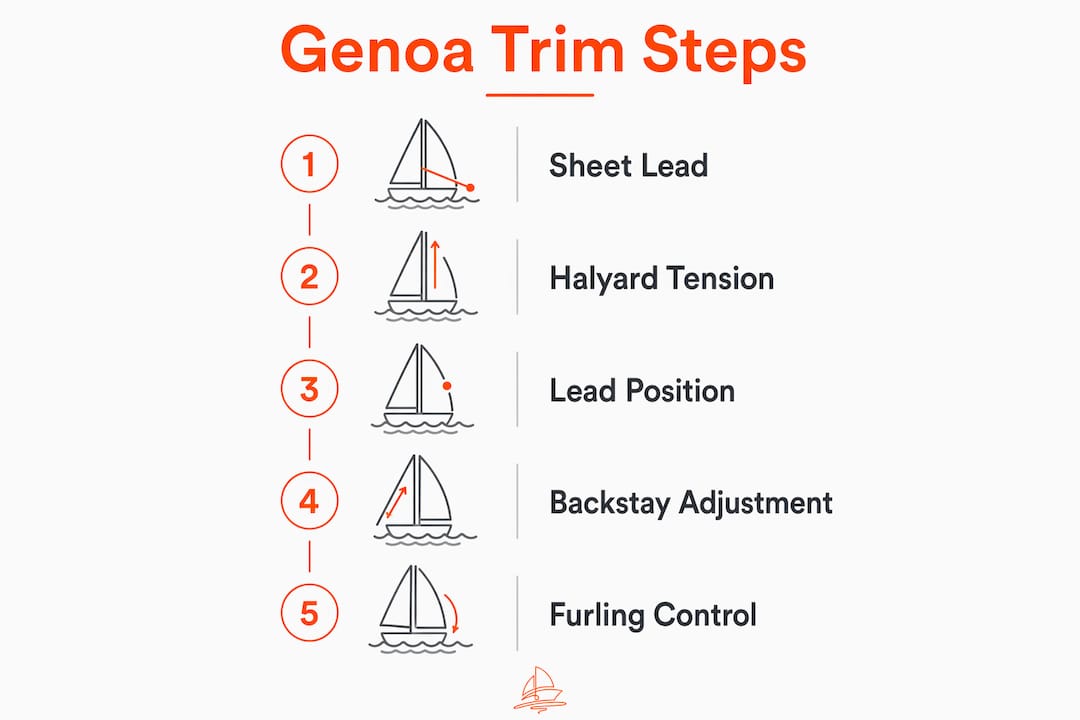
Genoa trim starts with the sheet lead car position. The neutral lead position forms a straight line from the mid-luff through the clew to the car. Too far forward loads the leech and closes the slot. Too far aft loads the foot and opens the top of the sail, spilling power.
Sheet lead adjustments
Move the car forward in lighter winds to add leech tension and keep the sail full. Move it aft in stronger winds to open the leech, reduce power, and improve helm balance. Watch the telltales along the luff. All three pairs should lift simultaneously when the sail is trimmed correctly. If the top telltale stalls first, the lead is too far forward. If the bottom telltale stalls first, move the car forward.
Halyard and headstay sag
In light air, ease the halyard slightly to increase headstay sag. More sag creates a fuller, more powerful sail shape that drives the boat in low-pressure conditions. As wind increases, tighten the halyard to flatten the sail and reduce drag. This is one of the most underused adjustments on cruising boats.
Backstay tension
Backstay tension flattens the headstay and depowers the genoa in winds over 15–20 knots. A tighter backstay bends the mast, flattens the mainsail, and reduces headstay sag simultaneously. The result is a flatter, less powerful genoa that reduces heel and keeps the boat on its feet. Understanding how your mast and rigging interact with sail shape is what separates average sailors from fast ones.
- Set the sheet lead car to neutral: straight line from mid-luff through the clew to the car
- Trim the sheet until the luff just stops lifting, then ease one inch back
- Adjust the lead car forward or aft based on telltale behavior at the top and bottom of the luff
- Ease the halyard in light air for more sag and power; tighten in stronger winds to flatten
- Apply backstay tension progressively as wind builds past 15 knots to depower without reefing
Pro Tip: Watch the top telltale on the luff. If it stalls before the middle and bottom ones, move the lead car aft. If the bottom stalls first, move the car forward. Telltales never lie.
How to adjust genoa furling and lead positions when reefing
Partial furling changes the shape of the genoa dramatically. When you roll in 20–30% of the sail, the clew rises and the effective sheeting angle changes. Moving the lead car forward after furling is necessary to maintain proper sail shape and prevent loss of drive. Sailors who skip this step end up with a baggy, twisted sail that pulls the bow down instead of forward.
Leaving the car in its original position after furling causes back-winding near the luff and poor leech tension. The sail looks full but performs poorly. The fix takes 30 seconds and makes a measurable difference in boat speed.
- Roll in the sail to the desired size before adjusting the lead
- Move the car forward by one to three positions depending on how much sail you furled
- Re-trim the sheet and check telltales again before settling on the new position
- Repeat the process every time you change sail size, not just at the beginning of a passage
Plastic sliders often bind when you try to move the lead car under load. Professionals ease the sheet briefly to reduce pressure on the car, slide it to the new position, and then re-trim. Ball-bearing cars move freely under load and eliminate this problem entirely.
Pro Tip: Before moving the lead car, ease the sheet two to three inches to take load off the track. The car slides instantly. Re-trim immediately after repositioning.
What equipment upgrades improve genoa handling and control?
The single biggest upgrade most sailors can make is switching from plastic slider cars to ball-bearing genoa lead cars. Adjustable genoa leads that move while sailing encourage proactive trimming and improve performance. Ball-bearing systems are the preferred choice because they move freely under load without binding. Plastic sliders require you to ease the sheet first, which interrupts the trim cycle and discourages frequent adjustment.
Convenient, easy-to-adjust controls result in more frequent trimming, which translates directly to faster and more balanced sailing. This is not a marginal gain. Sailors who adjust their leads every time the wind shifts by five degrees consistently outperform those who set it once and forget it.
| Control system | Ease of adjustment | Performance benefit | Best for |
|---|---|---|---|
| Ball-bearing lead car | High, adjustable under load | Frequent trim, maximum speed | Racing and performance cruising |
| Plastic slider car | Low, requires sheet ease | Basic trim, limited adjustment | Budget cruising |
| Fixed car | None | Set-and-forget only | Daysailing, simple rigs |
| Continuous line furler | High, single-line control | Easy reefing and sail management | Shorthanded sailing |
- Ball-bearing cars move under full sheet load without binding
- Purchase systems on the car track allow fine adjustments with minimal effort
- Continuous line furling systems let one crew member reef the genoa from the cockpit
- Integrated lead and furling systems from manufacturers like Harken and Lewmar simplify the entire sail control setup
Investing in quality hardware pays back every time you sail. A ball-bearing lead car costs more upfront but removes friction from both the equipment and the decision to adjust it. Sailors who find trimming easy actually trim more often. That habit alone adds measurable boat speed over a full day of sailing.
Key takeaways
A properly trimmed genoa is the single most powerful performance tool on a sloop-rigged sailboat, and the lead car position is the adjustment that matters most.
| Point | Details |
|---|---|
| Genoa vs jib | A genoa overlaps the mast and delivers more power in light to moderate winds than a standard jib. |
| Lead car position | Neutral position runs from mid-luff through the clew; adjust forward or aft based on telltale behavior. |
| Halyard and backstay | Ease the halyard in light air for power; tighten backstay in winds over 15 knots to flatten and depower. |
| Furling adjustments | Move the lead car forward every time you furl; skipping this step causes poor shape and lost drive. |
| Hardware upgrades | Ball-bearing lead cars allow adjustment under load and encourage the frequent trimming that builds boat speed. |
What I have learned from years of watching sailors miss easy speed
Most sailors set their genoa lead once at the dock and never touch it again. That single habit costs more boat speed than any other mistake I see on the water. The lead position is not a set-and-forget control. Wind shifts, sea state changes, and every reef you take in the genoa demands a fresh look at where that car sits on the track.
The second most common mistake is ignoring halyard tension. Sailors tighten the halyard at the start of the season and leave it there. In light air, a tight halyard pulls the headstay straight, flattens the sail, and kills power exactly when you need it most. Easing the halyard two to three inches in 8 knots of breeze makes the boat feel alive again.
Hardware matters more than most sailors admit. I have watched crews struggle with plastic slider cars for an entire passage, easing and re-trimming constantly just to move the lead one position. Switching to ball-bearing cars removes that friction and changes how often you actually adjust. When trimming is easy, you do it more. When you do it more, you go faster. That connection between hardware quality and sailing behavior is real and worth the investment.
The genoa rewards attention. Sailors who treat it as a dynamic, living part of the rig rather than a fixed shape get more speed, more comfort, and more satisfaction from every passage. Understanding how rig tuning affects sail trim is the foundation of that attention.
— Sailorix
Sail smarter with Sailorix

Sailorix is a global boat booking platform built for sailors who want more time on the water and less time worrying about costs. For €100 per year, members access yacht rentals worldwide with service fees of around 1%, far below the 10–20% charged by most booking platforms. Whether you want to practice genoa trim on a bareboat charter or explore new sailing grounds, Sailorix puts the right boat within reach. Visit Sailorix to browse available yachts, read in-depth sailing guides, and book your next passage at a price that makes sense.
FAQ
What is a genoa sail?
A genoa is a large, triangular headsail that overlaps the mast, with its clew extending behind the mast. It delivers more sail area than a standard jib and is used primarily in light to moderate winds for upwind and reaching performance.
How is a genoa different from a jib?
A jib stays within the foretriangle and does not overlap the mast. A genoa extends past the mast, adding sail area and power, but requires more precise trimming and is less effective in strong winds.
What does genoa sail overlap percentage mean?
Overlap percentage describes how far the clew extends past the mast relative to the foretriangle base. A 135% genoa means the clew is 35% of the foretriangle base length behind the mast, adding significant sail area.
Why do I need to move the lead car after furling?
When you partially furl the genoa, the clew rises and the sheeting angle changes. Moving the lead car forward restores proper leech tension and prevents the sail from twisting off and losing drive.
What is the best genoa lead car system?
Ball-bearing lead cars are the preferred system because they adjust freely under load without requiring you to ease the sheet first. Brands like Harken and Lewmar produce widely used systems for both racing and cruising applications.