
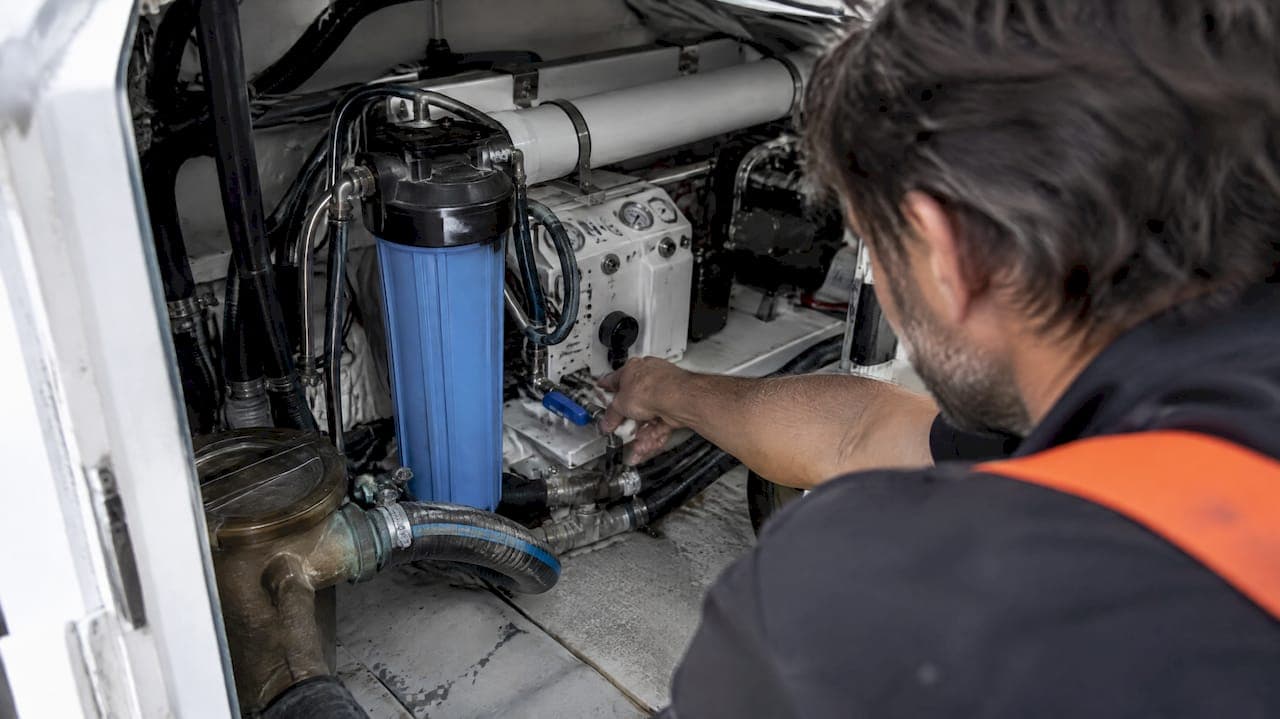
Watermakers are common on larger yachts and long-term or liveaboard charters, less so on smaller boats or short marina-hopping trips, and when properly maintained, the reverse osmosis water they produce is safe to drink. Before you book or board, ask for the vessel's last TDS reading and its most recent maintenance log. Those two numbers tell you more about water quality than any brochure claim.
TL;DR:
- Watermakers on boats usually produce water under 20 ppm TDS, but proper maintenance and recent testing are essential for safe drinking water.
- Systems with a capacity of 40 to 80 liters per hour are ideal for four to eight guests on a typical charter, ensuring reliable daily water supply.
- Availability of watermakers varies widely: larger yachts and long-term charters almost always include them, while smaller boats often rely on tank fills and refills.
- Asking for recent TDS readings, maintenance logs, and a demonstration during handover ensures the system functions correctly before booking.
- Portable backup units in the 10 to 20 liters per hour range serve as efficient, movable solutions for repairs and emergencies.
Table of Contents
- How a watermaker turns seawater into drinking water
- Are watermakers common on the boats you can charter?
- How much water output does your trip actually need?
- Power and installation: what makes a watermaker practical on a charter
- The daily habits that keep a watermaker reliable
- What watermakers cost, and the backup options operators use
- Your checklist for booking and handover
- When a watermaker actually matters for your trip
- How we help you confirm amenities before you book
- FAQ
- Sources
How a watermaker turns seawater into drinking water
A marine watermaker works by forcing seawater through a reverse osmosis membrane at high pressure, stripping out salt, minerals, and microorganisms until what comes out the other side is fresh enough to drink. The process relies on a chain of components, and a weak link anywhere in that chain shows up in the water quality.
- Pre-filters remove sediment and larger particles before seawater reaches the pump, protecting the membrane from damage.
- High-pressure pump pushes water through the membrane at the pressure reverse osmosis requires, typically several hundred psi.
- RO membrane does the actual filtering, and advanced marine units can remove contaminants down to 0.0001 microns, producing water under 20 ppm TDS.
- Brine outlet discharges the concentrated salt water left behind.
- Post-treatment (mineralization or UV) is optional on some systems but improves taste and adds a microbial safety layer.
TDS, or total dissolved solids, is the simplest way to judge output quality without lab equipment. A handheld or built-in TDS meter reads in parts per million, and well-maintained systems can consistently stay below 20 ppm, which is well within drinkable range. A sudden jump in TDS usually means a filter needs changing or the membrane is fouling.
Water conditions matter too. Sediment-heavy harbors or algae blooms increase how often pre-filters need swapping, so a boat that cruises mostly in clear offshore water will go through filters more slowly than one that spends time in silty anchorages.
Are watermakers common on the boats you can charter?
Availability depends heavily on boat class and trip length. Larger sailing and motor yachts, extended liveaboard charters, and many premium catamarans tend to include a watermaker as standard equipment, since multi-day trips without dock access make one practical rather than optional. Smaller day-charter boats and short weekend rentals often skip the installation entirely, relying instead on filled tanks and dock refills.
Listings don't always make this clear, so a little label-reading helps:
- Look for specific wording. "Watermaker installed" or a stated output figure (like 40 LPH) signals a real, working system. Vague phrases like "fresh water available" usually just mean tanks.
- Check the amenities section against the boat's size and itinerary. A 35-foot boat on a three-day coastal hop rarely needs one; a 50-foot catamaran on a two-week remote itinerary almost always should have one.
- Ask the operator directly for the system's last TDS reading, the date of its most recent service, and whether they can demonstrate it running at handover.
That handover demonstration matters more than any listing description. Cruising forums and charter blogs consistently note that a quick walkthrough and a shown TDS number cut guest complaints dramatically, because it replaces a vague promise with something you can see and verify yourself.
How much water output does your trip actually need?
Daily water use adds up fast once you factor in showers, galley use, and the occasional top-up for washing gear. A single guest using water conservatively might use relatively little, but a full crew showering twice a day and running a galley pushes total demand well beyond what a small unit can keep up with.
Manufacturers group output into rough bands that map to typical charter sizes:
- Small, 10 to 20 LPH: suited to couples or as a backup unit on larger boats rather than the primary source for a full crew.
- Charter-appropriate, 40 to 80 LPH: the range commonly recommended for vessels carrying four to eight guests, since it covers daily demand without requiring the unit to run around the clock.
- High-output, above 80 LPH: used on larger yachts or when the schedule calls for frequent, large batches, such as refilling a sizable tank between legs.
At the lower end of the charter-appropriate band, a 40 LPH unit fills a 160-liter tank in roughly four hours, while an 80 LPH unit does the same job in about two. That gap matters because duty cycle affects membrane wear: a system that has to run almost continuously to meet demand ages faster than one with comfortable margin. When you're comparing boats, a unit sized with some headroom above your group's expected use is a better sign than one that's barely adequate on paper.
Portable backup units in the 10 to 20 LPH range are commonly kept on larger vessels as a stopgap if the main system needs repair, since they're light, storable, and quick to deploy without a permanent installation.

Power and installation: what makes a watermaker practical on a charter
A watermaker is only as useful as the power system behind it, and charters vary widely in how they handle that tradeoff.
- Portable 12V units typically draw about 16 to 18 amps, which is manageable on a healthy battery bank but can strain a smaller one if run for hours at anchor without the engine or solar topping things up.
- Larger 24V or AC systems are more efficient per liter produced but usually need a generator or a strong alternator connection to run at full output, which is why many are wired into the boat's main electrical system rather than run as standalone units.
- Solar-only setups can work for smaller portable units but generally need a sizeable array to support a high-output system at anchor without draining the battery bank overnight.
Timing matters as much as capacity. Many operators run the watermaker underway, using alternator output while the engine is already turning, and save heavier anchor-time use for midday when solar production peaks. Planning daily runs this way, rather than letting the unit idle on standby all day, reduces battery strain and keeps the membrane from sitting under load longer than necessary.
Installation location affects day-to-day usability too. A unit tucked into an accessible locker with room to swap filters and check hoses gets serviced on schedule; one buried behind other gear tends to get neglected, and noise and ventilation around the pump matter if it's installed near a cabin.
The daily habits that keep a watermaker reliable
Most watermaker problems trace back to skipped basics rather than mechanical failure, and the fixes are simple enough that both crew and attentive guests can watch for them.
- Freshwater flush after every use is the single habit that protects the membrane most. Industry guidance treats it as critical, since skipping it allows biological growth that fouls the membrane and shortens its life considerably. Units with autoflush handle this automatically, which is one reason it's worth asking whether a boat's system has that feature.
- Pre-filter checks should happen more often in silty harbors than in clear offshore water, since sediment clogs filters faster and a clogged filter forces the pump to work harder for less output.
- TDS and feed pressure are the two numbers worth watching. A rising TDS reading or a pressure drop both point to a filter change or membrane issue before it becomes a bigger repair.
- Guest tasks versus technician tasks are worth separating clearly. Guests can reasonably ask to see a flush cycle run or a TDS reading taken, but filter replacement, membrane servicing, and troubleshooting a pressure fault are operator or technician work, not something a charter guest should be doing mid-trip.
Pro Tip: Ask to see the freshwater flush happen once at handover. If the crew can't demonstrate it in under a minute, that's a sign the habit isn't routine on that boat.
What watermakers cost, and the backup options operators use
Prices scale with output and complexity; for a technical overview of planning and installation considerations for marine watermakers, see our Watermaker Installation: A Planning Guide for Boat Owners. Compact units suited to a couple start at lower price points, while mid- to high-capacity marine systems cost considerably more and typically add installation fees on top of the unit price. Output ranges commonly cited by marine suppliers run from 6 to 20 GPH for small-boat systems up to 25 GPH and above for higher-capacity installs, and undersizing a unit for the boat's needs just pushes it into longer runs and faster wear, while oversizing adds idle time and more maintenance overhead than necessary.
Charter operators weigh portable against permanent installs differently depending on fleet size and itinerary:
- Portable units offer flexibility and work well as a dedicated backup, since they can be moved between boats or stowed when not needed.
- Permanent installs integrate into the boat's plumbing and power system, which is more convenient day to day but harder to relocate or repair quickly if something fails mid-charter.
- Common backup strategies include keeping a small portable spare aboard, carrying a bottled water reserve regardless of watermaker capacity, and in some fleets, a standing maintenance contract that guarantees fast turnaround on repairs between charters.
Your checklist for booking and handover
A short set of direct questions, asked before you book or right at handover, covers nearly everything that matters about a boat's water system.
- Is a watermaker actually fitted, or is "fresh water available" just referring to tank capacity?
- What's the output, in LPH or GPH, and does that match your group's size and trip length?
- What was the last TDS reading, and can the crew show it to you rather than just state it?
- When was the unit last serviced, and is there a maintenance log you can glance at?
- Does it have autoflush, or does flushing depend on someone remembering to do it after every use?
Beyond the questions, the proof worth asking for is concrete: a maintenance log entry, an actual TDS readout, and a brief demonstration at handover rather than a verbal assurance. If a listing's amenities section is vague, our platform lets members message owners and operators directly to confirm specifics like this before committing to a booking, and our programs give members added access to verified listings and add-on requests when a detail needs confirming ahead of time.
When a watermaker actually matters for your trip
A watermaker earns its keep on remote passages, extended anchoring away from marinas, or any trip with a large group expecting regular showers and galley use, where dock refills aren't a realistic backup plan. For short marina-hopping trips with easy access to a dock tap every night or two, it's a nice-to-have rather than a necessity, and plenty of good charters run fine without one. Whatever the boat has, carry a bottled reserve anyway. It costs little and covers the one scenario a watermaker can't: its own failure.
— SAILORIX
How we help you confirm amenities before you book
We built our platform around transparency, which means checking details like watermaker availability shouldn't require guesswork on your part. Membership gives access to verified listings and direct communication with owners and operators, so you can ask about output, maintenance history, or TDS readings before you ever pay a deposit.

Start by browsing available boats and checking amenity details directly on Sailorix.
FAQ
How much does a watermaker for a boat cost?
Small, couple-sized units start at lower price points, while mid- to high-capacity marine systems cost considerably more and typically require added installation fees. The right size depends on crew demand and available power, not just the sticker price.
Can you drink water from a watermaker?
Yes, when the system is properly maintained. Reverse osmosis removes salt and contaminants effectively enough that advanced marine units can produce water under 20 ppm TDS, which is well within safe drinking range, so always ask for a recent TDS reading before relying on it.
What is the 12 person rule on a yacht?
This refers to vessel classification rules that determine when a boat is operating as a commercial passenger vessel rather than a private one, which affects crew requirements and regulatory compliance. U.S. Coast Guard guidance outlines when these commercial classifications apply, so charterers should confirm a vessel's status if passenger limits or owner-specified crew are involved.
Why are watermakers so expensive?
Cost comes from the combination of the high-pressure pump, the RO membrane itself, and the installation work needed to integrate the unit into a boat's plumbing and electrical system. Higher-output units built for charter-sized demand, generally in the 40 to 80 LPH range, cost more than small personal units because they need sturdier pumps and larger membranes to keep up without constant running.
Sources
- How a boat watermaker works — ECHOTec
- Watermaker for charter boat — LEDI
- Watermaker for passage making — LEDI
- MSIB: Recreational vessel vs. SPV/UPV — U.S. Coast Guard (via Chicago Harbor Safety)
- Boat water makers: reverse osmosis systems — Marea Marine