

"Charter boat age" means the hull build year of the vessel you're about to book, not how old you need to be to rent one. Before you pay a deposit, ask the operator three things: the hull build year, the refit date and scope, and dated photos of engine hours and equipment. As a rough guide, boats 0 to 5 years old show lighter wear, 5 years marks a common fleet rotation point, and boats past 7 or 8 years often need closer inspection of mechanical systems.
TL;DR:
- Confirm the hull build year through registry documents, not just refit dates, to properly assess the boat's true age and condition.
- Request detailed documentation including engine hours, service logs, recent photos, and a full inventory to verify the boat's maintenance status.
- Recognize that boats over five years tend to be at natural resale points unless they have been well maintained and recently overhauled mechanically.
- Understand that extensive charter use, often averaging five seasons, accelerates wear on soft goods and mechanical systems more than age alone indicates.
- Use direct questions and documented replies to avoid potential misrepresentations and ensure you are booking a vessel with a transparent and verified maintenance history.
Table of Contents
- How Do You Check a Charter Boat's Real Age?
- What Does Charter Boat Age Actually Tell You About Condition?
- What Questions Should You Ask Before You Book?
- What Should Be On Your Pre-Booking Checklist?
- Why Transparent Age Data Changes What You Can Afford
- Book With the Age and Condition Facts in Hand
- Sources
How Do You Check a Charter Boat's Real Age?
Listings lie by omission more than by outright deception. A field that says "Year: 2024" might mean the hull was built in 2024, or it might mean a 2017 boat got a refit in 2024. Those are two very different boats, and the wording alone won't tell you which one you're looking at.
Ask the operator directly: "What is the hull build year, and what work did the refit include?" That single question, recommended by charter-industry writers who've dug into how listings present year and refit information, separates a cosmetic touch-up from a real mechanical overhaul. A refit that replaced upholstery and repainted the hull is not the same as one that replaced the engine, rewired the electrical system, or rebuilt the plumbing.
Beyond that one question, request documentation you can actually verify:
- Hull identification number or registry documents showing the build year
- Engine serial numbers and hour logs, ideally with service dates attached
- A dated equipment inventory PDF listing everything from life jackets to the dinghy motor
- Recent, dated photos of the engine room, helm electronics, and cabin interiors
- Maintenance records covering the past two to three seasons
Also ask how many charter weeks the boat runs per season. A boat marketed as "new in 2022" might have already logged three or four full seasons of guest turnover by the time you're looking at it, since a launch year says nothing about cumulative charter use. Screenshots of the registry page or title document, cross checked against the engine serials, are the fastest way to confirm an operator isn't quietly rounding a boat's age down.
What Does Charter Boat Age Actually Tell You About Condition?
Age alone is a rough proxy. What matters more is how hard the boat has worked and how well it's been kept up, but the benchmarks still hold up as a starting point for what to expect.
A boat typically shows lighter wear on soft goods and mechanical systems in its early years, assuming the operator runs a normal maintenance schedule. After several years, it is likely to have gone through one full charter life cycle. This is exactly why the resale market treats it as a natural exit point: ex-charter yachts are commonly sold around the five-year mark, often while they still hold solid value. Past 7 or 8 years, expect the operator to have replaced more components, and expect to ask harder questions if they haven't.
A busy charter base runs boats for a typical range of weeks per year. Multiply that by several seasons and you get a level of cumulative use, in anchorings, engine hours, and crew changeovers, that a private boat the same age would never see. Industry reporting on charter yacht wear backs this up: five charter seasons can produce wear closer to what a private owner would rack up over a decade.
That wear doesn't hit every system evenly:
- Wears faster: upholstery, canvas, bilge and freshwater pumps, dinghies, mattresses, and galley appliances
- Holds up longer: the hull itself and a diesel engine that's been professionally serviced on a regular schedule
Here's where a lot of renters get tripped up: engine hours alone can mislead. A boat with 800 hours that ran short trips with a lot of idling can be in worse shape than one with 1,200 hours that ran longer, steadier passages under a diligent maintenance plan. Usage pattern and service frequency tell you more than the number on the hour meter.
What Questions Should You Ask Before You Book?
Copy these into your message to the operator, in order:
- "What is the hull build year, separate from any refit date?"
- "What did the most recent refit include, and when did it happen?"
- "What are the current engine hours, and how often has the engine been serviced?"
- "Can you send dated photos of the engine room, helm, and cabin interior from this season?"
- "Can you send a full equipment inventory list?"
Watch for these red flags while you wait for answers. A listing that shows only glossy promotional photos, with no recent interior shots, is worth a second look. So is a "Year" field with no clarification when you ask about it directly, or an operator who hedges instead of answering the build year question. Vague phrases like "excellent condition" mean nothing on their own. Charter professionals consistently point renters toward dated photos and full inventories instead of taking condition claims at face value.
If an operator refuses to share service records or an inventory PDF, that's your signal to either walk away or insist on a recent third-party survey before you commit to a deposit.
Pro Tip: Save every reply in writing, even a screenshot of a chat message. If the boat shows up with different equipment or worse condition than promised, a documented paper trail is what gets you a refund conversation instead of an argument.
What Should Be On Your Pre-Booking Checklist?
Before any deposit leaves your account, get these in hand:
- Hull build year, confirmed through registry documents or serial numbers
- Refit date and a written description of what the refit covered
- Current engine hours plus a service log covering recent seasons
- Dated photos of the engine room, helm electronics, and interior from the current season
- A downloadable equipment inventory list
- A full price breakdown with no hidden add-ons
Nice to have, if the operator can provide it: a recent independent survey, proof of any major part replacements, and a sense of how often crew turns over on that boat.
| What you need | Why it matters | If the operator can't provide it |
|---|---|---|
| Hull build year | Confirms true age, not just refit date | Ask for registry docs or walk away |
| Refit scope and date | Separates cosmetic work from mechanical work | Request a written description before booking |
| Engine hours and service log | Usage pattern matters more than raw hours | Ask for a recent survey instead |
| Dated current-season photos | Verifies condition claims | Treat "excellent condition" claims skeptically |
| Equipment inventory PDF | Prevents surprises on boarding day | Ask about the operator's partial refund policy |
If a listing checks out on paper, dig into inspection tools you can bring yourself, covered in nautical tools every yacht and boat renter needs, before you finalize.
Why Transparent Age Data Changes What You Can Afford
Sailorix built its membership model around one idea: fees shouldn't eat the budget you'd rather spend on a better-documented boat. Most marketplaces charge 10 to 20% in service fees. Sailorix members pay roughly 1% after a $100 annual membership, which means the money you save on fees can go toward a boat with a cleaner service history instead of the cheapest listing available.
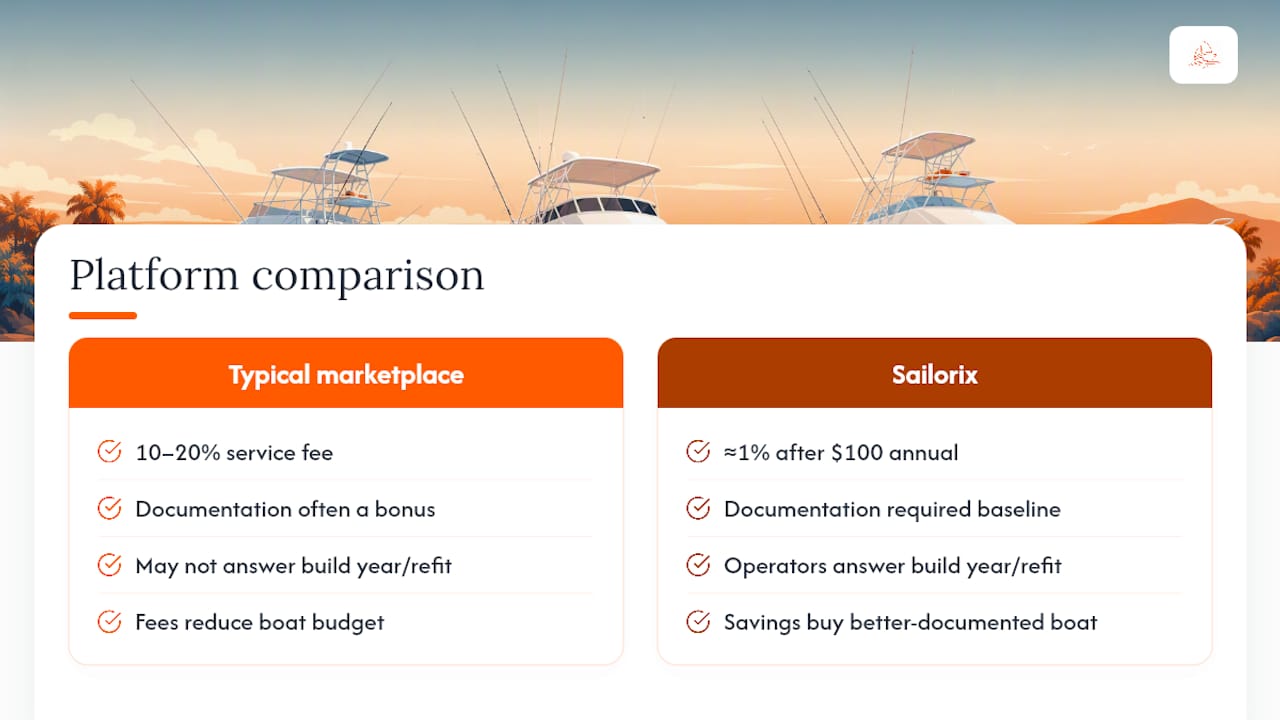
Operators on the platform are expected to answer build year and refit questions directly, and Sailorix's own yacht rental standards spell out what documentation renters should expect as baseline, not as a bonus. That transparency matters more once you understand how charter wear accumulates: a boat that looks fine in photos can still be five hard seasons deep.
Store every reply, photo, and inventory list inside your booking thread as you go. When a dispute comes up later, having that record already attached to the booking saves you from digging through old texts and emails.
— SAILORIX
Book With the Age and Condition Facts in Hand
Sailorix gives you a direct path to boats with real documentation instead of vague promotional listings, which is just as important as choosing charter bus for your wedding transportation to keep your event logistics smooth. Because membership cuts service fees to roughly 1% instead of the usual 10 to 20%, you keep more budget to choose a well-documented boat over the cheapest one on the page.

Search by destination and boat type on Sailorix, then message the operator directly through the platform to request the hull build year, refit scope, engine hours, and dated photos before you commit. Your requests and their replies stay attached to the booking, so you're not hunting through old messages if a question comes up later. If you want a second read before you book, the guide on key charter terms explains refit, inventory, and charter week in plain language. When you're ready, start your search on Sailorix and get the age and condition facts before your deposit leaves your account.
Sources
- How to Read a Charter Listing Like a Pro | Boat Tomorrow
- Second hand boats: buying an ex-charter yacht - Yachting World