
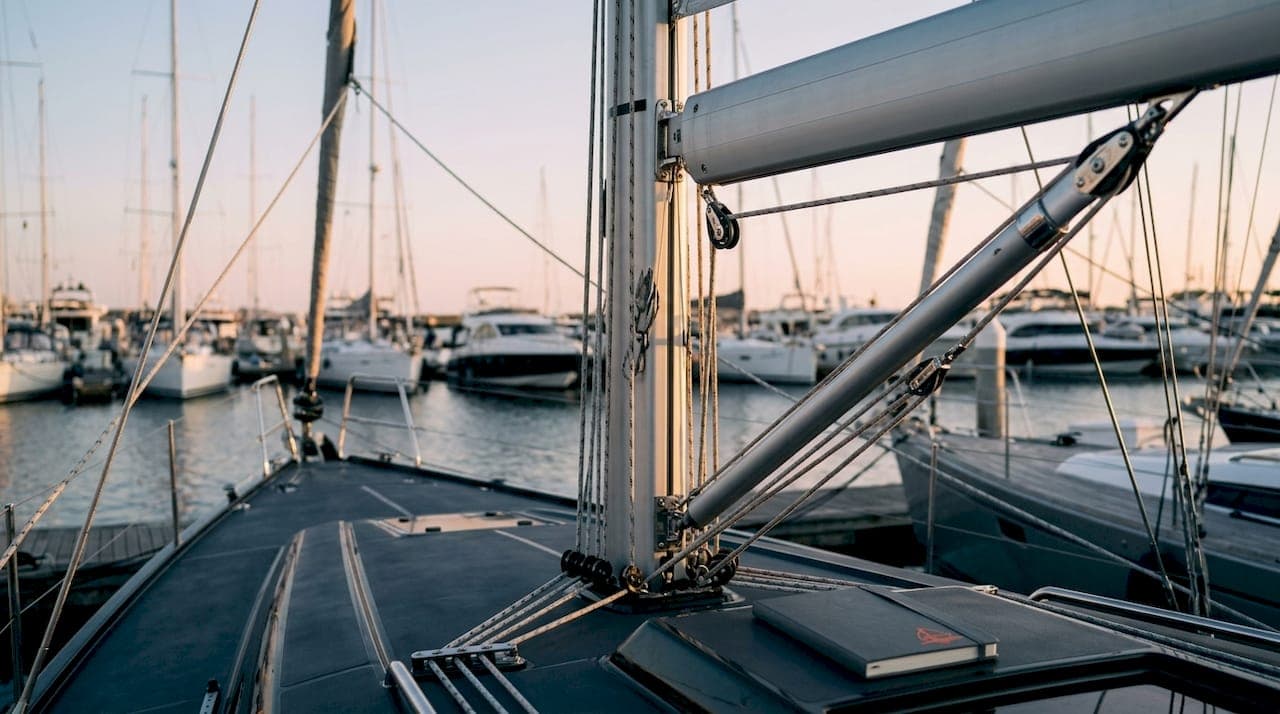
A mast is defined as a long vertical spar or pole rising from a vessel's keel or deck to support sails, booms, yards, and rigging. It acts as the structural spine of any sailing vessel, transmitting wind forces captured by the sails down through the hull. Without a mast, a sailboat cannot harness wind power or maintain the rig tension required for safe handling. Masts appear on everything from small dinghies to tall ships, and understanding them is the first step toward reading any vessel's design.
What are masts and how do they differ by type?
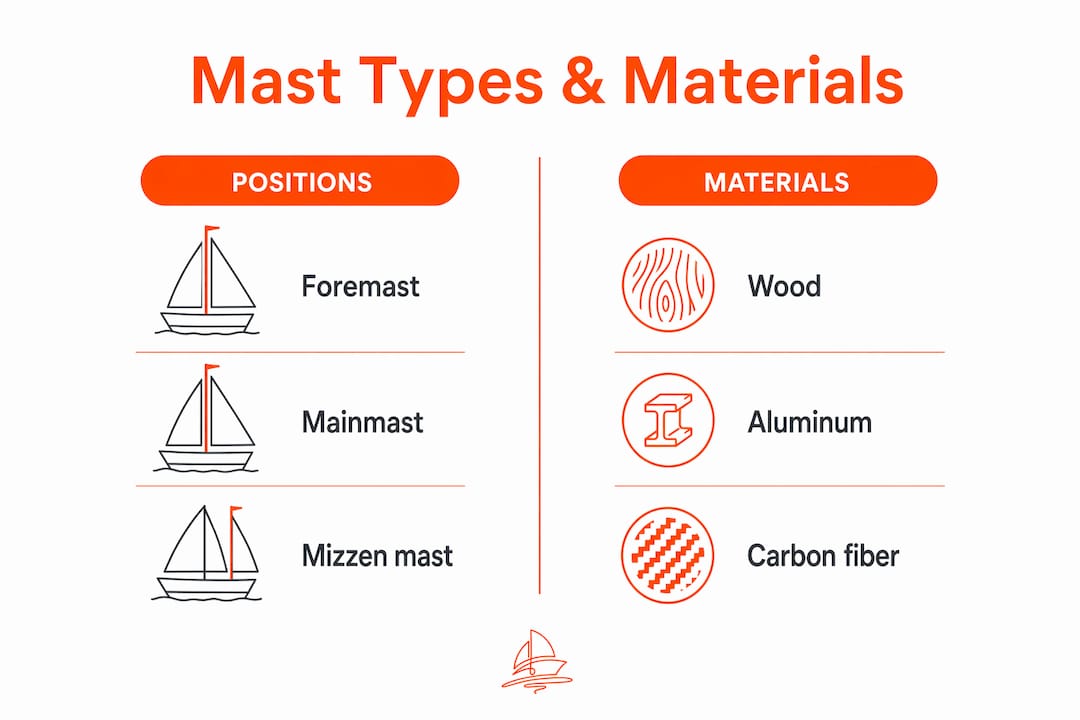
Masts on sailing vessels fall into distinct categories based on their position on the boat and the rig configuration. The three most common positions are the foremast, the mainmast, and the mizzen mast. The foremast sits forward of the mainmast and is the first mast from the bow. The mainmast is the tallest and most structurally significant spar on the vessel. The mizzen mast sits aft of the mainmast and is shorter, used on ketches, yawls, and schooners to balance the sail plan.
Beyond position, mast support configuration divides masts into three types: stayed, supported by side struts, and unstayed or free-standing. Stayed masts rely on a network of wire rigging, called shrouds and stays, to hold them upright. Unstayed masts are self-supporting and built from stiffer materials like carbon fiber. Free-standing masts appear on certain modern cruising designs and some traditional rigs where simplicity is a priority.
| Mast type | Position on vessel | Common rig |
|---|---|---|
| Foremast | Forward of mainmast | Schooner, ship rig |
| Mainmast | Center or dominant position | Sloop, ketch, full ship |
| Mizzen mast | Aft of mainmast | Ketch, yawl |
| Stayed mast | Any position | Most modern sailboats |
| Unstayed mast | Any position | Certain cruising designs |
Pro Tip: On a sloop, there is only one mast. If you see two masts and the aft one is shorter and forward of the rudder post, you are looking at a ketch. If the aft mast is behind the rudder post, it is a yawl.
Industrial contexts use the word "mast" differently. Forklift masts, for example, come in simplex, duplex, triplex, and quad configurations based on lift stages. Each stage adds height capability but also affects the collapsed height and forward visibility. The word "mast" in that context shares the same core meaning: a vertical structure that bears a load.
What materials are masts made from?
The three dominant mast materials are wood, aluminum, and carbon fiber. Each one changes how a boat handles, how much maintenance it demands, and how much it costs to replace or repair.
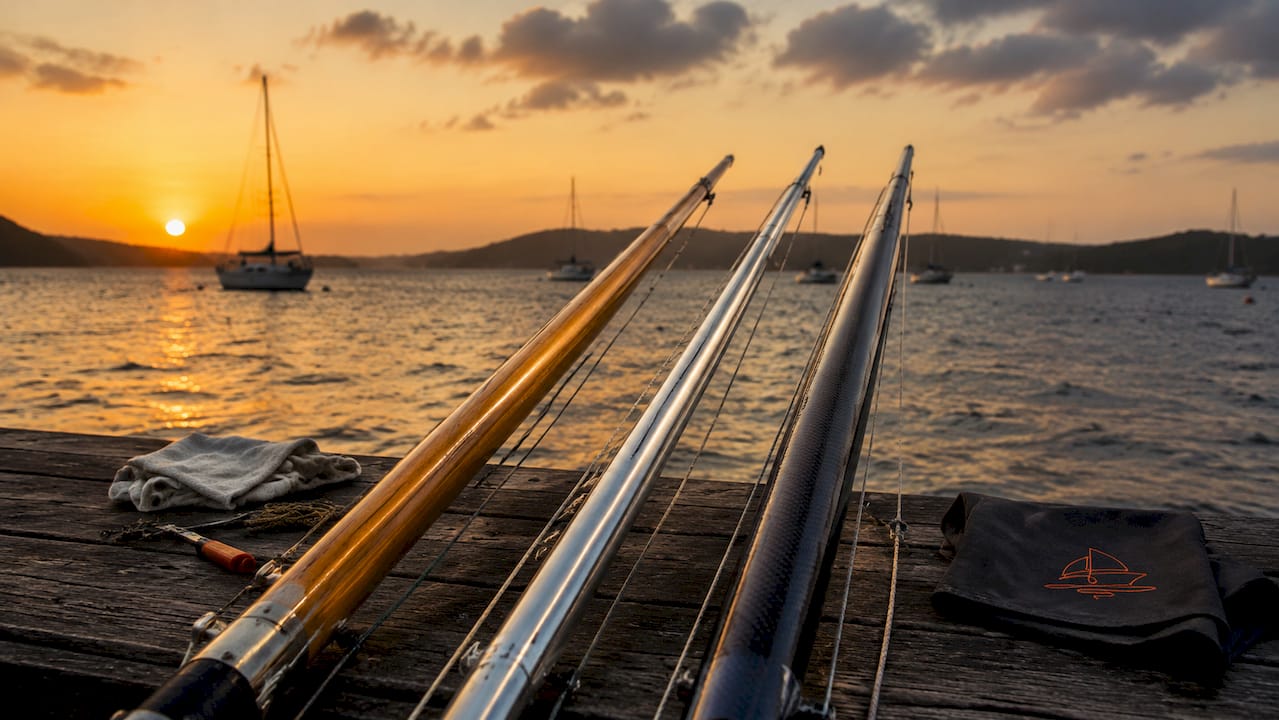
Wood was the original mast material and remains in use on classic and traditional vessels. Sitka spruce is the most common species for wooden masts because it offers a high strength-to-weight ratio. Wood flexes in a forgiving way, absorbs shock loads well, and can be repaired with basic tools. The downside is ongoing maintenance: wood requires regular varnishing or painting to prevent rot and checking for hidden cracks.
Aluminum offers durability and is the most widely used material on production sailboats today. It is lighter than wood, resists corrosion with proper anodizing, and tolerates beginner mistakes in rig tuning. An aluminum mast that is slightly undertensioned will flex rather than fail catastrophically. That forgiving quality makes it the right choice for sailors who are still learning rig management.
Carbon fiber sits at the performance end of the spectrum. It is significantly lighter and stiffer than aluminum, which reduces the center of gravity and improves boat speed. That stiffness is also its weakness: carbon fiber can develop unseen internal damage from impact or overtensioning, and carbon fiber demands expert inspection to catch problems before they become failures. The cost of a carbon mast is also substantially higher than aluminum.
| Material | Weight | Flex | Maintenance | Best for |
|---|---|---|---|---|
| Wood | Medium | High | High | Classic and traditional vessels |
| Aluminum | Light | Medium | Low | Production and cruising boats |
| Carbon fiber | Very light | Very low | Expert level | Racing and performance yachts |
Pro Tip: If you are buying your first cruising boat, an aluminum mast is the most practical choice. Carbon fiber rewards experienced sailors who inspect their rig regularly and understand tension loads.
How does a mast function structurally on a sailing vessel?
A mast functions as a compression member. The sails pull on it from multiple directions, and the rigging holds it in column under those loads. Think of it like the center pole of a tent: the fabric pulls outward, the guy lines hold the pole upright, and the whole system works together under tension.
The standing rigging consists of shrouds and stays. Shrouds run from the masthead or spreader tips down to chainplates on the sides of the hull, providing lateral support. Stays run fore and aft, with the forestay supporting the mast forward and the backstay pulling it aft. Rig tension must fall within 10–25% of the wire's breaking load. Too little tension causes the mast to pump in a seaway, which fatigues the metal at the base. Too much tension overloads the chainplates and hull structure.
The location of the mast step matters enormously for safety. Keel-stepped masts pass through the deck and rest on a fitting at the keel, distributing loads across the full depth of the hull. A keel-stepped mast can remain standing even if a shroud parts, because the deck provides a secondary support point. Deck-stepped masts sit on a fitting on the deck itself. They are easier to remove for transport or storage, but they are more vulnerable to failure if a stay lets go.
The shroud angle relative to the mast must be at least 11 degrees to provide effective lateral support. A narrower angle means the shrouds pull more downward than sideways, reducing their ability to resist lateral loads. This is why wider beam boats can carry more effective shroud geometry than narrow hulls.
Key structural risks to watch for include:
- Cracked or corroded chainplates, which are the fittings that attach shrouds to the hull
- Worn or broken swage fittings at the top and bottom of each wire
- Mast pumping in heavy weather, which signals undertensioning
- Delamination in carbon fiber spars, which is invisible to the naked eye without close inspection
What are the functions of masts beyond sail support?
Masts serve a wide range of functions beyond holding up sails. On modern vessels, the masthead is prime real estate for electronics and safety equipment. Large ships use masts) for radio aerials, radar arrays, and lookout positions. On a cruising yacht, the masthead typically carries a wind instrument, a VHF antenna, and navigation lights.
Navigation lights mounted on the mast are required by the International Regulations for Preventing Collisions at Sea, known as COLREGs. The all-round white light at the masthead is visible from all directions and signals a vessel at anchor. The steaming light, mounted lower on the mast, indicates a vessel under power. Getting these lights right is not optional: they are a legal requirement and a safety necessity.
On historic tall ships, masts carried fighting tops and crow's nests used as lookout platforms. Sailors stationed there could spot land, reefs, or enemy vessels well before anyone on deck. That function survives in modern form on large commercial ships, where the bridge wings and mast-mounted cameras serve the same purpose.
Radio and telecommunications masts on land share the same engineering principle. A mast relies on external guy wires for stability, while a tower is self-supporting. That distinction matters for sailors because it explains why rigging failure is so dangerous: remove the guy wires from a stayed mast and the structure collapses.
Secondary mast functions on modern boats include:
- Mounting radar domes for collision avoidance
- Carrying AIS antennas for vessel identification
- Supporting spinnaker halyards and code zero furlers
- Providing attachment points for downwind poles and whisker poles
Key Takeaways
A mast is the structural spine of a sailing vessel, and its material, step location, and rigging tension determine both performance and safety.
| Point | Details |
|---|---|
| Mast definition | A vertical spar rising from keel or deck, supporting sails and rigging as a compression member. |
| Types by position | Foremast, mainmast, and mizzen mast define the rig configuration and sail balance. |
| Material choice | Aluminum suits most cruisers; carbon fiber delivers speed but demands expert maintenance. |
| Keel vs. deck stepped | Keel-stepped masts distribute loads better and stay standing if a shroud parts. |
| Beyond sail support | Masts carry navigation lights, antennas, radar, and communication equipment on modern vessels. |
Why sailors underestimate the mast at their own risk
Most sailors who are new to the sport think of the mast as just a tall pole. That mental model causes real problems. The mast is the single most load-bearing structure above the waterline. Every gust of wind that fills the sails sends a force through the rig and into the hull, and the mast is the conduit for all of it. Treating it as background furniture is how rigs fail offshore.
The most common mistake I see is neglecting rig tension checks before a season. Shrouds stretch over time. Swage fittings corrode from the inside where you cannot see it. A rig that passed inspection two years ago may be one hard gust away from a failure. A mast inspection guide should be part of every sailor's spring commissioning routine, not an afterthought.
Material choice also shapes the sailing experience more than most buyers realize. An aluminum mast on a cruising boat forgives small tuning errors and survives the occasional accidental gybe without drama. A carbon mast on a racing boat rewards precision and punishes neglect. Choosing the wrong material for your skill level and sailing style creates a mismatch that shows up every time conditions get demanding.
The other underrated factor is the step location. Sailors who cruise offshore should prioritize keel-stepped masts. The ability to survive a stay failure without losing the rig entirely is not a theoretical benefit. It is the difference between a manageable emergency and a dismasting in open water. For day sailing or racing on sheltered water, a deck-stepped mast is a reasonable trade-off for the convenience of easy removal.
— Sailorix
Mast knowledge that makes you a better sailor
Understanding masts is not just academic. It changes how you inspect your boat, choose your next vessel, and handle emergencies at sea. Sailorix publishes detailed guides on every aspect of sailing rigs, from mast materials and maintenance to rig tuning and offshore safety.

Whether you are preparing for your first offshore passage or looking to upgrade from a production cruiser to a performance yacht, Sailorix connects you with the knowledge and the boats to make it happen. The platform lists yachts worldwide with real-time availability, and a €100 annual membership keeps service fees at roughly 1%. Browse available yachts on Sailorix and put your mast knowledge to work on the water.
FAQ
What is the basic mast definition in sailing?
A mast is a vertical spar rising from a vessel's keel or deck that supports sails, booms, yards, and rigging. It functions as a compression member, transferring wind loads from the sails into the hull.
What are the main types of masts on a sailing vessel?
The three main types by position are the foremast, mainmast, and mizzen mast. By support configuration, masts are either stayed, supported by side struts, or unstayed and free-standing.
What material is best for a sailboat mast?
Aluminum is the best choice for most cruising sailors because it is durable, low maintenance, and forgiving of tuning errors. Carbon fiber is better for racing but requires expert inspection to prevent unseen damage.
What is the difference between a keel-stepped and deck-stepped mast?
A keel-stepped mast passes through the deck and rests on the keel, providing greater structural integrity and the ability to remain standing if a shroud fails. A deck-stepped mast sits on the deck and is easier to remove but less resilient in a rigging failure.
What functions do masts serve beyond holding sails?
Masts carry navigation lights required by COLREGs, VHF and AIS antennas, radar domes, and wind instruments. On historic vessels, they also supported lookout platforms and signal yards.