
June and September are the best months to sail Greece, balancing warm water, manageable wind, and thinner crowds against better prices. The core season runs April through October, with July and August marking the peak: hottest temperatures, strongest Meltemi winds, and the highest rates. The right pick still depends on your region, crew experience, and how much heat and wind you actually want.
TL;DR:
- Booking for July and August requires securing the best boats several months in advance due to high demand and premiums, especially in popular fleets.
- Mid-September offers optimal conditions, with warm water and calmer winds, while late April and October provide lower prices but more unpredictable weather.
- The Ionian is the safest region for beginners and families year-round, whereas the Cyclades demand experienced crews during peak Meltemi months of July and August.
- Planning longer crossings is safer during morning hours, and always having a sheltered bay as a backup enhances safety during strong Meltemi winds.
- Using multiple weather sources like HNMS and Windy before and during your trip improves route safety amid seasonal wind fluctuations.
Table of Contents
- What Is the Best Time to Sail Greece?
- What Is Greek Sailing Weather Like Month by Month?
- Which Greek Region Fits Your Sailing Style?
- How Strong Is the Meltemi and How Should You Plan Around It?
- When Should You Book Your Greek Sailing Trip?
- What Should You Check Before Booking a Charter?
- Which Month and Region Should You Actually Pick?
- Book Smarter, Not Just Earlier
- Where to Check Greek Sailing Forecasts
- Sources
What Is the Best Time to Sail Greece?
The Greek sailing season runs from late April through late October, driven largely by the Azores High pressure system that keeps summer weather settled and predictable across the Aegean and Ionian seas. Inside that window, shoulder months and peak months behave like two different vacations.
Peak season, July and August, gives you the warmest air and the liveliest ports, but also the strongest wind, packed anchorages, and top-dollar charter rates. Shoulder months, May, June, September, and October, trade a few degrees of heat for calmer seas, open moorings, and meaningfully better pricing.
A quick way to sort it out:
- Want guaranteed heat and don't mind wind or crowds? Go July or August.
- Want warm water without the chaos? Book June or September.
- Want a bargain and don't mind occasional weather swings? Try October or late April.
- Sailing with kids or nervous first-timers? Skip peak Meltemi months in exposed regions.
What Is Greek Sailing Weather Like Month by Month?
Weather and crowds shift fast across the season, and the difference between booking in May versus August can change the entire feel of a trip.
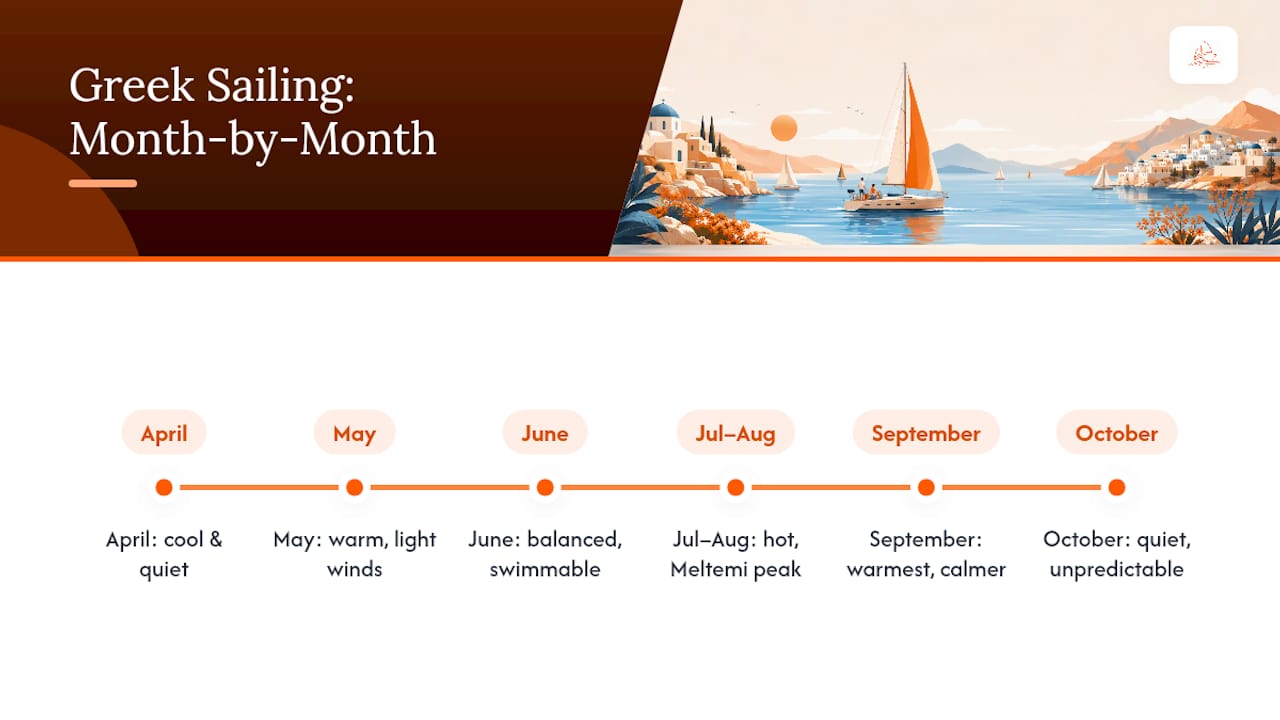
April stays cool and unpredictable. Sea temperatures linger in the mid-60s Fahrenheit, marinas are quiet, and rain is still possible. It suits sailors who want solitude over swimming weather.
May warms things up. Air temperatures climb into the 70s, winds stay generally light, and tourist numbers are still low. It is an underrated shoulder month for travelers who want good conditions without June's higher prices.
June is where most experienced charterers tell you to start looking seriously. Sea temperatures become genuinely swimmable, the Meltemi hasn't hit full strength yet, and most islands are reachable without heavy wind management. It is arguably the most balanced month on the calendar.
July and August bring the hottest air, the warmest early-summer seas, and the strongest, most consistent Meltemi winds, which typically peak during these two months. Anchorages fill up fast, marina fees rise, and this is the season when a confident crew or a hired skipper matters most, especially in the Cyclades.
September earns its reputation as a broker favorite for good reason. Sea temperatures often hit their annual high, sometimes reaching the 70s Fahrenheit even into late September, while the Meltemi begins easing.
October rewards flexible travelers with quiet harbors and discounted charters, though weather becomes noticeably less predictable as the month progresses, with a higher chance of rain and shifting fronts by late October.
Pro Tip: If you can only pick one week all year, aim for the second half of September. The water is at its warmest, the wind has calmed from its August peak, and you'll have entire bays to yourself that were packed a month earlier.
Which Greek Region Fits Your Sailing Style?
Greece isn't one sailing destination. It's four distinct ones, and picking the right region matters as much as picking the right month.
- Ionian Sea: Sheltered, calmer, and forgiving for beginners and families. Good conditions hold across nearly the entire season, making it the safest bet if you're unsure about wind exposure.
- Cyclades: Beautiful but exposed. The Meltemi hits hardest here, so June and September are the sweet spot for most crews, while July and August suit only sailors comfortable with strong, sustained wind.
- Saronic Gulf: Close to Athens, sheltered, and ideal for shorter charters. A solid choice if you want island-hopping without long open-water crossings.
- Dodecanese: Farther south and slightly milder in Meltemi intensity, with warm water that holds later into the season. Worth considering for an October trip when the Cyclades start feeling risky.
If your crew's experience is limited, choose your region before you choose your dates. A calm-water region during a rough month often beats a wind-prone region during a "perfect" one.
How Strong Is the Meltemi and How Should You Plan Around It?
The Meltemi is a strong, dry northerly wind that builds through the summer and typically peaks in July and August, sometimes gusting into the 30 to 40 knot range in the Cyclades and central Aegean. It usually strengthens through the afternoon and eases overnight, which shapes how experienced sailors time their passages.

Long open-water crossings during peak Meltemi conditions deserve real caution, especially for less experienced crews. Waiting for a calmer window, or choosing a sheltered anchorage instead of pushing through, is standard practice among charter skippers rather than a sign of overcaution.
A few habits keep most trips safe and comfortable:
- Check the EMY marine bulletins every morning before deciding on that day's route.
- Cross-reference wind and sea-state data through the POSEIDON monitoring network for satellite and buoy readings.
- Use Buoyweather or Windy for hour-by-hour routing decisions once you're underway.
- Plan longer passages for morning hours, before the Meltemi builds.
- Always keep a sheltered bay as backup if forecasts shift midday.
Pro Tip: Bookmark two forecasting sources, not one. HNMS gives you the official synopsis; Windy gives you the granular, hour-by-hour picture you'll actually use while underway.
When Should You Book Your Greek Sailing Trip?
Booking timing shapes both your options and your price. For July, August, or early September, aim to reserve between November and May, since the best boats in popular fleets get claimed months ahead. Six months out is comfortable for most other windows. Low season, meaning April, May, and October, allows genuine last-minute flexibility.
Pricing follows a predictable curve: shoulder months typically run moderately below peak August rates, with the steepest discounts appearing after the first week of September.
A few tactics help stretch your budget:
- Target the second half of September for warm water and lower prices together.
- Look for flexible cancellation windows when booking shoulder-season charters.
- Compare June versus September directly before committing, since both offer similar value but different crowd levels.
What Should You Check Before Booking a Charter?
Before locking in a charter, confirm the base location, fuel policy, and whether an Advance Provisioning Allowance (APA) applies. Verify skipper qualifications if you're hiring one, especially for Aegean routes where Meltemi experience matters, and check what insurance coverage is included.
A membership can simplify this process by reducing service fees and letting you compare availability across regions and fleets in one place. Before departure, request a local weather briefing and confirm your skipper's experience with Meltemi passages specifically, not just general sailing hours.
Which Month and Region Should You Actually Pick?
If you're sailing with family, the Ionian in June or September gives you calm water without sacrificing warmth. First-timers do best in the Saronic or Ionian during June, when conditions stay forgiving. Experienced crews chasing real wind should head to the Cyclades in July or August, when the Meltemi is at full strength.
— SAILORIX
Book Smarter, Not Just Earlier

That same membership also makes cross-region comparisons practical. Instead of digging through separate Ionian, Cycladic, and Dodecanese listings on different sites, you can check real-time availability across all of them in one search, which matters most in shoulder months when the best-value boats disappear fast. If June or September is your target window, that's exactly when comparison speed pays off. For a lifestyle detour while you plan, Waves & Frames has sailing photography worth browsing for itinerary inspiration.
Ready to see what's available for your dates? Check availability and membership details on Sailorix before your target weeks fill up.
Where to Check Greek Sailing Forecasts
For long-term seasonal patterns, lean on HNMS marine bulletins and the POSEIDON monitoring network, both built on official meteorological and satellite data. For short-term, day-to-day routing decisions once you're aboard, Buoyweather and Windy give faster, more granular wind readings you can check hour by hour.
Sources
- EMY (Hellenic National Meteorological Service) marine
- POSEIDON Monitoring Network
- George Yachts — Best Time to Charter a Yacht in Greece (month-by-month)