
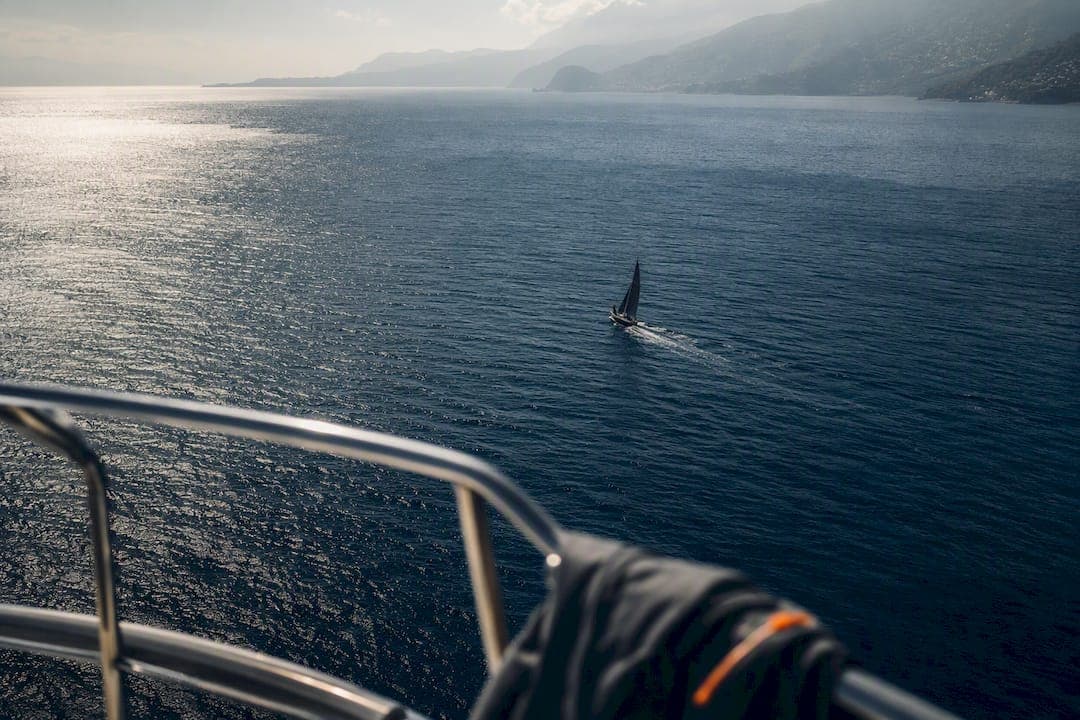
The Mediterranean sailing season runs roughly April through October, with peak conditions from mid-July through mid-September. For most sailors, June and September deliver the best balance of warm water, steady wind, and manageable prices, while July and August bring the busiest anchorages and the highest rates. Regional wind patterns like the Meltemi and event calendars in the western Mediterranean can shift that recommendation depending on where you're headed.
TL;DR:
- The best months for sailing in the Mediterranean are June and September, offering warm water, steady winds, and lower prices compared to peak summer.
- Regional wind patterns like the Meltemi in the east and the Mistral in the west heavily influence sailing conditions and route planning from July to September.
- Booking 8 to 10 months in advance is recommended for peak season, while shoulder weeks in June and September often have better availability and rates.
- Prices can double during marquee event weeks like the Cannes Film Festival and Monaco Yacht Show, so booking around those periods can significantly reduce costs.
- Winter sailing is only feasible in limited regions such as the Canary Islands and southern Spain, due to marina operations, provisioning challenges, and weather risks elsewhere.
Table of Contents
- When Is the Mediterranean Sailing Season, Month by Month?
- Which Region and Month Should You Choose?
- How Do Mediterranean Winds Affect Your Sailing Season?
- What Are the Water Temperatures Like Across the Season?
- When Should You Book to Get the Best Price and Availability?
- Which Month Is Best for Your Sailing Goals?
- Can You Sail the Mediterranean in Winter?
- How Sailorix Helps You Time Your Charter Right
- A Straight Answer on Timing
- Ready to Search for Your Ideal Sailing Week?
- Sources
When Is the Mediterranean Sailing Season, Month by Month?
The practical sailing season stretches from April to October, but it's not one continuous block of good weather. Charter brokers generally split it into three distinct phases: an early shoulder season, an eight-week peak, and a late shoulder season that tapers into winter. Thinking of it that way, rather than as six uniform months, makes booking decisions a lot easier.
Peak season runs from mid-July through mid-September. This is when air temperatures across the region sit in the mid-80s to low 90s Fahrenheit, marinas fill up fast, and popular anchorages in places like the Amalfi Coast or the Cyclades can feel more like parking lots than quiet coves.
Shoulder season covers May through early July, then early September into October. Water is warm enough to swim comfortably, wind is generally more predictable, and you'll pay noticeably less for the same boat.
Off-season covers November through April. A handful of southern regions stay viable, but most of the Mediterranean charter fleet is either laid up or undergoing maintenance during these months.
Here's a quick snapshot of what each month typically brings:
- April: Cool water, unpredictable weather, but very few crowds and the lowest rates of the sailing calendar.
- May: Warming fast, reliable wind, and one of the best months for cost-conscious sailors who don't mind a light jacket at night.
- June: Arguably the sweet spot. Warm days, manageable evenings, wind that behaves, and prices still well below peak.
- July: Peak season begins. Expect hot, still days punctuated by strong afternoon winds in the Aegean.
- August: The busiest month by a wide margin, driven partly by the Ferragosto holiday in Italy, when much of the country takes to the water at once.
- September: Often cited by charter brokers as the single best all-around month. Water is at its warmest, crowds thin out fast after Labor Day, and Meltemi winds calm down.
- October: A quieter, cooler shoulder month, good for experienced sailors who prioritize solitude over guaranteed sunshine.
A few calendar-driven spikes matter more than the broader monthly pattern. Marquee events like the Cannes Film Festival and the Monaco Yacht Show create brief but intense demand for boats and berths in the western Mediterranean, and those price and availability spikes are tied to specific weeks, not entire months. Booking around those dates, rather than avoiding the whole month, often solves the problem.
Which Region and Month Should You Choose?
Timing advice changes depending on where you point the bow. The Mediterranean isn't one climate zone with one calendar. It's several overlapping seasons stitched together by geography and wind.
Western Mediterranean: French Riviera and Balearics
The Riviera and the Balearic Islands run on an event-driven calendar as much as a weather one. The Cannes Film Festival in May and the Monaco Grand Prix in late May kick off an early demand surge, followed by a summer that stays crowded through August. Ibiza and Mallorca see their nightlife scene peak in July and August, which is exactly when berths in Palma or Port Adriano get hardest to secure.
If you want the Riviera without the film-festival prices, aim for the first half of June or the back half of September. You'll still get calm water and warm afternoons, just without the yacht traffic jams off Saint-Tropez.
Italy, Sardinia, and the Amalfi Coast
Italy's cruising grounds face a tighter squeeze than almost anywhere else in the region. August, driven heavily by the Ferragosto holiday, packs anchorages along the Amalfi Coast and around Sardinia's Costa Smeralda to capacity. Mooring in Positano or Capri in mid-August without a reservation booked months in advance is close to a lost cause.
Sardinia rewards patience. Its water stays swimmable well into October, and the crowds that make Porto Cervo unbearable in August thin out dramatically by mid-September.
Greek Islands: Cyclades and Ionian
Greece splits cleanly into two different sailing experiences depending on which side of the country you choose. The Cyclades, including Mykonos and Santorini, sit directly in the path of the Meltemi, a strong northerly wind that regularly blows 20 to 35 knots through July and August. That wind makes for exciting downwind runs but rough, uncomfortable upwind legs, and it can pin boats in port for a day or two at a time.
The Ionian Sea, on the western side of Greece, largely escapes the Meltemi. Islands like Kefalonia, Zakynthos, and Corfu offer gentler thermal breezes and calmer water through the same months, which makes the Ionian a far better call for families or anyone sailing with less experienced crew during peak summer.
Eastern Mediterranean and Turkey
Turkey's southern coast, particularly the Turquoise Coast around Fethiye and Göcek, runs a longer comfortable season than most of Greece. The coastline's geography offers more sheltered bays, which soften the impact of the same Meltemi and Etesian wind system that hammers the Cyclades. Sailors looking for a calmer alternative during the height of summer often shift east rather than west.
Southern Spain and the Canary Islands
Southern Spain, and especially the Canary Islands, operate on a nearly year-round calendar. The Canaries sit far enough south and are influenced enough by the Atlantic that winter sailing stays genuinely viable, which sets them apart from almost every other cruising ground discussed here.
How Do Mediterranean Winds Affect Your Sailing Season?
Three named wind systems do most of the work in shaping when and where you'll want to sail, and each behaves differently depending on the month.
The Meltemi, also called the Etesian wind in meteorological literature, dominates the eastern Mediterranean from July into early September. It's a dry, strong northerly flow that can build to 20 to 35 knots or more in the Aegean, often strengthening in the afternoon and easing overnight. Experienced sailors use it for fast point-to-point passages; less experienced crews often plan shorter hops and build in weather days.
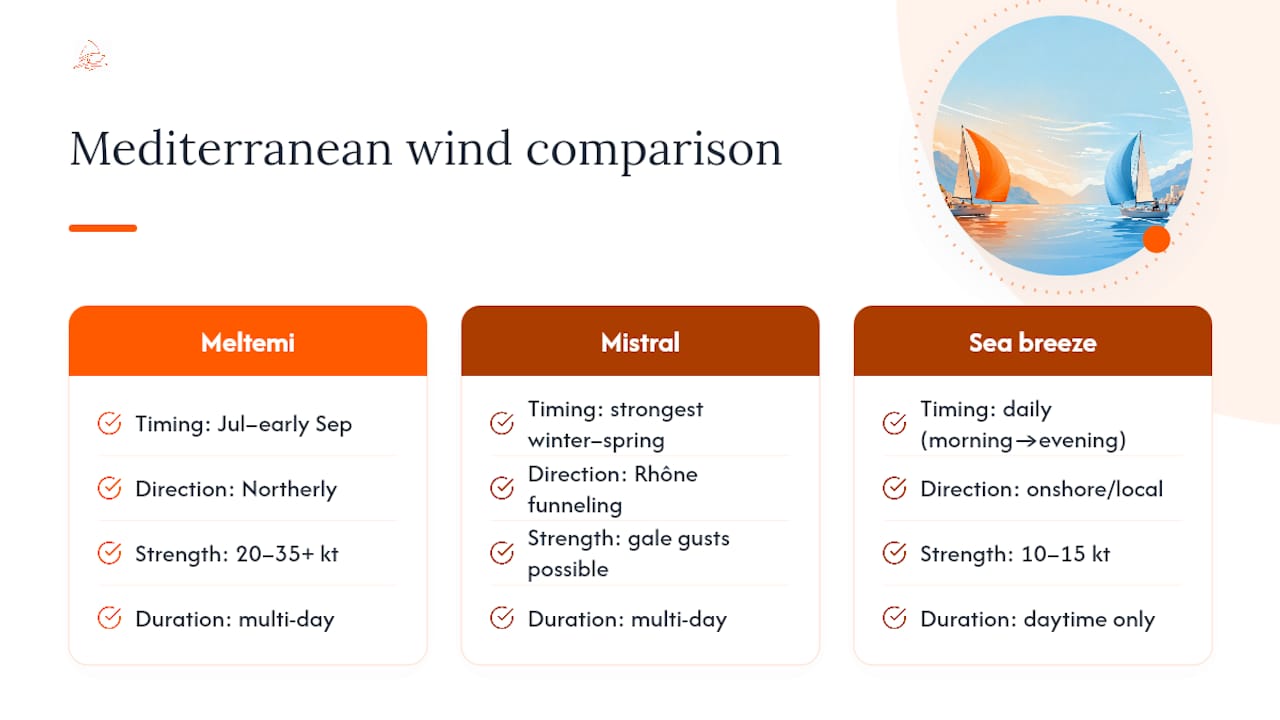
The Mistral plays a similar role in the western Mediterranean, funneling cold, dry air down the Rhône Valley into the Gulf of Lions with gusts that can hit gale force. It hits hardest in winter and spring but can appear in summer too, which is why routing around the French coast benefits from sheltered bailout options along the Riviera rather than long open crossings.
Layered on top of both systems is the daily sea breeze, a far gentler and more predictable pattern driven by the temperature difference between warm land and cooler water. It typically builds through the morning, peaks in early afternoon, and dies off by evening. This is a completely different animal from a synoptic wind event like the Meltemi or Mistral. A sea breeze is a forecastable daily rhythm; the Meltemi and Mistral are multi-day weather systems that can override the local pattern entirely.
For family trips, that distinction matters more than any single statistic. A steady 10 to 15 knot afternoon sea breeze makes for pleasant, comfortable sailing. A three-day Meltemi blow at 30 knots is a different trip altogether, and it's worth building slack into any itinerary during July and August specifically because of it.
What Are the Water Temperatures Like Across the Season?
Sea temperature tracks air temperature with a lag of roughly a month, which is part of why September consistently outperforms June for anyone prioritizing warm water over anything else.
Statistic Callout: Spring water temperatures across most of the central Mediterranean sit in the mid-teens Celsius, roughly the high 50s to low 60s Fahrenheit. By peak summer, temperatures climb into the low to mid 20s Celsius, or the mid to upper 70s Fahrenheit. September is often the warmest point of the whole year in many central spots, with water reaching around 24 to 25°C (75 to 77°F) even as air temperatures start to ease.
Some regions hold that warmth longer than others. Sardinia, the Balearic Islands, and southern Greece all stay swimmable well into October, thanks to the deep water's slow response to cooling air. That extra month of comfortable swimming is one of the strongest arguments for pushing a trip into the shoulder season rather than squeezing it into July.

Sea state follows a similar late-season shift. Through summer, the Mediterranean tends toward flat, settled conditions between wind events. By October and into November, that starts to change: swell builds, weather systems move through more frequently, and the gap between good days and rough days widens. It's a livable trade for sailors chasing quiet anchorages, but it's worth planning around rather than discovering mid-passage.
When Should You Book to Get the Best Price and Availability?
Price swings hard across the Mediterranean sailing calendar, and the gap between peak and shoulder rates is one of the clearest signals in the entire charter market. Boats that command top dollar in the first three weeks of August routinely drop meaningfully in price just a few weeks earlier or later, for essentially the same weather.
Lead time matters as much as the calendar month:
- Peak season (mid-July to mid-September): Book 8 to 10 months ahead for popular boats and prime anchorages.
- In-demand yacht models: Even outside peak weeks, book 5 to 7 months out if you want a specific boat type or layout.
- Shoulder weeks (June, early September, October): 3 to 5 months of lead time is usually enough, and earlier booking generally locks in better rates.
- Last-minute deals: They exist, mostly in shoulder weeks when an owner needs to fill a cancellation, but treat them as a bonus, not a plan.
Event weeks compress this whole picture. The Riviera and Sardinia see the heaviest mid-summer clustering, and marquee events like Cannes or the Monaco Grand Prix can double demand for specific dates without affecting the rest of the month at all. A boat available in the third week of May might be fully booked the following week purely because of what's happening onshore.
Pro Tip: Starting your charter on a Wednesday or Thursday instead of the standard Saturday can unlock availability and occasionally shave money off the rate, since most charter turnovers cluster around the weekend.
If flexibility is on the table, shift your target week rather than your target month. A trip that starts the third week of June instead of the last week of July can mean a meaningfully lower rate for water that's nearly as warm, and strategic timing is one of the more reliable ways to control costs without downgrading the boat.
Which Month Is Best for Your Sailing Goals?
Different priorities point to different weeks on the calendar. Here's how to match your goal to a specific window:
- Calm seas and family trips: Target June, or shift to the Ionian and Saronic Gulf in July if you want peak-season dates without Meltemi exposure.
- Best overall value: The third week of June and the second to third weeks of September consistently offer the strongest combination of price and conditions, according to charter-market analysis.
- Warmest water for swimming and snorkeling: Late August through September, when sea temperatures peak across most of the central and eastern basin.
- Social scene and nightlife: Mid-July through August in spots like Ibiza and Mykonos, with the understanding that you're paying premium rates for the crowd, not despite it.
None of these are mutually exclusive, but they do pull in different directions. A sailor chasing the liveliest beach clubs in Mykonos in August will pay more and deal with more wind than someone chasing quiet coves in the Ionian the same week. Knowing which trade-off you're actually making up front saves a lot of disappointment on day three.
Can You Sail the Mediterranean in Winter?
Winter sailing is possible, but it's a genuinely different undertaking than a summer charter, and it only really works in a handful of places.
Southern Spain and the Canary Islands are the strongest year-round options, thanks to milder Atlantic-influenced winters and a charter infrastructure that stays active outside the main season. Parts of the southern Turkish coast and southern Cyprus also hold up reasonably well through the cooler months, with mild days even in January.
Elsewhere, winter brings real logistical friction. Many marinas across Italy, Greece, and the wider Aegean scale back operations or close sections of their docks for maintenance between November and March. Provisioning gets harder as seasonal shops and tavernas near popular anchorages shut down for the winter. Weather risk climbs too, since winter storm systems move through more frequently and with less warning than the predictable summer wind patterns.
Anyone set on an off-season trip should build in a real operational checklist: confirmed weather windows before departure, a backup berthing plan in case a marina is unexpectedly closed, and provisioning arranged in advance rather than assumed. None of that is difficult, but skipping it in winter causes problems that summer sailors rarely encounter.
How Sailorix Helps You Time Your Charter Right
Some boat-booking platforms build their search tools around the exact pattern this guide describes: shoulder weeks in June and September consistently deliver strong conditions at a fraction of peak pricing, and real-time availability is the only reliable way to catch those windows before they fill.
A short checklist makes the difference between a good week and a great one:
- Confirm your target week against regional wind risk, not just the general season.
- Check crew certification requirements early, especially STCW and ENG1 documentation if you're chartering with a skipper.
- Understand your APA (advance provisioning allowance) expectations before you sign anything.
- Build one or two flex days into any itinerary that touches a Meltemi or Mistral corridor.
Real-time inventory search matters most in shoulder weeks, when a cancellation can open up a boat that was booked out months in advance. Checking availability regularly in the weeks leading up to your target dates, rather than assuming everything is locked in, is often how the best last-minute value gets found.
A Straight Answer on Timing
If you want one sentence of advice from this entire guide, here it is: pick June or September unless you specifically want peak-season energy and are prepared to pay for it. Everything else is detail in service of that choice.
The checklist is short. Pick your region based on wind exposure, not just scenery. Pick a target week rather than a target month, since a handful of days can shift both price and crowd size dramatically. Then build in flex days, because Mediterranean wind systems don't check anyone's itinerary before they blow.
Pro Tip: A boat booked for the third week of September will often cost noticeably less than the same boat in the first week of August, for water that's actually warmer.
— SAILORIX
Ready to Search for Your Ideal Sailing Week?
That difference alone can cover a meaningful chunk of a shoulder-season charter.

Whether you're chasing the third week of June or a quiet October window in Sardinia, the fastest way to know what's actually available is to search live inventory rather than guess based on last year's prices. Before you lock in dates, it's worth reviewing what every charterer should confirm about crew, certificates, and boat condition. Start your search on Sailorix and see what's available for the week you actually want.
Sources
This guide draws on a mix of charter-industry data and meteorological references to keep the timing advice grounded in real patterns rather than guesswork.
Improve Sailing's season breakdown anchors the April to October window and peak/shoulder definitions used throughout. GetBoat's charter guide supports the specific shoulder-week value recommendations. Yachts for Kings' regional charter guide informed the regional rotation and pricing patterns. Cruise Critic's seasonal guide backed the broader spring/fall balance discussion, and the Etesian winds entry on Wikipedia provided the technical grounding for Meltemi behavior in the eastern basin.
- When Is the Mediterranean Sailing Season? - Improve Sailing
- Mediterranean Yacht Charter Guide 2026: Rates, Seasons
- Etesian winds — Wikipedia