

Most U.S. boat rentals require you to be at least 18, but many rental companies set higher minimum ages for personal watercraft and high-horsepower boats. State law sets the legal floor, and it's the rental state's law that governs, not your home state's rules. Before booking anything, check the specific state's boating agency page and read the rental agreement's fine print on authorized operators.
TL;DR:
- Most states regulate boat rental age minimums differently, with some bans on renting to anyone under 18, like Nebraska.
- State laws vary widely, often requiring additional boater safety cards based on age, birth year, or horsepower, especially for PWCs.
- Operating without the required age or boater education certification can void insurance coverage and lead to legal and financial liabilities.
- Confirm specific vessel and certification requirements directly with the rental company before booking to avoid disqualification at the dock.
Table of Contents
- What Do State Boat Rental Age Laws Actually Say?
- What Age Do Rental Companies Actually Require?
- Do You Need a Boating License to Rent?
- Why Are PWC and High-Horsepower Rentals Stricter?
- Checklist: What to Verify Before You Book
- What Happens If You Rent or Operate Underage?
- Does Federal Law Override State Boating Rules?
- How Sailorix Helps You Confirm Eligibility Before You Book
- Check Your Eligibility Before You Book a Boat
- Sources
What Do State Boat Rental Age Laws Actually Say?
The state where you're renting controls the rules, period. That trips people up constantly. A renter from a state with loose boating laws assumes those same rules travel with them to Florida or California. They don't.
Nebraska draws one of the clearest lines in the country. State law flatly bans boat liveries from leasing, hiring, or renting a motorboat or personal watercraft to anyone under 18. No exceptions carved out for supervised minors, no gray area. If you're 17, you're not renting in Nebraska, full stop.
Florida takes a different approach. There's no blanket minimum age to operate every boat, but PWCs are singled out. The Florida Fish and Wildlife Conservation Commission requires PWC operators to be at least 14, and rental companies must rent PWCs only to renters 18 and older. On top of that, anyone born on or after January 1, 1988, who operates a vessel with 10 horsepower or more needs an approved boater safety identification card, regardless of age.
Georgia ties some rental restrictions to horsepower rather than age alone, and the Georgia Department of Natural Resources publishes the specifics for boats above certain engine thresholds. States like California, New York, New Jersey, and Hawaii go further still, requiring boater-education certification for most or all operators, not just those renting PWCs.
A few patterns show up again and again once you compare states side by side:
- Many states allow supervised operation by minors under a certain age, but that exception usually disappears the moment a rental company is involved.
- Horsepower thresholds (often 10 hp) trigger education requirements even when age alone wouldn't.
- Birth-year rules mean two people the same age can face different certification requirements depending on when they were born.
Aggregated data from the U.S. Coast Guard's state boating law summaries confirms just how uneven this patchwork gets. Two neighboring states can have completely different rules for the same size boat.
What Age Do Rental Companies Actually Require?
State law is the floor, not the ceiling. Rental companies routinely set their own minimums well above what's legally required, and they're allowed to. A company can legally refuse to rent to a 19-year-old even in a state where 18 is the legal minimum, simply because their internal policy says 21.
Here's what shows up most often across the industry:
- 18 is the common baseline for standard powerboats and pontoons, matching what most guides describe as the industry norm.
- Twenty-one is a frequent cutoff for PWCs, speedboats, or anything the company considers higher risk.
- Twenty-five shows up as a common minimum age for larger vessels, high-performance boats, or renters without documented experience.
Beyond age, companies typically ask for a government-issued photo ID, a credit card in the renter's name (not a debit card, in most cases), and sometimes a driving record check. Some operators ask about DUI history or prior boating incidents before handing over the keys. None of this is state-mandated. It's risk management, and it means a renter who legally qualifies can still get turned away if company policy sets a higher bar.
Pro Tip: Call the rental company directly before you book anything. A five-minute conversation about their specific age and ID policy beats finding out you're disqualified when you're standing at the dock with your family waiting in the car.
Do You Need a Boating License to Rent?
There's no such thing as a federal boating license. What people call a "boating license" is almost always a state-issued boater education card earned by passing a course built on standards from the National Association of State Boating Law Administrators, or NASBLA. States design their own courses around that model, then issue their own card, which is why terminology and requirements shift from state to state.
Here's how to get squared away before a rental:
- Check whether your birth year triggers a requirement. Many states, including Florida, require the card only for operators born after a specific cutoff date.
- Confirm if the requirement applies statewide or only above a horsepower threshold. Some states certify everyone; others only require it for higher-powered vessels.
- Take a NASBLA-approved course online. Most run just a few hours and issue a printable or digital certificate immediately upon completion.
- Save a copy on your phone and bring a physical printout if the rental company asks. Some operators won't accept a screenshot alone.
Reciprocity generally works in your favor. Most states that require education cards recognize cards issued by other NASBLA-approved programs, so a course completed in your home state usually satisfies the rental state's requirement, though it's worth confirming since the rental state's law is what actually governs.
Why Are PWC and High-Horsepower Rentals Stricter?
Personal watercraft get treated differently almost everywhere, and it's not arbitrary. Jet skis and similar craft accelerate faster, turn sharper, and put riders closer to the water, which raises the injury risk in a collision or fall. Regulators and rental companies both respond by tightening the rules.
- Operator age minimums for PWCs often sit below the rental minimum. Florida allows 14-year-olds to operate a PWC generally, but requires renters to be 18.
- Rental company minimums for PWCs frequently land at 21, even in states where the legal operating age is much lower.
- Horsepower thresholds, commonly set around 10 hp, trigger boater-education requirements that don't apply to smaller, slower boats.
Before you assume you qualify, confirm two separate things: the type of vessel and its engine horsepower. A pontoon boat and a PWC from the same marina can carry entirely different age and certification rules, even on the same dock.
Checklist: What to Verify Before You Book
Skipping this step is how people end up stranded at the marina. Run through it in order.
- Look up the rental state's boating agency page for age minimums, PWC rules, and education-card requirements. Every state publishes this, and it takes about ten minutes to find.
- Read the rental agreement itself, not just the marketing page, for the company's actual minimum age, authorized-operator list, and any PWC-specific restrictions.
- Gather your documents: photo ID, boater education card if required, and the credit card you'll use to book. Ask about damage coverage and, if you don't meet the minimum age, whether a crewed charter is available instead.
Pro Tip: Screenshot the rental company's stated age policy from their website before you book. If there's a dispute later, having their own written policy in hand settles it fast.
What Happens If You Rent or Operate Underage?
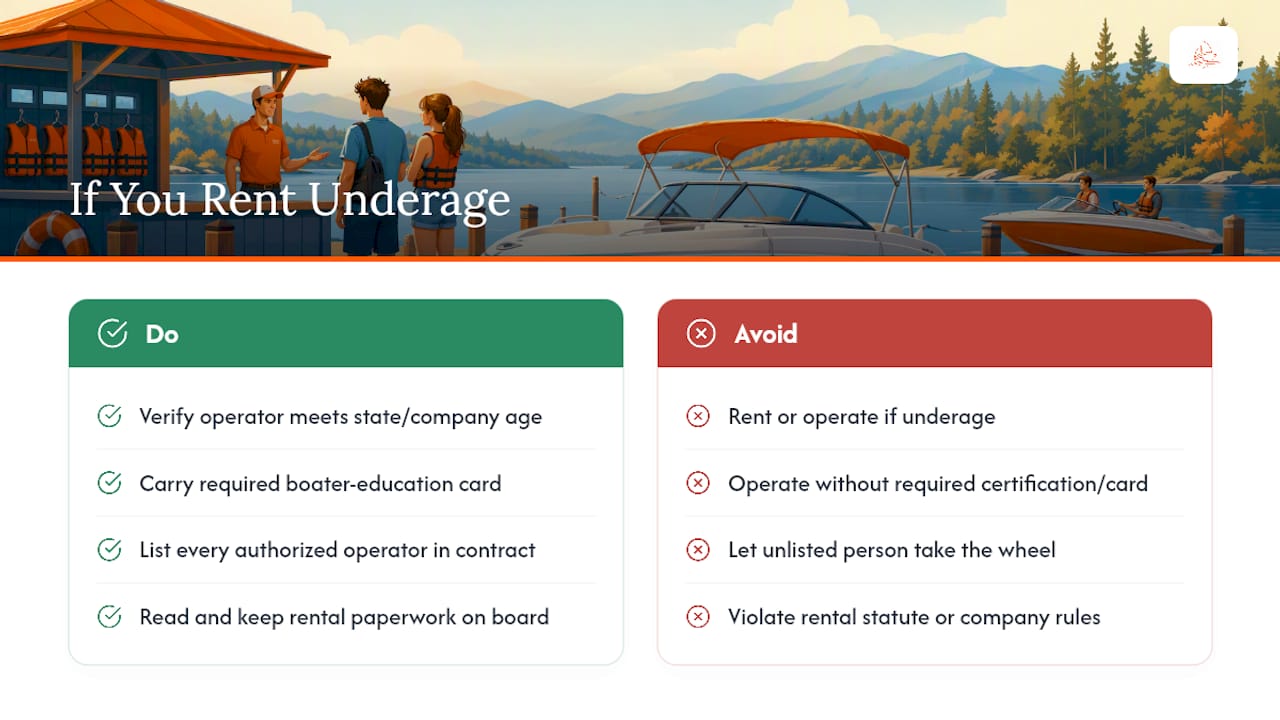
Consequences vary by state, but they're rarely trivial. In states like Nebraska where the law flatly prohibits liveries from renting to anyone under 18, a company that violates the statute risks fines and potential liability exposure, and the underage renter can be denied any insurance coverage tied to the trip.
For the renter, the bigger risk usually isn't a citation. It's what happens if there's an accident. Insurance policies covering rental boats typically require the operator to meet the legal and company age requirements. Operate underage, and coverage can be voided entirely, leaving you personally responsible for property damage, injury claims, or salvage costs that easily run into tens of thousands of dollars.
Some states also treat operating a boat or PWC without required certification as a citable offense, similar to driving without a license, even if age alone wouldn't disqualify you. A missing boater-education card where one is legally required can result in a fine independent of any accident.
Rental companies protect themselves too. Most agreements state explicitly that renting to, or allowing operation by, someone outside the authorized-operator list voids the contract's protections. If a friend or family member who wasn't listed on the rental agreement takes the wheel and something goes wrong, the company can deny any claim tied to that incident, and the renter who signed the agreement bears the liability.
None of this is designed to scare you off the water. It's designed to make clear why the paperwork step matters as much as the boat itself.
Does Federal Law Override State Boating Rules?
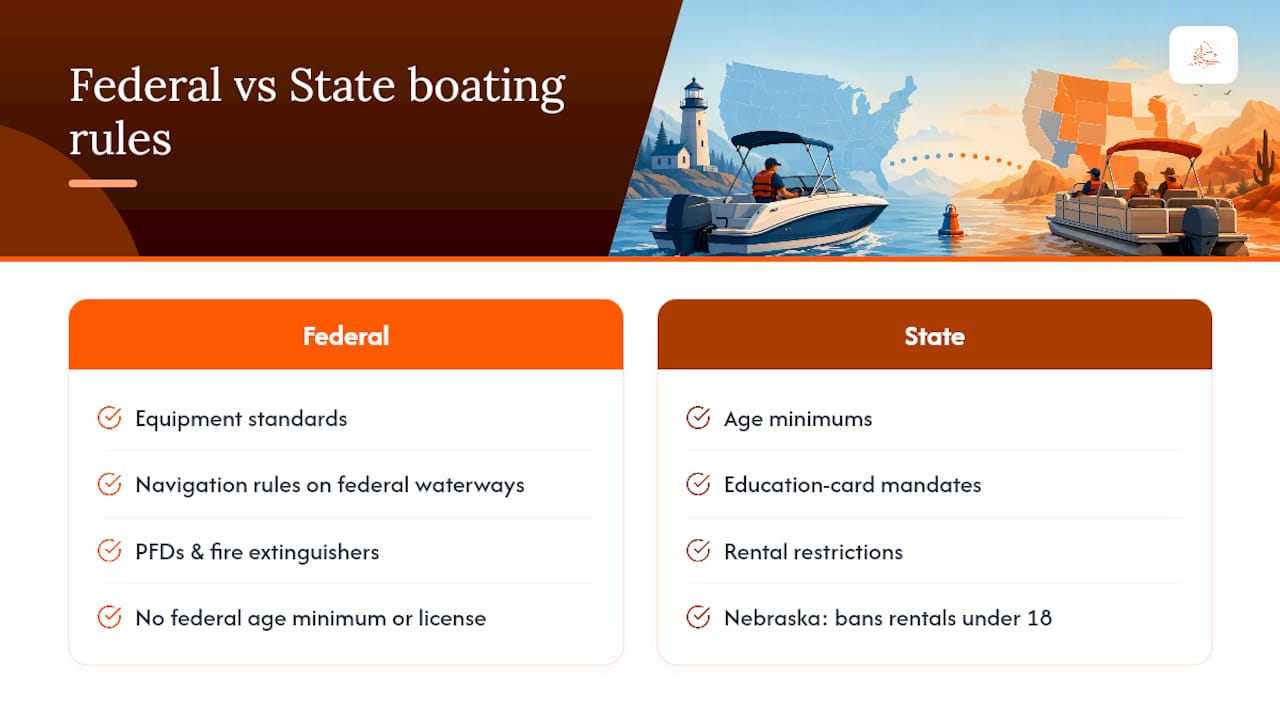
Boating regulation in the United States runs almost entirely through the states, not Washington. There's no federal minimum age for renting or operating a recreational boat, and no federal boating license exists, a point worth repeating since it's one of the most common misconceptions renters bring to the dock.
The federal government's role sits mostly in equipment standards, navigation rules on federally regulated waterways, and safety requirements like personal flotation devices and fire extinguishers. Age minimums, education-card mandates, and rental restrictions are left entirely to individual states, which is exactly why Nebraska can flatly ban rentals to under-18s while Florida ties its rules to horsepower and birth year instead.
This state-by-state structure means there's no federal preemption to fall back on. You can't argue that a federal rule overrides a stricter state law, because no federal age rule exists to conflict with it. The NASBLA model that shapes boater-education courses is itself a coordination framework between states, not a federal mandate, which is why course content looks similar nationwide even though each state administers and issues its own card.
The practical upshot: don't assume a rule that applied on your last rental trip applies again somewhere new. Every state builds its own framework, and the rental state's version is the only one that counts.
How Sailorix Helps You Confirm Eligibility Before You Book
Sailorix flags vessel-specific requirements at the listing level, so you see whether a boat needs a boater-education card or falls under stricter PWC rules before you commit to anything. The platform's real-time availability search also surfaces crewed charter options alongside bareboat rentals, which matters if you don't meet a state or company's bareboat minimum. Membership unlocks access to that full range of listings with discounted service fees, and the Sailorix blog hosts practical checklists for confirming IDs and certification before departure day.
— SAILORIX
Check Your Eligibility Before You Book a Boat
Renting a boat shouldn't mean guessing whether you'll pass a dockside age check. Sailorix lets you filter listings by vessel type and see which ones require a boater-education card or carry a higher age minimum, before you ever put down a payment.

If you're not sure you meet a bareboat minimum for a PWC or high-horsepower boat, Sailorix surfaces crewed charter alternatives on the same search, so a captain handles the operating requirements while you handle the vacation. Visit the Sailorix boat rental checklist to review what to confirm before you book, then search live availability for your destination and dates.
Sources
- Nebraska Legislature — Motorboat or personal watercraft; age restriction on lease, hire, or rental
- Florida Fish and Wildlife Conservation Commission — Boating regulations
- Boat-Ed — Boating license vs boater education card
- NASBLA — About NASBLA