
Most states don't issue a literal "boat rental license," but many require a NASBLA-approved boater education card before you can legally rent or operate a powered boat, depending on state law. Check both your state's rules and the rental company's specific policy before you book. Some states do not require boater education, but rental businesses may still have their own requirements.
TL;DR:
- Most states require a NASBLA-approved boater education card for rental or operated powered boats, especially if born after a certain year or if vessel type mandates it.
- Rental companies often verify that renters have valid photo IDs, relevant certification, and a security deposit, and some require a licensed captain regardless of state law.
- Out-of-state renters must confirm that their home state's certification is accepted in the rental location, as reciprocity rules vary and do not automatically transfer.
- Owners of rental boats must navigate additional licensing, registration, and insurance requirements, especially if operating as a commercial livery, to avoid legal penalties and coverage voidance.
- Platform-verified listings streamline compliance checks before booking, reducing surprises and ensuring that renters and owners meet the legal and insurance standards.
Table of Contents
- Boat Rental License USA: Quick Checklist Before You Book
- State Requirements at a Glance: Where Boater Education Is Mandatory
- How to Get Your State-Approved Boating Education Card
- What Rental Companies Actually Check at Pickup
- Renting Out Your Own Boat: Livery Rules, Registration, and Insurance
- Penalties for Renting or Operating Without Proper Certification
- Boating License vs. Rental Operator Permit: Not the Same Thing
- Renting a Boat Out of State: What Non-Residents Need to Know
- Temporary and Short-Term Boating Permits
- How Platforms Cut Through the Licensing Confusion
- SAILORIX: A Compliant Path to Boat Rentals
- Sources
Boat Rental License USA: Quick Checklist Before You Book
Before you show up at the dock, get your paperwork sorted. Rental companies turn away unprepared renters constantly, and it's rarely because they're being difficult. State law and their own insurance policies leave them no choice.
Here's what to have ready:
- A valid, government-issued photo ID matching the name on your reservation
- Your state boater education card, if your birth year or vessel type requires one
- A credit card for the security deposit (often separate from the rental payment itself)
- Questions answered in advance about horsepower limits, PWC age minimums, and captain requirements
Call or email the rental outfit before you drive there. Ask directly: do they accept out-of-state education certificates, do they require a licensed captain for your boat class, and what's the deposit policy if something gets damaged? If you don't already hold the required certification, you can usually knock it out online in a few hours before your trip. Our boat rental checklist covers the full pre-trip list in more detail.
Pro Tip: Screenshot your digital education card and email a copy to yourself. Marina Wi-Fi is unreliable, and a rental clerk waiting on a slow-loading app is not a great first impression.
State Requirements at a Glance: Where Boater Education Is Mandatory
Boating education law in the United States isn't federal. Each state sets its own age cutoffs, exemptions, and vessel-specific rules, which is why "do I need a license to rent a boat" doesn't have one national answer.
Most states tie the requirement to a birth-year cutoff: if you were born after a specific year set by your state, you need a card regardless of age. A handful of states, including Alaska, Arizona, South Dakota, and Wyoming, don't mandate statewide boater education at all, though local marinas and rental companies in those states can still impose their own requirements.
The common triggers to watch for:
- Birth-year cutoffs. If you were born on or after a specific year set by your state, you need proof of completed education regardless of how experienced you actually are.
- Minimum operating age. Separate from the education requirement, some states set an outright minimum age to operate a powered vessel without adult supervision.
- PWC-specific rules. Jet skis and personal watercraft often carry stricter age and certification rules than a pontoon boat or center console in the same state.
- Horsepower exceptions. A few states waive education requirements for low-horsepower motors, which matters if you're renting a small fishing boat versus a performance craft.
Discover Boating maintains a state-by-state map showing which states require boating safety education and the birth-year triggers behind each one. That's a solid starting point, but state rules do change, so confirm directly on the official state marine board or DMV boating page before your trip. Searching "[your state] boating education requirements" almost always surfaces the right government page in the first result.
One thing that trips people up: your home state's rules don't travel with you. If you live in a state with no requirement but you're renting a boat in Florida, Florida's rules govern your trip, not your home state's exemption.
How to Get Your State-Approved Boating Education Card
Getting certified is usually a quick process.
- Find an approved provider. Look for NASBLA approval or direct listing on your state's marine agency site. The U.S. Coast Guard maintains boating safety course resources that point to legitimate, state-recognized options rather than random third-party sites that may not count in your state.
- Pick online or in-person. Online courses through providers like Boat-Ed or BoaterExam let you finish at your own pace, with course length varying by state. In-person classes, often run through state wildlife agencies or the BoatUS Foundation's free courses, suit people who learn better with an instructor in the room.
- Pass the final exam and get your card. Most states require passing a final exam at a specified minimum score. Digital cards usually generate instantly; physical cards can take one to three weeks to arrive by mail.
Pro Tip: Finish your course at least two weeks before your trip if you're waiting on a physical card. Rental companies increasingly accept a printed digital certificate or the provider's app, but not every one does, and you don't want to find that out at the dock.
What Rental Companies Actually Check at Pickup
State law sets the floor, but individual rental companies often add their own layer of requirements on top. Their insurance carriers usually demand it.
Expect the staff to verify:
- A valid photo ID that matches your reservation name
- Your boater education card, if your state requires one for your age or vessel type
- A signed rental agreement acknowledging responsibility for damage
- A credit card hold for the security deposit, separate from your rental fee
- Completion of a brief in-person safety briefing, even if you already hold a card
Some companies go further than state law requires. It's common for a rental outfit to refuse first-time renters a larger or faster boat without a licensed captain aboard, regardless of what your education card says you're allowed to operate. Others charge extra for a damage waiver or require it outright for anyone under 25.
Before you book, ask three things: do they accept out-of-state or online education certificates, is a captain required for the specific boat class you want, and what's their deposit and insurance policy if the boat gets damaged. Getting those answers over the phone saves you from a canceled trip standing on the dock. Our guide on avoiding boat rental scams covers related red flags worth watching for when you're evaluating an unfamiliar rental company.
Renting Out Your Own Boat: Livery Rules, Registration, and Insurance
If you're on the other side of the transaction, thinking about renting out a boat you own, the rules shift substantially the moment money changes hands. Accepting payment for boat use commonly reclassifies the vessel from recreational to commercial, which triggers a separate set of licensing, inspection, and insurance obligations most owners don't see coming.
Every state's specifics differ, but the pattern repeats:
- Oregon requires boat rental businesses to register with the State Marine Board and meet livery equipment standards, with registration renewing every two years.
- Florida requires a livery operator permit for anyone renting out motorboats or PWCs, separate from standard vessel registration.
- Several states, including Minnesota and Illinois, apply their own passenger and rental licensing rules once you're operating what amounts to a small charter business rather than lending a friend your boat.
Standard recreational insurance policies typically exclude commercial or livery use outright, so you'll need to contact your insurer about hull and liability coverage specifically written for rentals. Before listing your boat, confirm your state's livery registration rules, secure that commercial coverage, keep an inspection log current, and put a clear written rental agreement in place. Skipping any one of those steps is how owners end up with a denied insurance claim after an incident, not before.
Penalties for Renting or Operating Without Proper Certification
The consequences for skipping certification range from a minor inconvenience to a real legal problem, depending on which side of the transaction you're on.
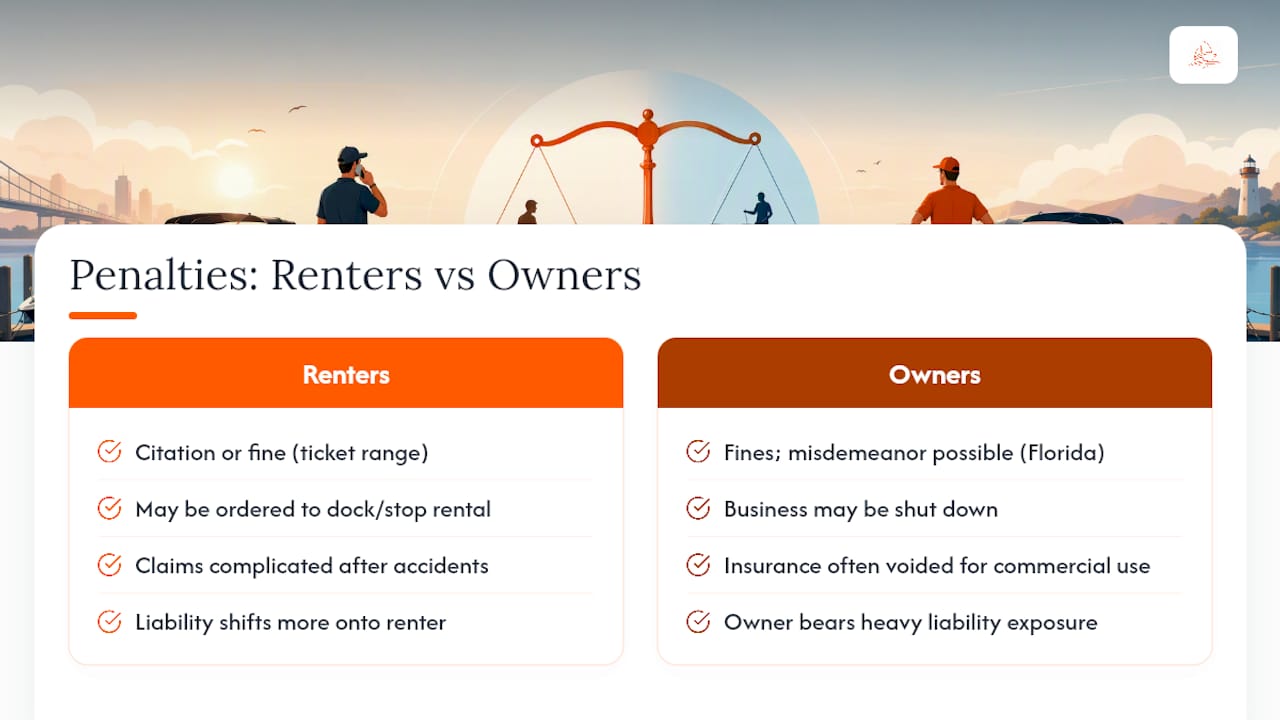
For renters caught operating without a required education card, most states treat it as a citation carrying a fine, typically in the range of a traffic ticket rather than a criminal charge. Some officers will simply require you to dock and end the rental if you can't produce proof on the water. The bigger cost usually isn't the fine itself. It's what happens if there's an accident: operating in violation of your state's education requirement can complicate insurance claims and shift liability more heavily onto you.
For owners running rentals without the required livery permit, the stakes climb. In Florida, operating a rental business without a valid livery permit can constitute a misdemeanor, carrying real fines rather than a simple citation. Beyond the legal exposure, an owner caught renting without proper commercial classification often finds their insurance policy voided entirely if a renter gets hurt or a boat is damaged, since standard recreational coverage doesn't extend to commercial use in the first place.
None of this is designed to be punitive for its own sake. States impose these rules because an unlicensed rental market, with no education verification and no commercial insurance backstop, shifts risk onto renters who have no idea what they're actually operating. The paperwork is annoying. The alternative, an uninsured accident with an untrained operator at the wheel, is worse.
Boating License vs. Rental Operator Permit: Not the Same Thing
People conflate these two concepts constantly, and the confusion causes real booking problems.
A personal boating license, more accurately called a boater education card or safety certificate, proves that you as an individual completed a state-recognized safety course. It's tied to you, not to any specific boat, and it typically doesn't expire. Once you have it, you carry it for life and use it anywhere that state's card (or a reciprocal one) is accepted.
An operator permit or livery permit is a completely different animal. It's a business-level authorization tied to the rental company itself, allowing that business to legally rent boats to the public. It has nothing to do with your personal qualifications as a renter. When you rent from a licensed livery, you still need your own education card if your state requires one; the livery's permit doesn't substitute for your personal certification, and your personal certification doesn't substitute for their business license.
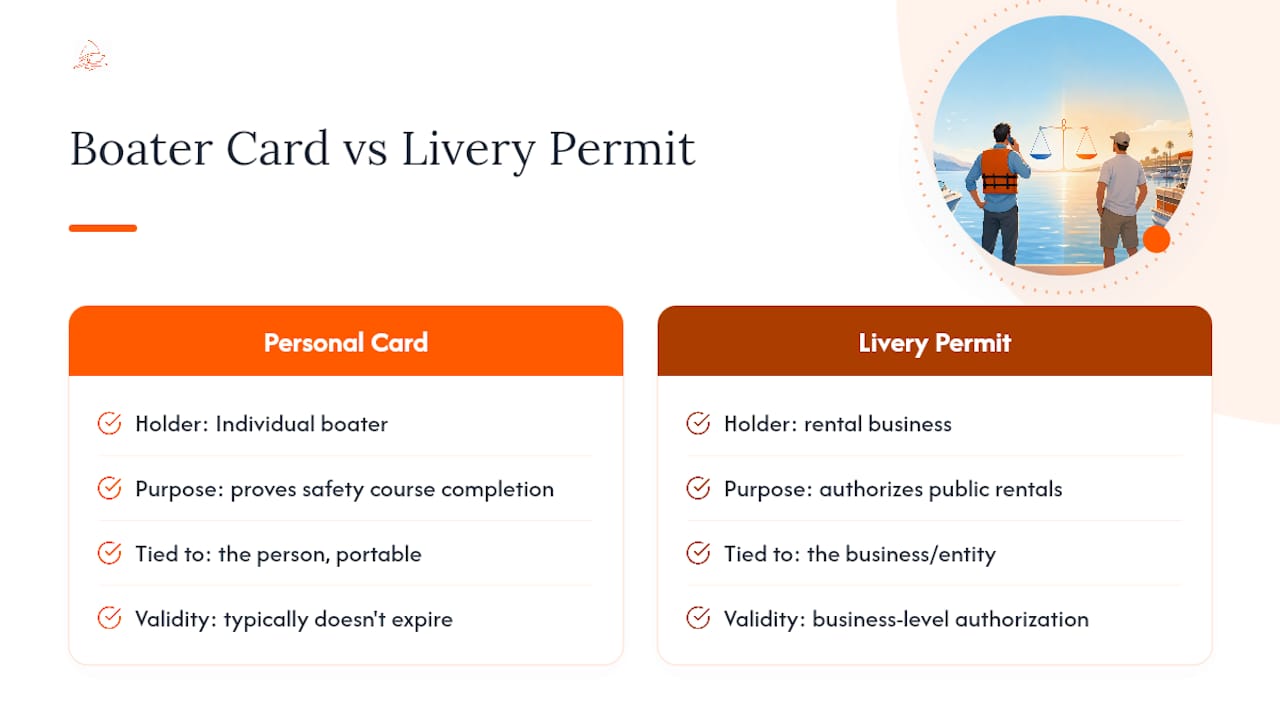
Where this gets confusing is that some states require both simultaneously for certain rentals: the renter needs a personal education card, and the business needs a livery permit, and the two requirements are checked independently. Neither one covers for the other. If you're renting, you only need to worry about your own card. If you're the one renting out a boat, you need to think about the business permit on top of anything your own operating background covers. Our piece on why boat licensing matters breaks down this distinction with more state-specific examples.
Renting a Boat Out of State: What Non-Residents Need to Know
The single biggest mistake out-of-state renters make is assuming their home state's rules travel with them. They don't. The state where you're boating governs the requirement, not the state where you live or where you learned to boat.
That cuts both ways. If you live in a state with no education mandate and you're renting in a state that requires one, you need the card before you go, full stop. If you live in a state with a mandate and you're visiting one without one, you're technically fine on the state's requirement, though the rental company itself might still ask for proof of experience.
Reciprocity between states is common but not universal. Most states accept a properly NASBLA-approved education card earned anywhere in the country, since the underlying course standards are similar nationwide. But "common" isn't "guaranteed," and a handful of states apply extra conditions or age-specific caveats to out-of-state cards. Carry your original card and a digital or photo backup, and call the rental company or the state marine agency ahead of time to confirm your specific card will be accepted for your specific vessel class. It's a five-minute phone call that prevents a ruined trip.
Temporary and Short-Term Boating Permits
Not every renter wants to invest in a permanent education card, especially for a one-time vacation rental. Some states address this with a temporary certificate option, though it's far from universal.
A handful of states issue temporary operator permits, often valid for 60 to 90 days, aimed specifically at visitors or first-time boaters who need to satisfy a legal requirement without committing to the full standard course. These temporary permits typically still require completing some version of a safety course, just a condensed one, and they don't carry the same lifetime validity as a standard education card.
More commonly, rental companies solve this problem themselves rather than the state doing it: many liveries offer an on-site basic safety orientation that satisfies their own rental requirement even in states with no statewide mandate, paired with a captain or skipper requirement for renters who can't produce formal education proof. That's often the more practical route if you're renting once and don't plan to buy a boat of your own anytime soon.
If a temporary permit exists in your destination state, it's worth pursuing over the full course only if you're confident you won't be renting again within that state's validity window. Otherwise, the standard permanent card, which typically takes the same few hours to complete, is the better long-term investment since it never expires and travels with you nationwide.
How Platforms Cut Through the Licensing Confusion
The friction in this whole system isn't the education requirement itself. It's the mismatch between what renters assume and what a specific rental company actually enforces on a given day.
Platform-verified listings solve a real problem here: when a booking platform pre-checks a livery's registration and insurance status before listing it, renters stop guessing whether a business is even legally allowed to rent to them. That single step eliminates a surprising share of the "we didn't know we needed that" moments that ruin trip days.
If you're renting, confirm education card acceptance and any skipper requirement in writing before you travel, not verbally at the counter. If you own a boat and rent it out, keep your inspection logs current and require education proof from anyone taking a bareboat rental. Livery-specific insurance isn't optional once money changes hands.
— SAILORIX
SAILORIX: A Compliant Path to Boat Rentals
Booking directly with an individual livery means you're the one verifying registration, insurance, and permit status yourself, and that research often happens after you've already put down a deposit. SAILORIX flips that order: listings on the platform are checked for verified compliance before you ever see them, so the legwork covered in this guide happens before your card is charged, not after.

That difference matters more on larger charters, where a percentage-based fee adds up fast. For renters who want a skipper included because they lack the required education card, or owners listing a boat who want pre-verified insurance checks handled up front, a platform-managed booking removes the guesswork this article just walked through. Compare that against the full cost breakdown of booking online versus going direct.
Check available boats and current membership pricing at Sailorix before your next trip.
Sources
- Do you need a boating license to rent a boat? | Discover Boating
- Boat Rental Business Laws, Regulations & Compliance - LegalClarity
- Oregon State Marine Board : Boat Rental Business Hub : Boater Info : State of Oregon
- Livery regulations and safety information | Florida Fish and Wildlife Conservation Commission