

An affordable sailing trip workflow is a step-by-step planning process that helps budget travelers book, budget, and manage a sailing vacation without financial surprises. Most first-timers focus only on the base charter fee and miss the full cost picture. The Advance Provisioning Allowance (APA), crew gratuity, insurance, and marina fees routinely add 20–40% on top of the base rate. Follow the workflow in this guide and you will know exactly what to expect, where to save, and how to keep your sailing trip within budget from the first search to the final reconciliation.
What does an affordable sailing trip workflow actually cover?
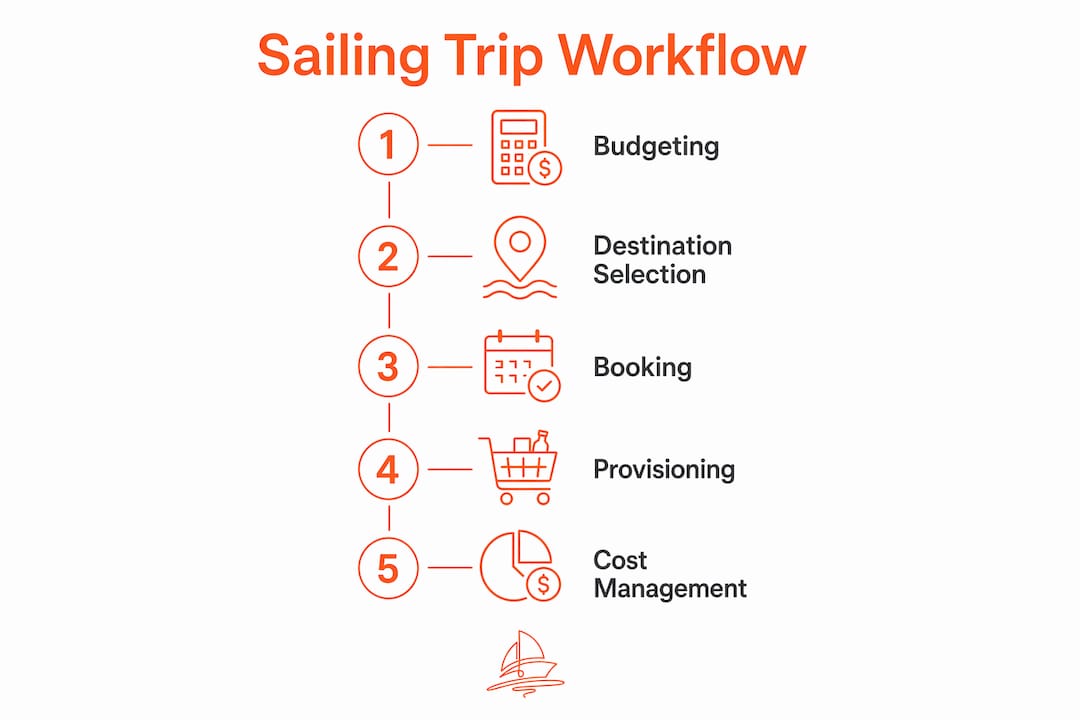
A complete budget sailing itinerary covers five distinct phases: budgeting, destination and timing selection, booking, onboard cost control, and post-trip reconciliation. Skipping any phase is where costs spiral. The workflow treats each phase as a checklist, not a suggestion. Budget travelers who follow all five phases consistently avoid the most expensive surprises in yacht charter planning.
The term "affordable sailing trip workflow" is an informal but useful label for what the charter industry calls a structured charter planning process. Professional brokers and charter companies use this process as standard practice. Knowing both terms helps you communicate with brokers and search for resources more effectively.

How to set a realistic budget for your sailing trip
The base charter fee covers only 60–80% of your total trip cost. That single fact changes everything about how you plan. Budget travelers who anchor their planning to the base rate alone routinely run short of cash mid-trip.
The remaining 20–40% breaks down into predictable line items:
- APA (Advance Provisioning Allowance): Typically 25–35% of the base fee on MYBA-style charters, paid before boarding and refunded if unused.
- Crew gratuity: 15–20% of the base charter fee, paid at the end of the trip.
- Charter insurance: 4–10% of the base fee, depending on the policy and region.
- Flights and transfers: Varies by origin; book early for the lowest fares.
- Marina fees: Nightly rates vary widely. Anchoring is free; marina berths in popular ports can run €30–€100 per night.
- Fuel: Expect €150–€300 per week for a standard sailing yacht in the Ionian Islands.
- Provisioning: Roughly €300–€500 per week for a group of 4–6 people.
Pro Tip: Apply a 1.6 multiplier to the base charter fee for a fast, conservative total cost estimate on a "plus expenses" charter. If the base rate is €3,000, plan for €4,800 total before flights.
Sample budget: Ionian Islands, Greece
The Greek Ionian Islands are one of the most beginner-friendly and affordable sailing destinations in Europe. A weekly bareboat charter runs €2,000–€4,500. Add a skipper at €150–€200 per day, fuel at €150–€300, and provisioning at €300–€500 for a group of four to six people. The per-person cost lands at roughly €500–€900 per week, excluding flights. That is a genuinely low-cost sailing plan compared to the Caribbean or the French Riviera.
| Cost Item | Estimated Weekly Cost |
|---|---|
| Bareboat charter (Ionian) | €2,000–€4,500 |
| Skipper (optional) | €1,050–€1,400 |
| Fuel | €150–€300 |
| Provisioning (4–6 people) | €300–€500 |
| Marina fees | €210–€700 |
| Total (excl. flights) | €3,710–€7,400 |
Understanding service fees in charter bookings is equally important. Platform fees from booking sites can add another 10–20% on top of charter rates. Sailorix charges approximately 1% for members, which is a meaningful difference on a multi-thousand-euro booking.
Which destinations and seasons reduce sailing costs the most?
Destination and timing are the two biggest levers in any low-cost sailing plan. Choosing the right combination can cut your total trip cost by a third compared to peak season in a premium location.
The most affordable sailing destinations for budget travelers include:
- Ionian Islands, Greece: Calm waters, short passages, and lower prices than the Cyclades. Ideal for beginners.
- British Virgin Islands (BVI): Competitive bareboat rates and straightforward navigation, though flights from Europe add cost.
- Croatia (Dalmatian Coast): Strong charter infrastructure with competitive pricing, especially in may and june.
- Turkey (Aegean Coast): Lower base rates than Greece with similar scenery.
Shoulder seasons deliver the best value. Arriving early in the season in may or june, or sailing in september, cuts charter rates significantly compared to july and august. Crowds are smaller, anchorages are quieter, and marina berths are easier to find.
Pro Tip: Aim to anchor or dock by early afternoon during peak season in popular areas. Early arrivals secure cheaper berths and avoid the scramble for spots that forces expensive last-minute alternatives.
Marina vs. anchoring: a cost comparison
| Overnight Option | Typical Cost | Best For |
|---|---|---|
| Town quay marina berth | €30–€100/night | Shore access, facilities |
| Anchor in a bay | Free | Privacy, cost savings |
| Small village quay | €10–€30/night | Balance of access and cost |
Anchoring is the single most effective way to cut marina costs. A guide to yacht anchoring techniques helps you do it safely and confidently. Provisioning at local inland markets rather than marina supermarkets also delivers consistent savings. Local markets cost less than marina shops, and the quality is often better. Walk five minutes from the dock and the price difference is immediate.
What is the step-by-step booking workflow for a budget charter?
A clear booking process is the backbone of any affordable yacht charter guide. Answer these four questions before you open a single booking platform:
- Where do you want to sail? Pick a region and a base port. Flexibility here saves money.
- When do you want to go? Shoulder season dates give you more options at lower rates.
- How many people are joining? Cabin count drives boat size, which drives cost.
- What charter type fits your group? Bareboat (you skipper), skippered (hired captain), or crewed (full crew included).
Once you have those answers, browse charter platforms using filters for boat type, size, and price range. For skippered or crewed charters, broker consultation adds real value. Brokerage services cost the charterer nothing because brokers earn their fee from the charter company. They negotiate contracts, verify boat condition, and prevent the surprises that cost budget travelers the most.
Payment timing follows a standard pattern. A 50% deposit is due upon signing, with the remaining balance plus APA due approximately four weeks before the charter start date. MYBA contracts (used on luxury and crewed charters) and CYBA contracts (common on bareboat charters) handle APA and security deposits differently. Read both sections carefully before signing.
Pro Tip: Verify your skipper's qualifications and local experience before confirming a skippered charter. A skipper who knows the local anchorages saves fuel, time, and stress.
For first-timers, the guide on how to book a yacht walks through each contract step in plain language.
How do you manage provisioning, fuel, and onboard costs?
APA is best understood as a working cash fund, not a deposit. APA covers fuel, food, and marina fees during the trip. The captain manages the fund, keeps receipts, and reconciles the total at the end. Any unspent APA is refunded to you after the charter. This is fundamentally different from a security deposit, which covers damage.
Practical onboard cost controls include:
- Shop at local markets. Inland markets consistently beat marina supermarkets on price and freshness.
- Adapt to wind conditions. Forcing a schedule against the wind burns extra fuel and adds stress. Flexibility is free.
- Communicate preferences early. Tell the captain your provisioning preferences before departure to avoid costly last-minute shopping runs.
- Track APA spending daily. Ask for a running total from the captain so you are never surprised at reconciliation.
Pro Tip: Communicate your food and drink preferences to the captain or charter company at least one week before departure. Early communication prevents expensive provisioning mistakes and reduces waste.
Understanding marina access and berthing costs helps you make smarter overnight decisions throughout the trip. A full breakdown of marina fee structures shows exactly what you pay for and where you can skip the marina entirely.
What are the most common mistakes in budget sailing trip planning?
Budget travelers make the same six mistakes repeatedly. Recognizing them before you book saves real money.
- Treating APA as a security deposit. APA is a spending fund. Underestimating it leaves the captain short of cash for fuel and food mid-trip.
- Budgeting only the base charter fee. The base fee covers 60–80% of total costs. The rest is predictable but often ignored.
- Choosing the wrong cabin layout. One cabin per couple is the standard rule. Cramped layouts lead to expensive last-minute boat upgrades.
- Ignoring weather-routing rules. Weather-routing apps do not replace pre-defined bailout rules. Set clear wind and visibility thresholds before departure to avoid costly delays.
- Arriving late on day one. Late arrivals waste the first charter day and may force expensive marina stays while waiting for the boat.
- Skipping a broker for complex charters. Brokers cost you nothing and prevent contract surprises that cost you a lot.
The most expensive mistake in charter planning is not the one you make on the water. It is the one you make at the desk, when you sign a contract you did not fully read.
What I have learned from applying this workflow in practice
The workflow described here is not theoretical. At Sailorix, we have seen hundreds of charter trips planned well and dozens planned poorly. The difference almost always comes down to two things: APA understanding and broker involvement.
Travelers who treat APA as a mystery upfront payment consistently run into friction mid-trip. Travelers who understand it as a managed cash fund arrive relaxed and leave with a refund. The math is the same. The mindset is different.
Brokers are underused by budget travelers who assume they add cost. They do not. A good broker catches contract clauses that would cost you far more than any fee. For skippered and crewed charters especially, broker involvement is not optional. It is the cheapest insurance you can get.
Flexibility is the final variable. Budget travelers who build slack into their itinerary, who anchor instead of marina-berth when conditions allow, and who shop at local markets instead of the dock shop, consistently come in under budget. The workflow gives you the structure. Flexibility gives you the savings.
— Sailorix
How Sailorix makes your budget charter easier
Planning a cost-effective sailing adventure takes research, comparison, and careful contract review. Sailorix brings all of that into one place.

Sailorix is a global boat booking platform with a membership model built for budget travelers. For €100 per year, members access yacht and boat rentals at approximately 1% service fees. That compares to the 10–20% fees charged by most charter booking platforms. Use Sailorix's search filters to compare boats by size, type, region, and price. Browse affordable sailing options across the Mediterranean, Caribbean, and beyond. The platform connects you directly with charter operators, so you see real availability and real prices without inflated markups.
FAQ
What is APA in a yacht charter?
APA stands for Advance Provisioning Allowance. It is a prepaid cash fund, typically 25–35% of the base charter fee, used to cover fuel, food, and marina fees during the trip. Any unspent amount is refunded after the charter.
How much does a budget sailing trip cost per person?
In the Ionian Islands, a budget sailing trip costs roughly €500–€900 per person per week, excluding flights. Total costs depend on group size, boat choice, and how much you anchor versus marina-berth.
When is the cheapest time to book a sailing charter?
Shoulder seasons in may, june, and september offer the lowest charter rates. Booking 6–12 months in advance for peak summer dates also secures better prices and more boat options.
Do I need a broker to book a sailing charter?
A broker is not required for bareboat charters, but brokerage services cost the charterer nothing and add significant value for skippered and crewed charters. Brokers negotiate contracts and prevent costly surprises.
What is the difference between a bareboat and a skippered charter?
A bareboat charter requires you to skipper the boat yourself, which demands a valid sailing license. A skippered charter includes a hired captain, adding roughly €150–€200 per day to your total cost but removing the navigation responsibility entirely.
Key takeaways
A complete affordable sailing trip workflow covers budgeting, destination selection, booking, onboard cost control, and post-trip APA reconciliation, and skipping any phase reliably produces financial surprises.
| Point | Details |
|---|---|
| Budget beyond the base fee | Add 20–40% to the charter rate to cover APA, gratuity, insurance, and marina fees. |
| Choose shoulder season dates | Sailing in may, june, or september cuts charter rates and reduces crowd pressure significantly. |
| Understand APA correctly | APA is a managed spending fund, not a deposit. Unused funds are refunded after the charter. |
| Use a broker for complex charters | Brokers cost charterers nothing and prevent expensive contract mistakes on skippered trips. |
| Anchor instead of marina-berthing | Anchoring overnight is free and is the single fastest way to reduce daily operating costs. |