
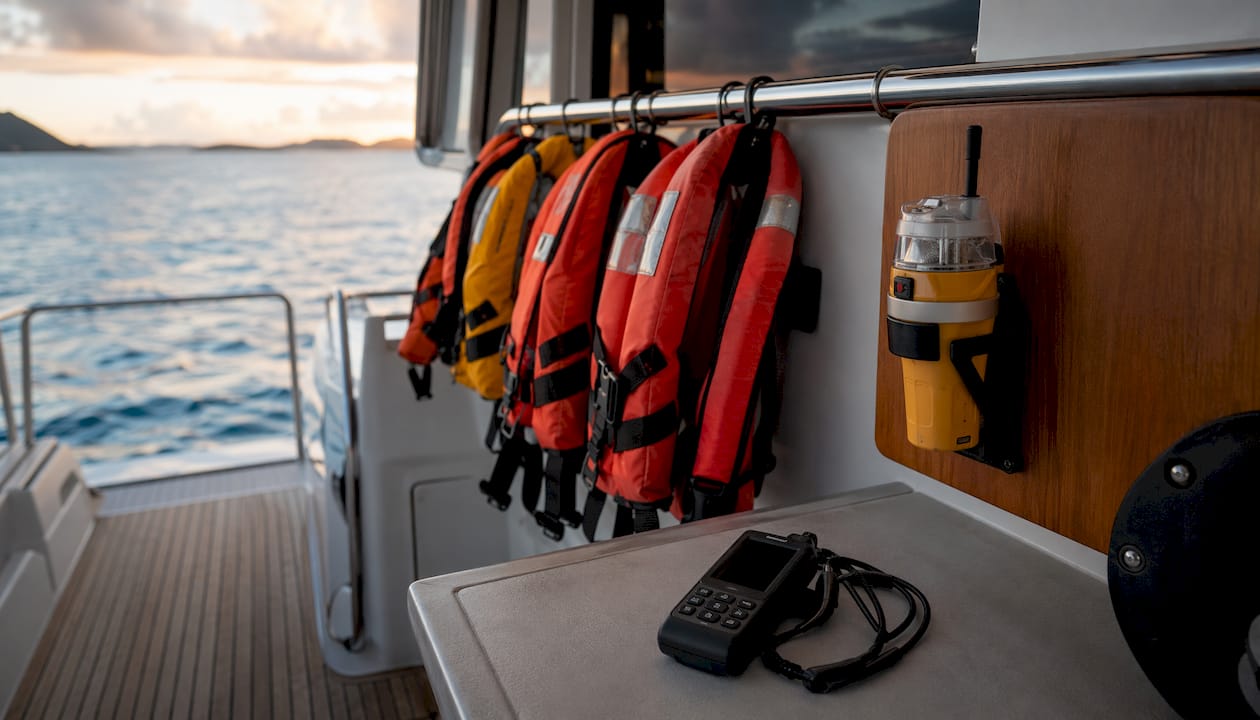
Before you step aboard a charter in U.S. waters, confirm these are present and working: a GNSS/GPS chartplotter with current charts, a magnetic compass, a VHF radio with DSC, an EPIRB or PLB, life jackets sized for everyone on board, flares, at least one fire extinguisher, a depth sounder, and a basic tool kit with spare fuses and batteries. That list covers navigation, safety, communications, and emergency response. Three quick questions to ask the charter company right now:
- Is the EPIRB registered and within its battery service date?
- Are the life jackets the right sizes for my group?
- What is the battery charging plan for onboard electronics?
Table of Contents
- What essential nautical tools should you find on a chartered yacht?
- Why redundancy and traditional skills still matter for renters
- Optional high-tech tools you may encounter or request
- Before you book: what to inspect and ask the charter company
- What to bring from home versus what to request as add-ons
- U.S. legal and safety basics every renter should know
- Key Takeaways
- What most renters get wrong about gear transparency
- Sailorix makes equipment transparency visible before you book
- Useful sources for U.S. renters
What essential nautical tools should you find on a chartered yacht?
Most U.S. charter vessels carry a fairly predictable set of marine navigation equipment, but condition and currency vary. Here is what to expect and what to verify.
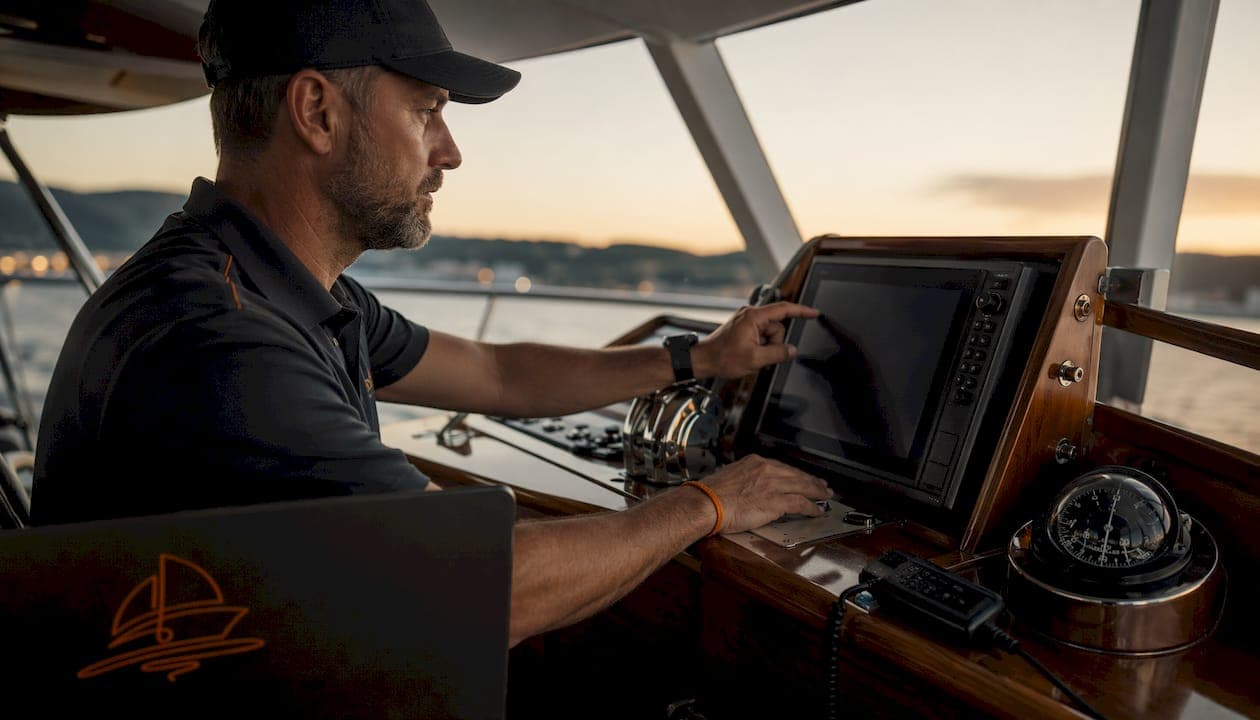
The GNSS receiver (GPS, GLONASS, or Galileo) is the primary position-fixing tool on any modern vessel. Many charters pair it with a chartplotter displaying NOAA electronic navigational charts. Confirm that those charts are current — outdated ENCs are a real grounding risk, and ECDIS-style chart currency is something renters rarely think to ask about.
| Equipment | Function | Verify at Check-In |
|---|---|---|
| GNSS/GPS chartplotter | Primary position fixing | Charts current, screen readable |
| Magnetic compass | Non-electrical backup heading | Swings freely, deviation card present |
| AIS (Class B) | Vessel ID and collision avoidance | Powered on, MMSI programmed |
| Radar (X-band) | Collision avoidance in low visibility | Antenna rotating, display functional |
| VHF radio (DSC) | Primary comms and distress | MMSI registered, DSC tested |
| EPIRB / PLB | Offshore distress beacon | Registration current, battery date valid |
| Depth sounder | Under-keel clearance | Transducer reading, alarm set |
| Life jackets / PFDs | Personal flotation | Correct sizes, service tags present |
| Flares | Visual distress signals | Within expiration date |
| Fire extinguisher | Fire suppression | Charged, inspection tag current |
AIS provides real-time vessel identification and tracking, which matters most in busy coastal corridors like Long Island Sound or the Florida Keys. Radar rounds out the collision-avoidance picture: X-band radar gives sharper resolution for close-quarters work, while S-band cuts through rain clutter on longer passages. The echo sounder is a safety device first, not just a fishing aid — set the shallow-water alarm before you leave the dock.
Why redundancy and traditional skills still matter for renters
Single-point failure is the real danger at sea. If your chartplotter loses power or the GPS signal drops, the magnetic compass is the only instrument that keeps working without electricity. Professional mariners are clear on this: relying solely on electronics is unsafe, and SOLAS-aligned practice requires a magnetic compass as a non-negotiable backup. That standard exists for commercial vessels, but the logic applies equally to a weekend charter.
Paper charts or downloaded NOAA PDFs serve the same backup role for route planning. If your chartplotter reboots mid-channel, knowing your last waypoint and having a paper reference is the difference between a minor inconvenience and a serious situation. Brush up on nautical terms for the instruments before you board — it speeds up every check-in conversation.
Pro Tip: Before casting off, spin the wheel and watch the compass card move freely. Then check the deviation card mounted near the compass — it tells you how much the boat's own magnetic field skews the reading at each heading. A missing or illegible deviation card is worth flagging to the charter company.
Optional high-tech tools you may encounter or request
Satellite communications, high-performance inertial navigation systems, and maritime AI assistants are increasingly available as charter add-ons, particularly on offshore or bluewater vessels. These tools are genuinely useful in the right context.
Maritime AI tools can interpret weather routing data, flag COLREGs scenarios, and help captains think through anchoring logic. Advanced inertial navigation systems once reserved for large commercial ships now appear on performance yachts, providing accurate heading and motion data even when GPS is momentarily unavailable. Satellite comms (Iridium, Starlink Maritime) matter most on passages beyond VHF range, typically offshore or in remote island groups.
The honest trade-off: these systems cost more to rent, consume more power, and require some familiarity to use well. For a coastal weekend trip, a working VHF and a solid chartplotter are almost always sufficient. For a week-long offshore passage, a professional skipper often delivers more value than any single piece of advanced gear.
Before you book: what to inspect and ask the charter company
Bring a checklist to the dock. Equipment condition at pickup is your responsibility to verify, and most charter disputes trace back to items that were never tested at handover.
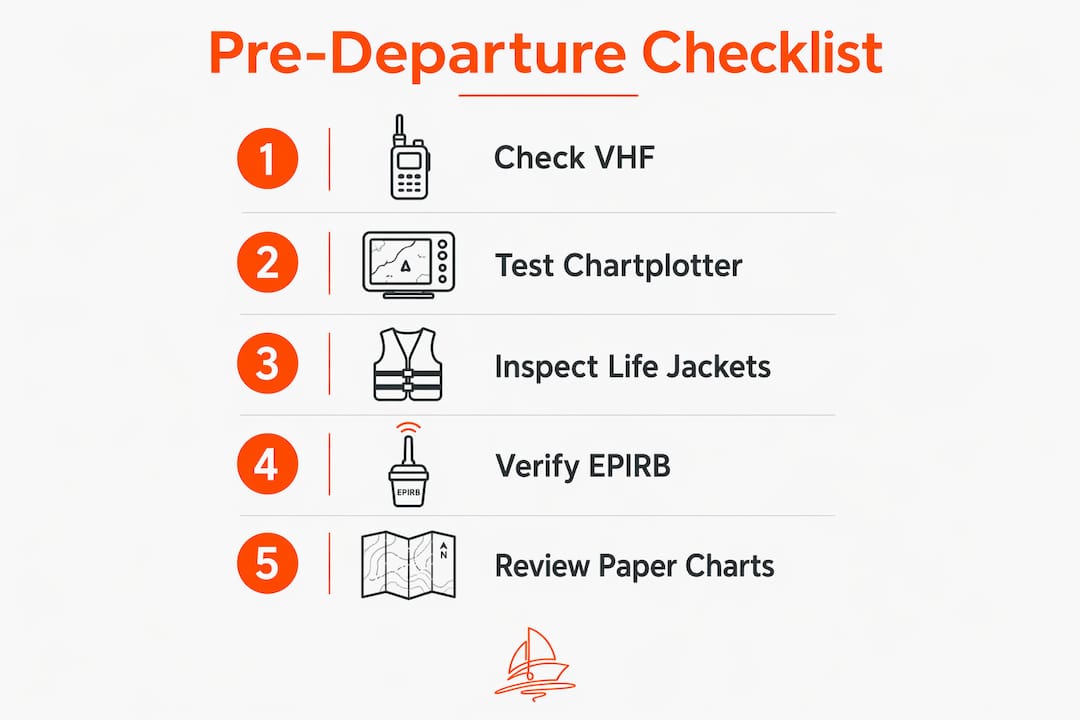
Dockside inspection steps:
- Power on the chartplotter and confirm chart coverage for your route
- Key the VHF and listen for a response on Channel 16
- Check each life jacket for the correct size and a valid service tag
- Read the EPIRB registration sticker and battery replacement date
- Test navigation lights (bow, stern, masthead) before dark
- Confirm the bilge pump activates manually and automatically
- Look for temporary repairs (tape over fittings, improvised clamps) and ask about them
Questions to ask the charter company:
- Is a skipper available, and what does that add-on cost?
- What is the insurance hold/damage deposit policy?
- How are the house batteries charged underway and at the dock?
- What spare tools and fuses are kept on board?
- What are the emergency procedures if I lose engine power?
- When were the engine and safety gear last serviced?
- What is the fuel policy (full-to-full or fixed allowance)?
- Is any onboarding or orientation offered before departure?
What to bring from home versus what to request as add-ons
Short answer: bring personal-safety items and small multi-use tools from home; request heavy or specialized systems through the charter or booking platform.
Bring from home:
- A personal PFD if you have a preferred fit or size
- A waterproof handheld VHF radio as a backup
- A waterproof flashlight or headlamp
- A folding knife with a marlinspike
- Non-slip deck footwear
- Any personal medications and a basic first-aid kit
- A charged phone and a power bank
Request as charter add-ons:
- Professional skipper (especially for first-time renters or offshore passages)
- Satellite communications package
- Additional life jackets for larger groups
- Insurance add-ons covering personal gear or liability
- EPIRB rental confirmation and registration paperwork
Pro Tip: Pack a compact multi-tool kit with an interchangeable-bit screwdriver and an adjustable wrench rather than separate tools. Onboard storage is tight, and those two cover the vast majority of minor fixes you will realistically encounter.
U.S. legal and safety basics every renter should know
Verify that the vessel meets USCG and state requirements before you leave the dock. That is not the charter company's job alone — as the operator, you share responsibility.
Core USCG requirements for recreational vessels include a wearable PFD for every person on board, a throwable Type IV device on vessels 16 feet and longer, sound signaling devices (horn or whistle), visual distress signals (flares) for coastal waters, at least one B-I fire extinguisher, and functioning navigation lights. Requirements scale with vessel length and operating area, so a 40-foot sailboat heading offshore carries a longer list than a 20-foot powerboat on an inland lake.
The U.S. Coast Guard's Boating Safety Division publishes the definitive federal equipment requirements at uscgboating.org. NOAA's Office of Coast Survey provides free, downloadable nautical charts for all U.S. waters at charts.noaa.gov. Both are primary sources — bookmark them before your trip, not after.
Coastal versus inland rules differ on visual distress signals and some communications requirements. Check your local USCG District for area-specific guidance, particularly in states like Florida, California, and Washington where state boating laws add requirements on top of federal minimums.
Key Takeaways
Every renter who confirms equipment before departure reduces their risk significantly. The nautical tools and safety gear below are the non-negotiables for any U.S. charter.
| Point | Details |
|---|---|
| Confirm the core kit at pickup | Test VHF, chartplotter, EPIRB, and life jackets before casting off — not after. |
| Redundancy prevents single-point failure | A magnetic compass and paper charts back up electronics when power or GPS is lost. |
| Know the USCG minimums | PFDs, flares, fire extinguisher, and navigation lights are federally required on most U.S. vessels. |
| Pack small, request big | Bring a handheld VHF and compact tools; book skipper and satcom as charter add-ons. |
| Sailorix shows add-ons at booking | Equipment checklists, skipper options, and insurance are visible before you confirm a reservation. |
What most renters get wrong about gear transparency
The conventional wisdom says "trust the charter company." That is mostly reasonable — but it misses the point. Charter companies maintain their fleets to a standard, not to your standard. A life jacket that fits a 200-pound adult is useless for a child. An EPIRB with an expired battery is decoration. These are not edge cases; they are the items that get skipped in a fast turnover between bookings.
The more useful frame: treat the pre-departure check as your own responsibility, not a formality. The charter company hands you the keys; you are the one making decisions on the water. That shift in mindset changes how you ask questions at pickup and what you pack from home. Redundancy is not paranoia. It is the same logic that makes professional mariners carry a compass they almost never need.
Sailorix makes equipment transparency visible before you book
Most booking platforms show you a boat photo and a price. Sailorix shows you what is actually on board. Equipment checklists, skipper availability, insurance options, and safety add-ons are all visible before you confirm a reservation — so there are no surprises at the dock.

The membership model keeps service fees notably lower than those typical on other platforms, which means the budget you save on fees can go toward the add-ons that actually matter: a professional skipper for an offshore passage, a satellite comms package, or an extra set of life jackets for a larger group. Book your next charter on Sailorix and confirm every piece of gear before you leave the marina.
Useful sources for U.S. renters
| Source | Focus | Why It Matters |
|---|---|---|
| USCG Boating Safety (uscgboating.org) | Federal equipment requirements, PFD rules | Primary authority for U.S. legal minimums |
| NOAA Office of Coast Survey (charts.noaa.gov) | Free nautical charts, ENC updates | Chart currency for chartplotters and planning |
| Amnautical.com | Navigation equipment types and functions | Practical explanations of GNSS, AIS, radar, compass |
| NavAI (navaitech.com) | Maritime AI routing and decision support | Context for optional AI-assisted navigation tools |
| Advanced Navigation (advancednavigation.com) | INS and high-performance marine nav systems | Background on inertial systems for offshore renters |
| Better Boat (betterboat.com) | Onboard tool kits and boating accessories | Compact tool recommendations for renters |
| Yachting Magazine (yachtingmagazine.com) | Essential onboard tools and repair guidance | Practical advice on temporary fixes and inspection |