

A schooner is a fore-and-aft rigged sailing vessel with two or more masts, where the foremast is typically shorter than or equal to the mainmast. That single structural fact drives nearly every handling decision you will make aboard one. Unlike a sloop, where one mast and one primary sail define the game, a schooner asks you to manage multiple sails working in concert, each affecting the other's airflow and the boat's balance.
Here is what sets schooners apart from other two-masted rigs:
- Foremast vs. mainmast position: On a schooner, the mainmast is always the aftmost mast. On a ketch or yawl, the smaller mizzen sits aft. That distinction changes everything about how the boat steers.
- Fore-and-aft on all masts: Every mast carries fore-and-aft sails, not square sails, giving schooners their characteristic efficiency on reaching and running points of sail.
- Key terms to know: foremast, mainmast, gaff rig, staysail, fisherman's staysail, halyards, sheets, and the "slot" between the two masts.
- Crew requirements: Small modern schooners can be single-handed or sailed with a small crew, though larger gaff-rigged vessels benefit from a bigger crew.
- Sail balance is the central challenge: You are always managing how the foresail and mainsail interact, not just trimming one sail to a telltale.
Table of Contents
- How schooners shaped maritime history
- What rig type does your schooner carry?
- How to sail a schooner: step-by-step handling techniques
- What experienced skippers say about sailing schooners
- Maintenance and safety checks for schooner rigging
- Navigation and passage planning for schooner voyages
- How schooners handle in different weather conditions
- Emergency procedures and troubleshooting on a schooner
- Sailorix makes your next schooner adventure easier to book
- Key Takeaways
How schooners shaped maritime history
Schooners trace their origins to the late 17th century, evolving from small two-masted gaff-rigged vessels used along the coasts and estuaries of the Netherlands. The rig caught on fast. After the Dutch monarch William of Orange took the British throne, the Royal Navy built HMS Royal Transport in 1695 with a schooner rig, and the vessel's speed and ease of handling made it an immediate model for commercial builders. By 1716, Boston port records document the first American schooner reference, and North American shipbuilders ran with the design for trading, fishing, and privateering.
The schooner's appeal was practical above all else. Cargo schooners moved bulk goods along the Atlantic coast; fishing schooners like the famous Bluenose worked the Grand Banks from 1921 to 1946, doubling as a racing champion. The three-masted schooner Atlantic set a transatlantic monohull sailing record in the 1905 Kaiser's Cup race that stood for nearly 100 years. In the period around 1900, New England and Great Lakes builders constructed schooners with multiple masts—up to seven—to spread sail area across manageable sizes without requiring mechanical hoisting gear. You can trace much of that maritime cultural legacy directly to the schooner's dominance in American coastal trade.
What rig type does your schooner carry?
The rig type determines how much work you will do on any given passage. The four main variations each have distinct handling personalities.
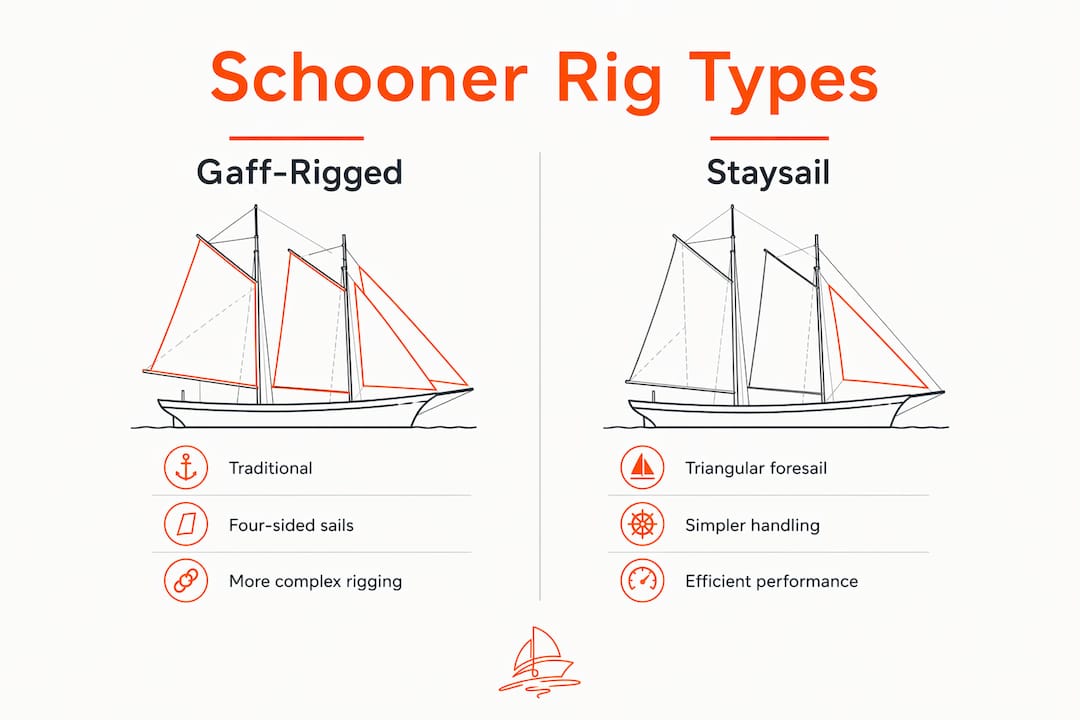
Gaff-rigged schooner. The traditional choice. Each mast carries a four-sided gaff sail with a boom at the foot and a gaff spar at the head. More sail area for a given mast height, but heavier gear and more lines to manage. Tacking takes longer because the gaff must swing through the wind. Reefing is a deliberate, multi-step process.
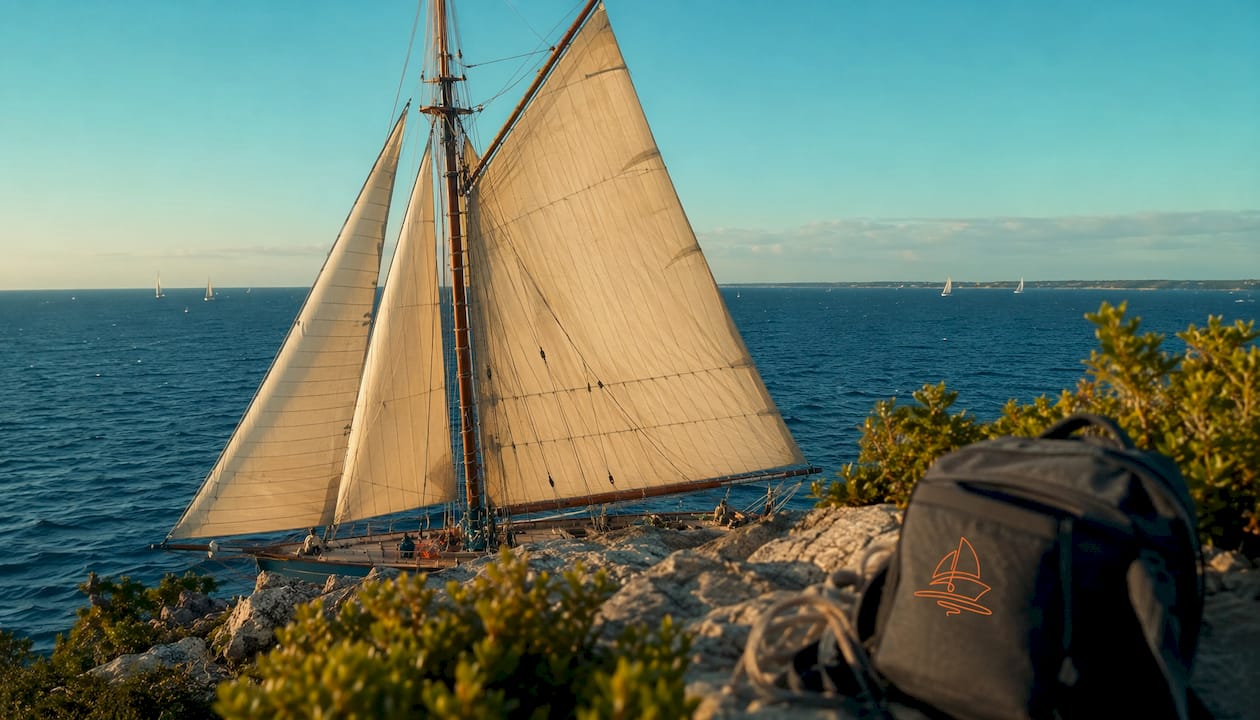
Staysail schooner. The foresail is replaced by a triangular staysail set on a stay between the masts rather than on the foremast itself. Less sail area overall, but the rig is cleaner, easier to tack, and demands less from a small crew. Performance to windward often surpasses a gaff-rigged schooner in a breeze.
Bermuda-rigged schooner. Both masts carry triangular Bermuda sails. Closest to modern yacht handling, with familiar sheeting angles and predictable tacking behavior. Less character than a gaff rig, but far less complexity. Good choice for sailors transitioning from sloop sailing.
Topsail and junk-rigged schooners. Topsail schooners add a square topsail on the foremast for downwind power, a feature the Baltimore Clipper exploited for speed. Junk rigs are rare but self-tacking and forgiving, occasionally seen on long-distance cruising schooners.
- Gaff rigs demand the most crew coordination but deliver the most sail area.
- Staysail rigs suit short-handed sailing better than any other schooner type.
- Bermuda rigs offer the gentlest learning curve for sailors new to two-masted vessels.
- Topsail variants add complexity but genuine downwind performance gains.
Pro Tip: Before you sail any schooner, identify every line and its function at the dock. Gaff-rigged vessels can carry 20 or more running lines; labeling them with colored tape saves critical seconds during a tack.
Understanding types of sails across rig configurations will sharpen your ability to read any schooner's setup quickly.
How to sail a schooner: step-by-step handling techniques
Schooner handling rewards patience and sequence. Rush any step and the boat tells you immediately.
-
Raise sails in order, starting with the foresail. The foresail gives you steerage and a stable platform. With the boat balanced on the foresail alone, you can safely raise or lower the mainsail without losing control. Never try to raise both simultaneously.
-
Trim the foresail before touching the mainsail sheet. Airflow through the slot between the two masts drives performance. Sheet the foresail first, then bring the mainsail in to match. Reversing that order collapses the slot and kills drive.
-
Use mainsail sheet tension to steer. The mainsail's aft position gives it outsized influence on the helm. Easing the mainsail sheet helps the boat bear off; sheeting in assists heading up. Treat it as a secondary steering tool, not just a power control.
-
Tack by backing the jib. As the bow swings through the wind, hold the jib or foresail sheeted to the old side briefly. That backed jib pushes the bow through and maintains momentum, which is critical on a heavy schooner that loses speed quickly in stays.
-
Ease sheets slightly when sailing to windward. Schooners often perform better with a touch of ease rather than hard-sheeted. Keeping boat speed up matters more than pointing high. A slight ease keeps the slot open and the boat moving.
-
Plan anchoring well in advance. Anchoring under sail is doable on a schooner but demands early planning, especially in crowded anchorages. Drop speed progressively by easing sails before the final approach. Consult solid anchoring techniques before your first attempt under sail.
-
Lower sails in reverse order. Drop the mainsail first while the foresail maintains steerage, then lower the foresail once you are in position. Rushing the sequence leaves you with a flogging mainsail and no way to steer.
Pro Tip: When entering harbor, begin reducing sail earlier than feels necessary. Maintaining steerage and controlled speed prevents last-minute scrambling at the dock, which is where most schooner mishaps happen.
What experienced skippers say about sailing schooners
Seasoned schooner captains consistently point to the same handful of lessons that took them years to internalize.
The most common beginner mistake is oversheeting. Pulling sails in too tight creates drag, causes side-slipping, and fights the boat's natural pace. Schooners are not sloops; they do not reward aggressive sheeting. Patience and a light touch produce better results than muscle.
Experienced sailors also emphasize the slot. The gap between the foresail's leech and the mainsail's luff is where the rig's efficiency lives. Disrupting that airflow by oversheeting either sail collapses drive and makes the boat feel sluggish and hard to steer.
- Never head fully into the wind to raise or lower sails; balance on the foresail instead.
- Watch the slot constantly; it is your primary performance indicator.
- Heaving to on a schooner is more complex than on a sloop; practice it in open water before you need it in an emergency.
- Back the jib on every tack until it becomes instinct.
- Accept that schooners have momentum and plan all maneuvers with that in mind.
Maintenance and safety checks for schooner rigging
Schooner rigging carries more components than a sloop, and each one needs regular attention. Standing rigging, the shrouds and stays that hold the masts in place, should be inspected for corrosion, cracked swage fittings, and loose turnbuckles before every passage. Pay particular attention to the forestay and the stay between masts on a staysail schooner; those carries constant load and show fatigue first.
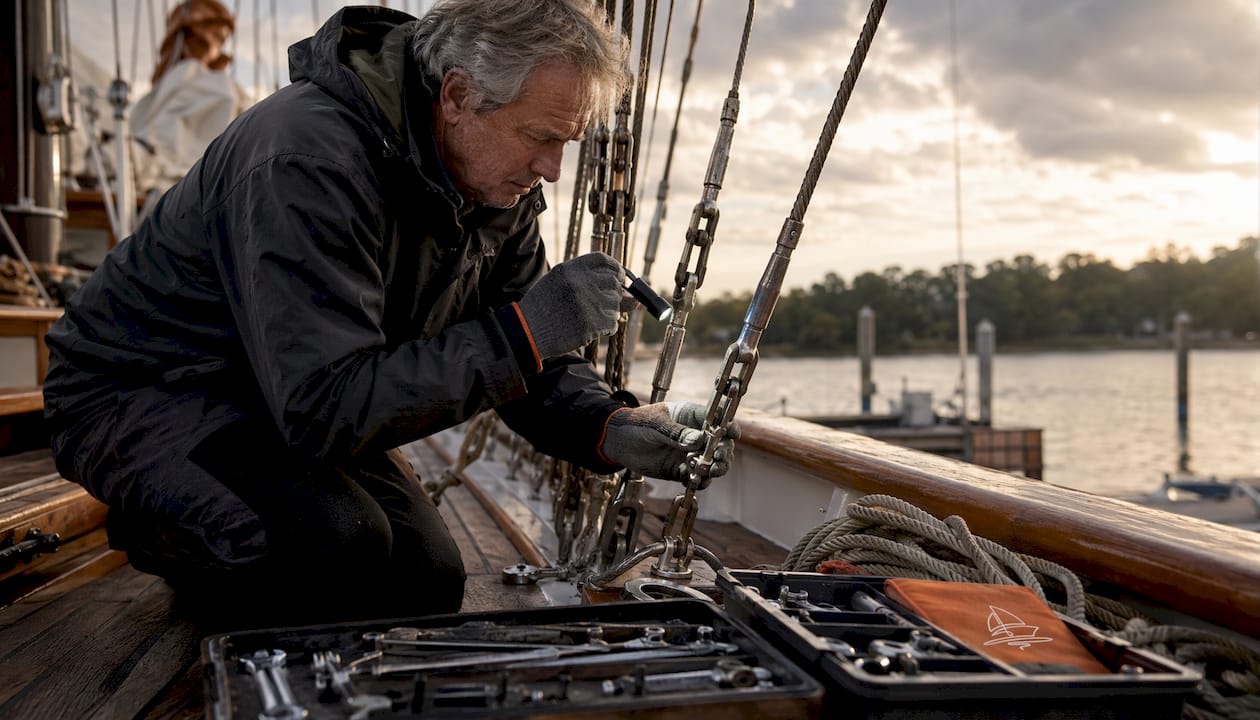
Running rigging wears faster on gaff-rigged vessels because the gaff jaws and throat halyard take repeated chafe. Check halyards at their sheave points and replace any line showing core exposure. Sails on gaff rigs also chafe against shrouds during broad reaches; baggywrinkle or chafe guards on the shrouds extend sail life considerably. A solid understanding of mast maintenance principles applies directly to schooner rig upkeep.
Safety checks before departure should include: all blocks and turning points for cracked shells, cleats for secure fastening, and boom and gaff jaws for wear. Carry spare halyards pre-rigged for the most critical sails. A halyard failure on the mainsail in open water is manageable; the same failure on the foresail while entering a harbor is not.
Navigation and passage planning for schooner voyages
Schooners are at their best on reaching and running points of sail, which should shape your route planning. When plotting a passage, identify legs where you can carry a beam or broad reach and minimize the upwind miles. A gaff-rigged schooner pointing 50 degrees to the wind is working hard; the same boat at 90 degrees is in its element.
Tidal planning matters more on a schooner than on a lighter modern yacht because the vessel's momentum makes course corrections slower. Build in extra sea room around headlands and shoals. For coastal passages, the National Park Service's maritime heritage resources document many of the traditional schooner routes along the American East Coast, which remain excellent cruising grounds today.
Waypoint spacing should account for the schooner's sail-change demands. Long offshore legs suit schooners well because you can set a comfortable reaching trim and leave it. Short coastal hops with frequent tacks or gybes are more demanding and require a well-drilled crew.
How schooners handle in different weather conditions
Light air is where schooners shine and where patience pays off. The fisherman's staysail, set in the gap between the two mastheads, captures wind that would otherwise be wasted and adds drive without loading the rig. In winds under 8 knots, fly everything you have and keep sheets eased.
Fresh breeze changes the calculation. Reef the mainsail before the boat starts to feel overpowered; the aft position of the mainsail means excess power there creates strong weather helm and makes steering exhausting. On a gaff rig, a single reef in the mainsail transforms the boat's manners. Reef early, reef decisively.
In heavy weather, reduce to foresail alone if conditions demand it. A schooner under foresail only is controllable and reasonably balanced. Running before a gale under bare poles or a small storm staysail is preferable to carrying too much canvas and losing control of the helm. Never underestimate how much the mainsail's aft position amplifies weather helm in strong winds.
Emergency procedures and troubleshooting on a schooner
A halyard jam is the most common mid-passage emergency on a gaff-rigged schooner. If the throat or peak halyard jams with the gaff half-raised, do not force it. Ease the sheet to spill wind, send someone aloft or to the mast to clear the jam, and keep the boat hove to if conditions allow. Carrying a sharp knife at the mast is not paranoia; it is standard practice.
Rudder failure on a schooner is manageable because the sail plan gives you real steering options. Ease the mainsail to bear off; sheet it hard to head up. A schooner with a locked rudder can be steered into a harbor under sail alone by an experienced crew, using exactly the mainsail sheet technique described earlier.
Man overboard on a schooner requires a pre-drilled procedure because the boat's momentum and multiple sails make a quick return harder than on a sloop. Assign one crew member to keep eyes on the person in the water at all times. Use the foresail to control speed on the approach and drop it at the last moment to kill way alongside the casualty. Practice the maneuver in calm conditions before you need it.
Sailorix makes your next schooner adventure easier to book

Knowing how to sail a schooner is one thing. Finding the right vessel to practice on is another challenge entirely. Sailorix is a global boat booking platform built for sailors who want access to quality vessels at honest prices. For €100 per year, members pay around 1% in service fees per booking to access schooners and yachts worldwide. That difference adds up fast on a week-long schooner charter.
Sailorix gives you real-time availability across a worldwide fleet, transparent pricing with no hidden fees, and a simple booking process that gets you on the water rather than buried in paperwork. Whether you want to practice schooner handling on a classic two-masted vessel in New England or take a longer passage on a gaff-rigged cruiser, the platform surfaces options that fit your budget and skill level. Book your schooner through Sailorix and spend your energy on the sailing, not the logistics.
Key Takeaways
Sailing a schooner demands understanding sail balance, sequential handling, and the unique steering influence of the aftmost mainsail before you leave the dock.
| Point | Details |
|---|---|
| Sail balance is central | Always raise the foresail first and trim it before adjusting the mainsail sheet. |
| The slot drives performance | Keep airflow clear between the foresail's leech and the mainsail's luff to maintain drive. |
| Back the jib on every tack | Holding the jib to the old side briefly swings the bow through and preserves momentum. |
| Reef the mainsail early | The mainsail's aft position amplifies weather helm; reef before the boat feels overpowered. |
| Sailorix for charter access | Members pay around 1% in service fees per booking to access schooners and yachts worldwide. |