
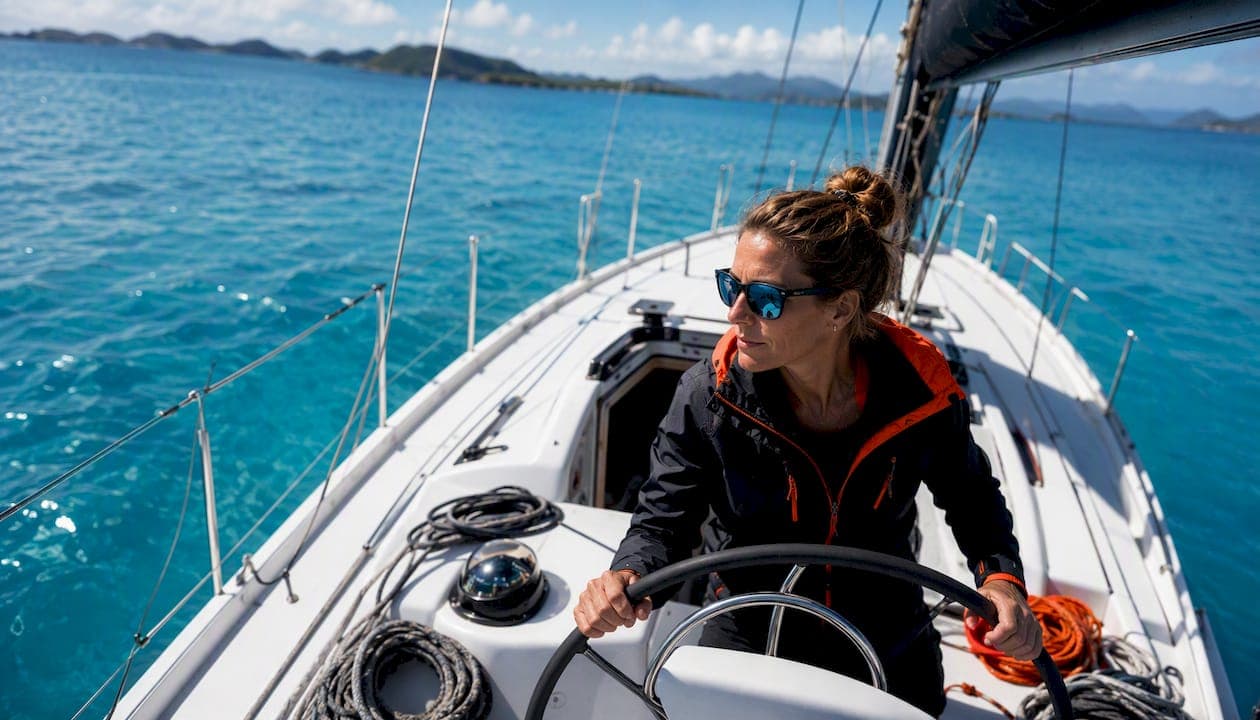
For most experienced and aspiring sailors, a 7-day bareboat or skippered charter out of Tortola delivers the best balance of short hops, easy provisioning, and access to the BVI's greatest anchorages. Road Town is the primary base: it has the largest charter fleets, the most provisioning options, and puts you within a few hours' sail of Norman Island, Jost Van Dyke, and Virgin Gorda. Soper's Hole on Tortola's West End works well if you want to start closer to Jost Van Dyke; Virgin Gorda suits groups who want to begin at The Baths and work westward.
Charter style at a glance:
- Bareboat: Best for certified sailors with documented offshore experience. Full control, lowest cost, maximum flexibility.
- Skippered: The smart pick for mixed-skill groups or anyone who wants local knowledge without giving up the feel of sailing. A hired skipper handles navigation, mooring, and weather calls.
- Fully crewed: Ideal for families or groups who want a floating resort. The crew handles everything; you just show up.
Season and price:
- Peak season runs December through April, with trade winds averaging around 15 knots and calm, predictable conditions. Shoulder months (May and November) offer lower rates and thinner crowds. June through November is hurricane season: most experienced sailors avoid it or buy comprehensive cancellation coverage.
- A 7-day bareboat typically starts in the mid-four-figures; skippered charters run higher once you add crew fees; fully crewed luxury yachts can reach five figures and beyond. Budget separately for fuel, provisioning, mooring fees, park permits, and gratuities.
Table of Contents
- What are the key facts about sailing in the BVI?
- Bareboat, skippered, or crewed: which charter fits your group?
- Sample itineraries: 5-, 7-, 10-, and 14-day BVI routes
- What does a BVI charter actually cost?
- What certifications do you need for a bareboat charter in the BVI?
- When should you sail the BVI, and how do you plan for safety?
- Provisioning, mooring, snorkeling, and local customs
- How do you book a BVI charter and what happens at check-in?
- How Sailorix simplifies booking a BVI charter
- Key Takeaways
- The BVI sailing reality most guides skip
- Ready to book your BVI charter through Sailorix?
- Useful sources for BVI sailing planning
What are the key facts about sailing in the BVI?
| Quick Fact | Detail |
|---|---|
| Peak season | December–April |
| Typical trade winds | ~15 knots during peak months |
| 7-day bareboat starting price | Mid-four-figures (USD) |
| Common start ports | Road Town (Tortola), Soper's Hole, Virgin Gorda Yacht Harbour |
| Typical inter-island sail times | 30 minutes to 3 hours between most stops |
| Certification requirement | ICC, RYA Day Skipper, ASA equivalent, or documented resume |
| Mooring pickup deadline | Before 14:00 in busy bays during peak season |
| National park fees | Required at The Baths and other protected sites |
Five things every skipper should know before leaving the dock:
- Customs clearance is required — You must clear in and out of the BVI. Road Town, Soper's Hole, and Virgin Gorda Yacht Harbour are the main ports of entry.
Bareboat, skippered, or crewed: which charter fits your group?
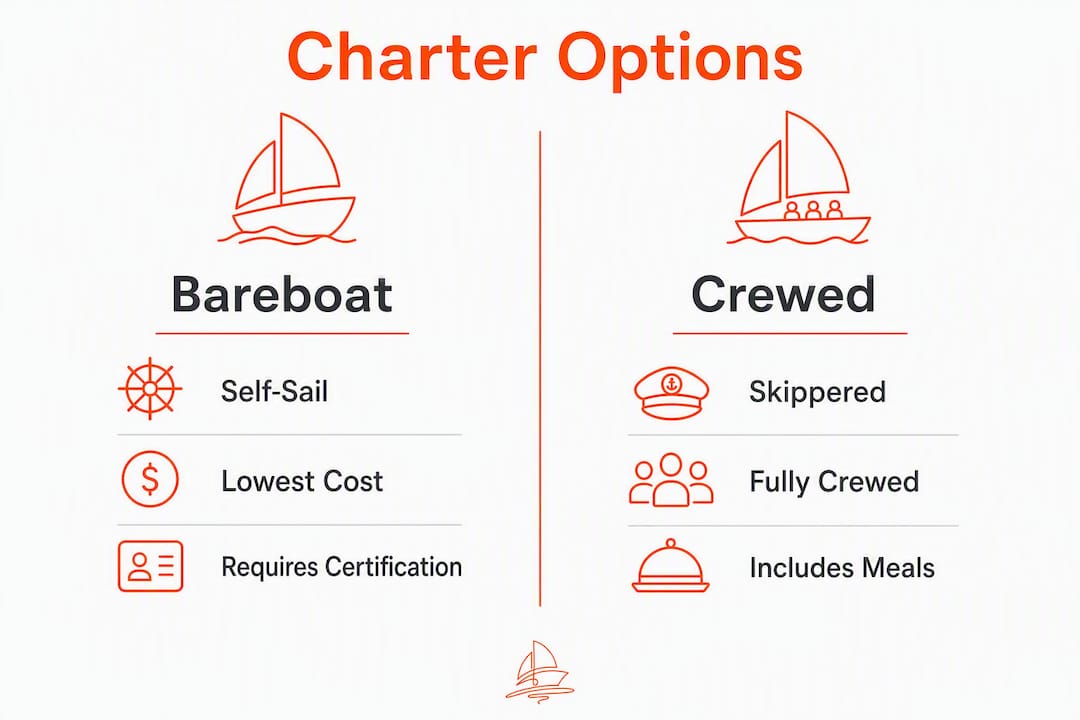
Bareboat
You take the helm, you make the calls, and you pay the lowest rate. Bareboat works when your skipper holds a recognized certificate (ICC, RYA Day Skipper, or an ASA equivalent) and can show a resume with offshore miles. Most operators also want a co-skipper with documented experience. The BVI is genuinely forgiving sailing territory: short passages, well-marked channels, and excellent mooring infrastructure. That said, the Anegada passage and a few reef approaches demand real navigation competence.
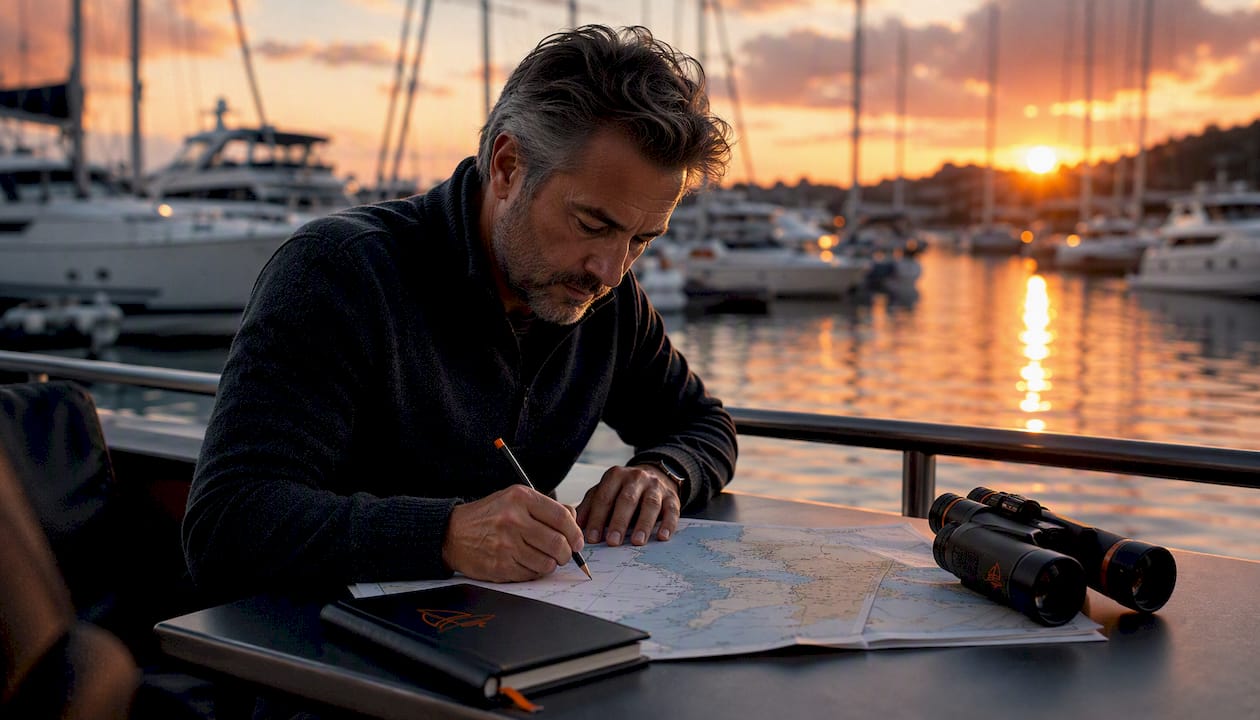
Ask yourself: Can your skipper read a chart, pick up a mooring ball in 20 knots of wind, and make a confident weather call? If the answer is yes for everyone who might need to take the wheel, bareboat is the right call.
Skippered charter
A professional skipper joins your boat. You sail as much or as little as you want; they handle the tricky bits. This is the most practical option for mixed-skill groups or anyone who wants local knowledge baked in. A good skipper knows which mooring fields fill first, where the reef hazards are on the Anegada approach, and which beach bar closes early. Expect to add skipper fees (typically $150–$250 per day) plus their food and accommodation costs on top of the base charter rate.
Fully crewed
Captain, chef, and sometimes a deckhand. The boat is provisioned before you board; meals appear on schedule; the only decision you make is whether to snorkel before or after lunch. Crewed charters cost significantly more, but for a honeymoon, a multi-generational family trip, or a group where nobody wants to think about weather windows, the premium is worth it.
Choosing between skippered and crewed often comes down to one question: do you want to participate in sailing the boat, or do you want to be a passenger on a beautiful one? A skippered charter keeps you involved; a crewed charter removes the boat from your to-do list entirely.
Pro Tip: If your group has two or three experienced sailors and a few novices, a skippered charter for the first two days and bareboat for the rest is a legitimate arrangement some operators will accommodate. Ask before you book.
Cost drivers that push a charter into a higher bracket: crew wages, provisioned meals, marina nights over mooring nights (marinas run $50–$150+ per night vs. $30–$40 for a mooring ball), and any add-on services like a dinghy with outboard or water toys.
Sample itineraries: 5-, 7-, 10-, and 14-day BVI routes
Five-day fast loop (Tortola base)
Short on time, not on highlights. This loop prioritizes the BVI's greatest hits with manageable daily sails.
- Day 1: Check in at Road Town or Soper's Hole. Afternoon sail to Norman Island (1–1.5 hrs). Pick up a mooring ball by 13:00. Snorkel the Caves; dinner at Willy T's.
- Day 2: Early start to Peter Island (30 min). Deadman's Bay for lunch. Afternoon to Cooper Island (20 min). Mooring field, beach bar.
- Day 3: Sail to Virgin Gorda (2–2.5 hrs). The Baths in the morning before the day-tripper crowds arrive. Overnight at Virgin Gorda Yacht Harbour or North Sound.
- Day 4: North Sound exploration. Saba Rock, Bitter End area. Afternoon return toward Tortola via Beef Island (2 hrs).
- Day 5: Return to base. Check out by 09:00.
Seven-day classic loop
The BVI's most-recommended anchorages in one week. This is the route most first-timers run, and it earns that reputation.
- Day 1: Road Town provisioning and check-in. Sail to Norman Island (1–1.5 hrs). Mooring at The Bight. Snorkel the Caves; Willy T's for sundowners.
- Day 2: Peter Island (30 min). Deadman's Bay morning swim. Afternoon to Cooper Island (20 min). Beach Bar for dinner.
- Day 3: Salt Island (20 min). Dive or snorkel the RMS Rhone wreck. Afternoon to Virgin Gorda (1.5 hrs). Overnight at The Valley mooring field.
- Day 4: The Baths early (before 09:00 to beat the crowds). Afternoon sail to North Sound (45 min). Saba Rock, Bitter End Yacht Club area.
- Day 5: North Sound to Anegada (2.5–3 hrs). Reef-aware navigation required; some skippers recommend local guidance for the approach. Lobster dinner on the beach. Overnight mooring.
- Day 6: Anegada to Jost Van Dyke (3–3.5 hrs). White Bay mooring field. Painkillers at the Soggy Dollar Bar. Foxy's at Great Harbour for dinner.
- Day 7: Jost Van Dyke to Soper's Hole or Road Town (45 min–1 hr). Check out.
Pro Tip: On the Anegada leg, depart no later than 07:00. The passage runs long, and you want to arrive with enough light to read the reef colors on approach. A GPS chart plotter with current BVI charts is non-negotiable for this leg.
Ten-day extended route
Add two days in Anegada and a deeper dive into North Sound. This version suits groups who want to slow down and actually stay somewhere long enough to explore ashore.
Follow the 7-day route through Day 5 (Anegada arrival), then:
- Day 6: Full day in Anegada. Rent bikes or a golf cart. Flamingo Pond, the reef flats, a second lobster dinner.
- Day 7: Anegada to Guana Island or Marina Cay (3 hrs). Quieter, less-visited stop.
- Day 8: Marina Cay to North Sound (45 min). Spend two nights. Explore Eustatia Island and Prickly Pear.
- Day 9: North Sound to Jost Van Dyke (2.5 hrs). White Bay, Foxy's, Sandy Spit if time allows.
- Day 10: Return to Tortola. Check out.
Provisioning note: re-stock at Virgin Gorda Yacht Harbour before heading to Anegada. Options on Anegada itself are limited.
Fourteen-day exploratory plan
Two weeks lets you sail with weather windows instead of against them. Build in at least two flex days.
Follow the 10-day route, then add:
- Days 11–12: West End (Soper's Hole). Explore Frenchman's Cay, provision, and use this as a staging point for a day sail to Sandy Cay or Green Cay.
- Day 13: Return to Norman Island or Peter Island for a second visit with more time to dive.
- Day 14: Leisurely return to base. Check out.
The 14-day format also lets you sit out a day of strong winds without blowing your itinerary. If a front pushes through, stay an extra night in a protected bay and move the following day. That flexibility is the real luxury of two weeks.
What does a BVI charter actually cost?
The base charter rate is only part of the number. Here's how the full budget breaks down.
| Cost Item | Bareboat | Skippered | Fully Crewed |
|---|---|---|---|
| 7-day base rate | Mid-four-figures | Mid-to-high four-figures | Five figures and up |
| Skipper fee | Not included | ~$150–$250/day | Included |
| Provisioning | Self-arranged | Self-arranged | Often included |
| Fuel | Extra | Extra | Sometimes included |
| Mooring fees | ~$30–$40/night | ~$30–$40/night | ~$30–$40/night |
| Marina nights | ~$50–$150+/night | ~$50–$150+/night | ~$50–$150+/night |
| National park fees | Per site | Per site | Per site |
| Customs/immigration | Small fee | Small fee | Small fee |
| Crew gratuity | N/A | 10–15% of charter fee | 15–20% of charter fee |
| Damage deposit | Required | Required | Required |
A realistic total budget for a 7-day bareboat for four people runs 30–40% above the base charter rate once you add fuel, mooring fees, provisioning, and park permits. Skippered and crewed charters add crew costs on top of that.
Money-saving moves:
- Book shoulder season (May or November) for meaningfully lower base rates and fewer crowds at mooring fields.
- Pre-order provisioning in Tortola for marina delivery. It saves time and usually costs less than buying on the islands.
- Choose mooring nights over marina nights wherever possible. The difference adds up across a week.
- Check for last-minute availability, but only if your dates are flexible. Peak-season last-minute deals are rare; shoulder-season ones are real.
When comparing charter quotes, ask for a full itemized breakdown. Any quote that bundles fuel, mooring, and fees into a vague "expenses" line is a red flag. You want line-item clarity before you sign.
What certifications do you need for a bareboat charter in the BVI?
Operators will ask for proof of competence before they hand over the keys. The standard accepted credentials are an ICC (International Certificate of Competence), an RYA Day Skipper or Coastal Skipper certificate, or an ASA 104 (Bareboat Cruising) equivalent. If you hold none of these, a detailed sailing resume with documented offshore miles and boat types can sometimes substitute, but the operator decides, and they often require a practical checkout sail.
Here's the typical verification sequence:
- Submit your sailing resume when you request a quote. Include boat types, total miles, offshore passages, and any leadership roles (skipper, co-skipper).
- Provide certificate copies (ICC, RYA, ASA) with your booking documents. Operators want these well before your charter date, not on arrival day.
- Schedule a practical checkout if the operator requires one. This is a short sail with a company instructor who verifies you can handle the boat, pick up a mooring, and manage basic systems. It usually takes 2–3 hours on the morning of check-in.
- Confirm co-skipper credentials. Most operators want at least one additional crew member with documented experience. List them on the resume too.
- Prepare your document packet for check-in: passports for all crew, sailing certificates, skipper resume, credit card for the damage deposit, and proof of charter insurance if you've arranged your own.
For a deeper walkthrough of the certification process and operator verification steps, Sailorix's guide covers the full sequence from application to checkout.
Operators vary in how strictly they apply these requirements. Some accept a strong resume for experienced sailors; others require a certificate regardless. Confirm the specific requirement with your operator before booking, not after.
When should you sail the BVI, and how do you plan for safety?
Peak season: December through April
Trade winds average around 15 knots during peak months, making for comfortable beam reaches between islands. Seas are generally calm, visibility is excellent, and the anchorages are at their most beautiful. The tradeoff is price and crowds: mooring fields fill fast, and charter rates are at their highest.
Shoulder months: May and November
Winds can be lighter and more variable. Occasional squalls pass through, but the weather is still manageable for experienced sailors. Rates drop, crowds thin, and you'll find mooring balls available well past 14:00. For budget-conscious sailors with flexible dates, May is arguably the best month in the BVI.
Hurricane season: June through November
Tropical storms can develop during June through November, and most experienced sailors avoid chartering during the peak of hurricane season (August–October). If you book during this window, confirm the operator's hurricane policy in writing: what triggers a cancellation, who initiates it, and what refund or rebooking terms apply. Comprehensive travel insurance with a "cancel for any reason" clause is worth the premium if you're sailing June–November.
Pro Tip: Check the NOAA marine forecast every morning before departure. The BVI sits in a zone where afternoon squalls can build quickly even in peak season. A 07:00 departure gives you time to reach your next anchorage before conditions change.
Safety planning checklist
- Monitor NOAA marine forecasts and local VHF weather channels (typically Channel 16 and 68 in the BVI) daily.
- Identify a safe harbor for each day's leg before you leave the dock.
- Know your operator's emergency contact number and the nearest Coast Guard frequency.
- Carry a functioning EPIRB and a handheld VHF as backup.
- Review your Caribbean risk awareness before departure, particularly for weather and regional safety considerations.
- Confirm your charter insurance covers medical evacuation and on-water assistance.
Provisioning, mooring, snorkeling, and local customs
Provisioning
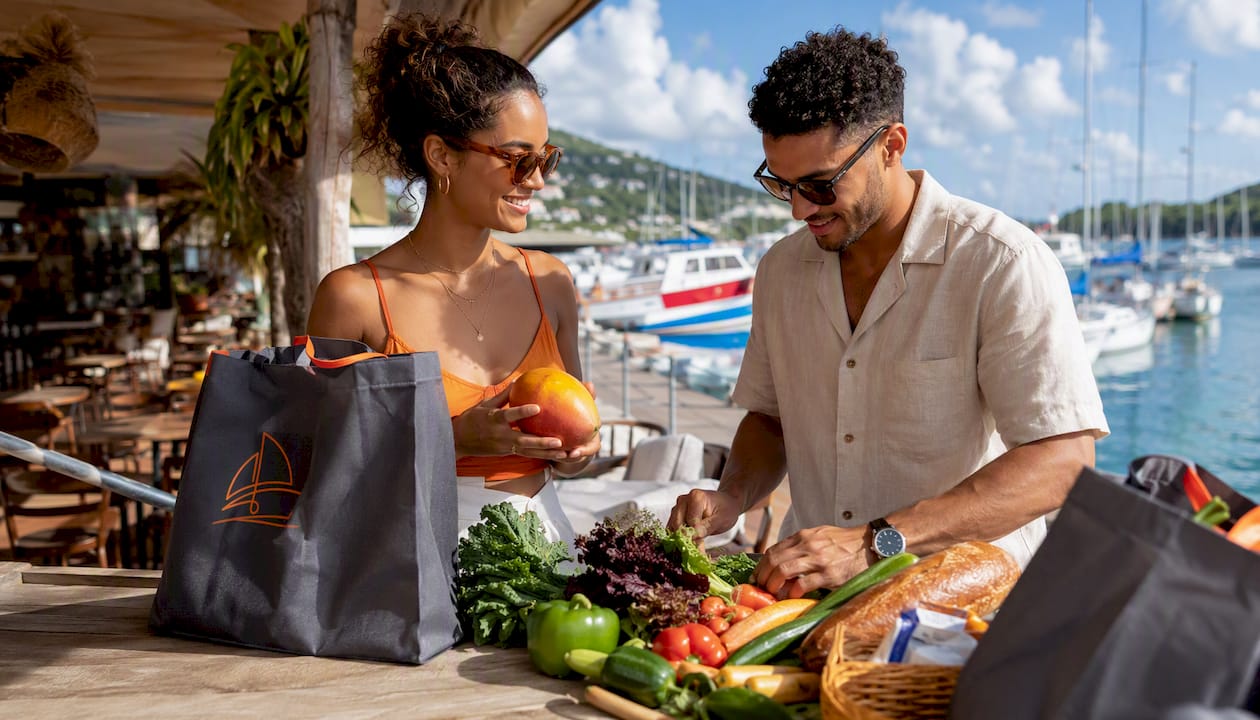
Pre-order groceries in Tortola for delivery to the marina on check-in day. Road Town has the best selection; Riteway Food Markets is the most commonly used option. Stock up on water, ice, and fresh produce before you leave, because resupply options shrink significantly once you're past Virgin Gorda. Freshwater conservation matters on a charter: most boats carry 100–200 gallons, which sounds like a lot until four people start taking long showers.
Mooring vs. anchoring
The BVI has an extensive mooring ball network maintained by the National Parks Trust and private operators. Use mooring balls wherever they're available: they protect the reef, they're easier than anchoring in tight bays, and arriving before 14:00 is the rule that actually matters in busy spots. Anchoring is permitted in some areas but restricted near reefs and in designated mooring fields. When in doubt, pick up a ball.
Top snorkeling and diving spots
- The Baths, Virgin Gorda: Giant granite boulders create tidal pools and swim-throughs. National park fees apply; go early to beat the day-tripper boats. The BVI National Parks Trust manages the site and lists current access rules.
- Norman Island Caves: Three sea caves on the western point of Norman Island. Snorkel inside with a light; the walls are covered in coral and fish. Mooring balls available.
- RMS Rhone, Salt Island: One of the Caribbean's best wreck dives. The 310-foot Royal Mail Ship went down in an 1867 hurricane. Accessible for snorkelers in the shallower sections; divers can reach the deeper hull.
- White Bay, Jost Van Dyke: Snorkeling off the beach is decent, but the real draw is the Soggy Dollar Bar and the sheer beauty of the bay. Mooring field fills fast in peak season.
- Anegada reef flats: Long, shallow reef system. Good for snorkeling from the dinghy; the lobster restaurants on the beach are the evening reward.
Local customs and fees
Tip generously at beach bars and restaurants: 15–20% is standard. Waste disposal rules are strict; carry all trash back to shore facilities. Clear customs properly at every port of entry and exit. The BVI takes this seriously, and an improper clearance can result in fines. National park fees and permit systems are enforced at The Baths and other protected sites; current fee amounts are posted at the sites and on the BVI National Parks Trust website.
How do you book a BVI charter and what happens at check-in?
Booking timeline
| Timing | Action |
|---|---|
| 9–12 months out (peak season) | Reserve your preferred boat and dates; pay initial deposit (typically 25–50% of charter fee) |
| 6–9 months out (shoulder season) | Good availability; same deposit structure |
| 3–6 months out | Narrowing selection; last-minute deals possible in shoulder season |
| 8–12 weeks before departure | Submit sailing resume and certificates for operator review |
| 4–6 weeks before | Finalize provisioning order; confirm insurance; pay balance |
| 1–2 weeks before | Confirm check-in time, marina location, and arrival logistics |
| Check-in day | Arrive at base by 09:00–10:00; practical checkout if required; inventory walk-through |
For a full step-by-step boat rental workflow from first search to check-out, Sailorix's guide covers every stage.
Check-in process
Expect 2–4 hours at the marina on check-in day. The charter base will walk you through the boat's systems (engine, electronics, safety gear, heads), conduct an inventory of all equipment, and note any existing damage on a condition report. Sign nothing until you've confirmed every item on that report. Photograph any pre-existing damage yourself before you leave the dock.
The damage deposit (typically $1,500–$5,000 depending on boat size) is held on your credit card. It's released after check-out inspection, usually within 7–14 days.
Insurance and cancellation
Charter insurance covers damage to the boat above the deductible. Most operators offer their own damage waiver; some require you to purchase it. Separately, buy travel insurance that covers trip cancellation, medical evacuation, and, if you're sailing in shoulder or hurricane season, a "cancel for any reason" policy. Confirm the operator's hurricane cancellation policy in writing: the trigger conditions, the notice period, and the refund or credit terms.
Check-out
Return the boat with the same fuel level as departure (or pay the difference). Complete the inventory walk-through with the base staff, report any damage immediately, and get written confirmation that the boat was returned in acceptable condition. Keep that document until your deposit is released.
How Sailorix simplifies booking a BVI charter
Sailorix is a global yacht booking platform built around one core idea: lower fees and transparent pricing for every booking. Here's what that means in practice for a BVI charter:
- Real-time availability: — Search by destination, boat type, and dates. BVI charter inventory updates live, so you see what's actually bookable, not what was available last week.
For sailors comparing quotes across multiple operators, Sailorix's membership model means the platform fee stops being a variable that inflates every quote. You pay once for the year and book as many charters as you want at the reduced rate.
Key Takeaways
Sailing the British Virgin Islands rewards sailors who book early, choose the right charter style for their group, and plan their itinerary around the mooring-field reality of peak season.
| Point | Details |
|---|---|
| Base from Tortola | Road Town offers the largest fleet selection, best provisioning, and central access to all major BVI stops. |
| Match charter style to skill | Bareboat for certified sailors; skippered for mixed groups; crewed for full-service leisure. |
| Book peak season 9–12 months out | December–April charters fill fast; shoulder months (May, November) offer lower rates and fewer crowds. |
| Budget 30–40% above base rate | Fuel, mooring fees, provisioning, park permits, and gratuities add significantly to the charter fee. |
| Sailorix membership cuts platform fees | An annual Sailorix membership reduces service fees to ~1%, versus the 10–20% standard on most booking platforms. |
The BVI sailing reality most guides skip
Most BVI charter guides spend their energy on the highlights reel: The Baths at sunrise, lobster on Anegada, painkillers at the Soggy Dollar. All of that is real and worth every word. What gets less attention is the operational rhythm that determines whether a trip runs smoothly or spends half its time problem-solving.
The single biggest variable is mooring field timing. It sounds like a minor logistical detail until you arrive at White Bay at 16:00 and find every ball taken. At that point, you're either anchoring in a spot that may not be ideal, motoring to an alternative anchorage in fading light, or spending the night somewhere you didn't plan. The 14:00 rule isn't a suggestion; it's the difference between the trip you planned and the trip you improvised.
The second underrated factor is the Anegada decision. Anegada is genuinely spectacular, and the lobster dinner on the beach is one of the best meals in the Caribbean. But the passage is longer than anything else in the BVI, the reef approach requires real chart competence, and if you're not confident in your navigation, hiring a local pilot for the arrival is money well spent. Skipping Anegada because the passage felt too ambitious is a legitimate call. Attempting it underprepared is not.
The BVI is forgiving sailing territory by Caribbean standards. Short hops, well-maintained mooring fields, and excellent infrastructure make it accessible to sailors who are still building their offshore confidence. But "forgiving" doesn't mean "effortless." The groups who have the best trips are the ones who treat the operational details, timing, provisioning, weather checks, and certification prep, with the same seriousness they bring to choosing their anchorages.
Ready to book your BVI charter through Sailorix?
The BVI charter market is competitive, and the difference between a good trip and a great one often comes down to the booking process: transparent pricing, the right boat for your group, and a platform that doesn't bury the real cost in a 15% service fee.

Sailorix members pay approximately 1% in service fees per booking, compared to the 10–20% standard on most charter platforms. On a mid-four-figure bareboat charter, that's a meaningful saving, and the membership costs €100 for the full year. The platform shows real-time BVI availability, lets you add a skipper or provisioning service at checkout, and gives you a single itemized quote with no hidden line items.
Search current BVI availability, compare boats by size and type, and book your charter on Sailorix to lock in your dates at the lowest service fee in the market.
Useful sources for BVI sailing planning
- BVI National Parks Trust — The Baths: — Official site for The Baths at Virgin Gorda. Check current access rules, mooring availability, and park fees before you visit.
- Island Hopper Guides — BVI First-Timer's Guide: — Covers certification requirements, hurricane policy considerations, and practical first-timer advice.
- The Blonde Abroad — Ultimate BVI Sailing Guide: — Pricing context, charter type comparisons, and Anegada navigation notes.
Always confirm current permit fees, customs procedures, and operator check-in requirements directly with your charter company before departure. Rules and fees change; the sources above reflect the best available guidance but are not substitutes for operator-specific pre-departure briefings.