
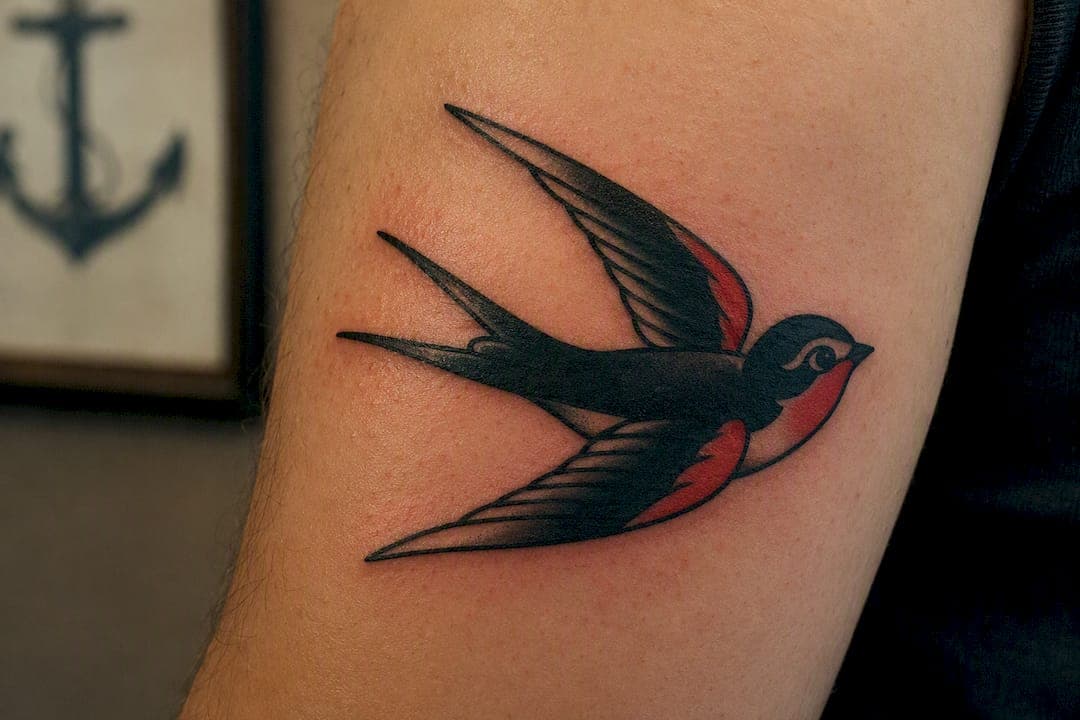
A sailor swallow tattoo marks distance traveled and a safe homecoming. The tradition ties back to a 5,000 nautical mile milestone at sea, a benchmark that modern sailors and shops now often stretch to 10,000 nautical miles, and the design's familiar bold outline and stripped-down color palette come from Norman "Sailor Jerry" Collins, who worked out of a Honolulu studio in the mid-20th century.
Here's what shaped the swallow into maritime shorthand for endurance and return:
- Distance earned it: one swallow per major mileage threshold, historically 5,000 nm.
- Sailor Jerry standardized the look: bold black lines, minimal shading, a handful of colors.
- Two swallows meant something specific: often read as a wish for safe passage home.
- The bird itself carried meaning: migratory habits made swallows a natural symbol of long journeys survived.
What follows covers where this practice started, what the swallow actually symbolizes beyond mileage, how to spot the classic style, and how to commission one yourself.
Key Takeaways
The sailor swallow tattoo traditionally marked roughly 5,000 nautical miles of sea travel, symbolized safe homecoming, and owes its classic bold look to Sailor Jerry's mid-20th-century style.
| Point | Details |
|---|---|
| Mileage tradition | One swallow historically marked 5,000 nautical miles at sea, with modern sources often citing 10,000 nm instead. |
| Sailor Jerry's influence | Norman Collins standardized the bold outline and flat color palette that defines the "classic" swallow look. |
| Symbolism runs deeper than distance | Swallows also represented safe return, endurance, and in folklore, a soul finding its way home. |
| Swallows differ from other nautical birds | Unlike the albatross or frigatebird, the swallow's meaning is tied to a specific, quantifiable mileage tradition. |
| Live the tradition firsthand | Sailorix's membership model gives access to boat rentals worldwide at roughly 1% service fees, a practical way to start logging your own sea miles. |
Table of Contents
- How swallow tattoos entered maritime culture
- What did a swallow tattoo actually mean?
- What makes the Sailor Jerry swallow look so recognizable?
- How has the swallow tattoo changed today?
- How do you choose and commission a sailor swallow tattoo?
- What does the swallow mean in other cultures?
- Which sailors made the swallow tattoo famous?
- How does the swallow differ from other nautical bird tattoos?
- Why this tradition still resonates in sailing culture
- Ready to earn your own sea miles?
- Sources
How swallow tattoos entered maritime culture
Tattooing didn't originate with Western sailors. It spread to them. Pacific voyages in the 18th and 19th centuries put European and American crews in contact with Polynesian and other indigenous tattoo traditions, and sailors brought the practice home in their own skin, according to Collectors Weekly's history of nautical tattoo motifs. Once tattooing took hold aboard Western naval and merchant vessels, sailors built their own visual vocabulary: anchors for stability, nautical stars for navigation, and swallows for distance.
The swallow specifically earned its place for a biological reason, not just an aesthetic one.
- Barn swallows are land birds. They don't belong out at sea.
- When one turned up on a ship, deep water from shore, it usually meant a storm had blown it off course.
- Sailors read that rare, almost accidental sighting as a sign that land, and home, was near.
Barn swallows can migrate roughly 10,000 kilometers twice a year, according to One Ocean Expedition's account of the tradition. A creature that small covering that much distance, twice annually, without losing its way home, made an obvious metaphor for men who spent years away from their families and somehow kept finding their way back.
What did a swallow tattoo actually mean?
Tradition holds that a single swallow was earned after 5,000 nautical miles at sea, a figure documented in Naval History Magazine's account of naval tattoo customs. Modern references frequently cite 10,000 nautical miles instead, likely a natural inflation as ships got faster and old thresholds started to feel too easy to hit. Neither number is a rulebook. It's folklore, passed crew to crew, tattoo shop to tattoo shop, with no governing body ever stamping an official mileage chart.
The swallow's meaning ran deeper than distance. Sailors treated it as a kind of talisman, believed by some superstitious crews to carry a sailor's soul home if he died at sea, since the bird itself was seen as incapable of getting lost.
Two swallows, positioned symmetrically on the chest, often signified a specific wish: safe return from a voyage not yet completed, worn almost like a prayer inked into skin before departure. A single swallow, by contrast, tended to mark distance already covered. The honest way to describe all of this is as documented tradition and folklore working together, not a fixed rulebook every sailor obeyed.
What makes the Sailor Jerry swallow look so recognizable?
Norman "Sailor Jerry" Collins didn't invent the swallow motif, but he's the reason it looks the way it does today. Working out of Honolulu starting in the 1930s, Collins refined a visual style built on thick black outlines, flat saturated color (mostly red, green, and yellow), and simplified forms that could survive decades of skin aging and sun exposure without turning to mush. That's what people mean when they say "traditional" or "old school" tattoo style now.
One recurring mix up worth clearing up: swallows and sparrows.
- Popular culture blends the two constantly, and Wikipedia's overview of sailor tattoo motifs notes they've become largely interchangeable despite different origins.
- A swallow has a forked tail and longer, more pointed wings built for sustained migratory flight.
- A sparrow is stockier, with a shorter, less dramatic tail.
- In old flash art the distinction often blurred anyway, since both got stylized into the same swooping silhouette.
Placement carried its own logic. Chest and shoulder swallows dominated, partly for visibility among crewmates and partly for the mirrored, symmetrical effect two birds could create across the sternum. Ankle placements showed up too, sometimes read as a nod to distance covered on foot as well as by sea.
How has the swallow tattoo changed today?
Outside strict naval tradition, the swallow has become something closer to a personal ledger. Sailors and cruisers now add birds incrementally as they log ocean miles, using the motif as a running record of voyages rather than a single earned badge, a practice Cruising World has documented among modern sailors marking circumnavigations and long passages one bird at a time.
The style has branched out visually too:
- Neo-traditional: heavier detail and shading layered onto the classic bold-line skeleton.
- Watercolor: soft color bleeds replace the flat fills Sailor Jerry made standard.
- Fine-line: minimal, almost sketch-like versions popular with people who want the symbol without the visual weight.
Plenty of people getting swallow tattoos today have never set foot on a working vessel. The bird now marks a milestone trip, a family voyage, or a memorial for someone who loved the sea. That flexibility is part of why the design has outlasted its original context.
Pro Tip: If a design you love borrows from a culture outside Western maritime tattooing, like Polynesian or Japanese motifs sometimes layered into swallow pieces, ask your artist directly about the symbol's origin and whether the specific elements you want are appropriate to combine. A good artist will tell you plainly if something crosses a line.
How do you choose and commission a sailor swallow tattoo?
Getting a swallow that actually means something to you, instead of a generic flash copy, takes a bit of legwork before you sit in the chair.
- Gather reference images that show the specific line weight and color approach you want, traditional bold or fine-line.
- Decide placement and size based on how visible you want it and whether you're planning a pair (mirrored chest swallows) or a single bird.
- Choose color versus black line only, since color demands more touch-up over the years than solid black work.
- Research the artist's portfolio specifically for traditional or neo-traditional work, not just their general style.
- Confirm the studio's licensing and hygiene practices before booking, including sterilization procedures and single-use needles.
When you talk to an artist, ask how they'd personalize a classic swallow without losing the elements that make it read as traditional, whether that's keeping the bold outline while shifting the color palette, or adjusting wing position slightly to fit your placement. Walk away if a shop pressures you to copy an existing piece of flash art without any changes, or if their sterilization answers feel vague or rehearsed.
Pro Tip: Ask for a custom sketch that keeps the swallow's silhouette and outline weight intact but swaps in a detail that's yours, a star, a wave, a small date, tucked into the wing or tail feathers.

What does the swallow mean in other cultures?
Western sailors didn't invent bird symbolism at sea. Cultures with deep maritime histories, particularly across the Pacific, developed their own bird motifs long before Sailor Jerry ever picked up a needle. Polynesian tattoo traditions used frigatebirds and other seabirds to represent navigation, guidance, and connection between the physical and spirit worlds, concepts that predate and likely influenced the broader wave of Pacific voyage tattoo exchange that Collectors Weekly traces back to the 18th and 19th centuries.
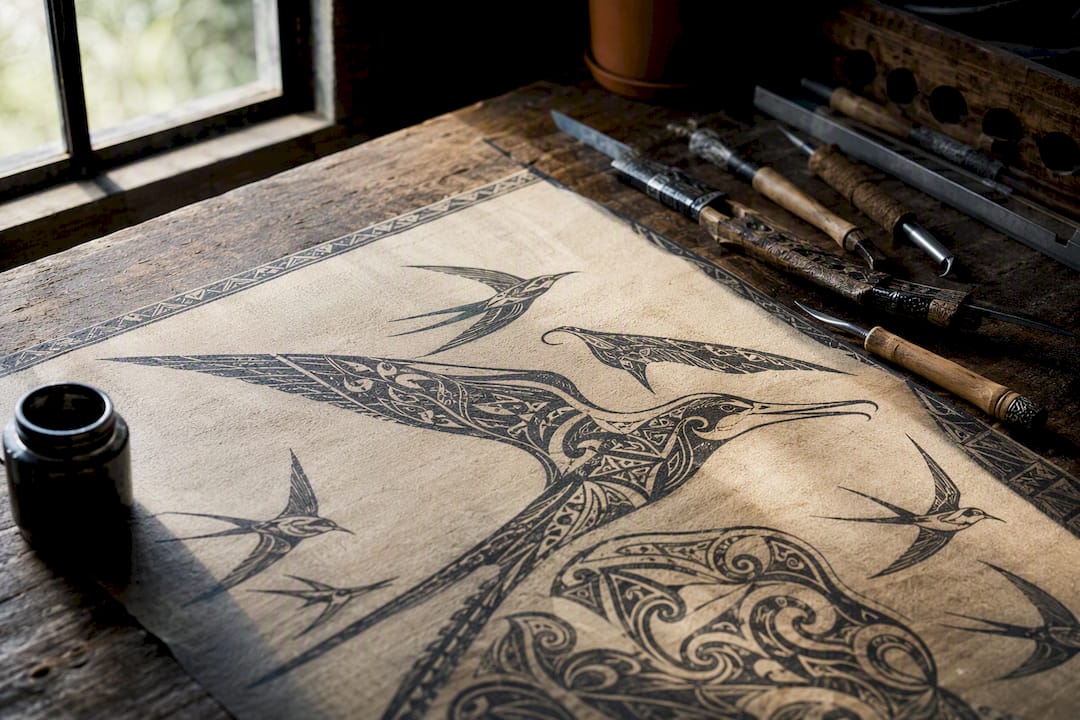
Japanese tattoo art, meanwhile, folded birds into much larger compositional traditions, swallows and cranes appearing alongside waves and dragons in full body pieces with their own symbolic logic around luck, longevity, and seasonal change.
None of these traditions are interchangeable with the Western sailor swallow, and treating them as the same motif with different paint jobs misses the point. The Western swallow's meaning is tied specifically to nautical mileage and homecoming folklore that developed among European and American crews. Pacific and Asian bird symbolism developed independently, carrying its own cultural weight and often its own restrictions on who can wear certain designs.
If you're drawn to a bird motif from outside your own cultural background, that's worth a direct conversation with an artist who actually specializes in that tradition, not a generic shop offering to "combine styles" for you. The swallow's story is really a story about cultural exchange at sea, sailors picking up ink from ports they visited and carrying it home, and that exchange worked best when it involved genuine relationships with the people whose traditions they were borrowing from.
Which sailors made the swallow tattoo famous?
Sailor Jerry himself is the obvious answer, not because he served as a career sailor his whole life (he did serve in the Merchant Marine before settling into tattooing full time), but because his Honolulu shop became a waypoint for military personnel passing through Pearl Harbor during and after World War II. Thousands of sailors got tattooed there, and Collins's swallow design rode home with them to ports across the country, which is a big part of why the style spread so uniformly instead of staying a regional quirk.
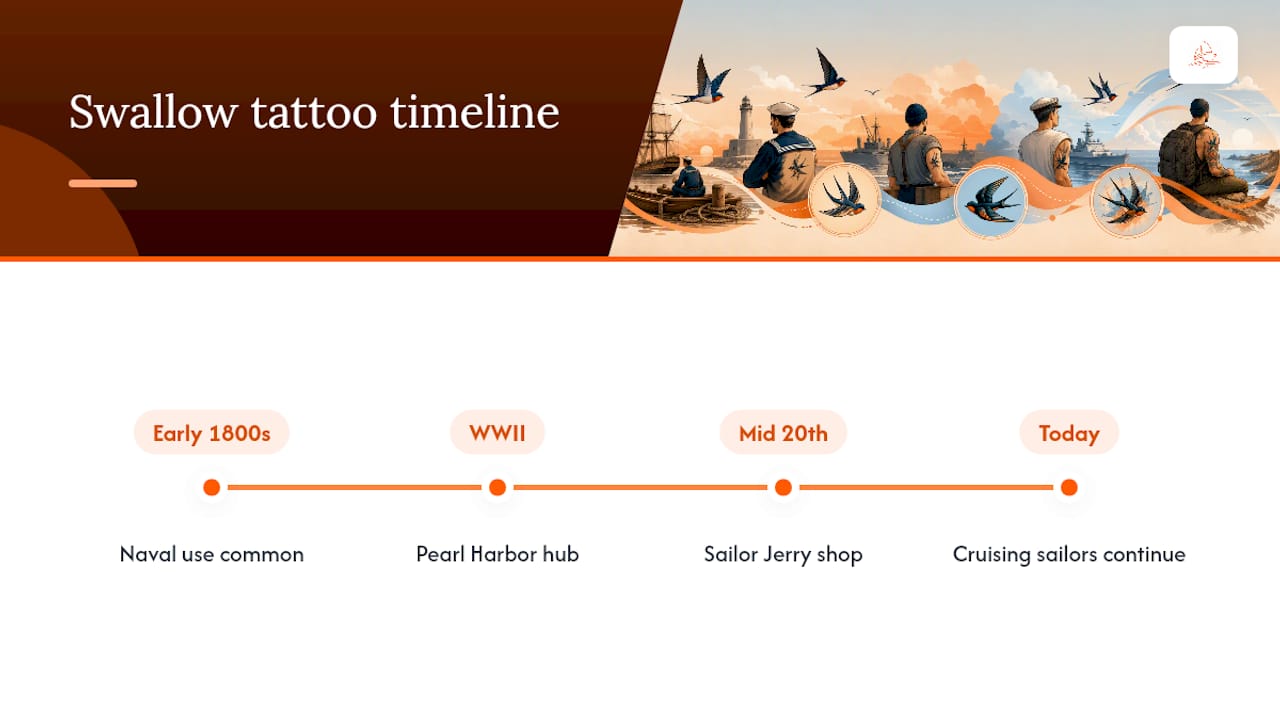
Beyond Collins, the historical record is thinner on individual named sailors and their specific swallow tattoos, mostly because tattoo culture in the 19th and early 20th century Navy wasn't well documented outside of ship logs and the occasional photograph. What is documented is the culture around it: swallows appeared often enough among naval crews that officers and shipmates recognized the mileage convention on sight, the way you'd recognize rank insignia. The tattoo functioned as an informal résumé, readable by anyone who knew the code, long before anyone thought to write the tradition down for outsiders.
Modern sailors have picked up where that informal record left off. Cruising sailors document their own swallow tattoos as travel logs now, adding a bird after a major passage or a completed circumnavigation, consciously continuing a practice that has no single famous founder so much as a whole community that kept it alive by repetition.
How does the swallow differ from other nautical bird tattoos?
Sailors used more than one bird in their tattoo vocabulary, and each carried a distinct meaning that's worth separating from the swallow.
- Albatross: tied to endurance and, thanks to Coleridge's Rime of the Ancient Mariner, also to guilt or bad luck if killed. Far heavier symbolic baggage than the swallow.
- Seagull: less codified in tradition, generally read as a simpler nod to coastal or seafaring life rather than a specific milestone.
- Sparrow: visually close enough to the swallow that the two get confused constantly, but lacks the swallow's specific mileage association.
- Frigatebird: significant in Polynesian tattoo tradition specifically, tied to navigation and spiritual guidance rather than Western mileage folklore.
The swallow stands apart because its meaning is quantifiable, even if loosely. Other nautical birds carry mood or general association. The swallow carries a number, whether that number is 5,000 miles or 10,000, which is part of why it became the default choice for sailors who wanted a tattoo that visibly counted something rather than just symbolized something.
Why this tradition still resonates in sailing culture
Sailorix spends a lot of time in the world of sailing guides, from nautical terminology to the practical mechanics of anchoring safely, and motifs like the swallow keep surfacing for a simple reason: sailing still produces the kind of hard-earned milestones that deserve marking. If you want more context on the culture that produced traditions like this one, our guide to how ships shaped maritime culture covers the broader history worth knowing.
Ready to earn your own sea miles?
Reading about the swallow's mileage tradition is one thing. Actually racking up nautical miles is another, and that's where most people stall out, chartering a boat through a traditional broker often means quotes that vary wildly and service fees that eat into the trip before you've even left the dock.

Whether you're chasing your first serious offshore passage or just want an affordable weekend on the water, real-time availability search makes it simple to find a boat that fits your dates and destination. Check available yachts and boats now at Sailorix and see what a membership actually saves you on your next booking.
Sources
- Earning Your Ink | Naval History Magazine
- Sailor Jerry — tattoo designs
- What is it with sailors and swallows? — One Ocean Expedition
- Swallow Tattoos and Sailors — Cruising World