
A sloop carries one mast, one mainsail, and one headsail. That's the whole definition. It's also the most common modern rig for boats under roughly 45 feet, and for good reason: fewer wires, fewer decisions, and better upwind performance than almost any multi-masted alternative. If you're sailing short-handed on a coastal cruiser or a performance racer under 45 feet, a sloop is almost certainly the right call.
Three things to know before you read further:
- Rig variants matter. Masthead vs. fractional, Bermuda vs. gaff — each changes how the boat handles, how you tune it, and what sails you carry.
- Handling is manageable, until the boat gets big. On larger boats over a moderate size, sail size becomes a real physical challenge, even individual sail size becomes a real physical challenge, even with roller furling.
- Tuning is the multiplier. Mast rake, shroud tension, and prebend have more effect on balance and speed than most sailors realize.
Table of Contents
- What does sloop rigging actually consist of?
- How do masthead, fractional, and gaff configurations compare?
- What headsails and reefing options work best on a sloop?
- How does rig choice affect performance and helm balance?
- How do you tune a sloop rig step by step?
- When is a sloop the right rig, and when isn't it?
- What does a solid rig maintenance routine look like?
- How did sloop rigging evolve over the centuries?
- How does a sloop differ from a ketch, cutter, and schooner?
- What materials are used in modern standing and running rigging?
- How do you choose sails for cruising versus racing?
- What are the trickier sloop rigging problems and how do you fix them?
- Key Takeaways
- What sailors often get wrong about sloop rigs
- Useful sources and further reading
What does sloop rigging actually consist of?
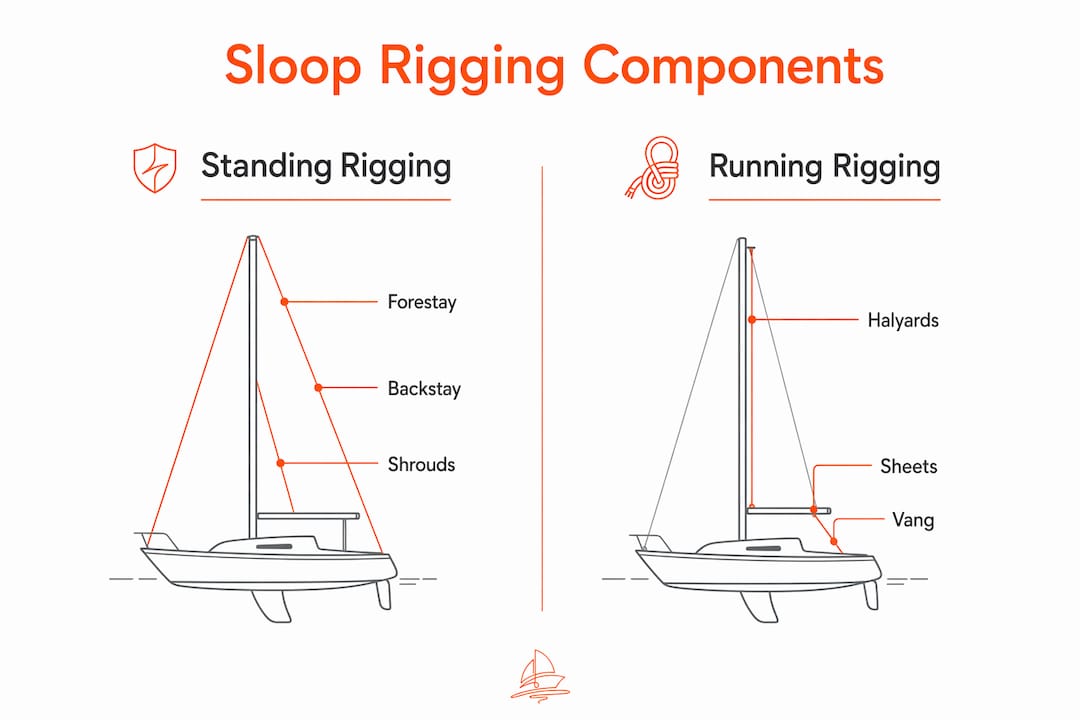
Every piece of sloop rigging falls into one of two categories: standing rigging, which holds the mast up, and running rigging, which controls the sails. Get those two categories straight and the whole system makes sense.
The mast and boom are the spars. The mast is stepped either on the keel (keel-stepped, more stable) or on the deck (deck-stepped, easier to remove). The boom attaches at the gooseneck fitting and controls the foot of the mainsail.
Standing rigging includes:
- Forestay: runs from the bow fitting (or bowsprit) to the mast; the headsail hanks or furls onto it.
- Backstay: runs from the masthead to the stern; counters forestay tension and controls mast bend.
- Cap shrouds: port and starboard wires from the chainplates to the masthead (or near it), providing lateral support.
- Lower shrouds: shorter wires that support the mast below the spreaders; they control fore-and-aft stiffness in the lower section.
- Spreaders: horizontal struts that widen the shroud angle, increasing lateral support without moving the chainplates outboard.
Running rigging includes halyards (hoist the sails), sheets (trim the sails), the vang (controls boom angle), the cunningham (adjusts luff tension on the main), and the outhaul (controls foot tension). Cleats, clutches, and blocks route these lines to the cockpit.
The hounds are the fittings on the mast where the shrouds and forestay attach. On a masthead rig, the cap shrouds and forestay share the same attachment point at the top. On a fractional rig, the forestay attaches lower, and the cap shrouds still reach the masthead.
| Component | Function |
|---|---|
| Forestay | Supports mast forward; headsail attachment point |
| Backstay | Counters forestay load; controls mast bend |
| Cap shrouds | Lateral mast support from spreader tip to masthead |
| Lower shrouds | Fore-and-aft and lateral support below spreaders |
| Halyards | Hoist and tension sails aloft |
| Sheets | Trim sail angle relative to the wind |
How do masthead, fractional, and gaff configurations compare?
The single biggest configuration decision in sloop rigging is where the forestay attaches. A masthead rig fastens the forestay at the very top of the mast; a fractional rig attaches it below the masthead, typically at 3/4 to 7/8 of mast height.

Masthead rigs carry a larger headsail relative to the mainsail. That headsail does most of the work upwind, which is why older production cruisers used big overlapping genoas. The backstay runs straight to the masthead, making backstay tension a direct and effective tool for controlling forestay sag and mast bend.
Fractional rigs put more sail area in the main. Because the forestay doesn't reach the top, the mast above the forestay attachment can flex, and the backstay becomes a powerful mainsail shape control. Racing boats favor fractional rigs for this reason. Many modern production cruising rigs blur the line, sitting at 19/20ths of mast height with large mains and non-overlapping jibs — easier to tack, easier to handle.
Gaff and gunter rigs use a four-sided mainsail with a spar (the gaff) along the top edge. They're lower-aspect rigs with a wider sail base, which generates good power on a reach but loses ground upwind compared with a tall Bermuda main. Gaff rigs still make sense on traditional wooden boats, classic schooners, and anyone prioritizing character over pointing ability. The gunter rig is a close relative: the gaff is set nearly vertical, approximating a Bermuda shape while keeping the mast short enough to fit under bridges.
| Configuration | Forestay position | Headsail size | Best use |
|---|---|---|---|
| Masthead Bermuda | Masthead | Large (often overlapping) | Cruising, coastal sailing |
| Fractional Bermuda | 3/4–7/8 height | Smaller, non-overlapping | Racing, performance cruising |
| Gaff sloop | Masthead or lower | Moderate | Traditional, character boats |
| Gunter sloop | Near masthead | Moderate | Trailerable, low-clearance boats |
Solent and dual-headstay setups add a second inner forestay, allowing a staysail to fly inside the headsail. This is technically a cutter arrangement, but some sailors rig it on a sloop hull for heavy-weather versatility without committing to a full cutter setup.
Pro Tip: On a fractional rig, easing backstay tension in light air lets the mast straighten and opens the mainsail leech for better power. Tighten it as the breeze builds to control main shape and heel.
What headsails and reefing options work best on a sloop?
The working jib covers roughly 100% of the foretriangle (the area between the forestay, mast, and deck). A genoa overlaps the mast, typically measured as a percentage of the foretriangle base: a genoa that extends well past the shrouds adds power but makes tacking slower. A staysail flies on an inner stay, useful in heavy air when the main headsail is furled or dropped.
For off-wind sailing, a symmetric spinnaker flies from a pole on the foredeck and works best on a dead run or broad reach. An asymmetric spinnaker (sometimes called a gennaker or code sail) is easier to handle short-handed and performs well on a reach, making it the more practical choice for cruising sailors.
Reefing the mainsail on a sloop comes down to two main methods:
- Slab reefing (jiffy reefing): Pull the reefing line to bring a new tack and clew down to the boom, then tie off the loose sail. Fast, reliable, and preserves sail shape better than any furling system. Most offshore sailors prefer it.
- In-mast or in-boom furling: The sail rolls into the mast or boom spar. Convenient for short-handed sailing, but the rolled sail loses its designed shape, reducing upwind performance noticeably.
Roller furling for headsails is now standard on cruising sloops. It's fast and manageable from the cockpit. The catch: a partially furled roller headsail develops an inefficient shape that hurts pointing ability. The fix is to carry a dedicated heavy-weather jib on a separate inner stay rather than relying on a furled genoa.
Step-by-step: reefing the main underway
- Head up slightly to ease pressure on the main.
- Ease the mainsheet and vang enough to reduce load.
- Ease the halyard until the new tack cringle reaches the boom.
- Hook or tie the tack cringle to the boom hook or reefing horn.
- Tension the reefing line to pull the clew cringle down and aft.
- Re-tension the halyard, trim the mainsheet, and resume course.
- Tie the loose sail bunt with reef points or a continuous line.
Pro Tip: Rig your reefing lines before you leave the dock. Trying to thread a reefing line through a boom block in 25 knots of wind is a miserable exercise that's entirely avoidable.
How does rig choice affect performance and helm balance?
A high-aspect Bermuda rig points higher upwind than a gaff rig. The tall, narrow sail plan generates lift efficiently at close-hauled angles, while the gaff's lower aspect ratio produces more drag relative to lift. For racing or passage-making where VMG (velocity made good to windward) matters, Bermuda wins.
Helm balance is where rig tuning gets personal. Weather helm — the boat's tendency to round up into the wind — is partly a function of mast rake. Increasing rake moves the center of effort aft, which tends to increase weather helm. A small amount of weather helm is desirable (it gives the helm feel and acts as a safety valve), but too much is exhausting and slows the boat.
Headsail shape plays a direct role. A full, powerful genoa drives the bow down and can create lee helm on some boats. A flat, small jib shifts drive aft toward the main, increasing weather helm. Partial furling changes the headsail's draft position and chord depth, which is why partially furled roller headsails reduce pointing ability — the shape simply isn't what the sailmaker designed.
Trim checklist for assessing balance:
- Check telltales on the headsail: both windward and leeward telltales should stream aft simultaneously when properly trimmed.
- Watch the helm load: more than 3–5 degrees of weather helm under sail suggests too much rake or too much headsail power.
- Adjust the traveler to control mainsail angle without changing sheet tension.
- Use backstay tension to control forestay sag and mainsail leech twist.
Pro Tip: A masthead rig typically needs a small amount of rake to manage helm; a fractional rig often needs more — measure carefully and adjust incrementally. Measure with a plumb bob hung from the masthead and a tape measure at the deck — don't guess.
How do you tune a sloop rig step by step?
Good tuning starts at the dock, not under sail. Work through this sequence before you leave the slip.
Dockside static tuning:
- Check all chainplate bolts and backing plates for corrosion or movement.
- Attach the rigging small sailboats attachment points: pin all clevis pins, insert cotter pins or rings, and tape over sharp ends.
- Step the mast (for small boats, feed mainsail rings onto the lower mast before stepping — it saves significant time).
- Set initial shroud tension: hand-tight plus a few turns on each turnbuckle, equal port and starboard.
- Sight up the mast track from the base. The mast should be straight athwartships with no side bend.
- Set initial backstay tension to create slight forestay tension without excessive prebend.
- Measure mast rake: hang a plumb bob from the main halyard shackle to the deck. Compare the measurement at the mast base to the measurement at the bow fitting.
Under-sail tuning:
- Sail close-hauled on starboard tack. Note helm feel and heel angle.
- Tack to port and compare. If the mast bends more on one tack, the leeward shroud is too loose.
- Adjust shroud tension in small increments (half a turn at a time) until the mast stays straight on both tacks.
- If you have persistent weather helm, reduce rake slightly. If you have lee helm, add rake.
- Check prebend: the mast should have a slight forward bow in the middle section when the backstay is tensioned. Seldén and other spar makers publish specific prebend limits as a percentage of foretriangle height — follow your spar manufacturer's guidance.
Common fixes:
- Lee helm: Add mast rake, move the mast step aft if adjustable, or reduce headsail size.
- Weather helm: Reduce rake, reef the main before the headsail, or move the mast step forward.
- Excessive forestay sag: Increase backstay tension, add a running backstay, or check for worn turnbuckles.
- Mast pumping in waves: Increase lower shroud tension to stiffen the lower section.
When is a sloop the right rig, and when isn't it?
The sloop's core advantage is simplicity. Fewer masts and wires mean lower maintenance costs and fewer things to inspect, replace, or break. That economic logic drives its dominance in charter fleets and production boatbuilding worldwide.
Where a sloop excels:
- Boats under 45 feet with a crew of one or two
- Coastal and offshore passages where upwind performance matters
- Racing, where the clean rig and high-aspect sail plan pay dividends
- Charter and production contexts where parts availability and simplicity reduce costs
Where it starts to struggle:
- Boats over 45 feet, where sail sizes become physically demanding even with furling systems
- Heavy offshore passages where sail-plan flexibility in severe weather is critical
- Sailors who want to split the sail plan into smaller, more manageable pieces
Compared with a cutter or ketch, the sloop trades heavy-weather flexibility for simplicity and upwind efficiency. A ketch's mizzen lets you heave-to more easily and balance the boat in a gale with just the mizzen and a small staysail. A cutter's inner forestay gives you a dedicated heavy-weather sail without relying on a partially furled genoa. Neither of those advantages matters much on a 35-foot coastal cruiser with a competent crew.
| Decision factor | Sloop | Ketch / Cutter |
|---|---|---|
| Boat length | Under 45 ft | Over 45 ft or offshore |
| Crew size | 1–2 | 2+ preferred |
| Upwind priority | Strong | Moderate |
| Heavy-weather flexibility | Limited | Better |
| Maintenance cost | Lower | Higher |
What does a solid rig maintenance routine look like?
Rigging failures rarely happen without warning. They happen when sailors ignore the warnings. Standing rigging on most cruising boats uses 1x19 stainless wire — low stretch, affordable, and reliable when inspected regularly. Rod rigging and high-modulus fiber alternatives (Dyneema, PBO) offer lower weight aloft but require more specialized inspection and replacement protocols.
Annual inspection checklist:
- Inspect every swage fitting and toggle for cracks, corrosion, or fishhook wire strands.
- Check chainplates for rust staining on the deck around the fitting (a sign of hidden corrosion below).
- Examine spreader boots and tips for cracking; a bare spreader tip can saw through a shroud.
- Inspect the forestay for broken wires, especially near the furler drum where the wire bends repeatedly.
- Check all turnbuckle threads for corrosion and confirm cotter pins are in place.
Pre-departure checks:
- Confirm all halyards are led correctly and cleated or clutched.
- Check sheet leads: a misled sheet can chafe through in hours.
- Verify the boom vang is attached and the topping lift is rigged.
- Look aloft for anything unusual: a halyard wrapped around a spreader, a shackle that's worked open.
Under sail, listen for creaks from the chainplates or mast partners — those sounds often precede a fitting failure. An asymmetric load (the boat heeling harder on one tack than the other in the same wind) suggests a shroud tension imbalance worth investigating at the next anchorage.
For mast materials and construction details that affect your maintenance approach, the mast boat guide covers aluminum, carbon, and wood spars in practical terms.
How did sloop rigging evolve over the centuries?
The word "sloop" comes from the Dutch sloep, related to the Old English slūpan (to glide). Early sloops were working vessels — fast, shallow-draft boats used for coastal trade, fishing, and naval dispatch work in the 17th and 18th centuries. They carried gaff mainsails and a single headsail, sometimes adding square topsails for downwind passages.
The Bermuda rig, which gave the modern sloop its defining tall triangular mainsail, originated in Bermuda in the 17th century. Local sailors developed the high-aspect fore-and-aft sail to sail efficiently to windward in the island's tricky reef-strewn waters. The rig spread slowly; it wasn't until the early 20th century that the Bermuda (or Marconi) rig became the standard for racing and cruising yachts worldwide, largely because of its superior upwind performance and simpler rigging compared with gaff rigs.
Post-World War II fiberglass production changed the sloop's trajectory again. Standardized hull molds and aluminum extrusion made the Bermuda sloop cheap to build and easy to maintain, cementing its position as the default leisure sailing rig. Today, the Bermuda sloop is the default rig for leisure craft across everything from simple cruising dinghies to large offshore racing yachts.
How does a sloop differ from a ketch, cutter, and schooner?
The sloop's single mast is its defining feature, and every comparison with other rigs comes back to that structural fact.
A ketch adds a shorter mizzen mast stepped forward of the rudder post. The split sail plan reduces individual sail size, which matters on boats over 45 feet. The mizzen also gives the crew a useful balancing tool in heavy weather. The trade-off: more standing rigging, more maintenance, and slightly worse upwind performance because the mizzen operates in disturbed air from the main.
A cutter keeps the single mast but moves it further aft and adds a second forestay (the inner stay), allowing two headsails. The cutter's sail plan is more flexible in heavy weather — you can drop the genoa and sail on the staysail alone. The sloop is simpler; the cutter is more versatile. For a deeper look at how a schooner's two-masted setup compares in practice, that contrast is worth reading.
A schooner carries two or more masts, with the forward mast (foremast) shorter than the main. Schooners excel on a reach and are iconic in American maritime history, but they're complex to rig, slow upwind, and rarely chosen for modern cruising.
What materials are used in modern standing and running rigging?
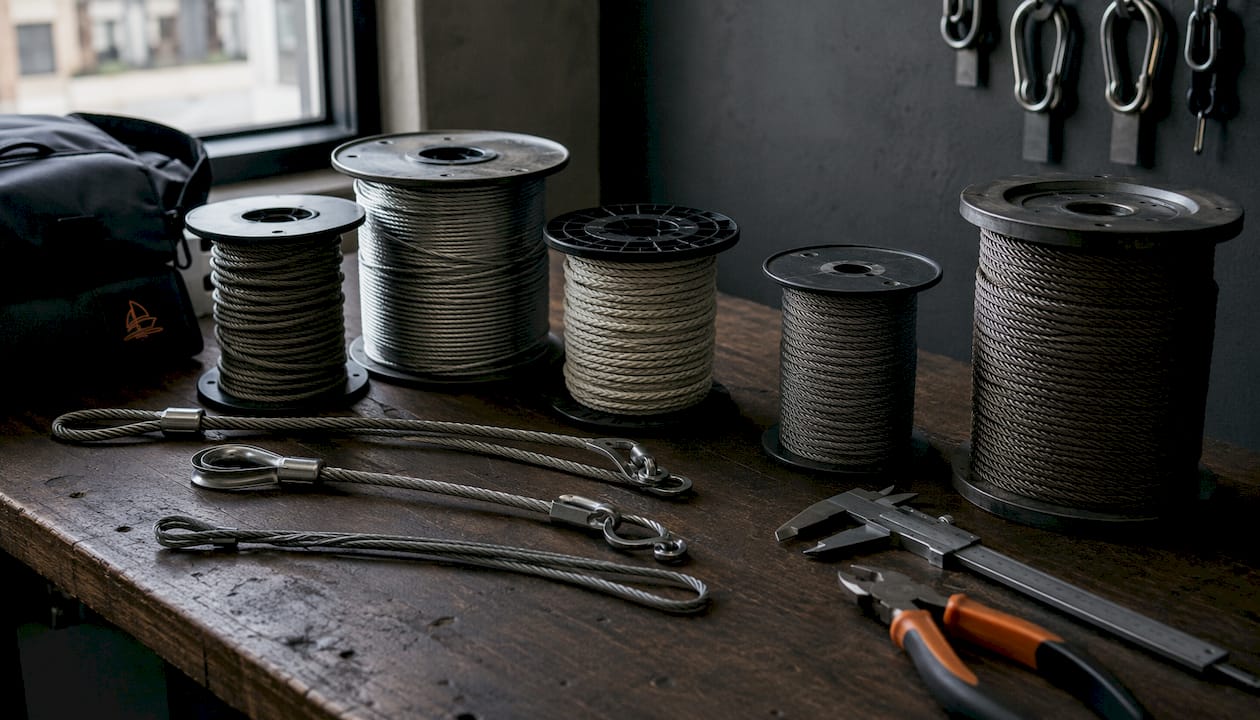
Standing rigging on most production cruising boats uses 1x19 stainless steel wire. The 1x19 construction (one central wire surrounded by 18 outer wires in two layers) is stiff, low-stretch, and resistant to fatigue under cycling loads. It's the practical default for boats that don't need to optimize weight aloft.
Rod rigging uses solid stainless steel rods instead of wire. It's stiffer and lighter for the same strength, which reduces stretch and improves rig tune stability. The downside: rod rigging is expensive, requires specialized end fittings, and can fail catastrophically without the visible warning signs (broken strands) that wire provides.
High-modulus fiber rigging — Dyneema (UHMWPE), Vectran, and PBO (Zylon) — is now common on racing boats and increasingly on performance cruisers. These materials are dramatically lighter than wire for equivalent strength, which lowers the center of gravity and reduces pitching. Dyneema is UV-sensitive and creeps under sustained load; PBO degrades with UV exposure and moisture. Both require careful inspection protocols.
Running rigging uses braided polyester for most cruising applications: affordable, low-stretch, and easy to splice. High-performance running rigging uses Dyneema cores with polyester covers, reducing stretch and weight on halyards and control lines where precision matters.
How do you choose sails for cruising versus racing?
For cruising, the priority is versatility and ease of handling. A 135% genoa on a roller furler covers most conditions from light air to moderate breeze. A dedicated heavy-weather jib on an inner stay handles anything above 25 knots without relying on a furled genoa's compromised shape. A full-battened mainsail holds its shape longer than a partial-batten sail and reduces flogging when reefing. An asymmetric spinnaker or code sail adds downwind speed without the complexity of a symmetric spinnaker and pole.
For genoa selection and overlap percentages, the practical tradeoffs between 110%, 135%, and 155% cuts are worth understanding before you order canvas.
For racing, the sail inventory expands. A non-overlapping jib (around 100–105%) tacks faster and works better with modern fractional rigs. A full wardrobe typically includes a light-air genoa, a medium-air working jib, a heavy-air blade jib, a symmetric spinnaker for downwind runs, and an asymmetric for reaching. Sail material shifts from durable Dacron to laminate fabrics (Mylar, carbon fiber laminates) that hold shape under load but don't last as long. For a broader overview of sail types and their uses, that resource covers the full spectrum.
What are the trickier sloop rigging problems and how do you fix them?
Beyond basic tuning, a few problems show up repeatedly on sloops and don't have obvious solutions.
Mast inversion happens when the mast bends backward (inverted S-curve) under load. It's caused by insufficient prebend or lower shrouds that are too loose. The fix is to increase prebend by tightening the backstay and adding lower shroud tension to stiffen the lower section.
Halyard wrap occurs when a loose halyard wraps around a stay or the mast in a gybe or tack. Prevention: keep halyards tensioned when not in use, and use halyard restrainers or anti-wrap devices on the mast.
Forestay sag in light air is common on masthead rigs with insufficient backstay tension. Excessive sag opens the headsail leech and reduces pointing ability. Tighten the backstay, or add a running backstay if the rig allows it.
Chafe on headsail sheets at the shroud contact point is one of the most common running rigging failures. Fit spreader boots, adjust sheet leads to minimize contact, and inspect sheets after every offshore passage.
Compression failure at the mast step shows up as cracking gelcoat around a deck-stepped mast or deformation at the mast partner. It's a structural issue that requires a boatyard assessment, not a dockside fix. Catch it early by inspecting the mast base and partner area annually.
For detailed mast tuning and mast rake adjustments, that resource walks through the full sequence with practical measurements.
Key Takeaways
A sloop's single mast and two-sail plan makes it the most practical rig for boats under 45 feet, with upwind efficiency and low maintenance cost as its defining strengths.
| Point | Details |
|---|---|
| Rig type determines sail balance | Masthead rigs favor large headsails; fractional rigs put more work in the main and offer finer tuning control. |
| Mast rake corrects helm | Increasing rake adds weather helm; reducing it corrects lee helm — measure with a plumb bob, adjust in small increments. |
| Roller furling trades shape for convenience | A partially furled headsail loses pointing ability; carry a dedicated heavy-weather jib for heavier wind conditions. |
| Annual inspection prevents dismasting | Check swage fittings, chainplates, and spreader tips every season; broken wire strands near fittings are the primary warning sign. |
| Sloop beats ketch under 45 feet | Simpler rigging, lower cost, and better upwind performance make the sloop the default choice for most cruising and racing sailors. |
What sailors often get wrong about sloop rigs
The conventional wisdom says the sloop is the "beginner rig" — simple, forgiving, nothing to overthink. That framing undersells it badly. The sloop is the dominant rig in offshore racing precisely because it rewards careful tuning. The gap between a poorly tuned sloop and a well-tuned one is larger than most sailors expect, and it shows up most clearly upwind in 15–20 knots, where mast rake, shroud tension, and headsail trim interact in ways that take real attention to get right.
The other thing sailors underestimate is the maintenance burden of standing rigging. Wire doesn't announce its fatigue. A shroud that looks fine on a casual inspection can have broken internal strands at a swage fitting that only show under load. The sailors who avoid dismastings aren't lucky — they're the ones who pull the rig every few years, inspect every terminal, and replace wire on a schedule rather than waiting for a visible problem.
Choosing a sloop over a ketch or cutter isn't just about simplicity. It's a deliberate performance choice. If your boat is under 45 feet and you're sailing with one or two people, the sloop gives you more speed, less to maintain, and a cleaner sail plan than any two-masted alternative. The trade-off in heavy-weather flexibility is real but manageable with the right sail inventory and a practiced reefing routine.
Useful sources and further reading
The sources below informed this guide and are worth bookmarking for deeper study.
| Source | What it covers | Relevant sections |
|---|---|---|
| American Sailing Association — What's in a Rig? The Sloop | Clear definition, prevalence, and size limits of the sloop rig | Definition, pros/cons |
| SAIL Magazine — Modern Rigs 101 | Masthead vs. fractional, mast rake, prebend, and production rig trends | Configurations, tuning |
| Sailboat Cruising — Sloop Rigs for Cruising | Cruising trade-offs, roller furling shape issues, rig comparisons | Sail handling, pros/cons |
| Gig Harbor Boat Works — Sloop Rig Tutorial | Step-by-step small-boat rigging sequence with video | Setup and tuning checklist |
| Glen-L — Rigging Small Sailboats | Attachment methods, hanks, bolt rope, gooseneck types | Anatomy, rigging technique |
| Wikipedia — Sloop | Historical development, rig variants, etymology | History section |
"The sloop is the commonest of all sailing rigs — with the Bermuda sloop being the default rig for leisure craft, being used on types that range from simple cruising dinghies to large racing yachts." — Wikipedia, Sloop